

You’ll reckon your Wi‑Fi could power a small city once these mesh systems reach every corner of the house. You want reliable coverage where you actually need it, not flaky dead zones or endless router hopping. I’ll walk you through five TP‑Link Decos that suit different needs and budgets, from simple AC1900 setups to Wi‑Fi 7 performance — so you can pick the one that stops buffering and starts working for you.
| TP-Link Deco X55 AX3000 WiFi 6 Mesh (3-Pack) |

| Best Value | Coverage: Up to 6,500 sq. ft. | Units (Pack Size): 3‑pack | Mesh Technology / Roaming: AI‑driven mesh for optimized Wi‑Fi / seamless roaming | VIEW LATEST PRICE | Read Our Analysis |
| TP-Link Deco 7 BE25 Wi‑Fi 7 Mesh System (3-Pack) |

| High-Performance Pick | Coverage: Up to 6,600 sq. ft. | Units (Pack Size): 3‑pack | Mesh Technology / Roaming: AI‑Roaming / Multi‑Link Operation (MLO) for seamless handoff | VIEW LATEST PRICE | Read Our Analysis |
| TP-Link Deco 7 Pro BE63 WiFi 7 Mesh (3-Pack) |

| Premium Powerhouse | Coverage: Up to 7,600 sq. ft. | Units (Pack Size): 3‑pack | Mesh Technology / Roaming: AI‑driven seamless roaming / Multi‑Link Operation | VIEW LATEST PRICE | Read Our Analysis |
| TP-Link Deco S4 Mesh WiFi System (3-Pack) |
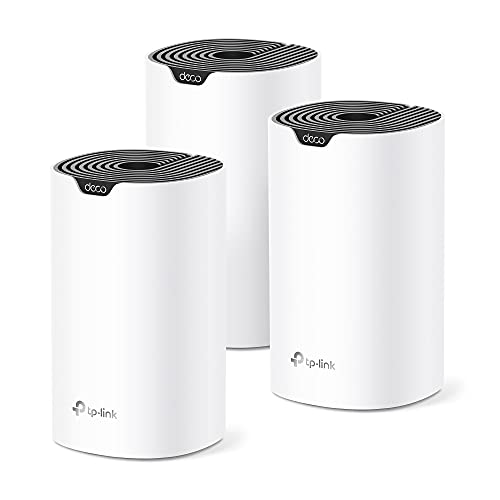
| Budget-Friendly Pick | Coverage: Up to 5,500 sq. ft. | Units (Pack Size): 3‑pack | Mesh Technology / Roaming: Deco Mesh seamless roaming with single network name | VIEW LATEST PRICE | Read Our Analysis |
| TP-Link Deco XE75 AXE5400 Tri-Band WiFi 6E Mesh |

| Best for Future-Proofing | Coverage: Up to 7,200 sq. ft. | Units (Pack Size): (implied) multi‑unit mesh (coverage listed for 3‑pack) — 3‑pack | Mesh Technology / Roaming: AI‑driven mesh with client learning and optimized roaming | VIEW LATEST PRICE | Read Our Analysis |
More Details on Our Top Picks
TP-Link Deco X55 AX3000 WiFi 6 Mesh (3-Pack)
Choose the TP‑Link Deco X55 AX3000 (3‑pack) in case you need fast, reliable whole‑home Wi‑Fi that handles many devices—its Wi‑Fi 6 AX3000 speeds (up to 2402 Mbps on 2×2/HE160 plus 574 Mbps on 2×2), AI‑driven mesh optimization, and support for up to 150 connected devices make it a strong pick for busy households or home offices that want seamless coverage and minimal buffering. You’ll cover up to 6,500 sq. ft., replace routers and extenders, and use wired Ethernet backhaul provided desired. Each Deco has three Gigabit ports, any unit can be the router, and HomeShield plus the Deco app simplify security and management.
- Coverage:Up to 6,500 sq. ft.
- Units (Pack Size):3‑pack
- Mesh Technology / Roaming:AI‑driven mesh for optimized Wi‑Fi / seamless roaming
- Security & Parental Controls:TP‑Link HomeShield (basic security, QoS, parental controls)
- Wired Backhaul / Ethernet Ports:Supports wired Ethernet backhaul; each unit has 3 Gigabit Ethernet ports
- ISP Compatibility / Modem Requirement:Works with major ISPs; modem required for most ISPs
- Additional Feature:AX3000 Wi‑Fi 6
- Additional Feature:Connects up to 150 devices
- Additional Feature:3 Gigabit Ethernet ports
TP-Link Deco 7 BE25 Wi‑Fi 7 Mesh System (3-Pack)
Should you need multi‑gig wireless speeds and broad home coverage for gaming, 4K/8K streaming, or lots of smart devices, the Deco 7 BE25 (3‑pack) delivers: Wi‑Fi 7 MLO and 4‑stream BE5000 radios push up to 4.3 Gbps on 5 GHz, while dual 2.5 Gbps ports and simultaneous wired/wireless backhaul let you hook up high‑performance wired gear without bottlenecks. You’ll get up to 6,600 sq. ft. coverage, support for 150+ devices, AI‑Roaming for smooth handoffs, and extended range from four high‑gain antennas with high‑power FEMs. TP‑Link HomeShield, VPN client/server support, backward compatibility, and voice control complete the package.
- Coverage:Up to 6,600 sq. ft.
- Units (Pack Size):3‑pack
- Mesh Technology / Roaming:AI‑Roaming / Multi‑Link Operation (MLO) for seamless handoff
- Security & Parental Controls:TP‑Link HomeShield (basic security, IoT ID, parental controls, reports)
- Wired Backhaul / Ethernet Ports:Supports wired backhaul; each unit has two 2.5 Gbps WAN/LAN ports
- ISP Compatibility / Modem Requirement:Works with any ISP; modem required for most providers
- Additional Feature:Wi‑Fi 7 BE5000 dual‑band
- Additional Feature:Two 2.5 Gbps ports
- Additional Feature:VPN client/server support
TP-Link Deco 7 Pro BE63 WiFi 7 Mesh (3-Pack)
Should you need blistering whole‑home Wi‑Fi for many simultaneous users, the Deco 7 Pro BE63 (3‑pack) delivers Wi‑Fi 7 speeds and capacity — tri‑band Multi‑Link Operation with 4K‑QAM and 320 MHz channels, six streams, and up to 10 Gbps class throughput to handle 200+ devices across roughly 7,600 sq. ft. You’ll get 6 GHz at 5188 Mbps, 5 GHz at 4324 Mbps and 2.4 GHz at 574 Mbps, plus AI‑Roaming that self‑optimizes a single SSID. Dual wired/wireless backhaul, four 2.5G ports and USB‑3 enhance reliability. HomeShield security, VPN client/server, Deco app and Alexa/Google controls finish the package.
- Coverage:Up to 7,600 sq. ft.
- Units (Pack Size):3‑pack
- Mesh Technology / Roaming:AI‑driven seamless roaming / Multi‑Link Operation
- Security & Parental Controls:TP‑Link HomeShield (network protection, parental controls, IoT security)
- Wired Backhaul / Ethernet Ports:Dual wired/wireless backhaul; four 2.5 Gbps WAN/LAN ports per unit + USB 3.0
- ISP Compatibility / Modem Requirement:Works with any ISP; modem required for most ISPs
- Additional Feature:Tri‑band Wi‑Fi 7
- Additional Feature:10 Gbps‑class capability
- Additional Feature:USB 3.0 port
TP-Link Deco S4 Mesh WiFi System (3-Pack)
In case you need reliable whole‑home Wi‑Fi for many devices, the Deco S4 (3‑pack) delivers coverage up to 5,500 sq ft and AC1900 speeds while handling up to 100 connected devices—making it a strong choice for families or small offices that want seamless roaming under one network name and easy setup via the Deco app. You get three identical units (any can be primary), automatic device switching for best speeds, and two Gigabit Ethernet ports per unit with wired backhaul support. It replaces separate router/extender setups, works with major ISPs (modem usually required), and includes sturdy parental controls and guest Wi‑Fi management.
- Coverage:Up to 5,500 sq. ft.
- Units (Pack Size):3‑pack
- Mesh Technology / Roaming:Deco Mesh seamless roaming with single network name
- Security & Parental Controls:Parental controls (robust) and Deco app management / guest control
- Wired Backhaul / Ethernet Ports:Supports wired Ethernet backhaul; each unit has 2 Gigabit Ethernet ports
- ISP Compatibility / Modem Requirement:Works with major ISPs; modem required for most ISPs
- Additional Feature:AC1900 (6‑stream) speeds
- Additional Feature:2 Gigabit ports per unit
- Additional Feature:Robust parental controls
TP-Link Deco XE75 AXE5400 Tri-Band WiFi 6E Mesh
Should you need future‑ready whole‑home Wi‑Fi that prioritizes low‑latency, high‑capacity connections for lots of devices, the TP‑Link Deco XE75 is a strong pick because it adds a 6 GHz band and Wi‑Fi 6E performance to a simple mesh setup. You’ll cover up to 7,200 sq. ft. and support about 200 devices with tri‑band AXE5400 speeds (6 GHz 2402 Mbps, 5 GHz 2402 Mbps, 2.4 GHz 574 Mbps). The 6 GHz band can serve as a dedicated backhaul or network band. AI‑driven mesh optimizes coverage; HomeShield and the Deco app handle security, parental controls, and remote management. A modem is required.
- Coverage:Up to 7,200 sq. ft.
- Units (Pack Size):(implied) multi‑unit mesh (coverage listed for 3‑pack) — 3‑pack
- Mesh Technology / Roaming:AI‑driven mesh with client learning and optimized roaming
- Security & Parental Controls:TP‑Link HomeShield (basic security, IoT ID, parental controls)
- Wired Backhaul / Ethernet Ports:6 GHz can be used as backhaul; units include Gigabit (and/or multi‑gig capable) ports as mesh backhaul option
- ISP Compatibility / Modem Requirement:Works with major ISPs; modem required for most ISPs
- Additional Feature:Dedicated 6 GHz band
- Additional Feature:Aggregate 5400 Mbps
- Additional Feature:6,500+ sq. ft. AI mesh (AI‑driven mesh)
Factors to Consider When Choosing Tp Link Mesh Wifi
While picking a TP‑Link mesh system, consider the coverage area you need and how many devices it must handle. Check whether the kit supports wired backhaul, which Wi‑Fi standard (like Wi‑Fi 6/6E) it uses, and whether its ports and speeds meet your wired device needs. These factors will help you match performance to your home or office layout.
Coverage Area Needed
Because mesh nodes cover defined ranges and real homes have walls, floors, and interference, you should start from mapping your floor plan and vertical layout to estimate how many units you’ll need. Measure square footage and count floors so you know whenever additional nodes are required for larger or multi‑story homes. Account for real‑world loss: concrete, brick, and metal can cut range by 30–70% versus open‑air specs. Plan node placement for overlapping coverage and line‑of‑sight where possible—aim for nodes every 1–2 rooms or roughly every 1,500–3,000 sq ft in typical layouts. Should you be able to, include wired Ethernet backhaul between nodes to extend usable coverage and enhance throughput. Prioritize stronger coverage in home offices, media rooms, and gaming areas.
Device Capacity Limits
Should you expect lots of phones, streaming boxes, smart sensors, and a few gaming rigs, check the mesh’s stated simultaneous‑device limit and plan for headroom—manufacturers often quote 100–200+ concurrent connections, but that’s about connections, not consistent speed. You’ll want a system rated above your current device count to avoid congestion as you add smart appliances and cameras. Count how many high‑bandwidth clients—4K/8K streamers, gaming consoles, videoconference endpoints—you typically use simultaneously; they dominate throughput compared with sensors or idle phones. Keep in mind that more devices sharing the same wireless channels can throttle per‑device speeds even though the connection count stays within limits. Finally, should many devices will be wired, verify the mesh offers enough Ethernet connectivity so wired clients don’t compete with wireless capacity.
Wired Backhaul Support
After you’ve tallied device counts and bandwidth-hungry clients, plan how mesh nodes will carry that traffic: wired backhaul offloads wireless links and keeps throughput consistent under load. You should use Ethernet between nodes to cut wireless congestion and enhance real‑world throughput. Pick systems with at least one Gigabit Ethernet port per node; prefer multi‑gig (2.5 Gbps+) ports if you have multi‑gig internet or heavy local transfers. Verify the mesh lets you assign WAN/LAN flexibly so any node can act as router or backhaul endpoint without re‑cabling. Decide your cable topology—star, daisy‑chain, or switch‑based—and run quality Cat5e/Cat6/Cat6a to match speeds and limit loss. Wired backhaul also lowers latency and frees wireless band for client devices.
Wi‑Fi Standard Choice
Upon selecting a TP‑Link mesh, match the Wi‑Fi standard to how you actually use the network: provided you need multi‑gig speeds, low latency for many simultaneous streams, or heavy LAN transfers, choose Wi‑Fi 6E or Wi‑Fi 7; for most homes Wi‑Fi 6 gives the best balance of performance and cost; and should your devices and internet be modest, Wi‑Fi 5 can still be a budget option. Pick 6E or 7 whenever you want the 6 GHz band, wider 320 MHz channels, or multi‑link operation to reduce congestion and push multi‑gig LAN or internet throughput. Use Wi‑Fi 6 for strong device density, improved range and battery life via OFDMA and MU‑MIMO. In case many clients are legacy, gains will be limited, so match standard to your device mix.
Port And Speed Needs
While planning your TP‑Link mesh, map out the ports and speeds you’ll actually need so wired devices and high‑speed links don’t get bottlenecked. Count the Ethernet ports per node and aggregate across the system: identify Gigabit versus 2.5 Gbps (or higher) needs for NAS, gaming PCs, and switches. Check whether any node can serve as the primary router with a WAN plus multiple LAN ports so you won’t require extra hardware. In the event you intend wired backhaul, confirm multi‑gig support on backhaul ports to preserve internet and LAN speeds. Verify USB or other expansion ports for storage, printers, or cellular modems. Finally, consider port placement and totals to decide whether an additional switch is required for all your wired connections.
Security And Parental Controls
Ports and speeds matter for performance, but you also need to lock down who and what can use that bandwidth: pick a TP‑Link mesh with a built‑in security suite that blocks malware and intrusions, keeps firmware updated, and spots vulnerable IoT devices so compromised gadgets can’t spread risk. You’ll want granular parental controls—per‑user or per‑device profiles, content/category filtering, and daily time limits—so you can block inappropriate sites and schedule access. Verify support for guest networks and isolated SSIDs to keep visitors off your primary LAN and IoT pool. Choose systems offering secure remote management with two‑factor authentication so you can adjust rules away from home. Finally, confirm logging and reporting (real‑time alerts, weekly/monthly summaries) to monitor blocked threats and enforcement.
App And Management Features
Get a management app you actually use: it should guide you through setup, let you manage nodes and firmware remotely, and make troubleshooting straightforward. You’ll want guided setup, remote management, and visible firmware updates so installs and fixes don’t require a tech visit. Confirm parental controls offer profiles, time limits, and content filters, and check whether advanced controls hide behind subscriptions. Make sure the app exposes QoS and device prioritization so you can allocate bandwidth to gaming, streaming, or work. Look for guest network creation, VLAN/SSID segmentation, and a detailed device list with IP/MAC and usage stats for easy admin. Finally, verify VPN configuration, remote access, and a clear security-update history to protect privacy and IoT devices.
