

You could suppose a hardwired smoke detector with a sealed 10-year battery solves installation headaches and end-of-life power worries, but the reality depends on compatibility and sensing tech. You’ll want models that truly interconnect over 120V, cut down false alarms, and give clear alerts across your home. Keep going to see which Kidde and Initial Alert options balance reliability, features, and replacement timing.
| Kidde 5″ Hardwired Smoke Detector with 10-Year Battery |

| Best for Long-Term Reliability | Power Source: 120V AC hardwired with built-in 10-year battery backup | Interconnectibility: Interconnects with other Kidde alarms (all linked units sound) | False-Alarm Reduction / Sensing Tech: Advanced/enhanced sensing tech to distinguish real smoke from cooking/steam | VIEW LATEST PRICE | Read Our Analysis |
| Kidde Hardwired Interconnectable Smoke Detectors (4-Pack) |

| Best Value Pack | Power Source: 120V AC hardwired with 10-year sealed battery backup | Interconnectibility: Interconnect capability; all interconnected alarms sound when one detects smoke | False-Alarm Reduction / Sensing Tech: Enhanced sensing technology that reduces cooking false alarms | VIEW LATEST PRICE | Read Our Analysis |
| First Alert SMI105-AC Hardwire Smoke Alarm (10-Year) |

| Best for Precision Detection | Power Source: 120V AC hardwired with 10-year battery backup | Interconnectibility: Interconnect hardwire capability; compatible First Alert/connected alarms sound together | False-Alarm Reduction / Sensing Tech: Precision Detection advanced sensing tech to reduce cooking nuisance alarms | VIEW LATEST PRICE | Read Our Analysis |
| Kidde Hardwired Smoke & CO Detector 4-Pack |
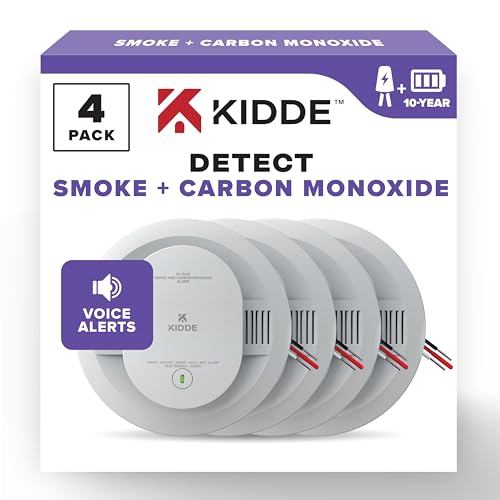
| Best Multi-Sensor Solution | Power Source: 120V AC hardwired with 10-year battery backup | Interconnectibility: Interconnect capability; all interconnected alarms sound when one detects smoke/CO | False-Alarm Reduction / Sensing Tech: Enhanced sensing technology to reduce false alarms from cooking | VIEW LATEST PRICE | Read Our Analysis |
| First Alert BRK SMI100-AC Hardwired Smoke Detectors (6-Pack) |

| Best for Contractors | Power Source: 120V AC hardwired (with 9V battery backup included) | Interconnectibility: Interconnectable up to 18 units (mix of smoke/CO/relay devices) | False-Alarm Reduction / Sensing Tech: (Designed for reliable detection; brand positioning implies nuisance reduction) — single-button silence/test for nuisance alarms | VIEW LATEST PRICE | Read Our Analysis |
More Details on Our Top Picks
Kidde 5″ Hardwired Smoke Detector with 10-Year Battery
In case you want a low-maintenance, code-ready alarm for a whole house, the Kidde 5″ hardwired detector with a built-in 10-year battery is a smart choice — it hardwires to 120V for continuous power, links with other Kidde units for whole-home alerts, and keeps backup coverage for a decade so you won’t be replacing batteries every year. You’ll get improved sensing that detects smoke over 25% faster*, an 85 dB alarm, and a red LED status light for quick checks. It meets UL 217 (10th Ed.), complies with FCC rules, and carries a 10-year limited warranty, ideal for homeowners and pros.
- Power Source:120V AC hardwired with built-in 10-year battery backup
- Interconnectibility:Interconnects with other Kidde alarms (all linked units sound)
- False-Alarm Reduction / Sensing Tech:Advanced/enhanced sensing tech to distinguish real smoke from cooking/steam
- Audible Alarm Level:85 dB
- Compliance / Standards:Tested to meet UL 217 (10th Edition); FCC compliant
- 10-Year Warranty / End-of-Life or Warranty Coverage:10-year limited warranty from first power-on
- Additional Feature:5-inch compact size
- Additional Feature:Red LED status light
- Additional Feature:Battery-replacement savings claim
Kidde Hardwired Interconnectable Smoke Detectors (4-Pack)
Homeowners who want reliable, low-maintenance fire protection will appreciate the Kidde hardwired 4-pack with a 10-year sealed battery backup — it keeps your ceiling-mounted alarms powered via 120V AC while eliminating battery changes for a decade. You get 85-decibel alerts (three long beeps) with synchronized red LED flashes and visible warning indicators. Improved sensing cuts down on cooking false alarms, and units meet UL 217 9th Edition and FCC standards. Internal self-tests run automatically, though you should push the weekly manual test. Interconnectability lets one triggered unit alert all others; check the User Guide for model-specific wiring and compatibility.
- Power Source:120V AC hardwired with 10-year sealed battery backup
- Interconnectibility:Interconnect capability; all interconnected alarms sound when one detects smoke
- False-Alarm Reduction / Sensing Tech:Enhanced sensing technology that reduces cooking false alarms
- Audible Alarm Level:85 dB (3 long beeps)
- Compliance / Standards:Tested to meet UL 217 (9th Edition); FCC standards
- 10-Year Warranty / End-of-Life or Warranty Coverage:10-year sealed battery (lifetime coverage implied); manufacturer 10-year coverage implied by sealed 10-year battery design
- Additional Feature:3-long-beep pattern
- Additional Feature:Weekly manual test recommended
- Additional Feature:Multi-pack value bundle
First Alert SMI105-AC Hardwire Smoke Alarm (10-Year)
In case you want a low-maintenance, code-ready alarm for a wired system, the First Alert SMI105-AC is a smart pick—its interconnect hardwiring plus a 10-year battery backup keeps your networked alarms sounding together and protected during outages. You’ll get Precision Detection advanced sensing that meets new industry standards, reduces cooking nuisance alarms, and provides earlier warning during fires. Whenever one unit triggers, all compatible First Alert alarms sound, and the alarm indicator shows which unit started it. Hardwired installation ties into your home’s system, the 10-year battery guarantees continuous backup, and an end-of-life warning tells you when to replace it.
- Power Source:120V AC hardwired with 10-year battery backup
- Interconnectibility:Interconnect hardwire capability; compatible First Alert/connected alarms sound together
- False-Alarm Reduction / Sensing Tech:Precision Detection advanced sensing tech to reduce cooking nuisance alarms
- Audible Alarm Level:(Loud alarm – conforms to standards) — implied 85 dB class (industry-standard loudness)
- Compliance / Standards:Complies with new industry standards (meets current requirements for interconnect hardwire alarms)
- 10-Year Warranty / End-of-Life or Warranty Coverage:10-year battery backup and end-of-life warning (10-year service life)
- Additional Feature:Alarm-initiator visual ID
- Additional Feature:End-of-life warning
- Additional Feature:Precision Detection branding
Kidde Hardwired Smoke & CO Detector 4-Pack
Should you want a reliable, low-maintenance alarm setup for a multi-room home, the Kidde hardwired Smoke & CO 4-pack is an excellent choice—its 10-year sealed battery backup means you’ll rarely worry about replacements. You get 2-in-1 smoke and CO detection with improved sensing that helps reduce cooking false alarms, and it meets UL 217 and UL 2034 standards. Hardwired 120V operation links to interconnect-capable units so all alarms sound together; check the User Guide for model-specific wiring. Voice alerts clearly announce “Fire!” or “Warning! Carbon Monoxide!” and LEDs indicate status, offering cost-effective protection and savings over the detector’s life.
- Power Source:120V AC hardwired with 10-year battery backup
- Interconnectibility:Interconnect capability; all interconnected alarms sound when one detects smoke/CO
- False-Alarm Reduction / Sensing Tech:Enhanced sensing technology to reduce false alarms from cooking
- Audible Alarm Level:(Voice plus alarm; loud alarm consistent with 85 dB class)
- Compliance / Standards:Meets UL 217 (9th Edition) and UL 2034 (CO) and FCC tested
- 10-Year Warranty / End-of-Life or Warranty Coverage:10-year battery backup (estimated savings over detector life)
- Additional Feature:Voice emergency alerts
- Additional Feature:Dual smoke+CO sensing
- Additional Feature:Estimated $40 savings
First Alert BRK SMI100-AC Hardwired Smoke Detectors (6-Pack)
In case you need reliable, whole-home protection for a new build or renovation, the First Alert BRK SMI100-AC 6-pack is a smart pick — it hardwires to 120V with a 9V backup and can interconnect up to 18 units so every room alerts together. You get six AC-powered smoke alarms with included batteries, a loud 85 dB horn, and single-button test/silence for quick checks. Open mounting and side-load battery compartments speed installation and replacement on job sites, while tamper-resistant pins deter interference. Backed with a 10-year limited warranty, these detectors suit contractors and homeowners wanting trusted, whole-home coverage.
- Power Source:120V AC hardwired (with 9V battery backup included)
- Interconnectibility:Interconnectable up to 18 units (mix of smoke/CO/relay devices)
- False-Alarm Reduction / Sensing Tech:(Designed for reliable detection; brand positioning implies nuisance reduction) — single-button silence/test for nuisance alarms
- Audible Alarm Level:85 dB
- Compliance / Standards:Industry-standard hardwired smoke detector (meets applicable certification/installation requirements); 10-year limited warranty
- 10-Year Warranty / End-of-Life or Warranty Coverage:10-year limited warranty
- Additional Feature:Open mounting design
- Additional Feature:Tamper-resistant pins
- Additional Feature:Side-load battery compartment
Factors to Consider When Choosing a Hardwired Smoke Detector With 10 Year Battery
As you shop for a hardwired smoke detector with a 10-year battery, check power source reliability and whether the sealed battery claim matches real-world performance. Compare sensing technologies and their resistance to false alarms so you get accurate alerts without constant nuisance triggers. Also confirm interconnect compatibility with your existing system to make certain all units communicate properly.
Power Source Reliability
Because your smoke detector’s power setup determines whether it stays active through outages and aging, prioritize models that pair 120V hardwiring alongside a sealed 10‑year backup battery. You’ll get continuous operation whenever household power is on and uninterrupted protection during outages without needing battery swaps. Choosing a dual‑source unit lowers the chance of total device failure versus replaceable‑battery–only models. Confirm the sealed battery’s expected 10‑year life aligns with the manufacturer’s warranty and the unit’s end‑of‑life timeline so support and power coverage match. For maximum reliability, mount detectors on circuits protected via standard breakers and routinely use the detector’s self‑test or manual‑test feature to verify both AC presence and backup battery readiness.
Battery Lifespan Claims
Regularly scrutinize a manufacturer’s “10‑year” claim before you commit to a hardwired smoke detector with a sealed backup cell. A “10‑year” sealed battery is meant to power the unit continuously up to ten years, then trigger an end‑of‑life alert; manufacturers test under standardized conditions, so real‑world results can differ. Expect lifespan reductions from extreme temperatures, high humidity, or frequent nuisance alarms. Sealed long‑life cells cut maintenance and disposal compared with replaceables, but you might need to replace the whole detector once the battery expires even when sensing components still work. Verify the detector includes clear low‑battery and end‑of‑life warnings, confirm warranty terms and commence date (often tied to initial power‑on), and factor potential variance into replacement planning.
Sensing Technology Performance
While pickiness about features can feel tedious, you should focus initially on the detector’s sensing technology and its real-world performance: photoelectric sensors excel at spotting smoldering, ionization ones respond faster to fast-flaming fires, and combined or precision systems bridge those gaps; look for units with improved algorithms that cut nuisance alarms, UL 217 validation of sensitivity and response, and built‑in diagnostics so sensors stay reliable over the detector’s 10‑year sealed‑battery life. You’ll want sensors whose detection speed differences are documented, since performance varies by particle size and combustion type. Favor models that use boosted algorithms to distinguish cooking or steam from actual threats, and that run continuous self-tests to flag sensor degradation. Stable sensing elements plus sealed batteries preserve consistent operation across the warranty period.
False Alarm Resistance
Often you’ll find that a detector’s false alarm resistance matters as much as its sensitivity; choose units with improved or multi‑criteria sensing (optical plus heat or CO correlation) and photoelectric elements to cut nuisance triggers from cooking or steam, and mind placement—keep detectors several feet from kitchens, bathrooms, and vents—to further reduce spurious alarms. You should favor detectors labeled “enhanced” or multi‑criteria because they distinguish particle sizes and patterns, lowering nuisance alarms from benign aerosols. Photoelectric sensors generally avoid cooking false alarms better than ionization types. Even the best sensor needs proper placement and regular upkeep: test monthly and clean dust or debris periodically to prevent contamination‑induced spurious alerts. These steps together give you reliable alarm performance without constant false triggers.
Interconnect Compatibility
Because interconnected alarms must act as a single system, you’ll want to confirm the wiring and signaling standards before buying: check whether your existing circuit uses 2‑wire, 3‑wire, or a proprietary interconnect, whether smoke, CO, heat, and relay devices on the line are mutually compatible, and what maximum node count and transformer specs the manufacturer allows so every unit will communicate and trigger reliably. Upon selecting units, verify the interconnect protocol matches your wiring and whether a dedicated interconnect conductor or jumper is required for retrofits. Confirm allowable mixed‑brand setups and review manufacturer remarks on node limits. Also prefer alarms that identify the initiating device (visual or coded signaling) so occupants and responders know the source of the alert.
Installation And Maintenance
Whenever you install a hardwired smoke detector with a sealed 10‑year battery, make sure your home wiring meets local codes for 120V AC circuits and that an interconnect conductor is present or installed so all units will sound together; mount detectors on ceilings or within 12 inches of the ceiling whenever wall‑mounted, keep them away from corners, vents, kitchens, and bathrooms to reduce false alarms, and plan to test each alarm weekly (including interconnect function) while replacing the entire unit at the manufacturer’s end‑of‑life or whenever it signals replacement. Before fitting, confirm you have a dedicated circuit or connector box per code. Install or verify the third conductor for interconnects so one triggered alarm alerts all. Test weekly with the manual button and replace the sealed unit at end‑of‑life.
Certification And Standards
Whenever you’re choosing a hardwired smoke detector with a sealed 10‑year battery, check that it’s tested to and compliant with UL 217 (and the latest edition, such as the 10th) to make certain reliable detection and reduced nuisance alarms; should the unit include CO sensing, confirm separate UL 2034 certification, and look for FCC compliance for any wireless components, plus a manufacturer warranty and certification dates that align with the battery’s 10‑year lifespan. Beyond those essentials, verify the product label and manual list the specific UL edition and certification numbers. Make sure FCC ID or equivalent appears for wireless modules. Confirm the warranty covers the full sealed-battery period and that certification dates don’t expire before battery end-of-life. Opt for models from reputable manufacturers with clear testing documentation.
