

You want control, you want efficiency, you want reliable dimming — and 2026 brings options that actually deliver. You’ll find bulbs that fade smoothly from full brightness to a cozy low, keep colors true, and play nice with smart hubs or old dimmer switches. Pick the right form factor and compatibility, and you’ll avoid flicker, heat issues, and premature failure. Here’s what to compare next.
| DEWENWILS GU10 Dimmable 5000K LED Bulbs (10-Pack) |

| Best for Task Lighting | Dimmable: Smooth stepless dimming 10%–100% | Lumens (Brightness): 500 lm | Base/Form Factor: GU10 (MR16-style spotlight) | VIEW LATEST PRICE | Read Our Analysis |
| Great Eagle 100W Equivalent A19 LED Bulbs (6-Pack) |

| Best High-Brightness | Dimmable: Dimmable (requires LED-compatible dimmer switch) | Lumens (Brightness): 1500 lm | Base/Form Factor: A19 (standard bulb) | VIEW LATEST PRICE | Read Our Analysis |
| Linkind Wi‑Fi RGBW Smart Light Bulbs (4-Pack) |

| Best Smart/Multi-Color | Dimmable: Dimmable via app/voice (not compatible with traditional dimmer switches) | Lumens (Brightness): 800 lm | Base/Form Factor: A19, E26 base | VIEW LATEST PRICE | Read Our Analysis |
| LUXRITE A19 60W Equivalent Warm White LED Bulbs (4-Pack) |
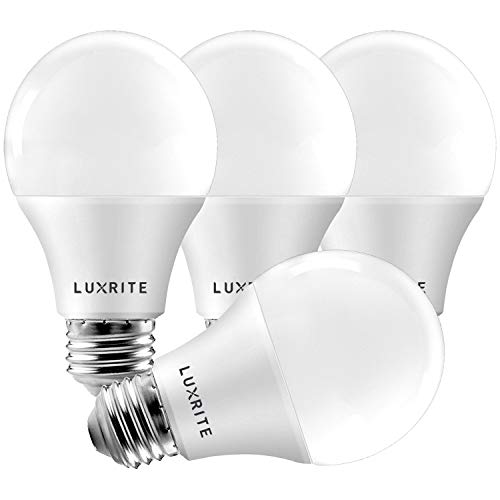
| Best Warm-Dimming Pick | Dimmable: Dimmable from 100% to 10% | Lumens (Brightness): 800 lm | Base/Form Factor: A19, E26 base | VIEW LATEST PRICE | Read Our Analysis |
More Details on Our Top Picks
DEWENWILS GU10 Dimmable 5000K LED Bulbs (10-Pack)
Should you need bright, daylight-white spot lighting that dims smoothly for tasks or ambiance, the DEWENWILS GU10 5000K 10-pack is a strong choice—it delivers 500 lm of flicker-free, 5000K light with stepless 10%–100% dimming, so you can tailor illumination for kitchens, track fixtures, or recessed spots without replacing fixtures. You’ll get soft, MR16-style beams with 80+ CRI that reveal true colors while avoiding glare. Each 7W bulb replaces a 50W incandescent, lasts 10,000+ hours, and cuts energy use over 90%. UL and Energy Star certified, GU10 plug-and-play installation fits standard recessed and track setups.
- Dimmable:Smooth stepless dimming 10%–100%
- Lumens (Brightness):500 lm
- Base/Form Factor:GU10 (MR16-style spotlight)
- Color Temperature:5000K (daylight)
- Energy-efficient LED:7W (50W incandescent equivalent), saves >90%
- Lifespan/Rating:10,000+ hours
- Additional Feature:No glare, no flicker
- Additional Feature:Energy Star & UL certified
- Additional Feature:Plug-and-play GU10
Great Eagle 100W Equivalent A19 LED Bulbs (6-Pack)
Should you want bright, warm light that cuts energy use without sacrificing output, the Great Eagle 100W Equivalent A19 6-pack is a strong choice—each 15W bulb delivers 1,500 lumens at 2700K, matching a traditional 100W incandescent while using far less power. You’ll get instant-on, full brightness even in sub-zero temps and accurate color rendering for natural-looking rooms. They’re dimmable—just pair them with an LED-compatible dimmer for smooth, flicker-free control. Use them in table or floor lamps, open pendants, kitchens, inhabited rooms, bedrooms, offices, and hallways. UL listed, with USA-based seller support and warranty assistance.
- Dimmable:Dimmable (requires LED-compatible dimmer switch)
- Lumens (Brightness):1500 lm
- Base/Form Factor:A19 (standard bulb)
- Color Temperature:2700K (warm white)
- Energy-efficient LED:15W (100W equivalent)
- Lifespan/Rating:(Not explicitly stated) — instant on, UL listed (typical LED multi-year life implied)
- Additional Feature:Instant on at sub-zero
- Additional Feature:1500 lm high output
- Additional Feature:USA-based seller support
Linkind Wi‑Fi RGBW Smart Light Bulbs (4-Pack)
Should you want full-color, app-driven control without adding a hub, the Linkind Wi‑Fi RGBW 4‑pack is a great pick — it gives you 16 million colors, tunable white (1800K–6500K), and 800 lumens per A19 bulb, all managed via the AiDot app or voice with Alexa/Google Home over 2.4 GHz Wi‑Fi (with Bluetooth backup for local control). You’ll set schedules, scenes, timers, and sunrise simulation, grouping bulbs for unified control. Music sync, Light Show and DIY effects add ambiance, while Bluetooth guarantees local control in case Wi‑Fi drops. Please observe: it won’t work with traditional dimmer switches.
- Dimmable:Dimmable via app/voice (not compatible with traditional dimmer switches)
- Lumens (Brightness):800 lm
- Base/Form Factor:A19, E26 base
- Color Temperature:Tunable 1800K–6500K (RGBW)
- Energy-efficient LED:9–?W equivalent to 60W incandescent, 800 lm (rated 25,000 hrs) [LED smart bulb]
- Lifespan/Rating:25,000 hours
- Additional Feature:Alexa & Google compatible
- Additional Feature:Dual WiFi + Bluetooth
- Additional Feature:16M colors + tunable white
LUXRITE A19 60W Equivalent Warm White LED Bulbs (4-Pack)
Should you want reliable, warm lighting that cuts energy use without sacrificing brightness, the LUXRITE A19 60W-equivalent is a smart pick — it delivers 800 lumens at a cozy 2700K while using just 9W, making it ideal for kitchens, bedrooms, and lamps where dimmable, high-quality light matters. You’ll get crisp, zero-flicker output with no delay and smooth dimming from 100% to 10% for mood scenes and task lighting. The A19 fits standard E26 sockets, works in enclosed fixtures, and drops energy use about 85% versus incandescent. Rated 25,000 hours, Energy Star and UL listed, it includes a two-year warranty.
- Dimmable:Dimmable from 100% to 10%
- Lumens (Brightness):800 lm
- Base/Form Factor:A19, E26 base
- Color Temperature:2700K (warm white)
- Energy-efficient LED:9W (60W equivalent), reduces usage by 85%
- Lifespan/Rating:25,000 hours
- Additional Feature:Enclosed-fixture rated
- Additional Feature:Zero flicker, zero delay
- Additional Feature:2-year warranty
Factors to Consider When Choosing a Dimming LED Bulb
Upon choosing a dimming LED bulb, you’ll want to check brightness in lumens and the color temperature to match your space. Make sure the bulb’s dimmability range and color rendering index (CRI) meet your needs, and confirm compatibility with your dimmer switch. These factors together determine how smoothly the light dims and how true colors will appear.
Brightness And Lumens
Brightness is what you notice initially, so pick dimmable LEDs through lumens rather than watts—about 800 lm usually replaces a 60W incandescent and 1500 lm replaces a 100W—so you get the actual light output you need. Choose bulbs that dim smoothly from roughly 100% down to 10% (or lower) so they remain usable at low settings. Match lumen output to the fixture and task: spot or track lighting needs fewer lumens focused in a beam, while general room lighting demands higher total lumens. Verify lumen maintenance and rated lifespan (often 10,000–25,000+ hours) to avoid significant brightness loss over time. Keep in mind that perceived brightness also depends on color temperature, so compare lumens within the same temperature range.
Color Temperature Choices
How warm do you want your space to feel as you dim the lights? Choose color temperature in Kelvins to match function and mood: 1800K–3000K reads warm and yellow, 3500K–4100K is neutral, and 5000K–6500K is cool/daylight. For living rooms and bedrooms, pick 2700K–3000K so dimming keeps a comfortable, relaxing ambiance. For kitchens, garages, or work areas, 4000K–5000K heightens contrast and alertness, though it can feel harsh when dimmed. Consider tunable white or smart bulbs (e.g., 1800K–6500K) should you desire flexibility to shift warmth for tasks or winding down. Finally, prioritize bulbs with high CRI and smooth-dimming design so color and perceived brightness stay accurate across dim levels.
Dimmability Range Compatibility
Should you want a dimming LED that gives you the mood control you expect, check the bulb’s specified dimming range (for example 10%–100%) and confirm it supports the low-end output you need. Verify whether the bulb offers stepless (continuous) dimming or stepped levels so transitions stay smooth without noticeable jumps. Look for manufacturer-stated minimum and maximum wattage/load requirements for dimmer circuits to prevent flicker, buzzing, or limited dimming when multiple bulbs share a dimmer. In case you plan to use voice or app control, confirm the bulb’s dimming is supported by the smart system (Wi‑Fi, Bluetooth, or hub) rather than relying on older wall dimmers, which can cause conflicts. Match specifications to your use for reliable mood lighting.
Dimmer Switch Requirements
Being aware of a bulb’s dimming range is only part of the scenario — the switch you’re pairing it with matters just as much. Check that the dimmer is labeled “LED-compatible” or “ELV/LED”; older TRIAC (leading-edge) dimmers often cause flicker, limited range, or buzzing with LEDs. Match the dimmer’s minimum load rating to the combined wattage of all connected LEDs — some modern LED dimmers work down to 1–5 W, while legacy units need much higher loads. Prefer trailing-edge (electronic/ELV) dimmers for smoother, quieter, wider-range control. For 3-way or multi-location setups, use dimmers rated specifically for 3-way LED use or a primary/companion electronic system to avoid incompatibility. Confirm the dimmer specifies flicker-free performance and the desired low-end dimming percentage.
Color Rendering Index
Perception matters whenever you dim the lights—Color Rendering Index (CRI) tells you how accurately a bulb shows colors compared to a natural reference, scored 0–100. You should pick LEDs with at least CRI 80 for general indoor use and 90+ where color accuracy matters, like art, retail, or makeup. Bear in mind CRI can shift slightly as bulbs dim, so choose models specified to maintain high CRI across their dimming range to avoid unexpected color shifts at lower levels. CRI is independent of color temperature (Kelvin), so compare CRI values when matching fixtures even though one is warm and another cool. In case skin tones or saturated reds matter, check R9 and newer metrics like TM-30 for more reliable evaluation.
Energy Consumption Lifespan
Accurate color at low light is essential, but you’ll also want to weigh how dimming affects energy use and bulb life. Dimmable LEDs draw roughly 10%–100% of rated wattage depending on setting, so dimming proportionally cuts immediate power use versus full brightness. Because LEDs already replace 60–100W incandescents with 8–15W models, you get about 75%–85% energy savings even before dimming. Running LEDs at reduced output reduces heat stress, often extending life so bulbs meet or exceed rated lifetimes (commonly 10,000–25,000+ hours). Total savings depend on duty cycle — dimming to 50% half the day yields about 25% energy reduction overall. Keep in mind that lumen-per-watt can fall at very low levels, so useful-light efficiency may change as you dim.
Fixture And Base Fit
Fit matters: before you buy a dimmable LED, confirm the bulb’s base type and physical size match your fixture so it seats securely, won’t rub trim, or block reflectors. Check base types (E26, GU10, MR16) against the socket and verify voltage—120V line vs. 12V low-voltage—so electrical fit is correct. Compare lamp shape and dimensions (A19, PAR, MR16) to make certain it won’t protrude, contact trim, or obstruct reflectors. Verify the fixture’s wattage rating or LED-equivalent to avoid overload and take into account enclosed-fixture restrictions that can raise operating temperature and shorten life. Should your fixture use a transformer or dedicated driver, confirm it’s compatible with dimmable LED loads. For recessed, track, or directional fixtures, match beam angle and mounting clearance to prevent glare or unwanted shadows.
Smart Control Integration
Should you’re choosing a dimmable LED for a smart home, make sure it actually works with your control ecosystem and the hardware you already have—some bulbs need a hub, others speak Wi‑Fi, Bluetooth, Zigbee, or Z‑Wave, and each option changes range, latency, and how you’ll control dimming. Confirm support for your voice assistant or platform and whether a bridge is required for full features. Check connectivity type to know whether you’ll use direct app control or a hub. Verify the bulb works with your existing wall dimmer or smart switch—many bulbs dim in‑app but aren’t compatible with leading‑ or trailing‑edge dimmers. Prefer bulbs with separate tunable‑white/RGB channels and firmware/app support for scheduling, groups, remote control, and OTA updates.
