

You may suppose pricier rigs always win on performance, but that isn’t necessarily true. You’ll want a system that balances CPU cores, a capable GPU, and room to upgrade. Suppose 16 GB dual‑channel RAM, a 500–1000 GB NVMe SSD, and a solid 450–650W PSU—but which exact models give the best value? Keep going to see practical options that match that checklist without overspending.
| Beelink SER3 Mini PC Ryzen 3200U 16GB 500GB |
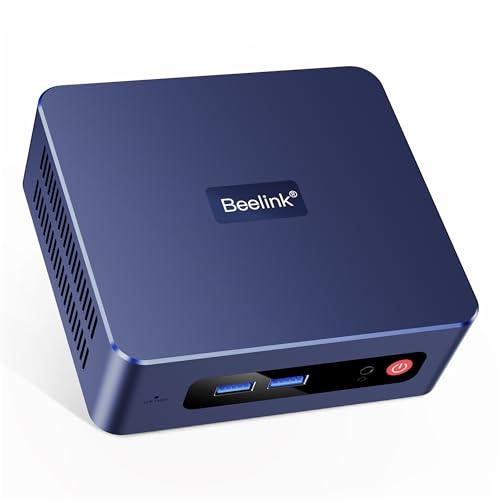
| Compact Power | Processor Family: AMD Ryzen 3 (Ryzen 3 3200U) | Integrated/Discrete GPU Capability: Integrated AMD Radeon Vega (iGPU) | RAM Capacity: 16 GB DDR4 SO‑DIMM | VIEW LATEST PRICE | Read Our Analysis |
| Skytech Archangel Gaming PC — Ryzen 5 RTX 3050 |

| Best Value Gaming | Processor Family: AMD Ryzen 5 (Ryzen 5 5500) | Integrated/Discrete GPU Capability: Discrete NVIDIA GeForce RTX 3050 (dGPU) | RAM Capacity: 16 GB DDR4 (3200 MHz) | VIEW LATEST PRICE | Read Our Analysis |
| Skytech Nebula Gaming PC — Ryzen 5 5500 RTX 4060 |

| Performance Champion | Processor Family: AMD Ryzen 5 (Ryzen 5 5500) | Integrated/Discrete GPU Capability: Discrete NVIDIA GeForce RTX 4060 (dGPU) | RAM Capacity: 16 GB DDR4 (3200 MHz) | VIEW LATEST PRICE | Read Our Analysis |
More Details on Our Top Picks
Beelink SER3 Mini PC Ryzen 3200U 16GB 500GB
Should you want a compact, budget-friendly desktop that handles everyday office work, 4K media, and light creative tasks, the Beelink SER3 delivers—its Ryzen 3 3200U with 16 GB RAM and a 500 GB NVMe SSD keeps multitasking smooth while dual HDMI 2.0 supports two 4K displays. You’ll get a two-core, four-thread CPU with Vega graphics adequate for photo edits, AI trial workloads, and 4K video playback. Ports include four USB 3.2 Gen2, Gigabit Ethernet, Wi‑Fi 5, Bluetooth 5.0, and a combo audio jack. Storage’s upgradeable to 2 TB, and tutorials support features like Wake on LAN.
- Processor Family:AMD Ryzen 3 (Ryzen 3 3200U)
- Integrated/Discrete GPU Capability:Integrated AMD Radeon Vega (iGPU)
- RAM Capacity:16 GB DDR4 SO‑DIMM
- NVMe M.2 SSD Storage:500 GB M.2 NVMe SSD (2280), upgradeable to 2 TB
- Wi‑Fi Connectivity:Wi‑Fi 5 (802.11ac)
- Operating System / Software State:(Not specified—consumer/embedded use; tutorials/support available)
- Additional Feature:Dual HDMI 4K@60Hz
- Additional Feature:Ultra-compact mini PC
- Additional Feature:Wake on LAN support
Skytech Archangel Gaming PC — Ryzen 5 RTX 3050
Should you want reliable 1080p gaming without overspending, the Skytech Archangel delivers a balanced combo: a Ryzen 5 5500 CPU, RTX 3050 GPU, and 16 GB of 3200 MHz RAM that’ll handle modern titles at high settings while staying under $1,000. You get a 1 TB NVMe M.2 SSD for fast load times, a 650W Gold PSU, and a high-performance air cooler with ARGB fans to keep temps down during long sessions. Video outputs and multiple USB ports cover peripherals, and 802.11ac Wi‑Fi plus Windows 11 Home arrive bloatware-free. It’s built in the USA with a one-year warranty.
- Processor Family:AMD Ryzen 5 (Ryzen 5 5500)
- Integrated/Discrete GPU Capability:Discrete NVIDIA GeForce RTX 3050 (dGPU)
- RAM Capacity:16 GB DDR4 (3200 MHz)
- NVMe M.2 SSD Storage:1 TB NVMe M.2 SSD
- Wi‑Fi Connectivity:Wi‑Fi 5 (802.11ac)
- Operating System / Software State:Windows 11 Home 64‑bit (no bloatware)
- Additional Feature:Included keyboard & mouse
- Additional Feature:ARGB front mesh case
- Additional Feature:650W Gold PSU
Skytech Nebula Gaming PC — Ryzen 5 5500 RTX 4060
Should you want strong 1440p gaming without breaking the budget, the Skytech Nebula — powered through a Ryzen 5 5500 and an RTX 4060 — is a smart pick. You get a 3.6 GHz base / 4.2 GHz boost CPU cooled by a high-performance air cooler with ARGB fans and a RAM heat spreader. RTX 4060 8GB and 16GB DDR4-3200 handle modern titles at Ultra, hitting smooth 60+ FPS in many cases. Storage is a 1TB NVMe M.2, and a 650W Gold PSU guarantees stability. Extras include Wi‑Fi, Windows 11 Home, gaming peripherals, and a one-year warranty.
- Processor Family:AMD Ryzen 5 (Ryzen 5 5500)
- Integrated/Discrete GPU Capability:Discrete NVIDIA GeForce RTX 4060 (dGPU)
- RAM Capacity:16 GB DDR4 (3200 MHz)
- NVMe M.2 SSD Storage:1 TB NVMe M.2 SSD
- Wi‑Fi Connectivity:Wi‑Fi 5 (802.11ac)
- Operating System / Software State:Windows 11 Home 64‑bit (no bloatware)
- Additional Feature:RTX 4060 8GB GPU
- Additional Feature:1440p/Ultra gaming capable
- Additional Feature:RAM heat spreader & ARGB
Factors to Consider When Choosing a Desktop PC Under 1000
While picking a desktop under $1000, you’ll want to prioritize processor performance and graphics capability to match your main uses. Check memory and storage options for speed and upgrade paths, and confirm the display outputs you need for your monitors. Finally, consider cooling and noise levels so your system stays quiet and reliable under load.
Processor Performance
Pick a CPU that matches how you’ll actually use the PC: aim for at least 4 cores and 8 threads, check single-thread turbo clocks around 3.5+ GHz for snappy responsiveness, and compare cache size and IPC generation because newer designs often beat older chips with similar core counts. You should prioritize balanced multi-core performance for productivity and light content creation, while noting single-core uplift matters for responsiveness and legacy workloads. Also check TDP and cooling headroom—higher-TDP chips sustain uplifts but need better cooling to avoid throttling. Finally, balance the CPU with RAM speed and your intended GPU choice so the processor isn’t bottlenecked or wasted; a well-matched platform delivers the best real-world performance under a $1,000 budget.
Graphics Capability
Evaluate the GPU you’re getting for real-world needs: for smooth 1080p gaming and light creative work aim for a modern midrange discrete card with 4–6+ GB of GDDR6, healthy core counts (CUDA/stream processors), and hardware features like ray-tracing or encoder support where relevant; also check memory bandwidth, power draw, and display outputs so the card matches your monitor and your PSU/case cooling to avoid throttling. You’ll want higher VRAM bandwidth and core counts for GPU-bound titles and editing tasks. Confirm your PSU (typically 450–650W for midrange cards) and case airflow can handle peak load. Match the GPU to at least a modern quad-core CPU and 16 GB RAM to prevent bottlenecks. Finally, verify HDMI/DisplayPort versions and max refresh/resolution for your monitor.
Memory And Storage
At minimum, get 16 GB of DDR4 RAM (preferably 3200 MHz or faster) in a dual‑channel kit (2×8 GB) and an NVMe M.2 boot drive of at least 500 GB so your system feels responsive for multitasking, modern games, and apps. You’ll benefit from dual‑channel bandwidth—two sticks give noticeably better performance than a single module. Use the NVMe as your OS/apps drive for fast boots and load times; it outpaces SATA SSDs and HDDs. For large game or media libraries, add a 1–2 TB HDD or a cheaper SATA SSD for bulk storage. Before buying, confirm the motherboard offers extra DIMM and M.2/SATA ports so you can upgrade RAM or add drives later without swapping core parts.
Display And Outputs
With your RAM and storage sorted, make sure the PC’s display outputs match how you work or play. Look for at least one HDMI 2.0 or DisplayPort 1.4 to handle 4K@60Hz or 1440p at 144+Hz; that prevents bottlenecks for smooth gaming or detailed editing. Check how many external monitors the GPU supports—some systems only drive a single display—so verify concurrent-display limits and max resolution per port. Confirm HDR and HDCP support provided that you stream protected content or need accurate color. In case you have older monitors, make certain VGA/DVI or plan for adapters. Also take into account onboard audio outputs like a 3.5mm jack or optical/SPDIF so you can route sound to speakers or an AV receiver without relying solely on HDMI.
Cooling And Noise
Often you will observe cooling and noise are the difference between a PC that performs and one that distracts, so prioritize cases and coolers with good airflow—multiple intake and exhaust fans—to keep CPU/GPU temps down approximately 10–20°C under load. Match your CPU cooler’s TDP rating to or above the processor’s TDP (a 65W CPU needs a ≥65W cooler) to avoid thermal throttling during sustained loads. Check fan count, size, and RPM: 120–140 mm fans move air at lower RPMs and cut noise versus smaller high-RPM fans. Make sure case clearance and intake airflow for GPU cooling headroom, since poor airflow can raise GPU temps and fan noise by 5–10 dB under load. If available, prefer systems under ~35 dBA idle and ~45–50 dBA gaming.
Connectivity Options
Considering how many ports and wireless options you really need? Make sure the PC offers a balanced mix: at least two USB 3.0/3.2 Gen1 ports, one USB 2.0, and a Type‑C whenever possible for faster transfers and modern peripherals. Verify a gigabit Ethernet (RJ45 1000BASE‑T) port for stable wired networking in cases latency or bandwidth matter. Look for multiple video outputs — HDMI 2.0 or DisplayPort — to support dual monitors and 4K@60Hz. Confirm built‑in Wi‑Fi (preferably 802.11ac or better) and Bluetooth 5.0 so you won’t need adapters for wireless networks and peripherals. Finally, check the audio configuration: combined headset vs separate mic/headphone jacks, and optical or S/PDIF in case you require high‑quality or multi‑channel audio.
Upgrade Potential
Because you’ll likely keep this PC for several years, prioritize upgrade potential while shopping under $1000. Check the motherboard’s expansion slots — count PCIe x16/x1 and M.2/SATA ports so you can add a discrete GPU, NVMe/SATA drives, or expansion cards later. Verify RAM slot count and max supported capacity and speed; systems with 4 slots let you grow from 8–16 GB to 32–64 GB more affordably. Confirm the PSU’s wattage, efficiency, and connector types, and leave 100–200 W headroom for future CPU/GPU upgrades. Inspect case and cooling compatibility: GPU length clearance, CPU cooler height, bay sizes, and airflow matter. Finally, make certain the BIOS/UEFI can accept microcode updates and enable faster RAM/XMP and newer CPUs.
Warranty And Support
Should you’re buying a desktop under $1,000, warranty and support matter as much as specs—because repairs or downtime can erase any savings—so check length, coverage, and service options before you buy. You should prefer at least a one-year parts-and-labor warranty that covers chassis and internal components. Verify covered failures—hardware defects, power supply, GPU/CPU—and take note exclusions like accidental damage, spills, and overclocking. Confirm extended-warranty and accidental-damage options, compare 1–3 year extensions, and watch for service fees. Assess support channels: knowledge base, 24/7 phone or chat, and expected repair or RMA turnaround times. Finally, check whether on-site service, mail-in repairs, replacement-part policies, and any shipping or diagnostic fees apply during warranty.
