

Like finding a shortcut through a crowded city, choosing a cheap gaming PC can save you time and money; you’ll want a machine that balances CPU, GPU, and fast storage without locking you out of upgrades. You’ll aim for at least six cores, 16 GB RAM, and a 500 GB+ NVMe SSD, and consider refurbished RTX 3060/5060 or RTX 3050 options for value. Keep going—there’s more on specific picks and what to watch for.
| HP ProDesk Desktop i5-6500 8GB 256GB SSD (Renewed) |

| Reliable Refurb Pick | Processor: Intel Core i5-6500 (6th Gen), 3.2 GHz | Graphics Card: Integrated/unspecified (no discrete GPU listed) | RAM: 8 GB DDR4 | VIEW LATEST PRICE | Read Our Analysis |
| Gaming PC Desktop — Ryzen 7 5700X RTX 5060 |
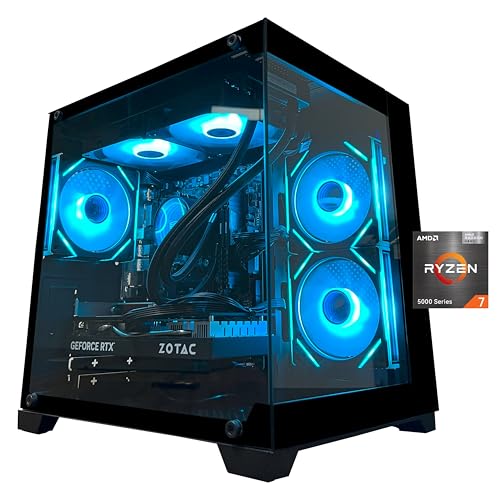
| Performance Powerhouse | Processor: AMD Ryzen 7 5700X, up to 4.6 GHz boost | Graphics Card: NVIDIA GeForce RTX 5060, 8 GB GDDR7 | RAM: 32 GB DDR4 3200 MHz (2 × 16 GB) | VIEW LATEST PRICE | Read Our Analysis |
| Prebuilt Gaming Desktop PC Ryzen 5 RX 560 16GB |
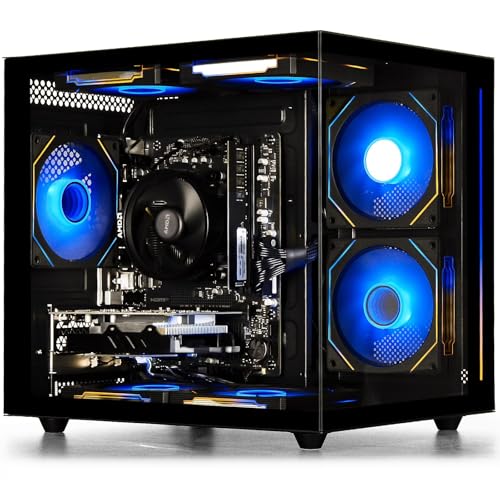
| Solid Midrange Choice | Processor: AMD Ryzen 5 (6-core), up to 4.1 GHz boost | Graphics Card: AMD Radeon RX 560, 4 GB VRAM | RAM: 16 GB DDR4 3200 MHz | VIEW LATEST PRICE | Read Our Analysis |
| STGAubron Gaming PC Desktop — i7 RTX 3050 16GB |

| Best Value Gamer | Processor: Intel Core i7, up to 3.9 GHz | Graphics Card: NVIDIA GeForce RTX 3050, 6 GB GDDR6 | RAM: 16 GB RAM | VIEW LATEST PRICE | Read Our Analysis |
More Details on Our Top Picks
HP ProDesk Desktop i5-6500 8GB 256GB SSD (Renewed)
Should you want a budget-friendly starter rig that handles light gaming and everyday tasks, the renewed HP ProDesk with a 6th‑gen Intel Core i5 and 8GB RAM delivers consistent, no-frills performance—paired with a 256GB SSD for quick boots and load times. You’ll get an i5-6500 (3.2 GHz, 6 MB cache) that’s reliable for general use and casual gaming. The unit’s professionally inspected and cleaned, ships with accessories (may be in a generic box), and includes a minimum 90-day warranty. Extras like RGB front lighting, a new gaming keyboard and mouse, USB WiFi adapter, and Windows 10 Pro add value.
- Processor:Intel Core i5-6500 (6th Gen), 3.2 GHz
- Graphics Card:Integrated/unspecified (no discrete GPU listed)
- RAM:8 GB DDR4
- Primary Storage:256 GB SSD
- Operating System:Windows 10 Pro (64-bit)
- Connectivity (Wireless):USB WiFi adapter included
- Additional Feature:RGB front-panel lighting
- Additional Feature:New keyboard and mouse
- Additional Feature:Includes USB WiFi adapter
Gaming PC Desktop — Ryzen 7 5700X RTX 5060
In case you want a midrange gaming rig that balances high-frame competitive play with smooth ray-traced visuals, this Ryzen 7 5700X build with an RTX 5060 is a strong pick. You get an 8-core/16-thread CPU ramping to 4.6 GHz, ideal for multitasking, streaming, and creative work. The RTX 5060 with 8 GB GDDR7 supports DLSS 4, ray tracing, and Reflex 2 to reduce latency. It includes 32 GB DDR4-3200 RAM and a 1 TB M.2 NVMe SSD. Cooling comes from a 240 mm ARGB liquid cooler and three ARGB fans. MSI B550M-A PRO, Wi‑Fi/Bluetooth, and a 650 W 80+ Bronze PSU round it out. Remove shipping foam on arrival; contact the seller for issues.
- Processor:AMD Ryzen 7 5700X, up to 4.6 GHz boost
- Graphics Card:NVIDIA GeForce RTX 5060, 8 GB GDDR7
- RAM:32 GB DDR4 3200 MHz (2 × 16 GB)
- Primary Storage:1 TB M.2 NVMe PCIe SSD
- Operating System:(Not explicitly listed) — shipped ready for Windows (seller notes); likely Windows (unspecified)
- Connectivity (Wireless):Wi‑Fi and Bluetooth (built-in)
- Additional Feature:240mm liquid cooler
- Additional Feature:3×120mm ARGB fans
- Additional Feature:650W 80+ Bronze PSU
Prebuilt Gaming Desktop PC Ryzen 5 RX 560 16GB
Suppose you want a ready-to-play rig that balances gaming and creative work without breaking the bank, this prebuilt Ryzen 5 system delivers—6-core CPU performance with a 4.1 GHz surge and an RX 560 GPU that handles 1080p gaming and everyday multitasking smoothly. You get Ryzen 5 with 32 MB L3, 16 GB DDR4 at 3200 MHz, and a 512 GB NVMe SSD for fast load times. The RX 560 includes 4 GB VRAM for casual gaming. Built‑in Wi‑Fi 6, multiple USB ports, RGB fans, and advanced air cooling round out a compact, black chassis ideal for budget builders.
- Processor:AMD Ryzen 5 (6-core), up to 4.1 GHz boost
- Graphics Card:AMD Radeon RX 560, 4 GB VRAM
- RAM:16 GB DDR4 3200 MHz
- Primary Storage:512 GB NVMe SSD
- Operating System:(Not explicitly listed) — implied Windows (unspecified)
- Connectivity (Wireless):Built-in Wi‑Fi 6
- Additional Feature:Built-in Wi‑Fi 6
- Additional Feature:Advanced air cooling
- Additional Feature:Compact black chassis
STGAubron Gaming PC Desktop — i7 RTX 3050 16GB
Should you want a capable midrange gaming rig that balances price and performance, the STGAubron with an Intel Core i7 and NVIDIA RTX 3050 delivers smooth 1080p play and solid multitasking with 16GB RAM. You get an i7 up to 3.9 GHz, RTX 3050 6GB GDDR6, Windows 11, 16GB RAM, and a 512GB SSD for quick load times. Connectivity includes Wi‑Fi 6, Bluetooth 5.0, Ethernet, HDMI, DisplayPort, DVI, and a serial port. Six RGB fans plus RGB keyboard and mouse keep things cool and styled. It’s backed through one year parts/labor and free lifetime tech support.
- Processor:Intel Core i7, up to 3.9 GHz
- Graphics Card:NVIDIA GeForce RTX 3050, 6 GB GDDR6
- RAM:16 GB RAM
- Primary Storage:512 GB SSD
- Operating System:Windows 11 Home (64-bit)
- Connectivity (Wireless):Wi‑Fi 6 and Bluetooth 5.0
- Additional Feature:Six RGB fans
- Additional Feature:RGB keyboard and mouse
- Additional Feature:1 year parts & labor
Factors to Consider When Choosing a Desktop PC for Gaming Cheap
While hunting for a cheap gaming desktop, you’ll want to balance budget and value so you don’t overspend on parts that won’t enhance performance. Consider CPU and GPU needs for the games you play, plus enough memory and fast storage to avoid bottlenecks. Also check cooling and noise levels so your budget build stays stable and comfortable during long sessions.
Budget And Value
A clear budget range—say $400–$800—lets you prioritize parts and avoid overspending on small performance gains. Decide how much you’ll spend on GPU or an integrated-graphics-capable CPU (target 40–50% of a tight budget), reserve 20–30% for the CPU, and use the rest for 16 GB RAM, a 500 GB+ SSD, and a reliable PSU. Aim for at least those baseline specs so games run well without immediate upgrades. Compare components via performance-per-dollar using real benchmarks (FPS at your target resolution and settings) instead of raw clock speeds or core counts. To stretch money, consider refurbished or previous-generation parts but check warranty length and possible repair or upgrade costs before buying.
CPU Performance Needs
In case you’re building a cheap gaming PC, prioritize a CPU that matches your GPU and play habits so you don’t waste money on unusable headroom or choke performance at higher frame rates. For 1080p, aim for at least a quad‑core with multithreading; modern titles and streaming benefit from 6 cores/12 threads or more. Favor CPUs with strong single‑core surge clocks (~3.8–4.6 GHz) for esports and CPU‑bound games. Check L3 cache and IPC—newer microarchitectures with larger caches deliver better real‑world FPS at similar clocks. Balance is key: an overpowered CPU won’t raise FPS when the GPU is the limiter, while a weak CPU can hold back a faster GPU, especially on high refresh monitors. Finally, consider TDP, cooling, and motherboard VRMs for sustained performance and upgradeability.
GPU Capability Requirements
You’ve matched your CPU to your gaming goals, so now focus on the GPU — it’s the component that mostly determines frame rates and image quality. For 1080p at medium-to-high settings, pick a modern card with 4–6 GB of GDDR6/GDDR5 and DirectX 12 support. Should you want stable 60+ FPS at 1440p or higher, aim for 8+ GB VRAM and higher core/shader counts to avoid quality drops. Check hardware ray tracing and vendor upscaling (temporal or AI frame generation) to enhance perceived performance without massive raw power. Compare memory bandwidth and bus width, and rely on real-world benchmarks for your games. Finally, confirm your PSU, cooling, and CPU can handle the GPU’s TDP to prevent throttling.
Memory And Storage
For budget builds, prioritize 16 GB of DDR4 RAM at 3000–3200 MHz and a 500 GB NVMe SSD as your core setup—this keeps games and background apps smooth and slashes load times without breaking the bank. You’ll see fewer stutters and better frame pacing, especially in CPU-bound titles where faster RAM helps. Use the NVMe drive for your OS and favorite games so load times and responsiveness improve dramatically versus HDDs or SATA SSDs. Add a 1–2 TB HDD for cheap bulk storage of media and less-played libraries. Whenever shopping, pick a motherboard and case with extra RAM slots and M.2/SATA connectors so you can upgrade capacity later without replacing core components.
Cooling And Noise
Moving from memory and storage, cooling and noise finish the image via keeping those fast components running at peak performance without becoming a nuisance. You should prioritize cases and coolers with clear airflow paths—front intake plus top or rear exhaust—since good ventilation can cut CPU/GPU temps 5–15°C versus cramped designs. For sustained loads pick at least a dual‑fan air cooler or a 120–240 mm AIO to avoid thermal throttling that can shave 10–30% off performance. Check fan count and specs: aim for fans ≤30 dBA at 1,000–1,500 RPM and avoid high‑RPM fans unless there’s noise dampening. Assure GPU clearance and direct airflow to prevent 10–20°C temp spikes and louder fans. Use fan curves or BIOS/software to target ~70–80°C, balancing acoustics and thermals.
Upgradeability And Ports
While spending less, plan for growth so your cheap gaming PC won’t become obsolete fast: check the motherboard’s expansion slots (at least one PCIe x16 plus spare PCIe x1 or M.2 slots), free DIMM slots and max RAM capacity, drive bays and M.2 connectors, and a PSU with 20–30% headroom and the right PCIe cables—these basics let you add a better GPU, more NVMe storage, extra RAM, or upgraded cooling without swapping the whole system. Also verify case clearance and mounting points so larger GPUs or extra fans fit. Look for multiple rear and front I/O ports (USB-A/C, HDMI/DisplayPort, audio, Ethernet) and internal headers for front USB, ARGB, and fans. These choices keep upgrade paths open and peripherals supported.
