You often overlook the importance of proper home insulation. It is crucial for your comfort, energy efficiency, and long-term financial savings. Good insulation transforms your home’s environment. It significantly reduces your utility bills. A poorly insulated attic, for example, can lead to a 25% heat loss in homes during fall and winter. This heat loss directly impacts your energy cost.
Are you tired of high energy bills? Do you feel drafts inside your home? Upgrading your insulation offers a key solution. Homeowners can save an average of 15% on heating and cooling cost, or 11% on total energy cost, by improving insulation. Investing in insulation brings substantial savings. This investment also enhances your home’s overall comfort.
Types of Home Insulation Explained
Understanding the different types of insulation helps you choose the best option for your home. Each type offers unique characteristics, R-values, and installation methods. You will find various common types of insulation available, each designed to meet specific needs for thermal performance and energy efficiency.
Fiberglass Insulation
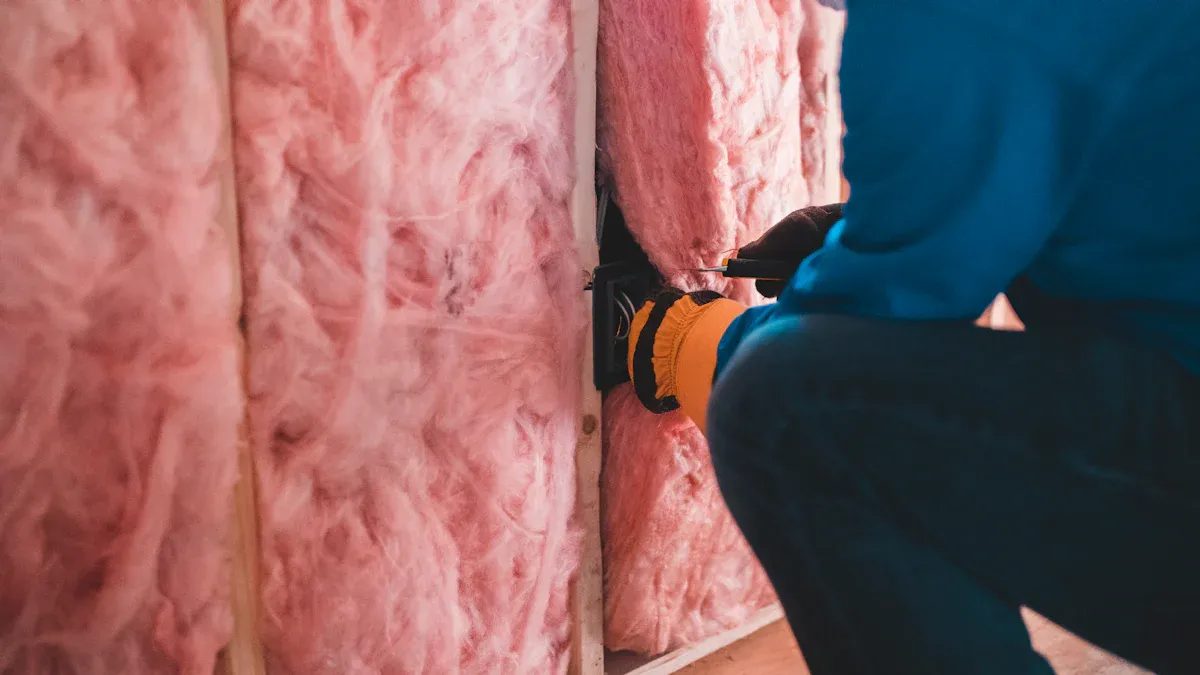
Fiberglass insulation is one of the most widely used types of insulation. You typically find it in batts, rolls, or as loose-fill material. Manufacturers create fiberglass from fine glass fibers, making it a cost-effective and versatile option for many homes.
Fiberglass insulation typically offers an R-value ranging from R-2.9 to R-3.8 per inch. A higher R-value means better thermal performance. For example, a 6-inch batt can provide approximately R-19, often sufficient for walls or attic floors depending on local building codes. Here is a general R-value range for fiberglass:
Thickness (inches) | Approximate R-Value Range |
|---|---|
3.5 | R-11 to R-13 |
6 | R-18 to R-21 |
9 | R-26 to R-34 |
12 | R-35 to R-45 |
You will find several advantages to using fiberglass. It is generally less expensive than other insulation types, making it budget-friendly at about $1.50 per square foot. You can often install fiberglass batts yourself, unlike other insulations requiring certified professionals. Fiberglass batts also effectively absorb and muffle sound waves due to their non-firm, non-solid nature, offering good sound attenuation.
However, fiberglass also has disadvantages. Its pre-cut shapes can lead to gaps if cavities do not match, compromising its performance. It is also prone to sagging over time, creating new gaps. While theoretically lasting a century, in real-world applications, it may degrade in 15-20 years due to gapping, sagging, and potential mold growth, especially in moist environments. Fiberglass is primarily recommended for interior walls where moisture is not a concern. It is not suitable for moisture-prone areas like basements, crawl spaces, or attics/exterior walls where high energy efficiency is crucial.
Cellulose Insulation
Cellulose insulation is an eco-friendly option made from recycled paper products, primarily newspapers. You typically find it as loose-fill insulation, blown into cavities or attics. This type of insulation is treated with fire-retardant chemicals, enhancing its fire resistance.
The R-value for loose-fill cellulose insulation typically falls between R-3.1 and R-3.8 per inch. Nu-Wool Premium Cellulose Insulation, for instance, has a specific R-value of 3.8 per inch.
Cellulose offers several advantages. It is eco-friendly and sustainable, made from approximately 80% recycled content, diverting paper waste from landfills. Its production requires less energy than fiberglass or spray foam, resulting in a smaller carbon footprint. Cellulose is generally cost-effective, typically $1 to $2 per square foot for attic applications, offering good return on investment through material savings and energy efficiency. Its dense, fibrous nature effectively fills gaps and cracks, creating a tighter thermal envelope and reducing drafts, providing superior air sealing capabilities. It also offers solid thermal performance and modest soundproofing benefits. Treated with boric acid, it provides Class 1 fire resistance and deters insects and rodents.
Despite its benefits, cellulose has drawbacks. Its paper fibers readily absorb water, leading to loss of insulating properties, sagging, and potential mold growth if exposed to leaks, inadequate ventilation, or high humidity. As a loose-fill material, it compacts over time, reducing its thickness and R-value, potentially requiring periodic inspections and top-up installations. Blown-in cellulose needs specialized equipment and expertise for proper installation to ensure even coverage, adequate density, and optimal performance. The installation process also generates considerable dust, which can irritate eyes, skin, and respiratory systems, necessitating protective equipment and containment strategies.
Spray Foam Insulation
Spray foam insulation is a highly effective type of insulation that expands upon application, filling cavities and creating an airtight seal. You can find it in two main forms: open-cell and closed-cell foam.
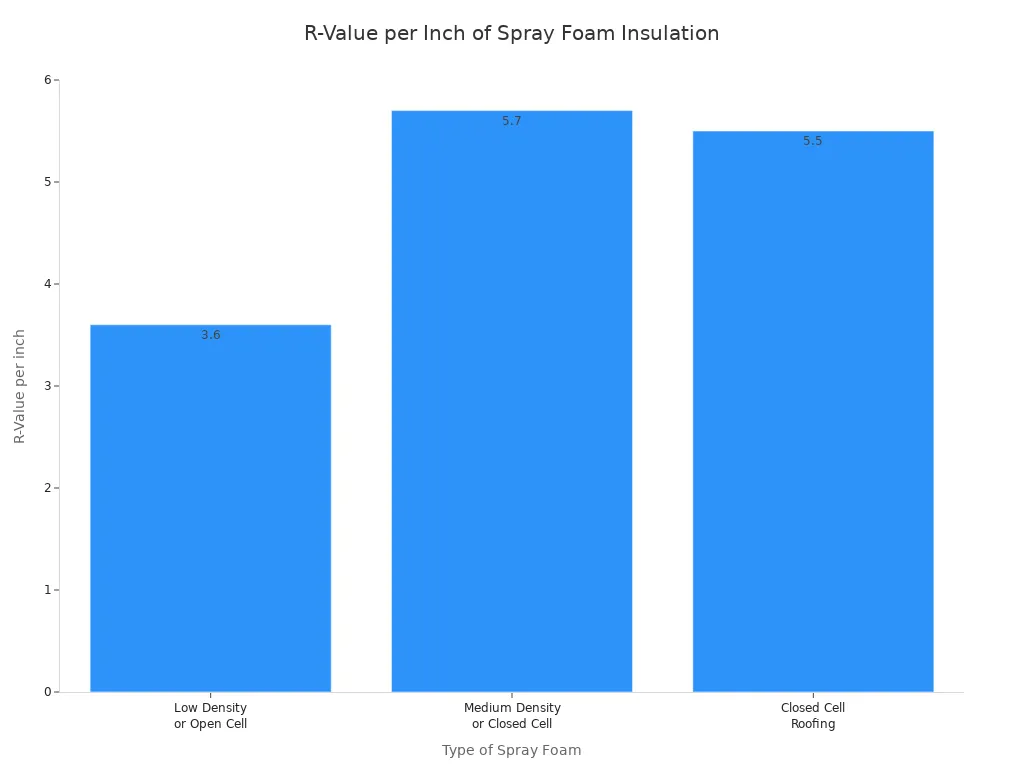
The R-value for spray foam insulation varies by type. Open-cell spray foam insulation typically has an R-value of R-3.6 to R-3.9 per inch. Closed-cell spray foam insulation offers a higher R-value, ranging from R-6 to R-7 per inch. The highest-quality closed-cell types typically range between R-6 and R-7 per inch.
Spray foam insulation offers superior energy efficiency. It fills all gaps and crevices, creating an airtight seal that significantly reduces heating and cooling costs, potentially by up to 50% immediately in uninsulated homes, or 30% overall compared to other insulation types. It provides a consistent R-value and does not degrade over time. Made of an inert polymer, it resists mold and mildew, even when wet, and acts as a pest deterrent. Closed-cell foam also blocks water, reducing risks of mold, mildew, and wood rot. Rigid closed-cell foam can even strengthen walls and roof decks, offering structural reinforcement. It also absorbs sound, minimizing outside noise.
However, spray foam has significant disadvantages. It has a higher upfront cost than fiberglass or cellulose, making the initial financial investment greater. It requires expert installation; rapid drying makes proper application challenging, and inexperienced installers may leave empty sections or apply it too thick/thin, leading to future problems. Once applied, it is difficult to remove or modify due to its strong adhesion. Chemical fumes during installation can cause respiratory issues without proper ventilation and protective gear. Traditional foams use petroleum-based materials and HFC blowing agents, raising environmental concerns. The airtight seal can also trap moisture and mask leaks or termite issues. Some lenders may hesitate to finance homes with spray foam, potentially affecting resale value.
Rigid Foam Boards
Rigid foam boards are stiff panels of insulation made from materials like expanded polystyrene (EPS), extruded polystyrene (XPS), or polyisocyanurate (Polyiso). You use them for continuous insulation on exterior walls, in basements, or under concrete slabs.
The R-value for rigid foam boards varies by type:
Product Name | R-Value (per inch) |
|---|---|
High-Density SilveRboard® | R4.1 to R5.0 |
SilveRboard® Graphite | R4.7 |
SilveRboard® | R4.0 |
SilveRboard® XS (SBXS) | R4.7 |
Envirosheet | R3.9 |
High-Density Envirosheet | R4.0 to R4.4 |
Envirostrap | R3.9 |
Rigid foam insulation offers several advantages. It effectively seals cracks and crevices, creating a strong barrier against outside air, which enhances indoor comfort. Its ability to be cut precisely allows it to fit irregular openings better than fiberglass batting. It acts as a vapor barrier, preventing moisture from entering the home, crucial for preventing wood rot, mold, and mildew, especially in homes with slab foundations. By absorbing sound waves, rigid foam insulation helps decrease noise levels both inside and outside the home. It is durable and stable, maintaining its position after installation, and resists water and pests, making it suitable for crawlspaces and basements. When properly sealed, it functions as an effective air barrier and you can easily cut and glue it to fit uniquely shaped areas.
However, rigid foam insulation is not fire-resistant and can emit toxic fumes when burned, posing a health hazard. Installation can be challenging and time-consuming, as boards require precise measurement and cutting. It is also one of the more costly insulation options available.
Mineral Wool Insulation
Mineral wool insulation, also known as rock wool or slag wool, consists of fibers spun from molten rock or industrial by-products. You typically find it in batt form or as loose-fill. It offers excellent fire resistance and soundproofing qualities.
Mineral wool insulation typically has an R-value ranging from R-3.0 to R-4.0 per inch, often around R-4 per inch.
Mineral wool offers significant advantages. It has a high R-value, meaning you need less insulation for the same protection. It is extremely durable and lasts longer than other insulation types, as it uses rocks, ore, and hard substances that will not sag or settle. Air pockets prevent moisture accumulation. Mineral wool withstands temperatures up to 1,000°C (1,832°F), making it highly fire-resistant and potentially leading to homeowner’s insurance discounts. Its dense nature means rocks block sound waves, preventing noise travel between rooms, providing excellent soundproofing. It is also stiffer than fiberglass, making it easier to cut with precision for a perfect fit.
Despite its benefits, mineral wool has some disadvantages. It sheds slivers that can irritate skin and cause lung damage if inhaled, requiring protective gear during installation. It is more costly than fiberglass due to unique manufacturing processes. Mineral wool is denser and considerably heavier than other materials, requiring you to consult with contractors regarding your home’s weight tolerance. It is not biodegradable, despite being made from natural elements. If it gets wet, it absorbs moisture and loses its R-value, with a risk of mold growth, so you should install vapor barriers and ensure dry environments.
Radiant Barriers
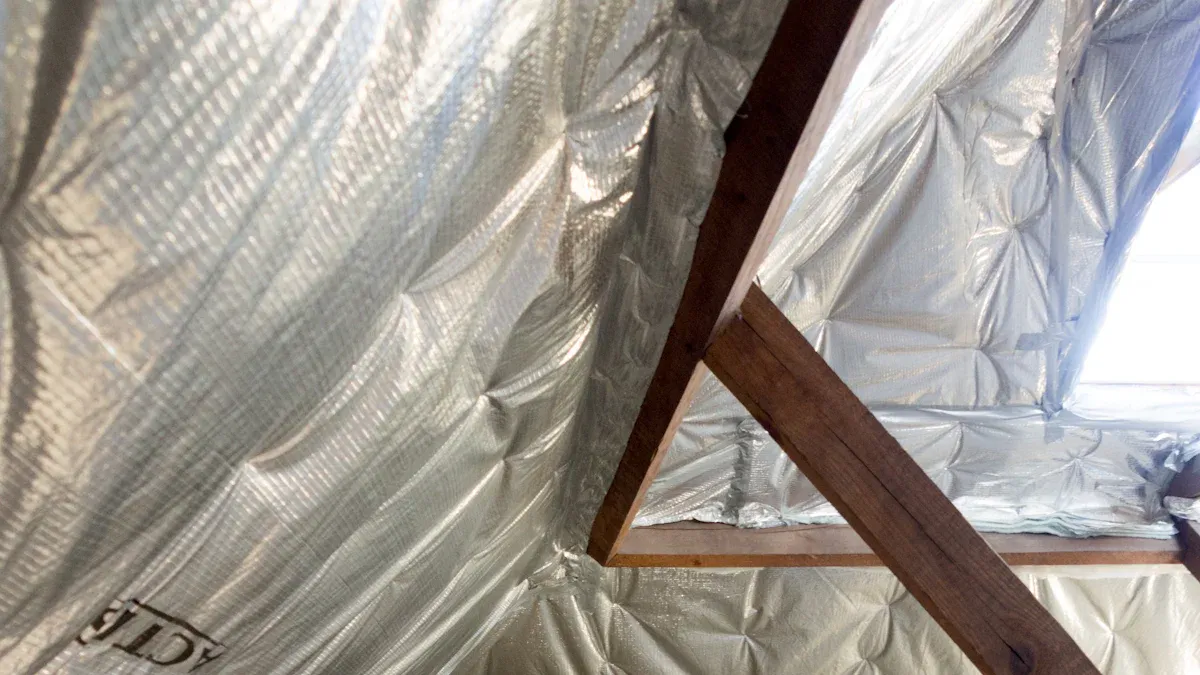
Radiant barriers are reflective materials, typically thin sheets of aluminum foil, installed in attics to reduce heat transfer by thermal radiation. They do not insulate in the traditional sense by resisting conductive or convective heat flow, but rather by reflecting radiant heat. You often see them installed on the underside of roof sheathing or across attic floor joists.
Radiant barriers primarily work by reflecting heat. They do not have an R-value in the same way as other insulation types because they do not resist conductive heat flow. Instead, they reduce radiant heat gain or loss.
Radiant barriers offer several advantages, especially in hot climates. When installed correctly, they keep attics cooler and reduce power bills in hot months. They can lead to a 5-10% reduction in cooling costs in warm, sunny climates, according to the U.S. Department of Energy. They also help keep stored items in the attic cooler, even if the attic is not climate-controlled. They reduce the need for air conditioning, leading to lower electric bills. Research by the United States Department of Energy indicates significant heat gain reduction through the ceiling, potentially saving up to 10% in heating and cooling utility expenses in warm climates.
However, radiant barriers also have disadvantages. They can be more expensive than traditional insulation materials, including both material and installation costs. Proper installation is crucial; incorrect installation can significantly reduce performance. There is a risk of radiant barriers trapping moisture, potentially leading to mold or mildew if ventilation is inadequate. Cooler attics can cause duct surfaces to reach the dew point, leading to condensation and “sweating ducts,” which creates a wet attic and fosters fungal growth. You may require a dehumidifier in the attic to prevent moisture issues, adding to energy consumption and cost. Their benefits are most pronounced in hot climates, making them less useful and a poor investment for generally cooler climates. Their effectiveness can also be reduced by certain building proportions, roof slope, shingle type, and ventilation. They often require additional insulation before installation to prevent heat transfer. Moisture frequently collects on the interior surface, as water vapor condenses and slides down the barrier, potentially causing water damage and mold. Perforated barriers are recommended to mitigate this issue.
Optimal Insulation Placement
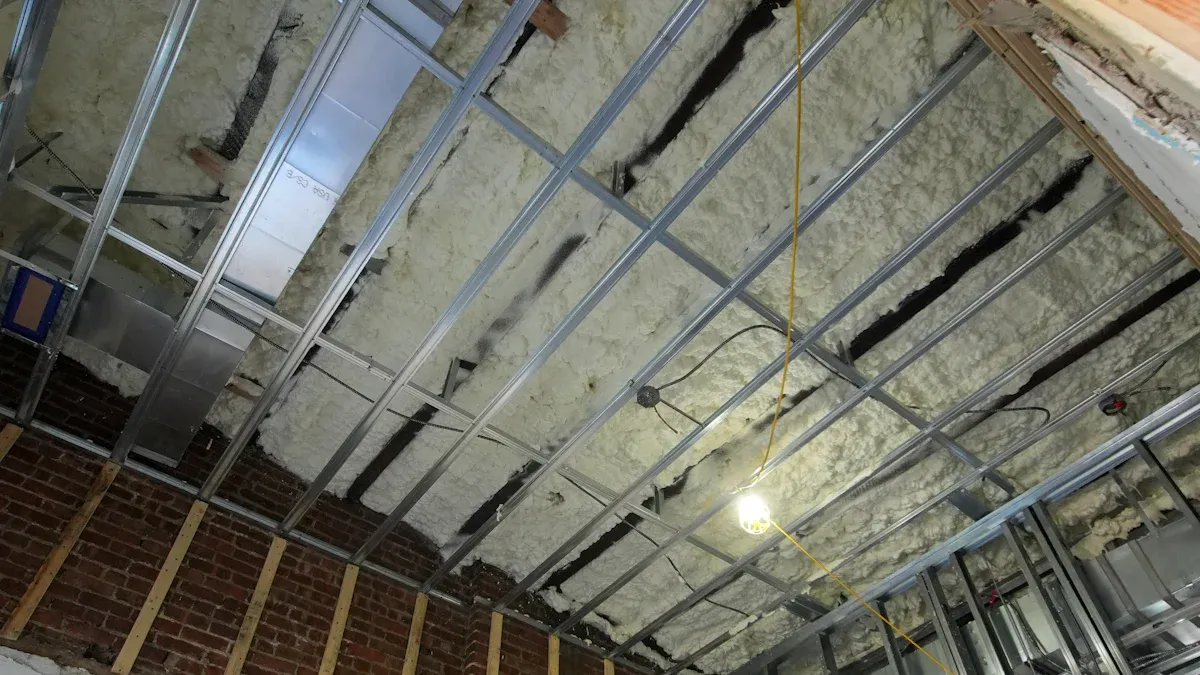
You must place insulation strategically for maximum effectiveness. Different areas of your home require specific types of insulation. This section guides you on the most effective locations. You will learn which insulation types suit each environment.
Attic Insulation
Your attic is a critical area for insulation. Loose-fill insulation works well here. This includes fiberglass, cellulose, or mineral wool. You can blow it into spaces with obstructions. This improves coverage where batts might leave gaps. Spray foam insulation also offers a high R-value. Many consider it the most suitable type for attics. Cellulose and fiberglass insulation are effective choices.
Wall Insulation
Walls are another key area for insulation. Common types of wall insulation include batt, blown-in, foam board, and spray foam. Batt insulation, often fiberglass, fits between studs. Blown-in insulation, like cellulose, fills existing wall cavities. Foam board insulation provides continuous insulation. Spray foam insulation creates an airtight seal. You choose the best insulation based on your wall structure.
Basement and Crawl Space Insulation
Basements and crawl spaces need specific insulation strategies. For vented crawl spaces, you should insulate the floor. Batt insulation (fiberglass or rock wool) works well. Spray foam insulation can also insulate sub-floors. For encapsulated crawl spaces, focus on foundation wall insulation. EPS foamboard and InsulBarrier are good choices. For interior basement walls, use XPS or EPS rigid foam boards. Mineral wool insulation and fiberglass batt insulation are also options. Spray foam insulation provides an excellent air seal.
Floor Insulation
Insulate floors above unheated spaces like basements or garages. These areas are prone to moisture. You need moisture-resistant materials. EPS, mineral wool, closed-cell polyurethane foam, and cementitious foam are good choices. These types create a strong barrier against dampness. Foam board, sprayed foam, and blanket insulation types are effective. Mineral wool offers superior sound insulation and thermal regulation. High R-value insulation, like polyurethane foam or closed-cell spray foam, retains heat.
Rim Joist Insulation
The rim joist area is where your house frame meets the foundation. This area is often overlooked. Spray foam insulation is an excellent choice here. It fills every space. It creates an airtight barrier. Rigid foam insulation also works well. This includes polyisocyanurate, expanded polystyrene (EPS), and extruded polystyrene (XPS). Rigid foam is cost-effective for materials. However, it requires more labor for proper installation. Spray foam insulation is easier to install in complex areas. Closed-cell spray foam is recommended for colder climates.
R-Value and Climate Zones
What is R-Value?
You need to understand R-value when you choose insulation for your home. R-value measures an insulation’s ability to resist heat transfer. A higher R-value indicates better thermal performance. This means the insulation provides greater thermal resistance. Doubling the thickness of an insulation layer doubles its R-value. This also halves the heat transfer through that layer. You can calculate the average heat loss per unit area by dividing the temperature difference by the R-value for the layer. For multi-layered insulation installations, you add the R-values of individual layers. This gives you the total R-value, which represents the total thermal resistance. R-value is a specific measure for products designed to reduce heat transfer. Increasing the thermal resistance (R-value) of your home’s envelope reduces building operating costs. It limits heat transmission and energy loss. Higher R-values lead to reduced heating bills in cold weather. They also result in lower cooling bills in hot weather. This improves your home’s overall energy performance.
Climate Zone Impact on R-Value
Your climate zone significantly impacts the R-value you need for insulation. Different regions experience varying temperatures and weather conditions. This means your home requires different levels of thermal resistance. Colder climates demand higher R-values to prevent heat from escaping. Hotter climates need higher R-values to keep heat out. The U.S. Department of Energy divides the country into eight climate zones. Each zone has specific recommendations for insulation. For example, Zone 1 includes Hawaii and other warm areas. Zones 7 and 8 cover very cold regions like parts of Alaska. Understanding your climate zone helps you select the right insulation for optimal thermal performance.
Recommended R-Values
You should follow specific R-value recommendations based on your climate zone. These guidelines ensure your home has adequate insulation. They help you achieve maximum energy efficiency.
Zone # | Attic | Wall | Floor |
|---|---|---|---|
7 | R49 to R60 | R13 to R21 | R25 to R30 |
6 | R49 to R60 | R13 to R21 | R25 to R30 |
5 | R38 to R60 | R13 to R21 | R25 to R30 |
4 | R38 to R60 | R13 to R21 | R25 to R30 |
3 | R30 to R60 | R13 to R21 | R25 |
2 | R30 to R49 | R13 to R21 | R13 |
1 | R30 to R49 | R13 to R21 | R13 |
For attics, you will find that warmer climates (Zones 1-3) typically recommend an R-value of R-30 to R-38. Mixed climates (Zones 4-5) suggest R-38 to R49. Cold climates (Zones 6-8) require R-49 to R-60 for effective thermal resistance. These recommendations help you choose the right insulation for your home.
Insulation ROI: Financial Benefits
Investing in insulation offers significant financial advantages. You can quantify these benefits through reduced utility bills, increased property value, and available financial incentives. Understanding these returns helps you make informed decisions for your home.
Energy Bill Savings
You will see immediate financial benefits from improved insulation through lower energy bills. Insulation reduces the amount of heat that escapes your home in winter. It also keeps heat out during summer. This means your heating and cooling systems work less. You can expect insulation to yield an annual return of 5 to 15 percent through these reduced energy bills. These savings accumulate over time, making insulation a smart long-term investment.
Increased Home Value
Insulation upgrades do more than just save you money on utilities. They also increase your home’s resale value. Buyers often look for energy-efficient homes. A well-insulated home appeals to them. The 2016 Remodeler Magazine “Cost vs. Value” report highlighted the strong return on investment for adding fiberglass attic insulation. This improvement topped the list for recouping initial investment.
Metric | Value |
|---|---|
Average cost of fiberglass attic insulation | $1,268 |
Average increase in home resale value | $1,446 |
Return on investment | 107.7% |
This data shows that the increase in your home’s value can exceed the initial cost of the insulation project.
Insulation Payback Period
The payback period for insulation projects varies. It depends on the project’s size and the specific areas you insulate. For large projects, you might see a return on your investment in just a few years. For specific areas, the payback period can range from 8 to 15 years. According to the US Department of Energy, the typical payback period for whole-home insulation upgrades, specifically retrofit home insulation, is between 2 and 10 years. For insulation investments in Annapolis, MD, the typical payback period is estimated to be between three and five years. Local climate and energy savings influence this timeframe.
Tax Credits and Rebates
You can further reduce the cost of your insulation investment through various tax credits and rebates. These incentives make upgrading your home’s insulation even more affordable.
The federal government offers tax credits for energy-efficient home improvements:
Credit Amount: You can claim 30% of the product cost, up to a maximum of $1,200.
Eligible Products: This includes typical bulk insulation products like batts, rolls, blow-in fibers, rigid boards, expanding spray, and pour-in-place. Air sealing products with a Manufacturers Certification Statement also qualify. These include weather stripping, spray foam, caulk, and house wrap.
Eligibility Requirements: Your home must be in the United States. You must own and use it as your principal residence. Renters making eligible improvements to their principal residence may also qualify.
Annual Limits: There is an overall total limit of $3,200 for efficiency tax credits in one year. A $1,200 limit applies to home envelope improvements, including insulation.
To qualify for these federal credits, the materials must be new items. You must place them in service at your principal residence in the U.S. after January 1 each year and before 2032. Your home should primarily be for personal use. Labor costs are excluded. You should keep receipts for purchase and installation. Also keep Energy Star Certifications for eligible products and Manufacturer Certification Statements. These documents prove products meet eligibility requirements and IECC standards.
Many states also offer additional tax incentives for insulation upgrades. These vary significantly by location. In Texas, for example, homeowners can explore programs from providers like Oncor, Austin Energy, and CenterPoint Energy. To qualify for these state insulation rebates, you typically need to own your property. You must also work with approved contractors and meet minimum r-value requirements. Most programs require professional installation and documentation of both pre-existing conditions and post-installation improvements. This includes photos and detailed receipts. In Oregon, utility rebates for energy-efficient installations, including insulation, are available through local energy utilities. Customers of Portland General Electric, Pacific Power, NW Natural, Cascade Natural Gas, or Avista can access incentives via the Energy Trust of Oregon. The Weatherization Assistance Program also helps low-income households improve energy efficiency and comfort.
Choosing Your Home Insulation
You must consider several factors when you select the best insulation for your home. These considerations ensure you pick the right types of insulation for your specific needs. You will achieve optimal thermal performance and safety.
Cost Considerations
The cost of insulation varies greatly by type and installation method. You should budget for both material and installation cost. Here is a general overview of material costs for different types of insulation:
Insulation Type | Cost Range (per square foot) |
|---|---|
General Insulation | $0.30 – $1.50 |
Foam Board | $0.25 – $2 (per board foot) |
Another Type | $1 – $2 |
Spray foam insulation often has a higher initial cost. However, its superior air sealing and thermal resistance can lead to greater long-term savings. You must weigh the upfront cost against potential energy bill reductions.
Installation Methods
Different types of insulation require specific installation techniques. Some insulation, like fiberglass batts, you can install yourself. Other types, such as spray foam, need professional installation. This ensures proper application and performance. Professional installation guarantees the insulation meets safety standards. It also ensures maximum thermal efficiency. Proper installation is key to effective moisture resistance.
Environmental Impact
You should consider the environmental impact of your chosen insulation. Some types, like cellulose, use recycled materials. Other types, such as certain foam products, may have a larger carbon footprint. You can choose insulation that aligns with your environmental values. This helps reduce your home’s overall impact.
Building Codes and Safety
You must follow local building codes when installing insulation. These codes specify minimum R-values for different areas of your home. They also address fire resistance and other safety concerns. For example, insulation that exceeds the height of the framing must cover the framing.
Here are some general building code requirements for insulation:
Cavity insulation must maintain permanent contact with the underside of the subfloor decking. It must also readily fill the available cavity space.
Floor framing cavity insulation can contact the top side of sheathing. This separates the cavity and the unconditioned space below. It must extend from the bottom to the top of all perimeter floor framing members. These members must be air sealed.
Basement walls must be insulated according to specific tables.
Access hatches and doors leading from conditioned to unconditioned spaces must be insulated. They need the same R-value required for the surrounding area.
You must ensure your chosen insulation meets fire resistance standards. This protects your home and its occupants. Always check with your local building department for specific requirements.
You have explored various insulation types and their optimal placement. You also understand the significant financial benefits. Assess your home’s current home insulation. Consider making improvements. Investing in insulation enhances your home’s comfort. It provides substantial energy savings. It also boosts your home’s long-term value. Consult an insulation professional. You can also conduct a home energy audit. This helps you make informed decisions for your home.