

You’ll want reliable timer switches like the UltraPro 60-Minute Mechanical for quick, battery-free control, or the Leviton Countdown Timer with easy presets perfect for bathrooms. For advanced scheduling, the UltraPro Daysmart 7-Day Digital offers customizable weekly programs with sunrise/sunset automation. The UltraPro 24-Hour Mechanical switch provides daily repeatable timing, while BN-LINK’s heavy-duty 60-Minute Mechanical handles higher loads. Each suits different needs and setups—explore how to pick the best fit for your space and energy goals.
| UltraPro 60-Minute Mechanical In-Wall Timer Switch |

| Reliable Classic | Timer Type: Mechanical spring-wound countdown timer | Voltage Rating: 125 VAC (also rated for 250 and 277 VAC loads) | Load Compatibility (Incandescent): Compatible with incandescent lighting | VIEW LATEST PRICE | Read Our Analysis |
| Leviton Countdown Timer Switch for Bathroom Fan |

| Best for Bathrooms | Timer Type: Electronic countdown timer with preset buttons | Voltage Rating: 120 Volts AC | Load Compatibility (Incandescent): Supports 1800W incandescent/halogen | VIEW LATEST PRICE | Read Our Analysis |
| UltraPro Daysmart 7-Day Digital In-Wall Timer |
| Smart Digital Control | Timer Type: Digital 7-day programmable timer with sunrise/sunset adjustment | Voltage Rating: 120 Volts AC | Load Compatibility (Incandescent): Compatible with incandescent bulbs | VIEW LATEST PRICE | Read Our Analysis |
| UltraPro 24-Hour Mechanical In-Wall Timer Switch |
| 24-Hour Simplicity | Timer Type: Mechanical 24-hour dial timer with override switch | Voltage Rating: 125 VAC | Load Compatibility (Incandescent): Controls incandescent bulbs | VIEW LATEST PRICE | Read Our Analysis |
| BN-LINK 60-Minute In-Wall Mechanical Timer Switch |

| Heavy Duty Performer | Timer Type: Mechanical spring-wound countdown timer | Voltage Rating: 125 VAC | Load Compatibility (Incandescent): Compatible with incandescent lighting | VIEW LATEST PRICE | Read Our Analysis |
More Details on Our Top Picks
UltraPro 60-Minute Mechanical In-Wall Timer Switch
Whenever you’re looking to easily control your lights or exhaust fans without fuss, the UltraPro 60-Minute Mechanical In-Wall Timer Switch is a solid pick. This rocker-style timer lets you set a countdown up to 60 minutes with a simple dial, no batteries needed. It works with incandescent, LED, and CFL bulbs and fits standard single or multi-gang plates. Since it’s spring-wound, you don’t need a neutral wire, making installation straightforward. It’s UL certified and handles up to 125 volts, supporting fans, heaters, and pumps too. Its included white and light almond faceplates blend seamlessly into your wall.
- Timer Type:Mechanical spring-wound countdown timer
- Voltage Rating:125 VAC (also rated for 250 and 277 VAC loads)
- Load Compatibility (Incandescent):Compatible with incandescent lighting
- Installation Type:In-wall, single-pole, wall mount
- Neutral Wire Requirement:No neutral wire required
- Color/Faceplate Options:White with light almond faceplates included
- Additional Feature:Spring-wound countdown
- Additional Feature:Includes two faceplates
- Additional Feature:Fits rocker plates
Leviton Countdown Timer Switch for Bathroom Fan
Provided that you want a timer switch that’s easy to install without a neutral wire, the Leviton Countdown Timer Switch, model DT160-1LW, is a smart pick for your bathroom fan. It offers 10-, 20-, 30-, and 60-minute presets plus a manual off button, so you control runtime precisely. Rated for 120V and up to 15 amps, it handles fans, lights, and more. The switch features two interchangeable black wires to reduce wiring errors and a green flex sleeve for grounding or neutral connection. Its slim design fits standard wallboxes, making DIY installation straightforward and efficient.
- Timer Type:Electronic countdown timer with preset buttons
- Voltage Rating:120 Volts AC
- Load Compatibility (Incandescent):Supports 1800W incandescent/halogen
- Installation Type:In-wall, single-pole, wire leads
- Neutral Wire Requirement:No neutral required; ground used if no neutral present
- Color/Faceplate Options:White; multiple optional faceplate colors sold separately
- Additional Feature:Five preset buttons
- Additional Feature:Green Flex Sleeve ground/neutral
- Additional Feature:Two interchangeable black wires
UltraPro Daysmart 7-Day Digital In-Wall Timer
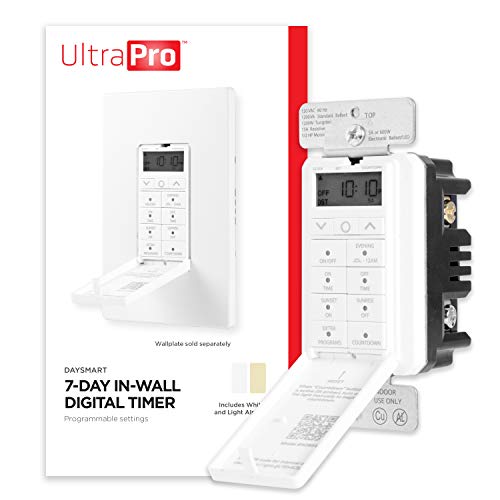
You’ll appreciate the UltraPro Daysmart 7-Day Digital In-Wall Timer provided you need precise control over your lighting schedules with minimal hassle. This timer offers daysmart technology that automatically adjusts for sunrise and sunset based on your region, ensuring your lights operate exactly whenever you want. It supports a 7-day cycle with multiple events and a countdown feature, all visible on a large LCD display. Compatible with LED, CFL, incandescent, and halogen bulbs, it replaces single-pole or three-way switches. With an override button and replaceable doors, it’s a versatile, user-friendly solution for indoor and seasonal lighting.
- Timer Type:Digital 7-day programmable timer with sunrise/sunset adjustment
- Voltage Rating:120 Volts AC
- Load Compatibility (Incandescent):Compatible with incandescent bulbs
- Installation Type:In-wall, single-pole or 3-way, wall mount
- Neutral Wire Requirement:Hardwired (neutral wire likely required for digital)
- Color/Faceplate Options:White with white and light almond doors included
- Additional Feature:Automatic sunrise/sunset adjust
- Additional Feature:Large LCD display
- Additional Feature:Replaceable programming door
UltraPro 24-Hour Mechanical In-Wall Timer Switch
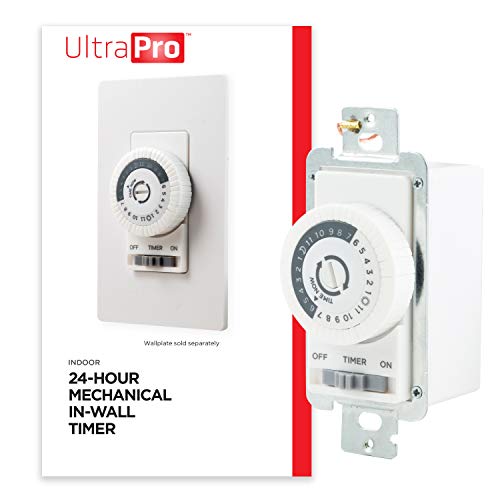
The UltraPro 24-Hour Mechanical In-Wall Timer Switch offers precise 30-minute interval control, making it ideal for anyone who wants reliable, daily automation of indoor lighting or fans. This white, dial-style switch replaces standard single-pole switches and requires a rocker-style wallplate (not included). It supports various bulbs, including LED, CFL, incandescent, and halogen, and handles up to 15 amps or 1250 watts. With a built-in override switch, you can easily interrupt the timer cycle whenever needed. Designed for indoor use, it requires a neutral wire for installation and works perfectly for lights, bathroom fans, or exhaust fans.
- Timer Type:Mechanical 24-hour dial timer with override switch
- Voltage Rating:125 VAC
- Load Compatibility (Incandescent):Controls incandescent bulbs
- Installation Type:In-wall, single-pole, replaces standard switch
- Neutral Wire Requirement:Neutral wire required
- Color/Faceplate Options:White; rocker-style wallplate required (not included)
- Additional Feature:24-hour dial control
- Additional Feature:30-minute interval settings
- Additional Feature:Built-in override switch
BN-LINK 60-Minute In-Wall Mechanical Timer Switch
In case you need a reliable timer switch that doesn’t require a neutral wire, the BN-LINK 60-Minute In-Wall Mechanical Timer Switch is an excellent choice. It features a spring-wound rotary knob allowing you to set any duration from 2 to 60 minutes easily. This heavy-duty switch handles up to 20 amps and works with incandescent, fluorescent, CFL, and LED lights, as well as exhaust fans and heaters. Installation is quick, fitting most single- or multi-gang plates, with interchangeable faceplates and knobs for a customized look. Its automatic shut-off saves energy and lowers your electricity bills efficiently.
- Timer Type:Mechanical spring-wound countdown timer
- Voltage Rating:125 VAC
- Load Compatibility (Incandescent):Compatible with incandescent lighting
- Installation Type:In-wall, single-pole, fits decorator/toggle plates
- Neutral Wire Requirement:No neutral required
- Color/Faceplate Options:White or metallic interchangeable faceplates included
- Additional Feature:Interchangeable faceplates/knobs
- Additional Feature:Quick installation, no neutral
- Additional Feature:ETL listed safety certified
Factors to Consider When Choosing Incandescent Timer Switches
While picking an incandescent timer switch, you’ll want to deliberate how long you need it to run and its load capacity to handle your bulbs safely. Make sure it fits your installation setup and works well with the type of bulbs you have. Also, decide whether a mechanical or digital timer suits your needs better.
Timer Duration Options
Selecting the right timer duration hinges on how you plan to use your incandescent timer switch. In case you need short cycles—say, 2 to 60 minutes—for bathroom fans or closet lights, mechanical spring-wound timers with continuous adjustment work well. For longer or recurring schedules, like outdoor or security lighting, electronic timers offering fixed presets or minute-by-minute precision and 24-hour/7-day programming are better suited. Decide whether you require a one-time countdown or repeatable daily/weekly operation; the former suits transient needs, while the latter manages recurring tasks efficiently. Also, match the maximum duration to safety and convenience—shorter max times prevent accidental long runs, while longer max settings reduce frequent resets. For motor-driven loads, make certain your timer supports appropriate run lengths to protect the motor from excessive cycling or continuous operation.
Load Capacity Ratings
Understanding timer duration options helps you determine how long your timer switch will run, but you also need to confirm the device can safely handle the electrical load. To begin, check that the timer’s incandescent wattage rating meets or exceeds the total wattage of your connected fixtures—most household timers support 1500–1800 W at 120 VAC. Match the ampere rating (usually 15 A or 20 A) to your circuit breaker and combined load; a 15 A timer handles up to 1800 W, while 20 A can support 2400 W. In case of controlling motorized loads like exhaust fans, verify the timer’s motor or horsepower rating, as motors draw higher starting current. Finally, when mixing load types, confirm separate ratings for incandescent and electronic loads to avoid overloads and always respect voltage-specific wattage limits.
Installation Requirements
Although choosing the right incandescent timer switch involves understanding load capacities, you also need to take into account specific installation requirements to guarantee safe and effective operation. Initially, verify whether your timer requires a neutral wire—mechanical models often don’t, but digital ones usually do. Check your switch box depth; older or crowded boxes may need slim timers for a proper fit. Confirm the timer’s voltage and current ratings match your circuit to prevent overloads. Identify whether your setup is single-pole or three-way, as three-way timers are essential for multi-switch control. Finally, make certain proper grounding, adhere to local codes, and always shut power at the breaker before installation. In case you’re uncertain, hire a licensed electrician to handle the job safely.
Compatibility With Bulbs
Upon selecting an incandescent timer switch, you’ll need to confirm that it’s compatible with the type and wattage of your bulbs. Check the switch’s rated lamp types and wattages to make certain it supports incandescent or tungsten loads explicitly. Verify the maximum current or wattage rating—like 15 A/1800 W or 20 A/2500 W—is equal to or higher than the combined wattage of all connected incandescent fixtures. Since incandescent bulbs are resistive loads, pick timers that list resistive or tungsten load compatibility rather than those designed only for electronic or LED bulbs. In the event of controlling multiple fixtures, add their wattages and compare this total to the timer’s motor and ballast limits to avoid overload. Also, check whether the timer requires a neutral or ground connection, as this varies between mechanical and electronic models.
Mechanical Versus Digital
Upon selecting between mechanical and digital incandescent timer switches, you’ll want to contemplate how each type handles timing and power requirements. Mechanical timers rely on simple spring-wound or dial mechanisms, offering straightforward countdowns up to about 60 minutes without needing a neutral wire or battery. They’re tough against electrical noise but limited to single-cycle timing. Digital timers, on the other hand, let you program detailed schedules—daily, weekly, or multiple on/off events—with precise minute-level control, LCD displays, and extra features like overrides. They usually require line power and sometimes a neutral wire or backup battery. Also, check each timer’s rated amperage and compatibility, especially for inductive loads like motors or fans, since mechanical and digital units differ in their electrical handling. Choose the one that fits your device’s specs and your timing needs.
Energy Efficiency Features
Upon choosing an incandescent timer switch, you should focus on features that directly impact energy efficiency. Mechanical spring-wound timers are great because they consume no standby power, running without electronics or a neutral connection. Digital or electronic timers, however, draw a small standby current to power displays, slightly increasing energy use. To save energy, pick a timer with countdown or preset intervals to limit how long your incandescent bulbs stay on—every minute saved cuts consumption. Also, match the timer’s contact ratings to your bulb’s wattage and amperage to avoid energy loss from overheating. Finally, choose timers that automatically shut off lights or fans to prevent them from running unnecessarily, which maximizes energy savings compared to manual switches left on for hours.
Safety Certifications
During the selection of an incandescent timer switch, you should prioritize safety certifications to guarantee reliable performance and protection. Look for UL, ETL, or CSA listings, which confirm the switch has been independently tested for fire, shock, and safety standards. Make sure the certification matches your intended voltage and application, such as 120–125 VAC for residential lighting. Check the timer’s rated current and load type—whether resistive, tungsten, motor, or LED ballast—to avoid overloading and voiding safety compliance. Also, verify compliance with wiring and insulation standards like short-circuit protection and grounding requirements to reduce fire and shock risks. Prefer switches that include certification details in their packaging or documentation, so you can confirm the model you buy matches the tested version.
