Choosing the right types of wood for furniture is crucial. You want furniture that lasts and looks good. Many consumers prioritize durable materials, viewing sturdy lumber as a smart investment. A 2023 report shows 68% of people value durability in their lumber choices. Style also matters; 58% find it influences their decisions. This hardwood and softwood guide helps you understand different lumber options. We define hardwood and softwood lumber for you. Knowing these lumber distinctions is key for durable and beautiful types of wood for furniture. Your lumber selection impacts the final piece. Sustainable lumber sourcing is also important to many.
Key Takeaways
Softwoods have more resins than hardwoods. They need extra steps before you stain them. Natural or light stains work best for softwoods like pine.
When choosing softwood, think about how you will use it. Consider if you need it for light use or if weight is important. Softwoods are good for rustic or simple looks.
Softwoods are often cheaper than hardwoods. They are easier to cut and shape. This makes them good for big projects or for people new to woodworking.
Pine is a popular softwood. It is cheap and easy to work with. Cedar smells nice and keeps bugs away. Fir is strong for building. Spruce is light and costs less.
Understanding Types of Lumber: Hardwood vs. Softwood
When you choose types of wood for furniture, you first need to understand the basic types of lumber. This hardwood and softwood guide helps you learn about these fundamental differences. You will see how these distinctions affect your furniture choices.
Defining Hardwood and Softwood
The terms “hardwood” and “softwood” do not always mean how hard the wood feels. Instead, they refer to the tree’s botanical classification. Hardwoods come from angiosperm trees. These are flowering plants. They produce seeds enclosed within a covering, like a fruit or a hard shell. Oak, maple, and cherry are examples of hardwood trees. Softwoods come from gymnosperm trees. These trees have “naked” seeds. They fall to the ground without a covering. Pine trees, for instance, are softwoods. They grow seeds in hard cones. The wind then releases these seeds when they are ready.
You can often tell the difference between these types of lumber by looking at the leaves. Hardwood trees typically have broad leaves. They often lose their leaves in the fall. Softwood trees usually have needle-like leaves. They stay green all year.
Key Characteristics and Properties
Hardwood and softwood lumber have different cellular structures. These structures give them unique properties.
Feature | Hardwood (Angiosperm) | Softwood (Gymnosperm) |
|---|---|---|
Seed Encasement | Seeds enclosed in ovary structures (fruit, shell) | ‘Naked’ seeds, not contained by fruit or nut |
Vascular Tubes | Have vascular tubes (pores) for water transport | Have linear tubes (tracheids) for nutrient transport |
Wood Grain | Pores create a distinct wood grain pattern | Tracheids do not form pores |
Density/Workability | Pores increase wood’s density and workability | Tracheids provide nutrients and pest protection |
Hardwoods have a complex cellular structure. You can see visible pores or vessels under a microscope. These pores transport water and nutrients. Softwoods have a simpler cellular structure. They move water through longitudinal tracheids and medullary rays. They do not have these visible pores.
Here are more details about their cell structures:
Softwoods (Coniferous trees):
Their primary vertical cells are tracheids. These cells are 2-4 mm long and about 30 μm wide. They provide both support and conduction. They have an open channel and a thin cell wall.
Storage cells, called parenchyma, are found radially.
Hardwoods (Broad-leaved trees):
Their primary vertical cells are fibers. These cells are 1-2 mm long and 15 μm wide. They provide support only. They have thick walls and a narrow central channel.
Vessels are present for conduction. They are 0.2-1.2 mm long. Stacked, open-ended cells form these vessels.
Hardwoods also contain a small number of tracheid cells and radial parenchyma cells for storage.
Generally, hardwoods are denser than softwoods. This density makes them stronger and more durable. However, some softwoods can be denser than some hardwoods. For example, balsa is a hardwood, but it is very light. You can see the density ranges for different types of lumber:
Wood Type | Species | Density Range (lb/ft³) |
|---|---|---|
Hardwood | Maple | ~43 |
Hardwood | Walnut | ~42 |
Hardwood | Mahogany | 31-53 |
Hardwood | Cherry | 43-56 |
Hardwood | Balsa | ~8 |
Softwood | Pine | 22-53 |
Softwood | Cedar | ~29 |
Softwood | Spruce | ~35 |
Softwood | Juniper | ~35 |
Hardwoods often have complex and varied grain patterns. These patterns can be curly or burled. Softwoods usually have straight or slightly wavy grain patterns. You can often do a simple “fingernail test” to identify softwood. If you can easily dent the wood with your fingernail, it is likely a softwood. These natural lumber types are different from engineered wood products. Engineered wood combines wood fibers with adhesives to create new materials.
Moisture content also differs between these types of lumber. Densely packed cells in hardwoods may hold less free water. For example, coastal Douglas fir, a softwood, has an average greenwood moisture content of 37 in heartwood and 115 in sapwood. Sweet gum, a hardwood, has a sapwood moisture content of 137 and a heartwood reading of 79. White ash, another hardwood, has almost identical green wood moisture content from heartwood to sapwood.
The Janka Hardness Scale
The Janka Hardness Scale measures the resistance of wood to denting and wear. This scale is very important when you choose types of wood for furniture. A higher Janka rating means the wood is harder and more durable.
Here is how they determine the Janka rating:
The Janka test uses a steel ball, 11.28 millimeters (0.444 inches) in diameter.
They press this ball into the wood until half of its diameter sinks into the wood.
The force needed to do this is the Janka hardness rating. They measure it in pounds-force (lbf).
The test is usually done on wood from the tree trunk, called heartwood.
The standard sample has a 12% moisture content. It must be free of knots.
Many factors affect the Janka rating. These include density, moisture content, growth patterns, and the direction of the wood grain. Slow growth and tight grain usually result in higher density and higher ratings.
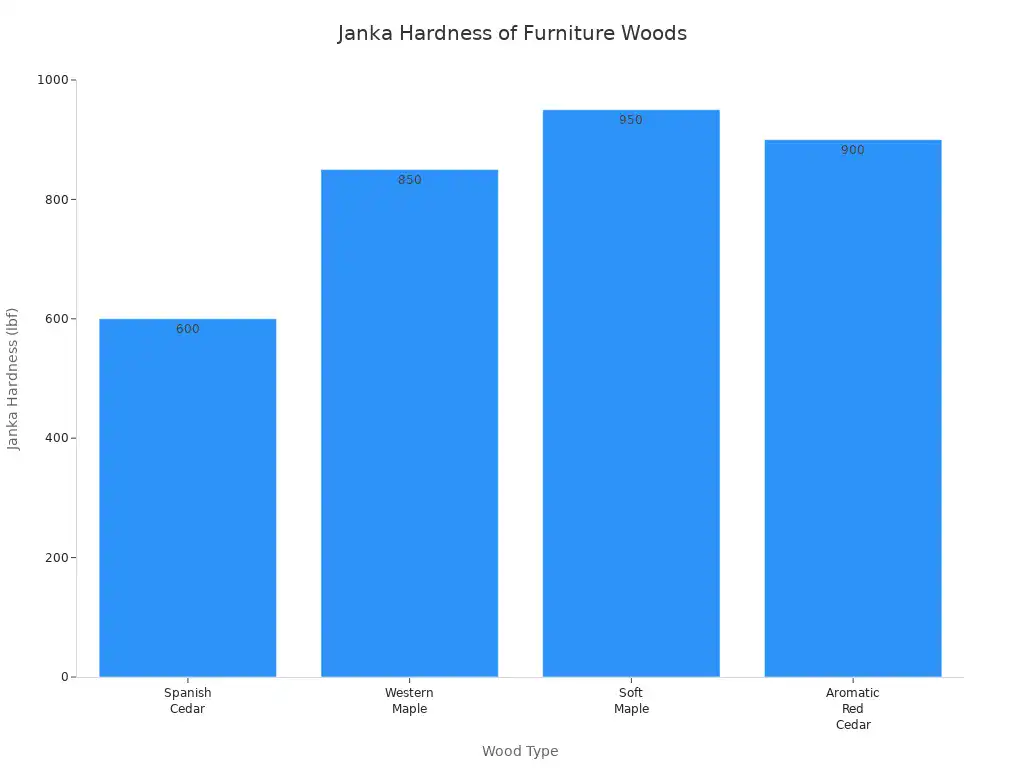
You can see the Janka hardness ratings for some common types of lumber:
Wood Type | Janka Hardness (lbf) |
|---|---|
White Oak | 1,350 |
Soft Maple | 950 |
Aromatic Red Cedar | 900 |
Western Maple | 850 |
Spanish Cedar | 600 |
Understanding these types of lumber helps you make informed decisions. You can select the best wood for your furniture needs. This hardwood and softwood guide gives you the knowledge to choose wisely.
Exploring Hardwood Types for Furniture

You choose hardwood for furniture when you want strength and lasting beauty. Hardwood comes from deciduous trees, which grow slowly. This slow growth creates a dense, complex cellular structure. This structure makes hardwood stronger and more durable than softwood. Hardwood is ideal for furniture that sees frequent use. Think about dining tables, dressers, and bed frames. The rich and unique grain patterns of hardwood species like oak and mahogany add a luxurious touch. They bring natural beauty to your furniture. Hardwood furniture is a long-term investment. It lasts a long time and often develops a desirable patina as it ages. Hardwood lumber is prized for its natural beauty. It features unique grain patterns, rich colors, and timeless elegance. These qualities elevate any project. Its versatility allows for seamless adaptation to various design styles. You can use it in furniture, flooring, and cabinetry. It enables intricate detailing and diverse design possibilities. Hardwood is renowned for its durability and longevity. Hardwood species like oak, maple, and cherry naturally resist wear and tear. They maintain structural integrity and aesthetics over time. You will find hardwoods frequently used for cabinetry and decorative woodwork.
Oak: Strength and Classic Appeal
Oak is a classic choice for types of wood for furniture. It offers exceptional strength and a timeless look. Oak lumber is very durable. It resists dents and scratches well. This makes it perfect for high-traffic areas in your home. Oak has a prominent grain. People often describe it as straight, open, or coarse. A distinctive feature is “ray fleck.” This refers to rays running perpendicular to the grain lines. These rays add depth and character to the wood. A prized color variation in oak lumber is “tiger stripe.” This shows darker streaks. A fungal infection in the living tree causes this effect. Oak lumber is a popular choice for solid wood furniture because of its durability and classic appearance.
Maple: Durability and Versatility
Maple is another excellent hardwood choice. It offers great durability and versatility. Maple lumber is very hard and dense. It resists impacts and wear. This makes it a top choice for kitchen cabinets, flooring, and heavy-use furniture. Both hard and soft maple are utilized. Hard maple is favored for its durability and resistance to wear. Soft maple can be stained to mimic other hardwood species. This offers aesthetic versatility. Maple lumber is also used for specialty items. These include musical instruments, baseball bats, and pool cues. This highlights its suitability for finely crafted and high-impact products. Hard maple’s density and durability also make it an ideal choice for cutting boards.
Cherry: Richness and Elegance
Cherry wood brings richness and elegance to any piece of furniture. Cherry lumber has a fine, straight grain and a smooth texture. It is known for its beautiful reddish-brown color. This color deepens over time. Natural cherry wood darkens due to oxidation when exposed to UV light. Initially, the wood has a light, pinkish tone. Over time, it transforms into a medium red tone. Approximately 80% of this darkening occurs within the first year. In sunny locations, significant darkening can happen within the first three months. Stains or heavy finishes can reduce or hide this darkening. Darker stains make it less noticeable. To accelerate darkening, expose the wood to ample sunlight and harsh lighting. Full oxidation can occur within three months. For dining tables with extension leaves, keep the table fully extended with all leaves attached for the first year. This ensures even darkening. If leaves are lighter than the table, detach them and expose them to sunlight. This evens out the color within 1-3 months. The room’s light exposure can lead to uneven color changes. For instance, if one side receives more light, using shades can help balance the darkening. Placing a rug on a cherry wood floor will likely result in uneven color changes due to blocked light.
Walnut: Luxury and Deep Tones
Walnut is a luxurious hardwood. It offers deep, rich tones and intricate grain patterns. Walnut lumber is known for its deep, rich color. This color ranges from creamy white to dark chocolate or purplish-brown. It often has striking contrasts. Its straight grain and occasional wavy or curly patterns enhance its natural beauty. Walnut’s natural hues and intricate grain patterns add warmth and sophistication. As a hardwood, walnut is resistant to wear and tear. This makes it a lasting choice for furniture. Walnut lumber is easily cut, shaped, and finished. This allows for intricate designs and smooth surfaces. This is ideal for custom furniture. The natural beauty of walnut makes each piece of furniture a work of art. It also ages gracefully, developing a patina over time. Walnut is versatile. You can use it in various furniture styles, from traditional to contemporary. You can finish it in different shades to match diverse interior designs. Custom walnut furniture is an investment. You can pass it down through generations due to its durability and timeless beauty.
Mahogany: Timeless Beauty
Mahogany is a hardwood that embodies timeless beauty. It has a fine, even grain and a reddish-brown color. This color deepens with age. Mahogany shaped centuries of interior design. It became a prized material among European artisans by the 18th century. Its rich hue, strength, and fine grain allowed for exquisite carving and elegant polish. During the Georgian era (1714–1830), artisans like Thomas Chippendale used mahogany for refined, symmetrical designs. These featured graceful curves and cabriole legs. In the Victorian period, mahogany adapted to a more robust and ornamental style. People used it for massive dining tables and elaborately carved bookcases. This reflected the grandeur of the era. Its resistance to warping and insect damage ensures that well-maintained antique mahogany furniture can last for centuries. This makes it a symbol of status, wealth, and enduring craftsmanship. Mahogany’s strength and density were highly valued by British cabinetmakers. It was less prone to warping, extending furniture lifespan. This allowed for thinner, more filigreed designs in furniture legs and rails. This directly led to the birth of the Chippendale furniture style. Its aesthetic properties, discovered in the 1730s, made it a high-status luxury commodity. It became a household staple in Europe. Families often judged others by their possession of fine mahogany pieces. Mahogany’s widespread popularity in furniture construction soared during the 17th and 18th centuries. It became the wood of choice for elegant pieces during the Georgian and Federal design periods. It was highly valued for its rich color, ability to hold intricate details, exceptional durability, strength, and workability. These qualities allowed craftsmen to create finely crafted furniture. Historically, mahogany furniture was a status symbol. It was associated with wealth, luxury, and prestige. It adorned the homes of nobility and wealthy merchants.
Ash: Flexibility and Modern Look
Ash is a hardwood known for its flexibility and modern aesthetic. Ash lumber is strong and durable. It has excellent shock resistance. This makes it a good choice for furniture that needs to withstand impact. Ash has a light color, often creamy white to light brown. Its grain pattern is similar to oak but generally straighter and more subtle. This gives it a clean, contemporary look. You often see ash lumber in modern furniture designs. It is also popular for sports equipment like baseball bats and tool handles. Its flexibility allows for steam bending. This creates unique curved furniture pieces. Ash is a versatile hardwood species that offers both strength and a fresh appearance. It provides a great alternative to more traditional types of wood for furniture. You can stain ash to mimic other woods, or you can leave it natural for a bright, airy feel. This natural lumber is a great choice for many projects. It stands apart from engineered wood options.
Exploring Softwood Types for Furniture
<<>>
Exploring Softwood Types for Furniture
You explore softwood for furniture when you need different properties than hardwood. Softwoods contain more resins than hardwoods. This means they require additional preparation before you stain them. Natural, clear, or light stain finishes are well-suited for softwood species such as pine. When you select softwood species for your furniture projects, you consider several factors.
Intended Use: You think about durability needs. Softwoods can work for less intensive uses like interior decorations. You also consider weight. Softwoods offer a lighter option for projects where weight is a concern.
Aesthetic Appeal: You look at grain and color preferences. Softwoods have unique textures. They suit rustic or minimalist aesthetics. You also consider finish compatibility. Think about how well the softwood will take the required finish or stain.
Budget Constraints: Softwoods are often less expensive. This makes them a smart choice for large projects or when budget is a primary concern.
Working Properties: Softwoods are generally easier to work with. This is especially true for beginners or intricate carving. Softwoods are also less tough on your tools compared to hardwoods.
Environmental Considerations: You look for FSC-certified softwoods for sustainability. Using locally sourced softwoods reduces transportation impacts and supports local economies.
You also consider durability, appearance, workability, sustainability, cost, and availability. Durability is essential for projects exposed to elements or heavy use. You consider resistance to decay, insects, and hardness (Janka scale). Each species offers unique colors, grain patterns, and textures. These influence the project’s aesthetic and how it ages. Workability refers to how easy it is to cut, shape, and finish the wood. This impacts project timelines and budget. Sustainability is important for eco-conscious choices. You look for certifications like FSC. Cost varies widely. Common softwoods are generally more economical. Local species are often more accessible and less expensive than imported lumber.
Pine: Affordability and Rustic Charm
Pine is a popular choice for types of wood for furniture. It offers affordability and rustic charm. Pine lumber is generally easy to work with. It takes finishes well. You often see pine in country-style or farmhouse furniture. It brings a warm, inviting feel to your home. Many different types of pine exist. Each has unique characteristics.
Pine Type | Scientific Name | Key Characteristics | Common Uses |
|---|---|---|---|
Eastern White Pine | Pinus strobus | Soft, fine, straight grain, light color, easy to work with, low resin content, good dimensional stability. | Furniture, interior trim, paneling, carving, construction, boat building, musical instruments. |
Western White Pine | Pinus monticola | Soft, fine, straight grain, light color, easy to work with, low resin content, good dimensional stability, slightly harder than Eastern White Pine. | Furniture, interior trim, paneling, carving, construction, matches, crates, boxes. |
Sugar Pine | Pinus lambertiana | Soft, straight grain, light color, easy to work with, low resin content, good dimensional stability, largest of the pines. | Pattern making, piano keys, organ pipes, sash, doors, general construction. |
Ponderosa Pine | Pinus ponderosa | Moderately soft, straight grain, yellowish-white sapwood, reddish-brown heartwood, distinct growth rings, good workability. | Millwork, sash, doors, paneling, furniture, construction lumber, boxes, crates. |
Southern Yellow Pine | Pinus taeda, Pinus palustris, Pinus echinata, Pinus elliottii | Hard, dense, strong, high resin content, distinct grain patterns, good for structural applications. | Construction lumber, flooring, plywood, poles, pilings, railroad ties, pulpwood. |
Scots Pine | Pinus sylvestris | Moderately hard, straight grain, yellowish-white sapwood, reddish-brown heartwood, durable, good workability. | Furniture, flooring, joinery, construction, pulpwood, Christmas trees. |
You find pine lumber in many forms. It is a versatile softwood.
Cedar: Aromatic and Resistant
Cedar is a distinctive softwood. It is known for its aromatic properties and natural resistance. Cedar lumber has a pleasant scent. This scent comes from natural compounds within the wood. The aromatic properties and pest resistance of Eastern Red Cedar come from phenolic compounds and acids. These compounds act as natural pesticides. Toxic phenols absorb through a pest’s respiratory tract. They damage the pest’s liver. The released acids cause damage to the pest’s lungs and trachea.
Cedar’s resistance to rot and decay comes from thujaplicins and other extractives. You find these in its heartwood. These natural compounds act as powerful fungicides and antimicrobials. Thujaplicins interfere with the growth of fungi. They prevent fungi from breaking down wood fibers. Cedar heartwood contains natural oils rich in sesquiterpenes. These include thujone and other essential oils. They form its built-in defense against pests. The volatile oils produce a potent aroma. This aroma is pleasant to humans. It is overwhelming and disorienting to many insects. It masks their pheromones and body odors. Direct contact with cedar oils can disrupt the respiratory and nervous systems of smaller insects. It proves toxic to moths, carpet beetles, and termites. Insects instinctively avoid areas with high concentrations of cedar oils. This is due to their repellent effect.
You commonly use cedar outdoors and in saunas. It offers excellent weather and mold resistance. Cedar is typically medium to somewhat low in price. It is a great choice for outdoor solid wood furniture or storage chests.
Fir: Structural Strength
Fir is a softwood prized for its structural strength. You often use fir lumber in construction. It also finds its way into furniture where stability is key. Fir has a straight, uniform grain. This makes it strong and reliable. Architectural Fir is a favorite among furniture makers. It is easy to work with. It resists wear and finishes nicely. This makes it ideal for furniture where both appearance and structural integrity are paramount. You might find fir in the internal frames of upholstered furniture. You also see it in sturdy shelving units. It provides a strong foundation.
Spruce: Lightness and Cost-Effectiveness
Spruce is a popular softwood. It is known for its lightness and cost-effectiveness. Spruce lumber is affordable and readily available. It has a better weight-strength ratio compared to pine lumber. However, it is a less durable wood species. This makes it more suitable for indoor use. It is susceptible to insects and fungi. This could affect its long-term cost and suitability for certain furniture applications.
Spruce wood is a popular and versatile softwood. It offers a great balance of strength and affordability. Spruce wood is generally cheap and affordable. This is especially true when you compare it to many hardwoods. Its fast growth rate and wide availability help keep costs low. This makes it a popular, cost-effective choice for furniture making. The wood is lightweight yet strong for its weight. This makes it ideal for both beginners and professionals. However, as a softwood, spruce is prone to dents, scratches, and surface damage. This can impact its long-term durability for furniture.
Advantages (Weight & Cost):
Lightweight: It is easy to handle and maneuver.
Affordable: It is budget-friendly for beginners.
Disadvantages (Weight & Cost):
Less Structural Strength: It is not ideal for heavy-duty structural applications.
Moderate Durability: It is not as tough as hardwoods.
You might choose spruce for projects where weight is a concern. You also choose it when budget is a priority. It works well for interior types of wood for furniture that do not experience heavy wear. You can use it for shelving or decorative pieces. This natural lumber offers a good alternative to more expensive engineered options. <<>>
Choosing the Right Wood for Your Furniture
You need to make smart choices when selecting wood for your furniture. Consider many factors beyond just how it looks. Selecting the optimal wood type for a furniture piece involves balancing style, durability, and value. Each wood type possesses unique characteristics. These include distinct grain patterns, color variations, strength, and workability. You should consider all of these for your project.
Durability and Longevity
You want furniture that lasts. Wood’s durability comes from its natural makeup. Cellulose fibers bound by lignin create a strong framework. This framework resists stress and bears weight. Hardwoods are generally denser and stronger. They come from angiosperm trees. Their condensed structure and slower growth lead to higher strength. Maple wood is known for its hardness. You prefer it for heavy-use items like dressers. White oak is also very durable. It resists warping, making it great for cabinetry.
Wood Type | Characteristics Contributing to Durability |
|---|---|
Hardwoods (General) | Denser and stronger, derived from angiosperm trees (usually deciduous). Their condensed structure and slower growth lead to higher strength and durability. |
Maple Wood | Known for hardness, preferred for heavy-use items like dressers and kitchen cabinets due to its inherent strength and condensed structure. |
White Oak | Noted for heft, durability, and resistance to warping, making it excellent for cabinetry and kitchen furniture. |
Proper processing methods also help. Kiln-drying removes moisture. This prevents warping. Good finishes protect the lumber from scratches and water. The quality of the lumber itself matters. High-quality, handcrafted wood is crucial for long-lasting solid wood furniture.
Aesthetics and Style
The look of your furniture depends on the wood’s grain and color. Fine-grained woods like maple have small pores. They appear uniform and subtle. These suit sleek interiors. Light-colored lumber with straight grain, like ash, brightens modern rooms. Darker lumber with richer grain, such as walnut, adds warmth. It suits traditional styles.
Ash: Has a bold grain with arches. Its light color suits contemporary designs.
Oak: Known for its prominent, often straight grain with ray fleck. This adds depth.
Mahogany: Prized for its reddish-brown color and ribbon-like grain. It gives elegance.
Walnut: Celebrated for its dark color and varied grain. It often shows unique swirling patterns.
Budget Considerations
Your budget plays a big role in choosing lumber. Prices vary greatly among different types of wood for furniture. Hardwoods are often more expensive than softwoods. For example, walnut lumber can cost around $10.75 per board foot. Eastern white pine lumber might be $2.50 per board foot. You can see the price differences in this chart:

You can find many options to fit your financial plan.
Intended Use and Environment
Think about where your furniture will go and how you will use it. Humidity greatly impacts wood. Wood absorbs or releases moisture. This causes shrinking, expanding, or warping. Temperature also affects humidity. Different types of lumber react differently. American beech and teak tolerate moisture well. Magnolia can withstand cold. You need to choose the best types of wood for furniture based on these conditions. Consider durability, sustainability, and your personal preference.
Wood Type: Consider hardwoods like oak for durability, or softwoods like pine for a rustic look.
Functionality: Choose furniture that suits your lifestyle.
Maintenance and Care: Some woods need regular oiling. Others resist stains better.
You now understand the key differences between hardwood and softwood lumber. This hardwood and softwood guide showed you their implications for furniture. Hardwoods offer durability and elegance; softwoods provide affordability and rustic charm. You make better choices for your projects. Consider durability, aesthetics, and budget when selecting lumber. This guide helps you confidently choose the best lumber for your next furniture piece or purchase.
FAQ
What is the main difference between hardwood and softwood lumber?
Hardwood lumber comes from flowering trees. Softwood lumber comes from conifers. Hardwood lumber is generally denser. Softwood lumber is often lighter. You choose different types of lumber for projects.
What makes hardwood lumber durable for furniture?
Hardwood lumber has a complex cellular structure. This makes the lumber strong. Hardwood lumber grows slowly. This creates dense lumber. You get durable furniture from this lumber.
What is the Janka hardness scale?
The Janka scale measures wood hardness. It shows how much force wood resists. A higher number means harder wood. You use this scale to pick strong wood.
What are common uses for softwood in furniture?
Softwood is good for rustic furniture. You use it for items like pine tables. Cedar works for outdoor pieces. Spruce is light and affordable. This wood suits many projects.