


Building your own work supports with these diy sawhorse plans offers significant advantages. You will save money, customize them perfectly, and ensure lasting durability. This post provides free, reliable sawhorse plans. These robust designs create a heavy-duty sawhorse suitable for many projects. You will gain immense satisfaction creating your own essential workshop tools.
Key Takeaways
Building your own sawhorses saves money. You can customize them for your needs. They will be strong and last a long time.
Choose good materials like 2x4s or 2x6s. Always use safety glasses and ear protection when you build. Keep your work area clean.
You can build different types of sawhorses. An A-frame design is very stable. A folding design saves space. A plywood box design makes a strong workbench.
You can make your sawhorses better. Add a top for a workbench. Add ways to hold wood in place. Protect them with paint or stain so they last longer.
Why Build DIY Sawhorses

Cost Savings
You save money when you build your own sawhorses. Material costs for a pair of sturdy sawhorses can be as low as $50. Many budget-friendly diy sawhorse plans, even for a pair, cost under $100 for materials. This makes building your own a smart financial choice. You avoid the higher prices of pre-made options.
Customization Options
Building your own sawhorses allows for perfect customization. You can adjust the height to match your own height or existing tables. For example, you can make them 34-36 inches high for a 6-foot person. You can also make them wider for larger projects. Consider adding features like 1/2-inch PVC pipe to support materials. You can even design them to be collapsible for easy storage. This saves valuable floor space in your workshop.
Durability and Strength
DIY sawhorses offer superior durability and strength. You choose the materials, ensuring they meet your heavy-duty needs. You can construct a truly heavy-duty sawhorse that withstands tough use. Adding radiused corners to notches prevents wood splitting. This increases the weight-bearing capacity significantly. Your custom-built supports will last for many years.
Project Versatility
Your custom sawhorses will support a wide range of projects. They are essential for construction industry projects and carpentry work. You will use them for woodworking and home renovation tasks. They are also perfect for unique endeavors like a speakeasy bar project or a DIY Basement Speakeasy Bar Arcade guide. These versatile stands become a core part of your workspace.
Before You Build
Material Selection
You need to choose the right materials for your sawhorses. Select sturdy lumber like 2x4s or 2x6s for the frame. Plywood is excellent for tops or gussets. Consider pressure-treated wood if your sawhorses will be outdoors or support very heavy loads, like a truck camper. Use strong fasteners, such as deck screws or carriage bolts, to ensure a secure build. Good material choices make a durable heavy-duty sawhorse.
Tools Needed
Gather your tools before you start building. You will need both hand tools and power tools.
Hand Tools:
Framing square
Hammer
Hearing protection
Safety glasses
Power Tools:
Air compressor
Air hose
Circular saw
Cordless drill
Miter saw These tools help you cut accurately and assemble your sawhorses efficiently.
Safety First
Always prioritize safety when building and using your sawhorses. Wear safety glasses to protect your eyes from flying debris. Use hearing protection when operating power tools. Keep your work area clean and free of clutter to prevent trips and falls. Secure your workpiece properly on the sawhorses before cutting or working on it. Follow all tool instructions carefully.
Free Sawhorse Plans
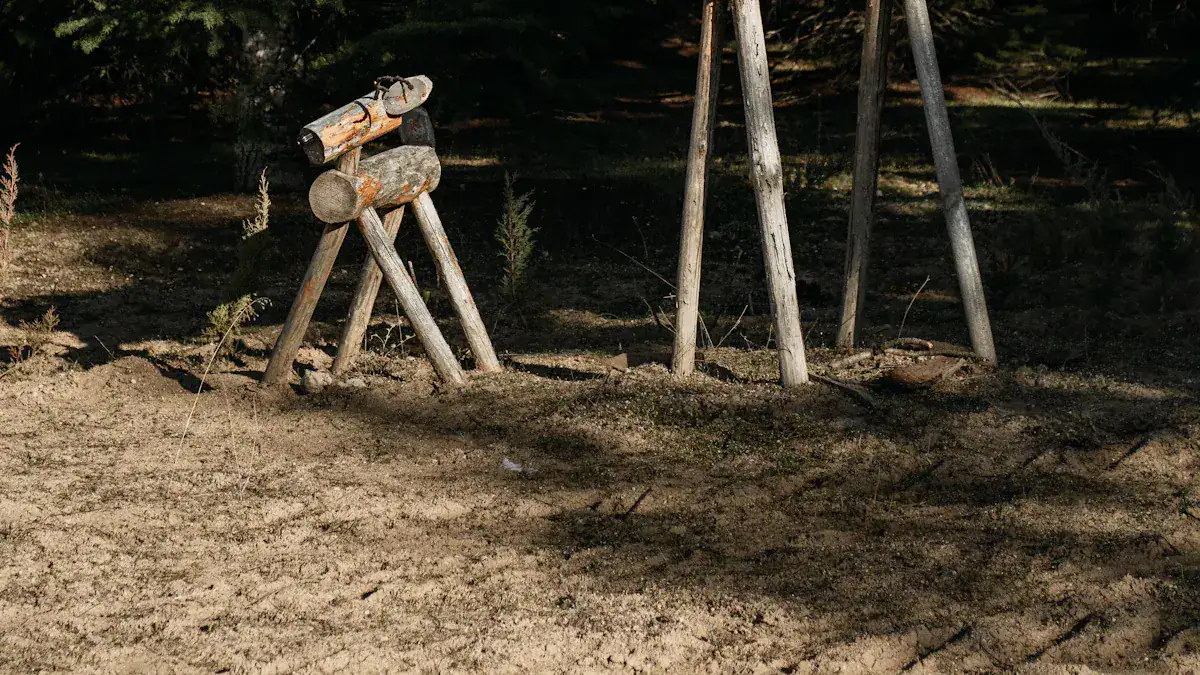
You can find many excellent free sawhorse plans online. These plans guide you through building sturdy work supports. Each sawhorse design offers unique benefits. You can choose the best option for your specific needs. Many plans include illustrations and free pdf download options.
Classic A-Frame Heavy-Duty Design
A classic A-frame sawhorse provides exceptional stability. This heavy-duty sawhorse design is a workshop staple. You can build a very strong sawhorse using common lumber. This design is perfect for supporting heavy loads.
Here are the materials you will need for one sawhorse:
One 8-foot 2×6 board
Two 8-foot 1×6 boards
2-inch screws
1-5/8-inch screws
Follow these steps to build your A-frame sawhorse:
Cut the top board to your desired length. Then, taper its edges using a table saw or circular saw.
Set your circular saw to a 13-degree bevel. Cut the legs to their required length at this angle. Mark each piece as you cut it. You can cut the legs close to their final size first. This helps you visualize the cut direction and bevel orientation.
Reset your circular saw to 90 degrees. Taper the legs. Mark the taper line 3-1/2 inches from the bottom of the leg up to the bottom of where the gusset will be.
Lay the top board upside down on a flat surface. Secure each leg with three 2-inch screws.
Trim the top and bottom edges of the gusset boards. Use parallel 13-degree angles. Create one gusset. Use it as a template to mark the other three.
Stand the sawhorse upright. Place a heavy object on it. This ensures all legs are flat. Attach the gussets using four 1-5/8-inch screws each.
This robust sawhorse design will serve you well for many projects. You can often find these diy sawhorse plans with a free pdf download.
Folding Sawhorse Design
A folding sawhorse design offers great portability and space-saving benefits. These are easy to build sawhorses. They are ideal for job sites or small workshops. You can quickly set up a full workstation on site. This sawhorse design is compact, lightweight, and portable. The legs fold up to a nice, compact size. This offers a small-to-large ratio. This makes them a multipurpose support system. You will appreciate the convenience of these knockdown sawhorse plans.
Here are the materials you will need for a pair of folding sawhorses:
4 – 2″ x 4″ x 8′ Boards (for frames)
1 – 2″ x 4″ x 8′ or 2″x 6″ x 8′ Board (for tops)
4 – 4″ Strap Hinges
1-1/4″ and 3″ Decking Screws
2″ Cabinet / Washer Head Screws
You can also build a collapsible sawhorse with a built-in shelf.
Cut the top 2×6 to length.
Cut both sides of each leg at a 15-degree angle. Ensure the angles are parallel.
Fasten hinges to the ends of two legs. Attach them to the top piece.
Attach the other two legs with 3-inch screws.
Cut the 2×4 that supports one side of the shelf. Mark a line 8 inches up from the bottom of the leg. Align the bottom of the 2×4 with this line. Attach it with two 3-inch screws on each side.
Cut the shelf to size. Notch the two corners.
Fasten hinges to the shelf. Use two 11-1/8-inch blocks to temporarily hold the shelf. Fasten the hinged side to the legs.
Cut a 23-3/4-inch x 1-1/2-inch strip of plywood. Overlap the 2×4 shelf brace. Attach it with wood glue and 1-1/4 inch screws.
Fasten the hinged side of the shelf to the legs.
These sawhorse plans provide excellent versatility. Look for a free pdf download to get started.
Plywood Box Sawhorse Build
A plywood box sawhorse offers incredible strength and a solid work surface. This heavy-duty sawhorse is often used as a temporary workbench. You can build a very robust structure.
For material selection, 1/2 inch plywood can work. However, 3/4 inch or 5/8 inch plywood offers additional strength and stability. This extra cost is often justified. If you use 1/2 inch plywood, ensure it is 5-ply, not 3-ply. This provides better strength, less warping, and smoother drilling. For 24-inch spans, 5/8 inch plywood is better. Thinner plywood can work for wider spans if you place appropriate supports underneath.
You can add internal bracing for extra stiffness.
Attach ankle brackets to the inside of the legs. Use #6 wood screws. You will need eight screws per bracket, on both the inside and outside of each leg.
Toe-nail screwing the leg into the foot adds extra strength.
Use 3-inch drywall screws to connect legs and stretchers. Use two screws per leg and three along the stretcher’s length.
Glue 21-inch long plywood strips to the underside of the work surface. These strips should be the same width as the tabletop. This creates internal bracing.
This heavy-duty sawhorse design provides a very stable platform. You can find many diy sawhorse plans for this type of build.
Enhancing Your Sawhorses
You can improve your DIY sawhorses. Add features to make them more useful. You can also protect them for longer life. These enhancements make your work easier.
Adding Functional Tops
You can add functional tops to your sawhorses. A sturdy plywood top creates a heavy-duty sawhorse workbench. You can cut plywood to a manageable size. This makes lifting easier. Plywood offers a steady surface and avoids sag. Rigid foam, like 2-inch thick Foamular, is another option. It is lighter than plywood. You can use it for light woodworking and crafts. It also works as a cutting surface. Sawhorse plans often include an easily replaceable sacrificial top. This protects your main sawhorse top.
Integrating Workholding Features
You can add workholding features to your sawhorses. Clamp two heavy, wide-faced sawhorses together. This holds boards on their side for jointing edges. Ensure the tops are at least 6 inches wide. They should touch if you position the legs correctly. You can also add round, cylindrical holes for 1-inch holdfasts. These provide solid workholding. Consider a Veritas inset vise with bench dogs. A twin-screw vise holds wide or long pieces. It is useful for hand-cutting dovetails. A leg vise offers a deeper throat and more clamping pressure. Tail vises and strategically placed dog holes secure flat panels.
Protecting Your Investment
Protect your sawhorses to make them last. LifeTime Wood Treatment is a non-toxic stain. It works for all outdoor wood. This treatment never needs recoating. It helps wood last twice as long. It also develops a silver to dark brown patina. You can apply it with a brush, roller, or garden sprayer. For outdoor sawhorses, apply a fresh coat of paint or stain annually. This protects the wood from weathering. Pressure-treated wood is excellent for outdoor use. It resists rot and insects. This extends the lifespan significantly. Apply a weatherproof sealant or stain. This protects them from elements. Assemble the frame with tight, secure joints. Pre-drill pilot holes to prevent splitting. Add metal brackets for extra stability.
Building your own heavy-duty sawhorses provides clear advantages. They are durable, customizable, and cost-effective. You save money and get exactly what you need for your projects. Choose from the many free diy sawhorse plans available. Start your building project today. You will feel great satisfaction creating your own essential workshop tools. These sawhorse plans empower you to build strong supports.
FAQ
What materials should you use for heavy-duty sawhorses?
You should use sturdy lumber like 2x4s or 2x6s for the frame. Plywood works well for tops or gussets. Consider pressure-treated wood for outdoor use or very heavy loads. Use strong fasteners like deck screws or carriage bolts.
What is the ideal height for a sawhorse?
The ideal height for a sawhorse depends on your height. You can customize it. Many people find 34-36 inches comfortable. This height works well for a 6-foot person. Adjust it to match your own working posture.
What are the benefits of a folding sawhorse design?
A folding sawhorse design offers great portability. You can easily store them in small spaces. They are perfect for job sites. You can quickly set up a workstation. This design saves valuable workshop space.
What safety precautions should you take when building sawhorses?
You must always wear safety glasses. Protect your eyes from debris. Use hearing protection with power tools. Keep your work area clean. This prevents trips and falls. Secure your workpiece before working on it.