
After a decking project, you often have leftover composite decking. Do not let these scraps go to waste. You can transform them into a functional and stylish diy outdoor table. Composite materials offer great durability. They require little maintenance. Your new table will also look good. This guide will show you how to plan your design. You will learn to gather materials. You will also build your own composite outdoor table.
Why Composite for Your DIY Outdoor Table
Choosing composite material for your outdoor table offers many benefits. It stands out from traditional wood. You get a table that looks great and lasts a long time.
Durability and Longevity
Composite decking is very strong. It resists many outdoor problems. You will not see it rot, decay, or get damaged by insects. It also stands up well to warping, cracking, and splintering. This means your table stays sturdy for years. Composite decking generally lasts 25 to 30 years. Some premium brands even offer warranties up to 50 years. This long lifespan makes your diy outdoor table a lasting addition to your yard.
Minimal Maintenance
You will save a lot of time and effort with composite. It needs very little care. You do not need to stain, paint, or seal it regularly. This saves you money too. Composite resists fading, staining, and mold. It also handles direct sunlight and water damage well. You just need to clean it sometimes. This makes composite furniture much easier to own than wood.
Aesthetic Versatility
Composite materials offer many design choices. They can look just like natural wood. Manufacturers use special techniques to copy wood grains and textures. You can find many colors and styles.
Earthy Browns: These include deep walnut or weathered teak. They give a warm, organic look.
Cool Grays: Options like ash gray or charcoal offer a modern feel.
Natural Wood-Look Shades: These mimic oak or sandy beige. They blend well with outdoor settings.
Multi-Tonal Decking: Some boards blend several shades. This adds depth and hides minor wear.
You can easily find a composite style that matches your outdoor space.
Planning Your DIY Outdoor Table Design

You need to think carefully about your table design. This ensures your new table fits your needs and space.
Table Size and Shape
First, consider how you will use your table. Think about how many people will sit at it. Also, consider the space you have available.
For four people:
A 48-inch round table top works well.
Square tables are also excellent. They typically measure between 36-48 inches on each side. These sizes are great space-savers for smaller yards or patios.
Table Height Options:
Dining height is about 30⅜ inches.
Counter height is around 35½ inches.
Bar height is about 38⅞ inches.
Choose a size and height that best suits your outdoor area and how you plan to use your new diy outdoor table.
Leg Options and Support
Your table needs strong, stable legs. You have several choices for materials.
Composite Legs: You can use more composite decking for the legs. This creates a uniform look. It also offers the same durability as your tabletop.
Wood Legs: Cedar or pressure-treated 2x6s are good options. Make sure you treat them for outdoor use to prevent rot.
Metal Legs: These provide a modern aesthetic. They are also very strong and durable.
No matter your choice, ensure the legs provide solid support. You can add cross-bracing between the legs. This significantly increases stability. A sturdy frame under the tabletop also prevents sagging.
Safety Considerations
Building your table involves power tools. You must prioritize safety. The U.S. Consumer Product Safety Commission (CPSC) reported over 418,000 emergency room visits in one year linked to power tools and workshop equipment. This highlights the common occurrence of injuries.
Personal Protective Equipment (PPE):
Always wear eye protection.
Use hearing protection.
Wear a dust mask. This is especially important in small areas or when making many cuts.
Clothing and Hair:
Avoid loose-fitting clothing.
Tie up long hair. These can get caught in moving parts of saws or drills.
Cutting Safely:
Cut slowly. This prevents rough cuts. It also stops the blade from binding or kicking back.
Use sharp blades. Dull blades increase the risk of binding and kickback.
Allow the saw blade to stop completely after a cut. This is crucial for small pieces. It prevents them from flying off.
Support your material adequately. Use sawhorses or stands for long boards. This prevents them from falling or shifting. Ensure your work surface is stable and level.
Tool-Specific Hazards:
Cutting tools (like circular saws): They can cause cuts and lacerations. They can also send flying debris into the air.
Drilling and fastening tools: These can cause puncture wounds. They can also cause injuries from flying debris. The torque can lead to sudden twisting. This can injure your wrist or shoulder.
Grinding and sanding tools: They produce flying particles and dust. These are harmful to your eyes and lungs. High-speed rotation can cause kickback injuries.
Pneumatic tools (like nail guns): They can cause puncture wounds. They also use high-pressure air, which can cause injuries.
Be aware of health hazards too. Prolonged exposure to loud noise can cause hearing loss. Vibrating tools can cause nerve damage. Dust and fumes can damage your lungs. Always work in a well-ventilated area.
Tools and Materials Needed
You need the right tools and materials to build your outdoor table. Gathering everything beforehand makes the process smoother.
Composite Decking Pieces
You already have spare composite decking from your previous project. These pieces are perfect for your table. They will form the tabletop. You can also use them for the legs.
Fasteners and Adhesives
You need strong fasteners and good adhesives. These will hold your table together.
For fasteners, use screws designed for composite.
Edge Deck Screws fasten through the board’s edge. They have a reverse rake tip. This tip removes material. It reduces splitting and cracking. These screws come in PROTECH, 316 Stainless Steel, and 304 Stainless Steel. These materials resist corrosion.
Composite Deck Screws hold boards without surface distortions. They are stainless steel or steel with coatings. Coatings include zinc, paint, or polymer. Stainless steel offers great rust protection. This is true in salty environments. These screws have smaller heads. They also have reverse top threads. These clear excess material.
Stainless Steel Screws are corrosion-resistant. They are great for coastal areas. They resist rust and corrosion. You can use them for wood, composite, and hardwood.
For adhesives, choose construction adhesives. Brands like Liquid Nails or Loctite PL Premium work well. They are for outdoor use. They bond with composite materials. They are easy to apply. They set quickly.
Do not use polyurethane glues like Gorilla Glue. Many users report these glues fail quickly. They also foam up during curing. Gorilla Glue itself says it is not for polyethylene. Trex decking contains polyethylene. So, Gorilla Glue is not recommended for it.
Always clean and dry the surface before applying adhesive. Follow the manufacturer’s instructions. Clamp boards together while the adhesive sets. Allow enough time for full curing. Never rely only on glue. Always use mechanical fasteners too.
Essential Tools
You will need specific tools for cutting and assembly.
A Circular Saw is a top choice. It makes precise, clean cuts. Use a 40-tooth blade. This balances power and speed. A carbide-tipped blade lasts longer.
A Miter Saw is also excellent. It makes precise angle cuts. It also does straight cuts.
A Jigsaw is useful for tight spaces. It makes curved cuts.
A Power Drill is essential. It secures boards with screws. Cordless drills offer flexibility. An impact driver drives screws firmly. A speed driver helps install face screws faster.
A Table Saw is ideal for precision. It cuts long pieces of material. It is hard to cut these freehand.
Use your drill to make pilot holes. This prevents splitting.
Building Your Composite Table
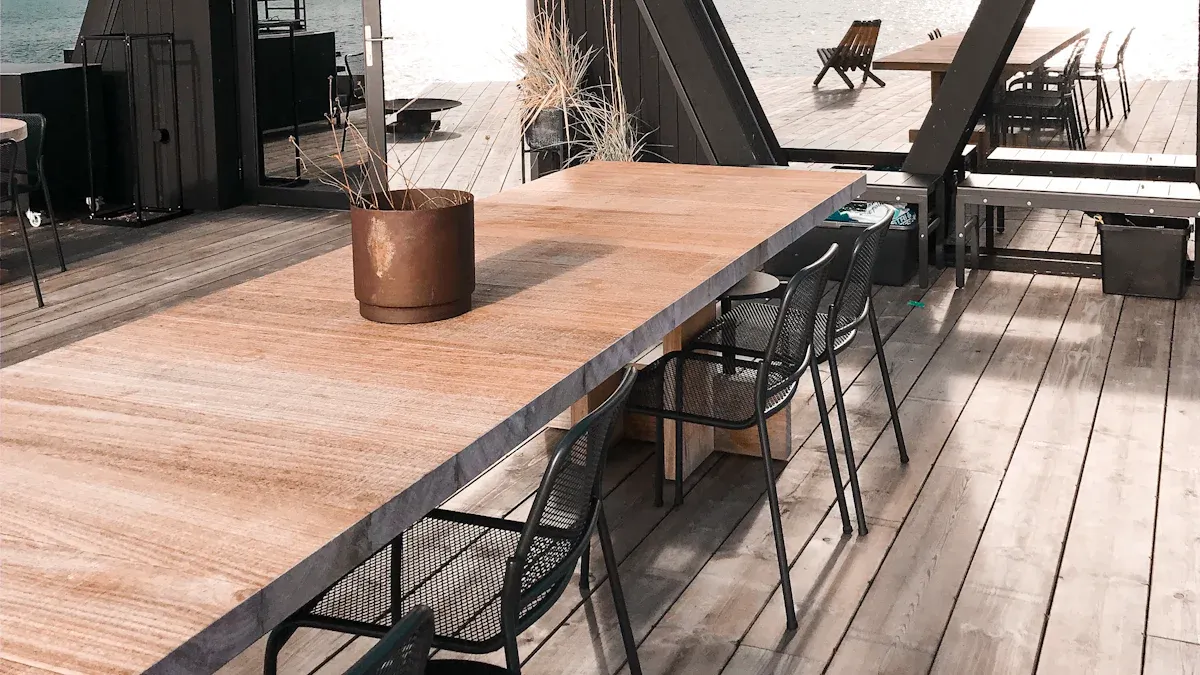
Building your table requires careful steps. You will cut the boards. You will assemble the top. Then you will attach the legs. Follow these instructions for a sturdy table.
Cutting Decking Boards
Accurate cuts are important. They ensure your table fits together well. Use the right saw blade for composite material. This prevents chipping and melting.
Here are recommended saw blade types for composite decking:
Saw Blade Type | Uses | Recommended Tooth Count |
|---|---|---|
General Purpose Circular/Miter Saw Blade | Most crosscuts and angled cuts; clean edge finishing | 40 teeth (carbide-tipped) for 10″ |
Rip Saw Blade | Fast lengthwise cuts (ripping boards to width) | 24 teeth (carbide-tipped) for 10″ |
Jigsaw Blade | Curved, notched, or detailed cuts (post wrapouts, special shapes) | High-tooth-count, fine blades |
Table Saw/Track Saw Blade | Precise, long rip or edge cuts (bulk or batch sizing) | 40+ teeth, thin kerf |
Always choose high-quality, carbide-tipped blades. These blades are specifically for composite materials. Regular wood blades dull quickly. They can also cause chipping. Fine-tooth, carbide-tipped blades give smooth, clean cuts. Use them with miter, circular, and table saws.
Consider these blade features:
Carbide-Tipped Teeth: These are essential for durability. They prevent dulling. They cut dense materials without overheating or melting.
Thin Kerf Design: This minimizes material removal. It reduces saw strain. It produces smoother, cleaner cuts. This is especially true for precise finishing.
Tooth Count: A 40-tooth blade is ideal for most 10-inch saws. It works for edge and crosscuts. For ripping boards, 24 teeth are best for fast, straight cuts. For ultra-fine detailing or trim, you can use 60+ teeth.
Sharpness and Maintenance: Regularly clean and inspect your blades. Re-sharpen or replace them after major projects. This maintains precision. It prevents material damage.
Cut your composite decking pieces to the planned lengths. Make sure all cuts are straight and square.
Assembling the Tabletop
You have a tabletop and a leg assembly. Now, join them together. Carefully place the tabletop onto the leg frame. Align the tabletop so it sits evenly on the frame. Use the pre-drilled pocket holes in the frame. Secure the tabletop to the frame with screws. Drive screws up through the frame into the underside of the tabletop. This creates a strong connection.
Inspect your finished table. Check for any loose screws or wobbly parts. Tighten everything as needed. Your new table, made from your spare composite decking, is now ready for use.
Attaching Legs and Reinforcement
You need a strong frame for your table. This frame supports the tabletop and holds the legs.
First, build the framework. Create attachment points for the legs. Drill pocket holes in each of the four corners of the frame. Then, attach the legs to the frame. Use pocket hole screws. Drill more pocket holes into the top of the frame. This provides space for the tabletop to attach.
Here are detailed steps for attaching the legs:
Arrange the aprons and legs. Place their good sides facing out. Use a large, flat work surface.
Position each apron. Place it 1/2-inch from the outside edge of the legs.
Fasten them together. Use exterior washer head screws through the pocket holes.
Fasten all four legs in this way. This creates the table frame.
Cut four corner braces. Use a miter saw. Ensure a 45-degree angle on the ends. Measure approximately 6-7/8-inch from the long points.
Fasten each brace in place. Use a pair of screws into each apron.
Drill two, 5/16-inch pilot holes. Drill through the center of the brace. Drill into the leg for the hanger bolts.
Bore out the holes in the corner brace. Use a larger 7/16-inch drill bit.
Slide a washer on the hanger bolt. Follow it with two nuts. Keep the nuts toward the end of the bolt.
Use two wrenches. Tighten the nuts together. This prevents them from turning on the bolt. It allows you to drive the hanger bolt into the table leg.
Once the hanger bolt is in place, loosen the nuts against each other. Remove one. Tighten the other. This secures the table leg.
This method ensures a very stable base for your diy outdoor table.
Final Assembly Steps
You have a tabletop and a leg assembly. Now, join them together. Carefully place the tabletop onto the leg frame. Align the tabletop so it sits evenly on the frame. Use the pre-drilled pocket holes in the frame. Secure the tabletop to the frame with screws. Drive screws up through the frame into the underside of the tabletop. This creates a strong connection.
Inspect your finished table. Check for any loose screws or wobbly parts. Tighten everything as needed. Your new table, made from your spare composite decking, is now ready for use.
Tips for Success and Customization
You can make your DIY outdoor table even better. Focus on stability, explore new designs, and learn proper care. These steps ensure your table lasts and looks great.
Enhancing Stability
A stable table is a safe table. You can prevent wobbles and ensure your table stands firm. Loose fasteners are a common cause of instability. You should tighten all screws, bolts, and connections regularly. Uneven floors also cause wobbles. Use leveling pads or shims to adjust for unevenness. You can install rubber pads, wood shims, or metal pads. Reinforce legs with L-shaped brackets or crossbars. This distributes weight and reduces sideways movement. If you notice bent or weak legs, replace them with sturdy ones. You can use plastic leveling wedges for a more durable solution than folded paper. These wedges are water-resistant and often include anti-slip features.
Creative Design Ideas
Your leftover composite decking offers many design possibilities. You already used your spare composite decking for the table. You can also create other matching items. Consider building an outdoor bench. If you have more material, make small tables to complement the bench. These provide extra surface area. You can transform short pieces into stylish shelves. Use these for display or utility outdoors. Construct an Adirondack chair. Composite decking resists heat, moisture, and cold. This means no annual refinishing. Small pieces, especially those with protective capping, make great coaster sets. These protect outdoor surfaces from beverages.
Care and Maintenance
Composite tables need minimal care. Regular cleaning prevents grime and stains. You should clean your table every few months. Clean more often in high-traffic areas. For routine cleaning, use a mild solution. Warm water with a small amount of gentle soap works well. You can also use a composite deck cleaner. This cleaner breaks down surface residue without harming the material. Use a soft bristle brush for general cleaning. Microfiber cloths and non-abrasive sponges work for spot cleaning. A standard garden hose with an adjustable spray setting is good for rinsing.
First, remove furniture and sweep away loose debris. Lightly wet the surface with a hose. Apply your chosen cleaner in sections. Gently scrub along the board’s texture. Rinse thoroughly with clean water. Allow the surface to air dry completely. Address stains promptly. Blot spills immediately. Mix mild dish soap with warm water. Gently scrub with a soft-bristled brush. Rinse thoroughly and dry completely. Never use bleach or abrasive cleaners. Avoid pressure washing for routine maintenance. It can damage the material.
You transformed leftover composite decking into a durable, stylish diy outdoor table. This project offers great satisfaction. You also gain a practical piece of furniture. Composite materials provide many benefits. They offer durability and require minimal maintenance. Repurposing these materials also helps the environment. You reduce landfill waste. You use recycled content. This avoids harmful chemical treatments. Start your own build. Embrace your creativity. Share your unique projects and ideas with others!
FAQ
Can you paint composite decking?
You do not need to paint composite decking. Manufacturers design it for lasting color. Painting can void your warranty. It may also cause peeling. Consider composite-specific stains for a color change.
How do you clean a composite table?
Clean your composite table with mild soap and water. Use a soft brush. Rinse it thoroughly. Avoid harsh chemicals. They can damage the surface. Clean spills quickly.
What screws work best for composite decking?
Use specialized composite deck screws. They have unique threads. These threads prevent mushrooming. Stainless steel screws resist corrosion. They are good for outdoor use.
Is composite decking slippery when wet?
Composite decking can be slippery when wet. Some brands offer textured surfaces. These surfaces improve traction. Always walk carefully on wet surfaces.