Many people enjoy DIY projects, especially for children’s furniture like bunk beds. You can save a lot of money; DIY furniture often helps you save 70% to 90% compared to buying new. This post gives you access to free, reliable diy bunk bed plans. It also highlights the critical importance of safety from building to daily use. When you build a bunk bed yourself, you create a unique design. You also ensure strong construction. Remember, safety always comes first.
Key Takeaways
Building your own bunk bed saves money and lets you create a unique design. Always prioritize safety from start to finish.
Find reliable DIY bunk bed plans online. Look for detailed instructions, material lists, and safety certifications like ASTM or CPSC.
Choose strong materials like solid hardwood or yellow pine. Avoid weak composite woods. Use food-safe, low-VOC finishes for health.
Ensure safety with strong joints, secure fasteners, and guard rails. Guard rails must be at least 5 inches above the mattress. Children under six should not use the top bunk.
Regularly check and tighten all parts of your bunk bed. Address any wear or damage quickly to keep it safe and strong.
Finding Free DIY Bunk Bed Plans
You want to build a bunk bed. First, you need good plans. Finding free diy bunk bed plans is easy. You just need to know where to look. You also need to know what makes a plan reliable.
Online Plan Sources
Many websites offer free plans. These plans help you build your own bunk bed. Ana-White.com provides many free plans. You can find various styles there.
Here are some popular free plans you can find online:
Camp Loft Bed with Stair, Junior Height
Clubhouse Bed – Free DIY Plans!
Modern Bunk Beds – Side Street
Essential Bunk Bed
Free Heavy-Duty Bunk Bed Plans (Twin, Full, or Queen Sizes)
Classic Bunk Beds
DIY Bunk Bed Steps with Built-In Drawers – Easy Build with Free Plans
Simple Bunk Beds (Twin over Twin)
Toddler Bunk Beds
Evaluating Bunk Bed Plans
You find many free bunk bed plans. Now, you must choose a good one. A good plan gives you all the details. It helps you build safely and correctly.
A comprehensive plan includes:
Detailed pages (14)
A shopping list for materials
A tools list (including a pocket hole jig and common garage tools)
Lumber layout diagrams
Reference diagrams for specific part dimensions
Step-by-step 3D assembly diagrams with written instructions (14)
A good bunk bed design also considers important features. You might want a full-size bottom bed for shared sleeping. A tall safety railing is crucial. It should be at least 12 1/2 inches high. Integrated shelving adds storage. Bedside lights for reading or lights above a desk area are useful. Aesthetic details like tongue and groove ceilings, stained wood, or shiplap can make your bunk bed look even better.
Always check for safety certifications. Reputable plans often follow standards. These standards ensure the bed is safe. Look for plans that mention:
ASTM
CPSC
ISO
Bunk Bed Styles & Sizes
Bunk beds come in many styles and sizes. You choose the best one for your space and needs.
Here are common bunk bed configurations:
Twin Over Twin: This is the most popular. It takes up the least room. You can often separate it into two beds.
Twin Over Full: This gives you more flexibility. It offers more sleeping space. It works for older and younger children.
Full Over Full: This maximizes sleeping space. It is very versatile. It is ideal for more children or teenagers.
Basic Bunk Bed: One bed sits directly on top of the other. It uses the least floor space. You can often separate it.
L-Shaped High Loft Bed: This provides more storage space. It takes up more floor space than a basic bunk.
Trundle Bunk Bed: This offers flexibility. It gives extra sleeping space without using more floor space.
Other options include standard bunks in twin, twin XL, or full sizes. These can have parallel or perpendicular beds. You can also find workstation bunks with desks. Futon bunks are another choice. Lofts are beds where the mattress foundation is more than 30 inches above the floor.
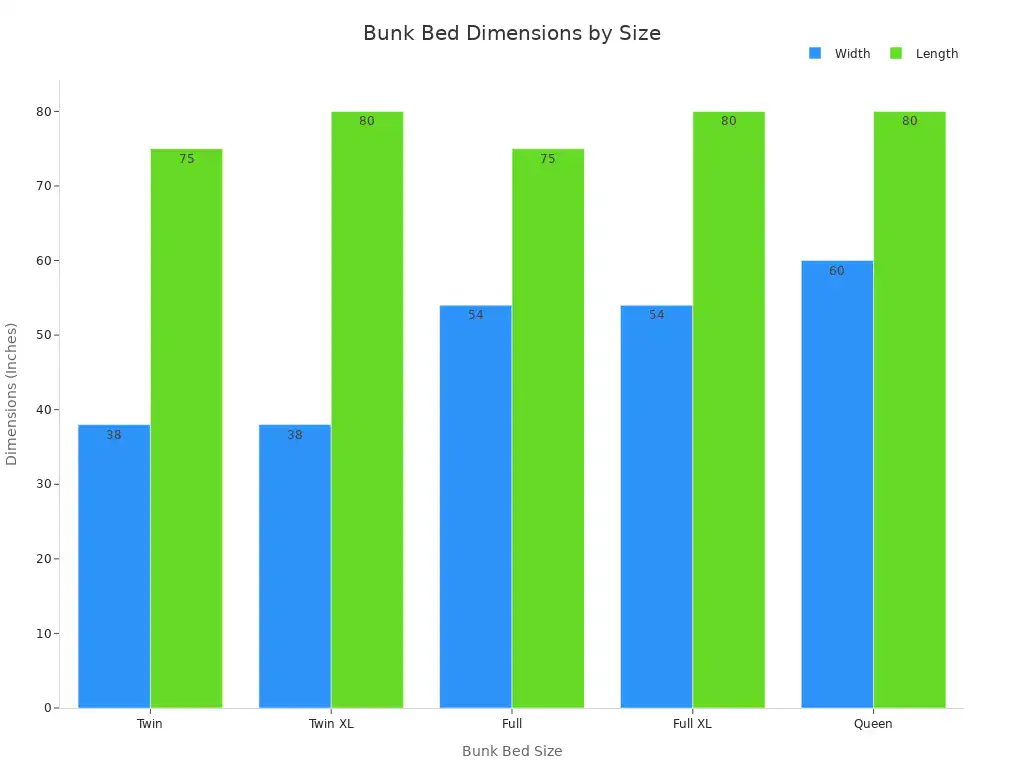
Here are common bunk bed sizes and their dimensions:
Size | Dimensions (W x L) | Ideal For |
|---|---|---|
Twin | 38 inches x 75 inches | Single sleeper, younger kids, shorter individuals |
Twin XL | 38 inches x 80 inches | Taller individuals, college dorms, young adults |
Full | 54 inches x 75 inches | Kids and adults, wider sleeping surface |
Full XL | 54 inches x 80 inches | Taller sleepers needing width and length |
Queen | 60 inches x 80 inches | Adults or guests, ample space, vacation homes |
Consider the space you have. Different styles need different amounts of room. A twin bunk bed is a good choice for smaller rooms.
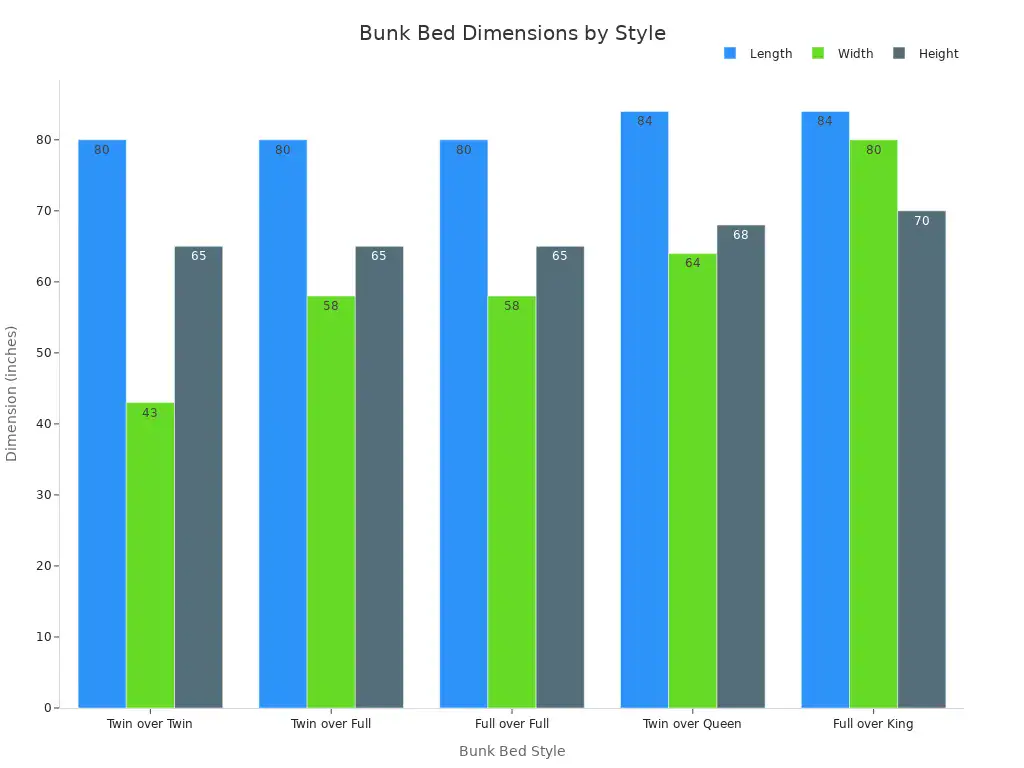
Bunk Bed Style | Ideal For | Footprint (L x W x H) | Vertical Clearance Recommendation |
|---|---|---|---|
Twin over Twin | Compact rooms, younger children | ~80″ L x 43″ W x 65″ H | At least 30–36 inches above top bunk |
Twin over Full | Growing kids, shared rooms | ~80″ L x 58″ W x 65″ H | At least 30–36 inches above top bunk |
Full over Full | Vacation homes, teens, adult guests | ~80″ L x 58″ W x 65″ H | At least 30–36 inches above top bunk |
Twin over Queen | Guest rooms, beach houses, older kids | ~84″ L x 64″ W x 68″ H | At least 30–36 inches above top bunk |
Full over King | Large guest suites, multi-generational homes | ~84″ L x 80″ W x 70″ H | At least 30–36 inches above top bunk |
Standard Bunks (General) | N/A | N/A | Most stand around 65″–70″ tall |
Walkways | N/A | N/A | Leave about 24–30 inches around the bed for easy movement |
Building Safety Tips
Building your own bunk bed gives you control over its quality. You must prioritize safety during construction. This ensures the bed is strong and secure for years.
Material Selection
Choosing the right materials is the first step to a safe bunk bed. The wood you select directly impacts the bed’s strength and durability.
Solid Hardwood (Oak, Maple, Cherry): These woods offer exceptional strength. They resist damage and last for decades with proper care. You get long-term durability and longevity.
Yellow Pine: This wood is also a strong choice for bunk beds. It provides good solidity and longevity, following closely behind hardwoods.
Softwood (Pine, Cedar, Spruce): Softwoods are more affordable. High-quality softwood bunk beds can last a long time, especially with good maintenance. Pine is popular because it is affordable and reasonably durable.
Avoid Composite Wood (MDF, Particleboard): These materials break easily and wear down quickly. They are not suitable for a long-lasting bunk bed.
After choosing your wood, consider the finishes and sealants. These are important for your child’s health. The CPSC sets regulations for furniture and toys for children under three. Finishes must be “non-hazardous.” Lead is a primary concern for federal agencies. Finish suppliers should provide written information and lead test results for their products.
Only coatings with harmful substances like lead or other heavy metals are unsuitable. Once paints and finishes dry, they are generally safe for human contact. Toddlers often touch and mouth furniture. This makes food-safe finishes crucial. Arin Schultz from Naturepedic explains that “food safe” means a child will not get harmful chemicals if they lick or nibble the finish. Unlike “non-toxic” or “eco-friendly,” which lack strict regulation, food-safe finishes meet FDA 21 CFR 175.300. This is the same standard as dinnerware.
Indoor air can have high levels of volatile organic compounds (VOCs). Everyday finishes release these chemicals over time. Studies link VOC concentrations to respiratory and neurological harm in children. Formaldehyde exposure increases asthma risk. A Swedish study found that rooms with solid wood furniture had fewer VOCs than rooms with particleboard or plastic toys. Food-safe finishes are typically water-based and low VOC. They are independently tested to FDA food contact standards. They avoid synthetic lacquers, harsh solvents, or formaldehyde-based adhesives.
Look for certifications to ensure safety:
GREENGUARD Gold: This is a leading standard for chemical emissions.
MADE SAFE: This screens over 6000 chemicals.
FSC: This ensures responsibly sourced wood.
FDA food contact compliance under 21 CFR 175.300: This is the same standard as everyday food-contact surfaces.
Legitimate brands offer ASTM structural testing, California Prop 65 compliance, and batch test reports. They do not rely on vague claims like “natural finishes.” You should ask for independent lab results.
Secure Joints & Fasteners
Strong joints and fasteners keep your bunk bed stable. You must use the right hardware and install it correctly.
Bolts, screws, and joints hold bunk beds together.
Locking nuts are better than standard nuts. They stay tight over time. Use them where you can.
You should regularly check and tighten all screws, bolts, and brackets.
Replace any missing or damaged hardware immediately.
Spax Screws are good for attaching a bunk bed to a wall. This adds extra stability.
Rails & Ladder Construction
Guard rails and a sturdy ladder are essential safety features. They prevent falls and ensure safe access to the top bunk.
Guard rails on the upper bunk must extend at least 5 inches above the mattress. This prevents a child from rolling out.
Guard rails next to walls or opposite the ladder should span the bed’s entire length. Any end gap must be less than 0.22 inches.
The guard rail on the side not against a wall can have end gaps. These gaps must be less than 15 inches.
When no mattress is present, the space under the guard rail must be small. A standard wedge should not pass through it.
The ladder also needs careful construction:
Anti-Slip Steps: Rungs should have non-slip coatings, textured surfaces, or grooves. This improves grip, especially for younger users or in low light.
Side Rails or Hand Grips: Integrated rails stabilize users when climbing up or down. They provide extra support for children or adults.
Even and Consistent Step Spacing: Rungs must be evenly spaced, usually between 7 to 12 inches apart. This ensures consistent footing and balance. It reduces missteps and prevents children from skipping steps.
Rounded Edges and Smooth Surfaces: Steps and ladder frames should have rounded edges. This eliminates sharp corners. Smooth, sanded surfaces minimize injury from bumps or splinters.
Secure Fastening to the Bed Frame: Ladders, whether fixed or removable, must attach securely. This prevents wobbling or movement. Fixed ladders are often bolted for permanent stability.
Guardrail Integration: Bunk beds with ladders must include guardrails along the upper bunk to prevent falls. Ladder entry points need specific guardrail gaps. These are typically no wider than 3.5 inches to prevent entrapment.
Ladder Placement and Clearance Guidelines: Regulations ensure ladders install with proper angles and spacing. This makes climbing safe and intuitive. It avoids overly steep angles or not enough clearance between rungs.
Structural Integrity Inspections: Safety standards require routine testing of the ladder’s hardware and joints. This prevents loosening over time. Regular inspections identify wear and ensure compliance.
Weight Capacity
Understanding weight capacity is vital for bunk bed safety. You need to know how much weight your bunk bed can safely hold.
Some adult bunk beds are independently tested. They hold 2,000 lbs per sleeping platform. This verifies their quality and durability.
The ASTM (American Society for Testing and Materials) and the Consumer Product Safety Commission set standards for bunk beds. The ASTM does not specify a particular weight limit for a person. Instead, the test requires 400 pounds to be slowly distributed between the two cleats of the upper bunk on the mattress support system. This test does not mean the bed is rated for a 400-pound person. For general use, a maximum weight of about 200-250 lbs is recommended. This applies when you use metal center supports. These supports increase slat and bed strength.
For queen-size bunk beds, the weight capacity typically ranges between 800 and 1,200 pounds per tier. This depends on materials and construction. These limits accommodate two adults comfortably on each level. Extensive stress testing validates these limits. This ensures durability and stability.
Usage Safety Tips
You built your bunk bed. Now, you must use it safely. Following these tips protects everyone.
Top Bunk Age Limits
Children need to be old enough for the top bunk. Experts suggest children under six years old are not ready. They lack the coordination to use the ladder safely. They might also roll over in their sleep. This increases fall risks. The Consumer Product Safety Commission (CPSC) guidelines state children younger than six years old should never sleep in the upper bunk. Children typically show the necessary maturity and coordination between six and eight years. This is when they can safely use a bunk bed.
Fall Prevention
Preventing falls is very important. You can take several steps. Do not let children under six sleep on the top bunk. Position the bunk bed in a corner. This uses two walls for bracing. It reduces fall risks. Ensure the top mattress fits snugly. It should not ride over the edge. Install a guardrail on the top bunk. The gap between the guardrail and the bed side must be no wider than 3½ inches. Verify that securely fastened wires or slats support the mattress. Discourage jumping or roughhousing on either bunk. This prevents falls and keeps the bed strong. You can also use safety netting. Make sure it is strong and securely attached.
Regular Safety Checks
You must regularly check your bunk bed. This keeps it safe over time. Look for loose screws. Check for worn hardware. Watch for any signs of instability. Inspect the sturdy railings and guardrails. Make sure they connect properly. Check for looseness or wobbliness. Ensure there are no large openings. Tighten all nuts and bolts. Inspect wooden components for splintered or cracked wood. Check hardware for rust or missing pieces.
Room Placement
Proper room placement is key for safety. Position the bunk bed away from ceiling fans. Keep it away from lights and other hanging objects. Ensure no curtains, cords, or strings are near the bed. These can pose a strangulation risk. Consider attaching taller bunk beds to the wall. Use appropriate mounting hardware for your wall type. This adds stability. Maintain at least 2 to 3 feet of clearance above the top bunk. This allows occupants to sit up without hitting their head. Ensure enough clearance around the bed for safe access.
Tools & Materials
Building a bunk bed requires the right tools and materials. You need to gather these before you start. This ensures a smooth building process.
Essential Tools
You do not need many fancy tools for a DIY bunk bed. Many plans use simple 90-degree cuts. This makes the building process easier for beginners. Here are some tools you will likely need:
Measuring Tape: You need this for accurate measurements.
Pencil: Mark your cuts clearly.
Circular Saw or Miter Saw: These cut your lumber to size.
Drill: You will drill pilot holes and drive screws.
Sander: Smooth rough edges.
Safety Glasses and Hearing Protection: Always protect yourself.
Lumber Choices
The type of wood you choose affects your bunk bed’s strength. Common construction-grade pine is a popular choice. You can use 2x4s and 2x6s. These are strong and affordable. You can also choose hardwoods like oak or maple for more durability. Always pick straight, knot-free lumber. This makes your bed stronger and safer.
Hardware & Fasteners
Strong hardware holds your bunk bed together. You need good quality screws and bolts.
Wood Screws: Use these for most connections.
Carriage Bolts: These provide extra strength for main joints.
Washers and Nuts: Use these with bolts to secure them tightly.
Wood Glue: This adds extra strength to your joints.
Finishing Supplies
After building, you need to finish your bunk bed. This protects the wood and makes it look good. Choose finishes safe for children. You can find non-toxic paint and stainers. These are safe for sustainable materials. Look for products that are GREENGUARD Gold certified. This means they have low VOC emissions. They do not release harmful chemicals into your child’s room. A non-toxic and VOC-free birch finish is another safe option. It has no health hazards.
How to Build Bunk Beds: A Guide
<<>>
How to Build Bunk Beds: A Guide
Building your own bunk bed is a rewarding project. Many diy bunk bed plans use simple 90-degree cuts. This makes the building process easier for beginners. You can learn how to build bunk beds with confidence.
Workspace Setup
Before you start, set up a safe workspace. You need a clear and organized area. This reduces risks like trips and falls. Always wear protective gear. This includes safety glasses, hearing protection, and sturdy footwear. Use gloves, but avoid them with certain power tools. Wear a dust mask or respirator to protect your lungs. Work in a well-ventilated area. This avoids inhaling harmful dust and fumes. Always use tools correctly. Read their manuals. Keep your tools sharp and clean. Use the right tool for each job. Secure your workpieces. Disconnect power tools when you are not using them. Stay focused and avoid distractions. Know your limits. Do not attempt tasks beyond your skill level. Keep a first aid kit nearby. Know how to use it.
Assembly Steps
Learning how to build bunk beds involves several key steps. Many simple diy bunk bed plans guide you through this process.
Prepare for Assembly: Gather all your tools and parts. Read the instructions carefully. Inspect all components for any damage.
Construct the Initial Framework: Attach the lower spacers to the legs of the end frames. Make sure they align precisely. Fasten them securely.
Build and Install the Ladder: Mark and assemble the ladder rungs. Then, securely attach the completed ladder to the bed frame.
Install and Secure Mattress Frames: Position and secure the lower mattress frame. Add middle spacers. Then, add the top mattress frame. Ensure both frames are stable.
Add Safety Features: Install safety rails on both the upper and lower bunks. Fasten them securely. Ensure they are tall enough.
Final Safety Checks: Check all screws and bolts for tightness. Inspect surfaces for smoothness. Test the bed’s stability. Verify safety rails and ladder alignment. Check mattress supports. Inspect for any damage. This ensures you build bunk beds safely.
Finishing & Curing
After assembly, you need to finish your bunk bed. This protects the wood. It also makes the bed look good. Apply your chosen finish. This could be paint or stain. Follow the product instructions for application. Allow the finish to cure completely. Curing means the finish hardens fully. This can take several days or even weeks. Do not use the bed until it is fully cured. This prevents fumes and ensures durability.
<<>>
Customization Ideas
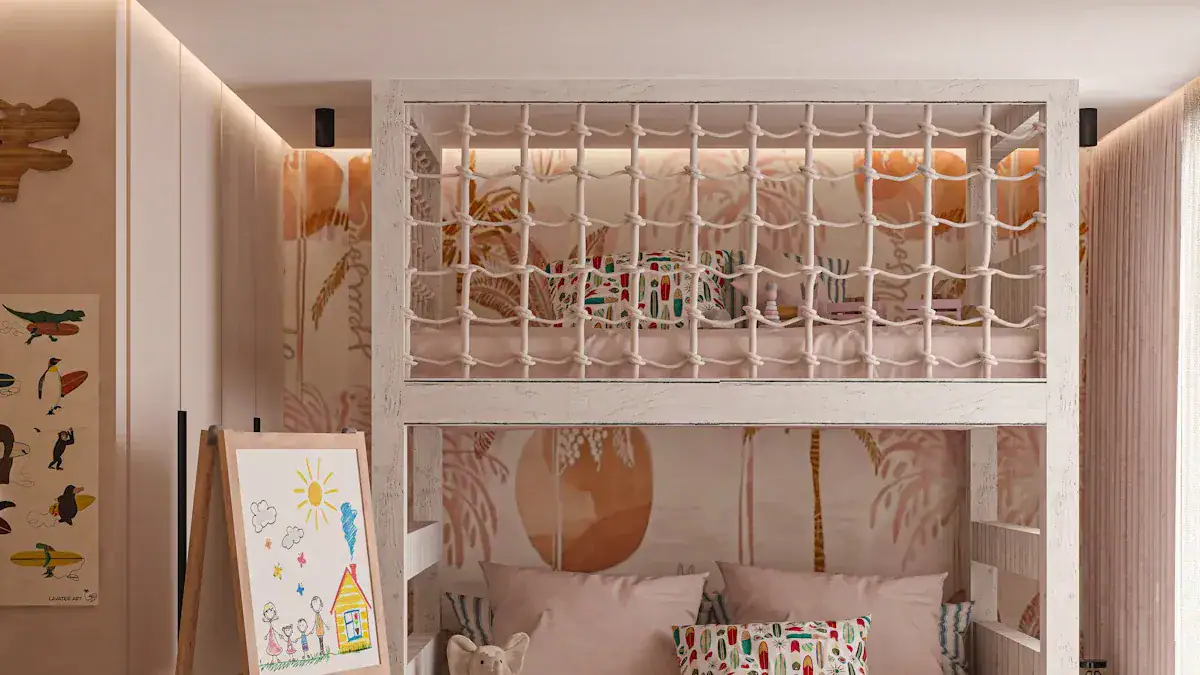
Building your own bunk bed offers many chances for customization. You can make it fit your child’s needs and your home’s style. You create a unique piece of furniture.
Integrated Storage
You can add storage directly into your bunk bed design. This helps keep rooms tidy. Many popular designs include built-in drawers beneath the lower bunks. You can also add wall-mounted shelves for books or toys. Under-bed storage bins are another great option. Some designs feature multi-functional furniture, like benches with storage compartments. You can also build in wall niches for items such as books, nightlights, or water bottles. Bunk beds with stairs often include built-in drawers or shelves within the steps. Each step becomes a functional storage area. This design maximizes space, especially for a twin bunk bed in a small room.
Themed Designs
Personalize your bunk bed with a fun theme. You can transform a simple bed into an adventure. Consider a castle, a treehouse, or a pirate ship. You can use paint, fabric, and small decorative elements. A themed bed makes bedtime more exciting for children. It also adds character to their room.
Desk & Play Areas
Maximize your space by adding functional areas. You can integrate a desk under the top bunk. This creates a quiet study spot. Some designs include a play area. This might be a small fort or a reading nook. A twin bunk bed with a built-in desk or play space is perfect for smaller bedrooms. It combines sleeping, studying, and playing in one compact unit.
Maintenance & Longevity
You want your DIY bunk bed to last a long time. Proper maintenance ensures its safety and durability. You can keep your bunk bed in top condition with a few simple steps.
Routine Inspections
You should regularly inspect your bunk bed. Look for any signs of wear or damage. Check all parts of the bed. This includes the frame, guardrails, and ladder. You want to catch small problems early. This prevents them from becoming bigger issues. A quick visual check can save you trouble later.
Fastener Tightening
Fasteners can loosen over time. You need to tighten all screws, bolts, and nuts. Use the correct tools for each fastener. Do this every few months. Loose fasteners make the bed unstable. A stable bed is a safe bed. Make sure every connection feels secure.
Addressing Wear
You might notice some wear and tear. Address these issues promptly. Sand down any rough spots or splinters. This prevents injuries. If you see cracks in the wood, repair them. You can use wood glue or wood filler. Replace any broken parts immediately. This includes guardrails or ladder rungs. A well-maintained bunk bed provides a safe sleeping space for years.
Building your own bunk bed is a rewarding project. You gain personal satisfaction, save money, and create a unique piece for your home. Many free diy bunk bed plans are available to guide you. Remember, safety is non-negotiable during construction and daily use. Approach your project with confidence. Pay meticulous attention to detail and safety guidelines. This ensures a durable and secure sleeping solution for your children.
FAQ
What age is safe for the top bunk?
You should not let children under six years old sleep on the top bunk. They lack the coordination needed for safe climbing. The Consumer Product Safety Commission (CPSC) recommends this age limit.
What materials are best for building a bunk bed?
You should choose solid hardwoods like oak or maple for the best strength. Yellow pine is also a strong option. Avoid composite woods like MDF or particleboard. They are not durable enough for bunk beds.
What is the most important safety feature for a bunk bed?
Guard rails are the most important safety feature. They must extend at least 5 inches above the mattress on the top bunk. This prevents falls. Ensure they are securely fastened to the bed frame.
What tools do I need for a DIY bunk bed?
You will need basic tools. These include a measuring tape, pencil, saw (circular or miter), drill, and sander. Always wear safety glasses and hearing protection when you use these tools.