

You may worry ionizers just add ozone or little real benefit, but modern tower fans pair low emissions with real air‑moving performance and safety certifications. You’ll get quiet brushless DC motors, wide oscillation, and smart controls on these top picks, plus independent ionizer switches and easy‑clean designs. I’ll walk you through six standout models and the key specs that matter so you can match features to your room—and avoid common pitfalls.
| Dreo 40″ Tower Fan — 5-Speed Oscillating Quiet |
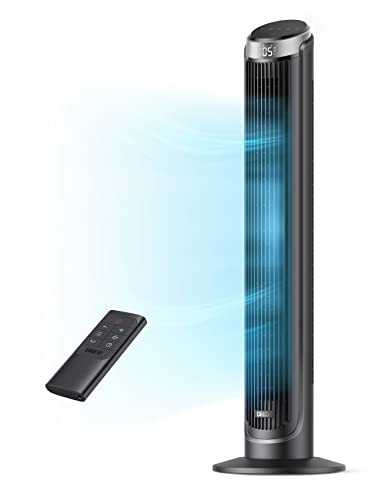
| Quiet Nighttime Pick | Oscillation: 90° wide-angle oscillation | Speed Settings: Five speed settings | Timer: 1–12 hour adjustable timer | VIEW LATEST PRICE | Read Our Analysis |
| Lasko 42″ Oscillating Tower Fan with Remote |

| Classic Reliable Choice | Oscillation: Oscillating function for wider room coverage (unspecified angle) | Speed Settings: Three speed settings | Timer: 7.5-hour timer | VIEW LATEST PRICE | Read Our Analysis |
| Della 42″ Smart Tower Fan with Remote App Voice |

| Best Smart Option | Oscillation: 90° oscillation | Speed Settings: 12 speed levels | Timer: 24-hour timer | VIEW LATEST PRICE | Read Our Analysis |
| Dreo 120° Oscillating Quiet Pedestal Fan (Adjustable) |

| Best Coverage | Oscillation: Horizontal oscillation up to 120° | Speed Settings: 9 wind speeds | Timer: 9-hour timer | VIEW LATEST PRICE | Read Our Analysis |
| Lasko Wind Curve 42″ Oscillating Tower Fan |

| Air Quality Option | Oscillation: Optimized oscillation angle for increased coverage (unspecified) | Speed Settings: 3 adjustable speeds | Timer: 7.5-hour automatic timer | VIEW LATEST PRICE | Read Our Analysis |
| DR.PREPARE 16″ Quiet Bladeless Tower Fan with Remote |

| Compact & Quiet | Oscillation: 80° oscillation | Speed Settings: 8 selectable speeds | Timer: 1–8 hour progressive auto-off timer | VIEW LATEST PRICE | Read Our Analysis |
More Details on Our Top Picks
Dreo 40″ Tower Fan — 5-Speed Oscillating Quiet
Provided that you want a quiet, compact tower fan that still delivers strong, wide-reaching airflow, the Dreo 40″ is a solid pick— it uses TurboSilent tech to drop noise to 28 dB while pushing air up to 26 ft/s with 90° oscillation, so you can sleep or work without distraction. You’ll get five speeds, four modes (Normal, Natural, Auto, Sleep), and remote or touch control for convenience. The timer runs 1–12 hours. Safety features include an ETL-certified bladeless grille, fused plug, and stable base. It’s portable with a handle, fits small spaces, and has easy-wash parts for upkeep.
- Oscillation:90° wide-angle oscillation
- Speed Settings:Five speed settings
- Timer:1–12 hour adjustable timer
- Noise Level / Quiet Operation:Quiet down to 28 dB (TurboSilent)
- Remote Control:Remote and touch controls
- Safety / Certifications:ETL-certified bladeless, fused safety plug, steady stand
- Additional Feature:Bladeless narrow grille
- Additional Feature:Built-in carry handle
- Additional Feature:Easy-wash impeller parts
Lasko 42″ Oscillating Tower Fan with Remote
Should you need a straightforward, sleep-friendly tower fan for a bedroom or larger room, the Lasko 42″ Oscillating Tower Fan with Remote delivers powerful, quiet airflow and easy remote control. You’ll appreciate its 42″ standing design with oscillation for broader coverage and a woodgrain-and-grey finish that fits many décors. Three speed settings let you tailor airflow; the remote adjusts speed, oscillation, and other functions without leaving bed. It runs quietly for restful nights, includes a 7.5-hour timer for scheduled use, and conserves energy. Provided you desire reliable, user-friendly cooling for larger spaces, this Lasko is a practical pick.
- Oscillation:Oscillating function for wider room coverage (unspecified angle)
- Speed Settings:Three speed settings
- Timer:7.5-hour timer
- Noise Level / Quiet Operation:Quiet operation optimized for sleep (exact dB not specified)
- Remote Control:Remote control for speed, oscillation, other functions
- Safety / Certifications:Quiet/safe operation for bedroom (specific certifications not listed)
- Additional Feature:Woodgrain finish option
- Additional Feature:Designed for larger rooms
- Additional Feature:Energy-conserving design
Della 42″ Smart Tower Fan with Remote App Voice
In case you want a smart, quiet tower fan that’s easy to control from anywhere, the Della 42″ Smart Tower Fan is a strong pick — it combines a brushless 35W DC motor and up to 1,950 CFM airflow with app, voice, and remote control so you can dial in comfort without getting up. You’ll get 12 speeds, four modes (Sleep, Auto, Natural, Normal), 90° oscillation and a 24‑hour timer. It runs as low as 23 dB, reaches 37 ft effectively, and uses Auto Mode to adjust via temperature sensors. Safety features, washable parts, tool‑free setup, and an 18‑month warranty round it out.
- Oscillation:90° oscillation
- Speed Settings:12 speed levels
- Timer:24-hour timer
- Noise Level / Quiet Operation:Ultra-quiet 23 dB
- Remote Control:Remote control (plus app/voice)
- Safety / Certifications:Pinch-proof grills, child lock, 45° tip-over protection, FCC & SGS certified
- Additional Feature:Wi‑Fi app control
- Additional Feature:Alexa/Google voice control
- Additional Feature:18-month warranty
Dreo 120° Oscillating Quiet Pedestal Fan (Adjustable)
Should you want a quiet, energy-efficient fan that can serve as a pedestal, oscillating fan, air circulator, and smart fan all in one, the Dreo 120° Oscillating Quiet Pedestal Fan is a top pick — especially for bedrooms or home offices where low noise and whole-room coverage matter. You get nine wind speeds, four modes, a large LED display, remote control, and a nine-hour timer to fine-tune comfort. The brushless DC motor with bionic blades cuts noise to about 20 dB while providing 30% more air with 40% less energy. It oscillates 120° horizontally, tilts 120° vertically, adjusts 37–42″, and cleans easily.
- Oscillation:Horizontal oscillation up to 120°
- Speed Settings:9 wind speeds
- Timer:9-hour timer
- Noise Level / Quiet Operation:Noise reduced to 20 dB
- Remote Control:Remote control with full adjustments
- Safety / Certifications:Brushless DC motor, energy-efficient design (safety features implied; tip protection not specified)
- Additional Feature:120° horizontal oscillation
- Additional Feature:Adjustable 37–42″ height
- Additional Feature:Large LED display
Lasko Wind Curve 42″ Oscillating Tower Fan
In case you want a portable, bladeless tower fan that adds a light air-cleaning lift, the Lasko Wind Curve 42″ delivers with its slim design, easy-carry handle, and built-in ionizer that releases negative ions for a fresher feel. You’ll get three speeds and optimized oscillation to cover large rooms, bedrooms, or home offices without fuss. The remote controls power, timer, speed, oscillation, and the ionizer, while a 7.5-hour timer handles scheduled cooling. ETL-listed safety, a one-year warranty, and Lasko’s 115+ years of U.S. design mean dependable performance from a brand claimed as the nation’s top fan.
- Oscillation:Optimized oscillation angle for increased coverage (unspecified)
- Speed Settings:3 adjustable speeds
- Timer:7.5-hour automatic timer
- Noise Level / Quiet Operation:Quiet bladeless design (exact dB not specified)
- Remote Control:Remote control with five functions (includes ionizer toggle)
- Safety / Certifications:ETL safety compliance, 1-year warranty
- Additional Feature:Built-in ionizer option
- Additional Feature:Molded carrying handle
- Additional Feature:Designed in USA
DR.PREPARE 16″ Quiet Bladeless Tower Fan with Remote
Should you want whisper-quiet cooling with precise control, the DR.PREPARE 16″ Quiet Bladeless Tower Fan with Remote fits the bill—its efficient 12W DC motor and eight speed settings give you customizable airflow without the noise. You’ll get wind up to 23 ft/s and motor speeds to 2000 RPM while noise drops as low as 25 dB, plus a sound/sleep mode for nighttime. Use the upper touchscreen or smart remote to adjust speeds, modes, oscillation, and a 1–8 hour progressive timer. The 16″ fan offers 80° sweep for bedrooms or offices, and a detachable impeller and rear guard ease cleaning.
- Oscillation:80° oscillation
- Speed Settings:8 selectable speeds
- Timer:1–8 hour progressive auto-off timer
- Noise Level / Quiet Operation:Near-silent down to 25 dB
- Remote Control:Smart remote control for speeds, modes, oscillation, timer
- Safety / Certifications:Detachable guards for cleaning; manufacturer support (specific certifications not listed)
- Additional Feature:Detachable impeller wheel
- Additional Feature:16″ compact form
- Additional Feature:1–8 hour progressive timer
Factors to Consider When Choosing a Tower Fan With Ionizer
Whenever choosing a tower fan with an ionizer, you’ll want to check ionizer effectiveness metrics and whether the unit’s coverage area matches your room size. Also consider noise level limits and energy consumption rates so the fan is comfortable and affordable to run. Finally, look at filtration and overall air quality performance to make certain it actually improves your indoor air.
Ionizer Effectiveness Metrics
Because ionizers vary widely in real-world performance, you’ll want to focus on measurable effectiveness—start checking ion output (ions per cm³ or per second), independently measured reductions in PM2.5/PM10 counts over time, the unit’s effective coverage area, and any ozone emissions reported under realistic test conditions. You should look for ion outputs in the millions to tens of millions per second to meaningfully influence fine particles. Prefer independent lab reports showing percent particle reduction after 30–60 minutes with clear test conditions (room size, initial load, instruments). Verify ozone stays well below health-based limits (e.g., <50 ppb or local guidance). Compare reported particle removal efficiency rather than marketing claims, and favor units with transparent, repeatable test data.
Coverage Area Needs
To pick a tower fan with an ionizer that actually works for your space, start alongside matching the fan’s CFM or stated coverage area to your room’s square footage—small bedrooms (~100–200 sq ft) need far less airflow than open-plan inhabited areas (>300 sq ft). Calculate your room’s square footage, then choose a fan whose CFM or sustained coverage matches it rather than relying on vague “powerful” claims. Check specified oscillation angle and effective distance—80–120° and 20–40 ft ranges distribute ions and breeze better. Factor fan height and placement: taller, wider‑oscillating towers cover whole rooms; compact units suit focused cooling. Finally, account for high ceilings, many openings, or strong HVAC; these conditions often demand higher CFM or broader oscillation to keep ionizer effects consistent.
Noise Level Limits
When needing a fan that won’t disturb sleep, aim for models that stay under about 30 dB (and under 25 dB for truly ultra‑quiet rooms), and always check noise specs across speed settings since low/sleep modes are typically 20–30 dB quieter than max output. You should compare decibel ratings carefully because a 10 dB increase roughly doubles perceived loudness—so a 35 dB fan will seem about twice as loud as a 25 dB unit. Look for manufacturers that publish separate noise figures for the ionizer, since that feature can add a distinct hiss or hum. In the event exact dB numbers aren’t available, use labels like “ultra‑quiet” and read nighttime user reviews to assess real-world performance.
Energy Consumption Rates
Noise and power often go hand in hand, since quieter tower fans tend to run at lower speeds and use less electricity; you’ll want to weigh both sound and energy in case you plan to run a unit overnight. Tower fans with ionizers usually use DC motors drawing about 10–50W, so continuous 24/7 use equals roughly 7–36 kWh monthly. Pick brushless DC motors and multiple speeds—running low can cut consumption 30–70% versus max. Recall extras: oscillation, ionizer, LEDs, and Wi‑Fi add about 1–5W each, raising total draw even at low fan speeds. Use timers or auto modes; running 8 hours/day versus 24 reduces monthly energy approximately 67%. Compare W per CFM: 20–40 CFM/W beats under 10 CFM/W.
Filtration And Air Quality
Although ionizers can cut fine particle counts through charging particulates so they clump and settle, they don’t trap contaminants the way HEPA filters do, so you’ll want a fan that pairs ionization with mechanical filtration for true air-cleaning. Choose models that include true HEPA or high-MERV prefilters to capture dust, pollen, and smoke while the ionizer reduces airborne counts. Verify ozone emissions stay well below certification limits (UL/FDA standards) since some ionizers produce small ozone amounts. Check performance specs — ion output rate and recommended room cubic footage — because effectiveness depends on room size and airflow. Keep in mind ionizers can make particles stick to walls and surfaces, increasing cleaning needs; factor that into maintenance expectations.
Control Options And Smart Features
After you’ve weighed filtration and ionizer performance, consider how you’ll actually control the fan and purification features. Look for multiple control methods—on‑unit touchpanel or buttons, an infrared remote, and app or voice control—so you can operate the ionizer and fan nearby or from across the room. Prefer Wi‑Fi or Bluetooth models for scheduling, remote activation, and voice‑assistant integration. Check whether the ionizer has independent controls or its own schedule so you can run purification without full airflow. Make sure status indicators show ionizer on/off, intensity, and timer settings clearly via LED/LCD or app. Finally, confirm safety‑related controls like child lock and auto shutoff tied to remote or app commands to avoid accidental activation.
Safety And Certifications
Because safety standards vary, you should prioritize verified certifications and built‑in protections while choosing a tower fan with an ionizer. Look for ETL, UL, or CE marks showing independent electrical and safety testing. Confirm third‑party lab reports (SGS, Intertek) for claims like low electromagnetic interference, ozone output, and overall electrical safety instead of relying on manufacturer statements. Make certain the ionizer meets regulatory ozone limits (FDA/UL/CPSC guidance) because some designs can produce harmful ozone. Check for tip‑over protection and a fused safety plug or over‑voltage protection to reduce fire and shock risks. Finally, favor bladeless or pinch‑proof grills and a child lock to prevent accidental injury, especially should children or pets share your home.
Maintenance And Cleaning
Whenever you’re choosing a tower fan with an ionizer, consider how easy it is to clean and maintain—regular upkeep keeps ion output stable, prevents excess ozone, and prolongs the motor’s life. You’ll want removable ion plates or collectors you can clean or replace every 1–3 months per manufacturer guidance to avoid buildup that cuts ion output and raises ozone. Wipe external grilles and housing weekly with a damp cloth, vacuum grills and vents monthly, and deep-clean blades, impellers, and washable filters every 3–6 months—always unplug and let parts dry fully. Track pre-filter, carbon, or HEPA replacement intervals (typically 3–12 months) to preserve air quality. Inspect cords, switches, and electrodes each cleaning; stop use and get service for frayed wiring, sparking, or persistent metallic/ozone smells.
