

You’ll find five top thermostat controllers for 2026 that cover hobby, DIY and pro needs: the Diymore 1800W plug‑in for high‑wattage home heating, Inkbird’s dual‑stage 12V unit for battery‑powered coolers, VIVOSUN’s heat‑mat thermostat for seedlings and reptiles, Inkbird’s Wi‑Fi ITC‑308 for remote control and alerts, and the compact XH‑W3001 module for precise DIY projects - keep going and you’ll get specs, placement tips and buying guidance.
| Diymore 1800W Digital Temperature Controller Plug-in Thermostat |
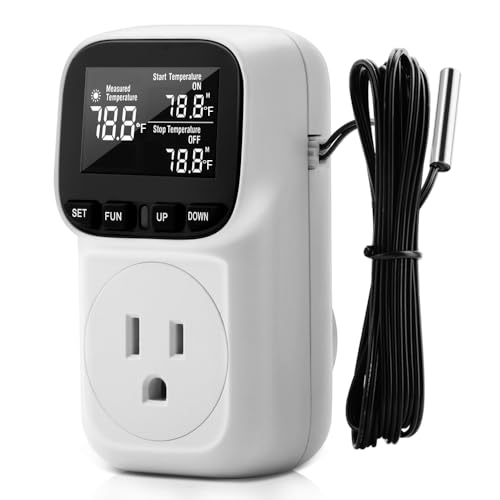
| Versatile Powerhouse | Temperature range / display range: -104°F to 210°F | Heating and/or cooling control: Controls heater or cooler via set start/stop temperatures (single output for heating or cooling) | Probe / external temperature sensor: Included probe, 2 m cable | VIEW LATEST PRICE | Read Our Analysis |
| Inkbird Dual-Stage 12V Digital Temperature Controller |

| Dual-Stage Precision | Temperature range / display range: (not explicitly full range) Fahrenheit/Celsius switchable; configurable target and differential (implied suitable for typical fermentation/incubation ranges) | Heating and/or cooling control: Dual relay outputs - independent heating and cooling control (automatic mode switches between them) | Probe / external temperature sensor: External temperature sensor supported (calibration available) - standard probe included | VIEW LATEST PRICE | Read Our Analysis |
| VIVOSUN Digital Heat Mat Thermostat Controller (40–108°F) |

| Grower-Friendly Pick | Temperature range / display range: Controls 40–108°F (display range 32–210°F) | Heating and/or cooling control: Controls heat mat (heating control only) | Probe / external temperature sensor: Sensor probe included for root/target temperature monitoring | VIEW LATEST PRICE | Read Our Analysis |
| Inkbird WiFi ITC-308 Digital Temperature Controller |

| Smart Remote Control | Temperature range / display range: Configurable (supports Celsius/Fahrenheit; app shows temperature - typical controller range for brewing/fermentation; exact numeric range not listed) | Heating and/or cooling control: Dual relay outputs - separate refrigeration (cooling) and heating control | Probe / external temperature sensor: External sensor supported (sensor included with ITC series) | VIEW LATEST PRICE | Read Our Analysis |
| Digital LED Temperature Controller Module XH-W3001 Thermostat |

| Compact DIY Module | Temperature range / display range: -50°C to 110°C (≈ -58°F to 230°F) | Heating and/or cooling control: Heating and cooling work modes (programmable to act as heater or cooler) | Probe / external temperature sensor: 1 m NTC10K stainless-steel waterproof probe included | VIEW LATEST PRICE | Read Our Analysis |
More Details on Our Top Picks
Diymore 1800W Digital Temperature Controller Plug-in Thermostat
Should you need a compact, plug-in thermostat that handles common home and hobby heating tasks, the Diymore 1800W Digital Temperature Controller is a solid choice-its 15A/120V rating and -104°F to 210°F range make it versatile for incubators, terrariums, fermenters, and small greenhouse or RV setups. You’ll plug it in, set separate start/stop temps with ±1% accuracy, and use calibration or reset in case needed. The 2 m probe and HD backlit display simplify placement and reading. Choose from five timing modes (cycle or countdown) with 0:00–99:59 limits. Settings persist after power loss, handling many small temperature-controlled systems.
- Temperature range / display range:-104°F to 210°F
- Heating and/or cooling control:Controls heater or cooler via set start/stop temperatures (single output for heating or cooling)
- Probe / external temperature sensor:Included probe, 2 m cable
- Display units (°C / °F) or switchable units:Fahrenheit shown (range listed in °F) - device supports temperature calibration (unit not explicitly stated but commonly °F/°C)
- Timers / scheduling or delay functions:Five timing/control modes (cycle timer, countdown ON/OFF, ON+OFF; timers 0:00–99:59)
- Power / load capacity:15A / 120V - up to 1800W
- Additional Feature:HD LED backlight display
- Additional Feature:Stores settings after power-loss
- Additional Feature:Five timer/control modes
Inkbird Dual-Stage 12V Digital Temperature Controller
Should you need a compact 12V controller that independently manages both heating and cooling for projects like car coolers, fermenters, or small greenhouses, the Inkbird Dual-Stage DV 12V fits the bill: it gives you two relay outputs with automatic mode to switch between heating and cooling, plus target and return differential setpoints so you can hold a tight temperature band. You’ll get Fahrenheit/Celsius display options, temperature calibration, and an optional compressor delay to protect refrigerating equipment. It sounds alarms for high/low limits and sensor errors. Designed for 12V systems, it’s ideal for car battery-powered coolers and small water- or air-cooling setups.
- Temperature range / display range:(not explicitly full range) Fahrenheit/Celsius switchable; configurable target and differential (implied suitable for typical fermentation/incubation ranges)
- Heating and/or cooling control:Dual relay outputs - independent heating and cooling control (automatic mode switches between them)
- Probe / external temperature sensor:External temperature sensor supported (calibration available) - standard probe included
- Display units (°C / °F) or switchable units:Switchable Fahrenheit/Celsius display
- Timers / scheduling or delay functions:Refrigerating control output delay (optional delay) and control logic for maintaining range (no multi-mode timers listed)
- Power / load capacity:12V system (automotive/12V appliances) - designed for 12V loads (specific wattage not listed)
- Additional Feature:Dual independent relays
- Additional Feature:Automatic heat/cool switching
- Additional Feature:Sensor-error and limit alarms
VIVOSUN Digital Heat Mat Thermostat Controller (40–108°F)
Should you need precise root-zone control for seedlings, reptiles, or fermentation, the VIVOSUN Digital Heat Mat Thermostat Controller delivers reliable temperature regulation from 40–108°F and handles up to 1000W, so it’s a strong choice for hobby growers and small-scale professionals who want an easy, plug-and-play solution. You’ll set target temps with a three-button interface, toggle °F/°C, and monitor via the included probe. The angled socket, hanging tab, and wall-mount keep cords tidy. Built with fortified plastic, corrosion-resistant parts, and clear specs, it’s compatible with any heat mat and backed with solid reviews and a warranty.
- Temperature range / display range:Controls 40–108°F (display range 32–210°F)
- Heating and/or cooling control:Controls heat mat (heating control only)
- Probe / external temperature sensor:Sensor probe included for root/target temperature monitoring
- Display units (°C / °F) or switchable units:Fahrenheit/Celsius toggle
- Timers / scheduling or delay functions:Simple thermostat (no advanced timer modes listed)
- Power / load capacity:Rated for 1000W
- Additional Feature:Angled socket + mounting
- Additional Feature:Rugged corrosion-resistant housing
- Additional Feature:Simple 3-button operation
Inkbird WiFi ITC-308 Digital Temperature Controller
Should you need a compact, app-controlled thermostat for home brewing, fermentation, or greenhouse work, the Inkbird WiFi ITC-308 is made for hands-off remote monitoring and control. You’ll connect over 2.4 GHz Wi‑Fi and use the INKBIRD app on iOS or Android to set temperatures, view readings, and receive alerts. Dual relay outputs let you control cooling and heating devices separately, with a maximum 1100 W (110 V) load. The unit offers high/low alarms, sensor-failure warnings, a compressor delay for protection, and simple plug-and-play operation. You can switch °C/°F and perform temperature calibration.
- Temperature range / display range:Configurable (supports Celsius/Fahrenheit; app shows temperature - typical controller range for brewing/fermentation; exact numeric range not listed)
- Heating and/or cooling control:Dual relay outputs - separate refrigeration (cooling) and heating control
- Probe / external temperature sensor:External sensor supported (sensor included with ITC series)
- Display units (°C / °F) or switchable units:Supports Celsius and Fahrenheit readings (configurable in app)
- Timers / scheduling or delay functions:Compressor delay feature (protects refrigeration) and app scheduling/remote control (timing via app assumed)
- Power / load capacity:Max output load 1100W (110V)
- Additional Feature:2.4 GHz Wi‑Fi connectivity
- Additional Feature:Controlled via INKBIRD app
- Additional Feature:Remote monitoring and control
Digital LED Temperature Controller Module XH-W3001 Thermostat
Should you need precise, compact temperature control for DIY incubation or equipment cabinets, the XH-W3001 delivers 0.1°C accuracy in a small, durable package. You’ll get a 12V, 10A (120W) controller that handles -50°C to 110°C with an operating limit to 110°C. The 1m NTC10K stainless-steel probe is waterproof and corrosion-resistant. LED indicators show output status and a digital tube displays measured temperature. You can set heating or cooling modes and program start/stop thresholds for reliable protection. It’s lightweight (1.06 oz), ABS-housed, supported through seller assistance and an online E-manual for setup.
- Temperature range / display range:-50°C to 110°C (≈ -58°F to 230°F)
- Heating and/or cooling control:Heating and cooling work modes (programmable to act as heater or cooler)
- Probe / external temperature sensor:1 m NTC10K stainless-steel waterproof probe included
- Display units (°C / °F) or switchable units:Display in °C (range given in °C) - typical units configurable (precision 0.1°C)
- Timers / scheduling or delay functions:Programmable thermostat modes (start/stop setpoints) - timing not emphasized but programmable control behavior present
- Power / load capacity:12V, 10A - up to 120W
- Additional Feature:High precision 0.1°C control
- Additional Feature:Waterproof stainless probe
- Additional Feature:Compact DIN-style module
Factors to Consider When Choosing Thermostat Controllers
Upon choosing a thermostat controller, you’ll want to check its temperature range and accuracy to make sure it suits your application. Consider the control modes, power handling, and whether it supports the probe type and placement you need. Also contemplate connectivity and remote control options should you want monitoring or adjustments from afar.
Temperature Range & Accuracy
Temperature range and accuracy determine whether a thermostat can hit and hold your target conditions, so pick a controller that not only covers the extremes you’ll see (add at least ±10–20°F margin) but also specifies tight control precision (look for ±1% accuracy or resolution like 0.1°C). You should verify the displayed resolution and setpoint resolution-0.1°C gives much finer control than 1°F-and confirm probe placement options and cable length because sensor location directly affects measured temperature. Make sure the controller supports calibration and documents drift or long‑term performance so you can correct offsets over time. Finally, choose a model whose stated range exceeds your application limits to avoid hitting the controller’s stops, and prefer units with traceable accuracy specs for repeatable results.
Control Modes Available
Because different processes demand different responses, you’ll want to match the controller’s operating modes to your equipment and duty cycle. Choose simple on/off (single-stage) for resistive heaters or basic cooling when you want minimal complexity. Should you need both heat and cool, pick dual-stage controllers with separate relays and automatic mode to keep temperature inside a target window. Use cycle timers or countdown modes whenever you need scheduled duty cycles or delayed starts for incubating, fermenting, or other repeatable tasks. Make certain the controller offers configurable differential/hysteresis and start/stop setpoints to avoid rapid cycling. For sensitive systems, prioritize advanced units that add alarms, compressor delay protection, and programmable multi-function modes so timing, safety, and equipment protection run with or separate from temperature control.
Power Handling Capacity
In case you’re sizing a thermostat controller, don’t just match voltage - confirm its current and wattage limits too, and pick a model with at least a 20–30% safety margin above your heater or cooler’s rated power. Match the controller’s max voltage and amperage to your load (typical 120–240 VAC for mains). Check or calculate maximum wattage (V×A) and avoid continuous near‑limit operation. Note relay, SSR, or triac types: contact ratings, SSR heat‑sink needs, and triac dissipation affect real handling. For inductive loads, verify inductive/motor ratings and inrush/surge limits because startup currents can be several times running current. If you’ll drive multiple or high‑power loads, distribute them across outputs or use external contactors, and size wiring, fuses, and protection to the controller and load ratings.
Connectivity And Remote Control
After you’ve sized the controller for power, decide how you’ll want to access and manage it: local-only interfaces keep things simple and offline, while Wi‑Fi or cellular models let you monitor and adjust settings from anywhere. Choose local-only provided you want straightforward manual control and no network exposure. In case you pick remote access, confirm supported protocols (2.4 GHz Wi‑Fi, Bluetooth, Zigbee, Z‑Wave) and compatibility with your router, hub, or automation platform to avoid pairing and range headaches. Inspect mobile/web apps for real‑time monitoring, alerts, scheduling, and data logging so you can respond to excursions. Require secure authentication and encrypted connections (WPA2/WPA3, TLS) plus regular firmware updates. Finally, prefer controllers with local fallback, alert thresholds, and auto-reconnect to stay safe during outages.
Probe Type & Placement
Upon choosing probes, pick the type and placement that let the controller actually sense the temperature you need to regulate: NTC thermistors give high precision (often 0.1–1°C) for close-range, stable measurements, thermocouples handle wider ranges and fast changes, and surface, air, liquid, or soil/root probes each suit different targets. You should mount the probe at the system’s thermal hotspot or actual target zone - root zone for mats, chamber center for incubators, midstream for liquids - and avoid airflow, vents, compressor housings, or heating elements unless you want those influences measured. Use waterproof, insulated, appropriately long cables, secure the probe to prevent movement, and watch shielding to minimize noise. After steady state, verify and calibrate against a reference thermometer and adjust placement when readings exceed stated accuracy.
