

Should you want restaurant-level precision without the fuss, these five sous vide immersion cookers make it easy to get consistent results every time. You’ll find models with ±0.1 °C accuracy, fast heat-up, strong circulation, and smart Wi‑Fi controls for long timers and presets. They’re safe, quiet, and built to handle everything from gentle pasteurization to perfect sears—so keep going to match the right unit to your cooking goals.
| Wancle 1100W Sous Vide Immersion Cooker (IPX7) |

| Compact Powerhouse | Power: 1100 W | Temperature Range: 25–90 °C | Temperature Accuracy: ±0.1 °C | VIEW LATEST PRICE | Read Our Analysis |
| INKBIRD WiFi Sous Vide Immersion Cooker ISV-100W |

| Smart Wi‑Fi Control | Power: 1000 W | Temperature Range: 25–99 °C (77–210 °F) | Temperature Accuracy: 0.1 °C | VIEW LATEST PRICE | Read Our Analysis |
| Anova Culinary Sous Vide Precision Cooker 3.0 (WiFi) 1100 Watts |

| Professional Connectivity | Power: 1100 W | Temperature Range: (typical sous vide range; precise control to cook temps) — supports precise sous vide temps (manufacturer states precision control; upper range comparable to 1100W models) | Temperature Accuracy: ±0.1 °C | VIEW LATEST PRICE | Read Our Analysis |
| Anova Culinary Sous Vide Precision Cooker Nano 2.0 |

| Space-Saving Starter | Power: (not explicitly listed) — lower‑power consumer model (Nano series; implied ~small footprint) | Temperature Range: 0–92 °C (32–197 °F) | Temperature Accuracy: ±0.1 °C (±0.2°F) | VIEW LATEST PRICE | Read Our Analysis |
| WiFi 2.4G Sous Vide Immersion Cooker (1000W) |
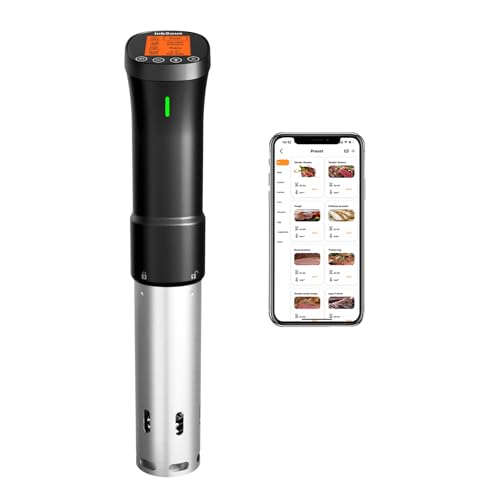
| Family-Friendly Smart Pick | Power: 1000 W | Temperature Range: 0–90 °C (32–194 °F) | Temperature Accuracy: ±0.1 °C (±1°F) | VIEW LATEST PRICE | Read Our Analysis |
More Details on Our Top Picks
Wancle 1100W Sous Vide Immersion Cooker (IPX7)
In case you want a compact, easy-to-use sous vide that heats quickly and fits small kitchens, the Wancle 1100W is a strong pick — its 1100W motor and 3D water circulation cut heat-up time and keep temperatures steady to ±0.1 °C, while the slim stainless-steel body and adjustable clip make it simple to mount and store. You’ll get precise 25–90 °C control, dual-display time/temperature readouts, and single-hand operation with a 30° angled touchscreen. IPX7 waterproofing lets you rinse it, and built-in overheat/current protections improve safety. It’s lightweight, compact, and includes a user manual and warranty support.
- Power:1100 W
- Temperature Range:25–90 °C
- Temperature Accuracy:±0.1 °C
- Timer / Max Time:1 minute–99 hours 59 minutes
- App / Remote Control:On‑unit touch controls (no app explicitly listed; reservation/delayed start)
- Construction / Material:Stainless steel housing/column; black finish
- Additional Feature:IPX7 rinse-safe waterproof
- Additional Feature:30° angled dual-display
- Additional Feature:Compact 40% smaller modules
INKBIRD WiFi Sous Vide Immersion Cooker ISV-100W
Should you want precise, restaurant-quality results with smartphone convenience, the INKBIRD WiFi Sous Vide ISV-100W is a smart pick. You’ll get 1000W fast heating, a 77–210°F (25–99°C) range with 0.1°C accuracy, and a calibration function to tweak offsets ±10°F. The compact metal circulator handles homogeneous temps for up to 20 L and runs ultra-quiet (<40 dB). Control it locally via the touch LCD or remotely over 2.4 GHz Wi‑Fi with the InkbirdPro app, which offers 14 presets. A 99-hour timer, recipe book, and warranty round out a focused, pro-minded cooker for home kitchens.
- Power:1000 W
- Temperature Range:25–99 °C (77–210 °F)
- Temperature Accuracy:0.1 °C
- Timer / Max Time:Up to 99 hours
- App / Remote Control:Wi‑Fi control via InkbirdPro app (2.4 GHz)
- Construction / Material:Metal body; black finish
- Additional Feature:Wi‑Fi remote control
- Additional Feature:Calibration adjustment function
- Additional Feature:Ultra‑quiet <40 dB
Anova Culinary Sous Vide Precision Cooker 3.0 (WiFi) 1100 Watts
Should you want restaurant-quality, edge-to-edge results with minimal fuss, the Anova Culinary Sous Vide Precision Cooker 3.0 (WiFi) is built for home cooks who prioritize precision and connectivity. You get an 1100-watt, third-generation circulator that maintains exact temperatures in a circulating water bath to eliminate overcooking. Dual-band WiFi and a two-line touch display keep control simple; you can set time and temp on the unit or via the Anova App. The adjustable clamp and removable stainless-steel skirt make setup and cleanup easy. Optional app subscription ($1.99/month or $9.99/year) adds recipes, guides, storage, and a two-week trial.
- Power:1100 W
- Temperature Range:(typical sous vide range; precise control to cook temps) — supports precise sous vide temps (manufacturer states precision control; upper range comparable to 1100W models)
- Temperature Accuracy:±0.1 °C
- Timer / Max Time:Up to 99 hours (app/control supports long cooks)
- App / Remote Control:Wi‑Fi control via Anova App (dual‑band Wi‑Fi)
- Construction / Material:Stainless steel (removable skirt) with black accents
- Additional Feature:Dual‑band Wi‑Fi
- Additional Feature:Removable stainless skirt
- Additional Feature:Two-line touch display
Anova Culinary Sous Vide Precision Cooker Nano 2.0
Perfect for home cooks who want restaurant-quality results without fuss, the Anova Culinary Sous Vide Precision Cooker Nano 2.0 gives you precise temperature control (0–92°C, accurate to ±0.1°C) in a compact, drawer-friendly package. You’ll lock in flavor and moisture across chicken, fish, vegetables, eggs, beef, lamb, and pork, avoiding overcooking with repeatable doneness. The 12.8″ unit clamps to pots, is made of durable plastic, and cleans easily. Control it on the cooker or remotely with the free Anova App; subscribe for chef lessons, extra recipes, and cook history (two-week free trial available).
- Power:(not explicitly listed) — lower‑power consumer model (Nano series; implied ~small footprint)
- Temperature Range:0–92 °C (32–197 °F)
- Temperature Accuracy:±0.1 °C (±0.2°F)
- Timer / Max Time:(supports long sous vide cooks via app/control; typical range up to ~99 hours)
- App / Remote Control:App control via Anova App (free; optional subscription)
- Construction / Material:Durable plastic body (compact form)
- Additional Feature:Drawer‑friendly compact length
- Additional Feature:Fixed pot clamp
- Additional Feature:Durable plastic housing
WiFi 2.4G Sous Vide Immersion Cooker (1000W)
For home cooks who want precise control from anywhere, the WiFi 2.4G Sous Vide Immersion Cooker (1000W) connects to the INKBIRD app so you can set, monitor, and adjust cooks remotely—with shared access for up to 100 family members. You’ll get 1000W rapid heating from a stainless steel column that reaches and holds 32°F–194°F (0°C–90°C) with ±1°F (0.1°C) precision. The 100-hour timer, preset and custom modes, and 14 built-in recipes simplify consistent results. Safety features include low-water automatic stop, temperature alerts, and a dry-heat alarm. A secure clamp, ultra-quiet <40 dB operation, and durable build finish the package.
- Power:1000 W
- Temperature Range:0–90 °C (32–194 °F)
- Temperature Accuracy:±0.1 °C (±1°F)
- Timer / Max Time:Up to 100 hours
- App / Remote Control:Wi‑Fi control via INKBIRD app (2.4 GHz)
- Construction / Material:Stainless steel heating column; durable construction
- Additional Feature:Low‑water automatic alarm
- Additional Feature:Share access (100 users)
- Additional Feature:Built‑in 14 recipes
Factors to Consider When Choosing a Sous Vide Immersion Cooker
Upon choosing a sous vide immersion cooker, you’ll want to check temperature range and accuracy, plus how fast the unit heats and holds steady. Consider connectivity and app control, build quality and materials, and practical things like size, clamp fit, and portability. Prioritizing the features that match how you cook will help you pick the right model.
Temperature Range & Accuracy
Although sous vide relies on gentle, consistent heat, you still need a cooker that hits the right range and holds it precisely. Choose a model that covers low‑temp precision (about 25–60°C) for delicate items and reaches higher temps (around 90–99°C) for pasteurization and quick finishes. Accuracy matters: aim for ±0.1°C (±0.2°F) or better whenever texture and safety depend on small differences. Verify the minimum and maximum set points and that the unit maintains stability over long cooks—hours to days—to avoid uneven doneness. Prefer devices with calibration or temperature‑offset features so you can match an external probe. Long‑term stability and minimal fluctuation, not just fast heating, deliver repeatable, professional sous‑vide results.
Heating Power & Speed
Consider wattage as the muscle behind your sous‑vide setup: higher power (around 1,000–1,100 W) gets big baths up to temp faster and recovers more quickly after you add food, while lower‑watt units are fine for small containers but struggle with large volumes or frequent heat shocks. You should match power to bath size—power‑to‑water ratio matters—since the same wattage performs better in a smaller container. Faster heat‑up and quicker recovery cut total cook time and keep temperature stable, essential for 15–20 L baths or whenever adding multiple or frozen items. Higher‑watt models possibly draw more electricity initially but can be more efficient long term through reducing runtime and temperature swings. Prioritize sufficient sustained power for consistent results over just high peak watts.
Connectivity & App Control
Tap into the app and you’ll see how connectivity converts a sous‑vide setup: Wi‑Fi models (usually 2.4 GHz) let you start, stop, and monitor cooks from anywhere, while Bluetooth limits you to near the device. Check which wireless mode the cooker supports and prefer Wi‑Fi for true remote control. Evaluate the companion app for remote start/stop, temp and time adjustments, presets, and live cook monitoring to streamline long or multi‑step recipes. Confirm multi‑user sharing and access controls provided that family members will use their phones. Look for firmware updates, calibration tools, and cook history or recipe storage to keep performance accurate and useful. Finally, assess connectivity reliability and reconnection behavior, and make certain the unit has local controls as a fallback.
Build Quality & Materials
Now that you’ve checked connectivity and app features, turn your attention to how the unit is built, because materials and construction determine durability, safety, and ease of upkeep. Look for corrosion‑resistant materials—stainless steel for the heating tube and any food‑contact parts—to guarantee longevity and simple cleaning. Check the outer housing and clamp: metal or high‑grade thermoplastic resists heat and repeated use while keeping the unit firmly attached. Prefer models with IPX7 or similar ratings and sealed electronics to guard against steam and splashes. Removable stainless‑steel skirts or detachable components make maintenance and dishwasher cleaning easier. Finally, verify integrated safety protections—overheat, current protection, and low‑water cutoff—and sturdy internal parts to reduce failure risk over time.
Size, Clamp, Portability
Balancing size, clamp design, and portability matters more than you might envision while choosing a sous vide immersion cooker: a compact unit slides into drawers or travel bags, an adjustable clamp fits various pot rims and depths, and the total length determines whether the heating column can reach and circulate properly in your usual cookware. You’ll want a small footprint for easy storage and travel, plus a clamp—adjustable or fixed—that grips different rim thicknesses and pot depths to prevent tipping during long cooks. Check immerse depth and minimum water level so circulation works in your typical pots. Favor lightweight models with single‑hand operation should you move the unit often. Finally, pick corrosion‑resistant clip and body materials for durability across pots and portable setups.
Safety Features & Alerts
Because sous vide runs long and unattended at precise temperatures, safety features and clear alerts are critical so you don’t come back to a hazard. You should pick a cooker with automatic shutoff and low‑water detection that kills the heater and sounds an alarm in case levels fall below the minimum to prevent dry heating. Look for overheat protection and current/short‑circuit safeguards to lower fire and electrical risks during extended cooks. Confirm a reliable waterproof rating (for example, IPX7) or rinse‑safe construction so splashes won’t short electronics. Prefer units that give audible alarms plus app or on‑device alerts for reached temperature, low water, or faults. Finally, verify a secure clamp and stable attachment to stop tipping or exposing hot elements.
Timer, Presets, Controls
When you’ll be leaving a cook running for hours, pick a cooker with a timer that covers the durations you actually use (some stop at about 99 minutes, others go to 100+ hours) and that lets you set minutes and hours precisely—ideally in an hours:minutes format like 99:59. Check the maximum duration so long braises or multi‑day cooks aren’t cut short. Prefer minute‑level precision and ability to enter hours:minutes. Should you want simplicity, choose models with useful preset programs that auto‑select temperature and time for common proteins. Look for delayed‑start or reservation functions to schedule a later beginning. Finally, evaluate the control interface—physical dial, on‑device touch, or app/Wi‑Fi—and whether it displays both time and temperature simultaneously for easy monitoring.
Noise Level & Reliability
In case you plan to run sous vide cooks for hours, pick a unit that stays quiet—aim for reported operating noise under about 40 dB—so it won’t be a constant background nuisance, especially in open kitchens or overnight sessions. You should also prioritize reliable construction: durable housings, sealed controls, and splash‑resistant or IPX7 ratings cut moisture damage risk. Look for built‑in protections like overheat and current cutoff to prevent failures during extended runs. Check mounting hardware—robust clamps and secure attachment systems reduce falls that cause malfunctions. Finally, read user reports and warranty terms to confirm consistent temperature accuracy and low failure rates over time. That combination gives you quiet operation plus long‑term dependability.
