

Like picking a trusted wristwatch, you want a temperature sensor that quietly gets it right. You’ll want accuracy, reliable connectivity, sensible battery life, and deployment flexibility that fits your space. I’ll walk you through five top 2026 picks—each with distinct strengths—so you can spot which one matches your needs and budget.
| Govee Bluetooth Indoor Hygrometer & Thermometer (Grey) |
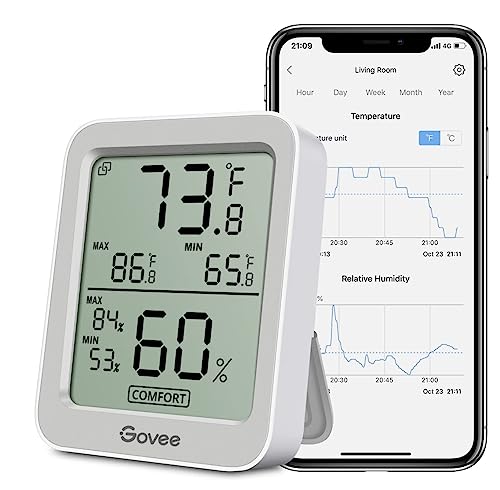
| Compact & Simple | Measures Temperature: Real-time temperature (±0.54°F / Swiss sensor) | Measures Humidity: Relative humidity (±3% RH) | App Connectivity / Mobile App: Govee Home app (Bluetooth; remote monitoring via app) | VIEW LATEST PRICE | Read Our Analysis |
| SwitchBot Wi‑Fi Humidity & Temperature Sensor 4‑Pack |

| Best for Automation | Measures Temperature: Temperature (±0.2°C / ±0.36°F; Swiss Sensirion) | Measures Humidity: Relative humidity (±1.8% RH; Sensirion) | App Connectivity / Mobile App: SwitchBot app via Hub 2 (Wi‑Fi/Matter remote access) | VIEW LATEST PRICE | Read Our Analysis |
| Govee WiFi Temperature & Humidity Sensor 2-Pack |

| Remote Monitoring Pick | Measures Temperature: Temperature (±0.54°F / ±0.3°C; Swiss sensor) | Measures Humidity: Relative humidity (±3% RH) | App Connectivity / Mobile App: Govee Home app (WiFi & Bluetooth; widgets) | VIEW LATEST PRICE | Read Our Analysis |
| SensorPush HT1 Smart Temp & Humidity Sensor |

| Precision Bluetooth Choice | Measures Temperature: Temperature (±0.3°C; HT1 sensor) | Measures Humidity: Relative humidity (included; ±0.3°C accuracy for temp) | App Connectivity / Mobile App: SensorPush app (Bluetooth; unlimited in‑app cloud with G1 gateway) | VIEW LATEST PRICE | Read Our Analysis |
| YoLink Smart Temperature & Humidity Sensor 3-Pack |

| Long‑Range Reliability | Measures Temperature: Temperature (wide range; suitable for fridge-to-outdoor uses) | Measures Humidity: Relative humidity (included; suitable for many environments) | App Connectivity / Mobile App: YoLink app (requires YoLink hub for full functionality) | VIEW LATEST PRICE | Read Our Analysis |
More Details on Our Top Picks
Govee Bluetooth Indoor Hygrometer & Thermometer (Grey)
Should you want a reliable, easy-to-use indoor sensor for monitoring temperature and humidity across rooms or small spaces, the Govee Bluetooth Indoor Hygrometer & Thermometer (Grey) is a strong pick — its Swiss-made hygrometer and ±0.54°F/±3% RH accuracy give you trustworthy readings, while Bluetooth range up to 196 ft and real-time alerts via the Govee Home app let you keep tabs remotely and act fast anytime conditions drift. You’ll pair it through the app (H5075), see live values on a 3-inch LCD, track max/min and comfort levels, view curve graphs, export up to two years of CSV data, and rely on 2-second refreshes.
- Measures Temperature:Real-time temperature (±0.54°F / Swiss sensor)
- Measures Humidity:Relative humidity (±3% RH)
- App Connectivity / Mobile App:Govee Home app (Bluetooth; remote monitoring via app)
- Alerts / Notifications:App alerts when values outside preset range (notifications)
- Data Export / Logging:20 days online view; export up to 2 years CSV
- Battery / Power:Battery powered (batteries included with device details)
- Additional Feature:3-inch LCD screen
- Additional Feature:3-level comfort indicator
- Additional Feature:196 ft Bluetooth range
SwitchBot Wi‑Fi Humidity & Temperature Sensor 4‑Pack
In case you need fast, reliable multi‑point monitoring for indoor and outdoor spaces, the SwitchBot Wi‑Fi Humidity & Temperature Sensor 4‑Pack is a smart choice—its IP65 rating and four industrial‑grade Swiss Sensirion sensors deliver frequent (4‑second) updates and ±0.2°C/±1.8% RH accuracy, so you can confidently track conditions across kitchens, greenhouses, wine cellars, instrument cases, and more. You’ll get dew point, VPD, and absolute humidity readings, plus real‑time alerts and preset thresholds via the app. The pack pairs quickly with the included Hub 2 (Matter), offers 68 days onboard storage, unlimited cloud backups, free exports, and broad voice/home integration.
- Measures Temperature:Temperature (±0.2°C / ±0.36°F; Swiss Sensirion)
- Measures Humidity:Relative humidity (±1.8% RH; Sensirion)
- App Connectivity / Mobile App:SwitchBot app via Hub 2 (Wi‑Fi/Matter remote access)
- Alerts / Notifications:App preset threshold alerts and real‑time notifications
- Data Export / Logging:On‑board 68 days; unlimited cloud storage; free export via app
- Battery / Power:Battery powered sensors (4‑pack); Hub 2 provides gateway power
- Additional Feature:Includes Hub 2 (Matter)
- Additional Feature:Measures VPD and dew point
- Additional Feature:IP65 water/dustproof
Govee WiFi Temperature & Humidity Sensor 2-Pack
Provided you need reliable remote monitoring with fast updates, the Govee WiFi Temperature & Humidity Sensor 2-Pack is ideal because its Swiss-made sensors refresh every 2 seconds and stream data over WiFi so you can check conditions from anywhere. You get two H5179 sensors, lanyard loops, batteries, and a manual. Connect via WiFi or Bluetooth in the Govee Home app (no 5G), view widgets, and adjust settings over Bluetooth. Accuracy is ±0.54°F/±0.3°C and ±3% RH. Set alerts for out-of-range readings. The app stores 20 days online and lets you export up to two years of trend data.
- Measures Temperature:Temperature (±0.54°F / ±0.3°C; Swiss sensor)
- Measures Humidity:Relative humidity (±3% RH)
- App Connectivity / Mobile App:Govee Home app (WiFi & Bluetooth; widgets)
- Alerts / Notifications:App alerts when temp/humidity outside set ranges
- Data Export / Logging:20 days online view; export up to 2 years historical data
- Battery / Power:Includes 3 AA batteries per sensor (pack includes batteries)
- Additional Feature:WiFi + Bluetooth connectivity
- Additional Feature:Widget support
- Additional Feature:2-pack with batteries included
SensorPush HT1 Smart Temp & Humidity Sensor
In case you need precise, battery-powered temperature and humidity monitoring with easy local access, the SensorPush HT1 is a great pick—its ±0.3°C accuracy, Bluetooth range up to 100 m line-of-sight, and compact wall-mount design make it ideal for homeowners and hobbyists who want reliable readings for fridges, wine cellars, grow tents, or instruments without constant cloud dependency. You’ll get temperature, humidity, heat index, dew point, and VPD with on-board 20-day logging and unlimited app storage. Setup takes seconds, Bluetooth is stable, and battery life runs 1–2 years. Add the optional G1 gateway for remote access and continuous cloud upload.
- Measures Temperature:Temperature (±0.3°C; HT1 sensor)
- Measures Humidity:Relative humidity (included; ±0.3°C accuracy for temp)
- App Connectivity / Mobile App:SensorPush app (Bluetooth; unlimited in‑app cloud with G1 gateway)
- Alerts / Notifications:App alerts (including remote/cloud when using gateway)
- Data Export / Logging:20 days on‑device; unlimited in‑app storage with gateway; export supported
- Battery / Power:Single lithium metal battery; typical 1–2 years battery life
- Additional Feature:Optional G1 WiFi Gateway
- Additional Feature:100 m Bluetooth range
- Additional Feature:Heat index and VPD
YoLink Smart Temperature & Humidity Sensor 3-Pack
Provided you need ultra-long-range, low-power temperature monitoring that won’t clog your home WiFi, the YoLink 3-pack is a smart choice because it uses a LoRa-based protocol and runs for years on AAA batteries, making it ideal for fridges, outbuildings, multi-floor homes, and remote spots like chicken coops or gun safes. You’ll need a YoLink hub (SpeakerHub or original Hub) for app control and alerts. Place sensors indoors or use weatherproof versions outdoors. Get app, email, SMS, and push alerts; Alexa can report temperature; IFTTT enables automations. The three-sensor kit is economical and expands within YoLink’s ecosystem.
- Measures Temperature:Temperature (wide range; suitable for fridge-to-outdoor uses)
- Measures Humidity:Relative humidity (included; suitable for many environments)
- App Connectivity / Mobile App:YoLink app (requires YoLink hub for full functionality)
- Alerts / Notifications:App push/email/SMS/critical alerts and IFTTT triggers
- Data Export / Logging:Logged data via hub/app; batteries last 2+ years (hub enables remote logging/export)
- Battery / Power:Two AAA batteries included per sensor; 2+ years battery life
- Additional Feature:LoRa long-range protocol
- Additional Feature:Hub-required ecosystem
- Additional Feature:Apple Critical Alert-style notifications
Factors to Consider When Choosing a Smart Temperature Sensor
Upon selecting a smart temperature sensor, you should prioritize accuracy and precision, then check connectivity options like Wi‑Fi, Bluetooth, or Zigbee to match your setup. Consider battery life expectations and data logging capacity so the device runs reliably and stores the history you need. Finally, confirm alert and notification options to make sure you’ll get timely warnings where and how you want them.
Accuracy And Precision
Although you could assume all smart temperature sensors report the same numbers, their stated accuracy and precision can vary enough to affect decisions and results, so check specs like temperature accuracy (e.g., ±0.3°C), humidity accuracy (e.g., ±3% RH), resolution, refresh rate, calibration traceability, and environmental influences before buying. You should confirm temperature and humidity accuracy meet your tolerances, noting resolution and refresh rate so transient events and fine changes aren’t missed. Prefer sensors with calibrated, traceable references or proven sensing elements (precision CMOS, Sensirion-style) for long-term stability and low drift. Use on-board logging and export to compare against reference instruments and correct systematic offsets. Finally, account for placement, airflow, radiation and condensation — use shielding or averaging to get repeatable, representative readings.
Connectivity Options
Pick the connectivity that matches how and where you’ll use the sensor, because wireless protocol, hub requirements, and ecosystem support determine range, power draw, latency, and integration options. Decide between local protocols (Bluetooth, Zigbee, LoRa) and Wi‑Fi: Bluetooth gives low power and direct phone access but limited range; Wi‑Fi allows remote access and frequent uploads without a hub but uses more power and can congest networks. Check whether a hub or gateway is required for cloud storage and smart‑home integrations—hubless sensors often only offer local/Bluetooth access. Verify supported ecosystems and standards (Matter, HomeKit, Alexa, Google) for voice control and automations. Finally, match wireless range and environmental ratings to placement—LoRa for long distances, IP‑rated radios for outdoor use.
Battery Life Expectations
Expect battery life to vary widely—anything from a few months to several years—depending on battery type, wireless protocol, and how often the sensor reports data. You’ll get longer runtimes with larger cells (AAA) and strict power management; coin cells are fine for low-duty devices but won’t last as long under heavy use. Choose low‑power radios like LoRa or BLE and use local gateways to avoid constant Wi‑Fi transmissions, which drain batteries fast. Reduce reporting frequency and disable continuous cloud uploads or high‑frequency sampling to conserve power. Keep in mind environmental extremes and extra measurements (humidity, dew point, VPD) can degrade battery performance, so factor in margins for cold or hot deployments and any additional sensing tasks during estimating real‑world lifespan.
Data Logging Capacity
Battery life and reporting cadence shape what you can actually record, so you should next look closely at a sensor’s data logging capacity. Check onboard buffer size and cloud storage limits—some devices keep only days locally while others retain weeks, months, or years for trend analysis. Verify refresh and logging intervals: seconds-level sampling gives high-resolution trends but eats storage and power; minute-level logs save space for long-term monitoring. Confirm export options (CSV, JSON) and that export history retention meets your offline analysis needs. Make sure local logging continues during connectivity outages and observe how long it holds data before overwriting. Finally, match capacity to goals: high-frequency short bursts for events, lower-frequency long retention for climate assessment.
Alert And Notification Options
At the point a temperature spike or humidity dip matters, you’ll want alerts that reach you immediately and reliably—check that the sensor can push notifications to your phone and send emails, SMS, or in-home alarms once readings cross your custom thresholds. Verify supported channels (app push, email, SMS, critical-priority phone alerts, in-home sirens) and confirm notification latency so readings reflect near-real-time conditions—seconds versus minutes matters. Look for per-recipient or per-device thresholds and scheduling so different team members or rooms get customized alerts. Make certain multi-recipient dispatch and that alerts can trigger automated remediation via routines, IFTTT, or scenes (vent fans, alarms). Test reporting frequency, failover behavior, and whether urgent alerts override do-not-disturb for reliable delivery.
Smart Home Integration
How will the sensor fit into your existing smart-home setup? Check which protocols it supports (Wi‑Fi, Bluetooth, Matter, Z‑Wave, Zigbee, LoRa) because compatibility affects range, remote access, and network load. Verify whether it needs a hub or gateway and whether that hub provides voice-assistant links, cloud access, or ecosystem bridging. Confirm compatibility with Alexa, Google Home, HomeKit, SmartThings, or IFTTT so readings can trigger routines or answer voice queries. Prefer sensors that support local automation and scene conditions so HVAC, dehumidifiers, or fans can be triggered without cloud dependence for lower latency and better privacy. Finally, make sure reporting frequency, data-export options, and available APIs meet your needs for logging and advanced third‑party dashboards.
Build Quality And Durability
Once you’ve confirmed protocol compatibility and automation options, pay close attention to build quality and durability—especially whether the sensor will face outdoor elements, high humidity, or frequent handling. Choose units with ingress protection ratings (IP65 or higher) for dust, splashes, or outdoor exposure to guarantee long-term reliability. Prefer industrial-grade sensing elements and solid enclosures to minimize drift and preserve accuracy across temperature and humidity swings. For humid or refrigerated settings, pick corrosion-resistant materials and sealed battery compartments. Consider expected battery life and whether batteries are user-replaceable to lower maintenance in remote spots. Finally, evaluate mounting options and physical dimensions—wall mounts, lanyards, or compact footprints—so you can fasten the sensor where vibration, knocks, or environmental stressors occur.
Deployment And Range
Because wireless range and placement determine whether a sensor reliably reports data, plan deployment around protocol limits, antenna performance, and environmental obstacles. Verify the wireless protocol and required gateway — Bluetooth gives tens of meters line‑of‑sight, Wi‑Fi covers typical home ranges but depends on router placement, and LoRa can reach kilometers in open air. Consider indoor vs outdoor placement and choose dust/water resistance plus longer antenna range for harsh conditions. Account for building materials and interference — concrete, metal, and crowded 2.4 GHz bands can cut range dramatically. Space sensors and site gateways so each stays within practical range plus a margin; add repeaters or extra gateways for multi‑floor or sprawling sites. Recall reporting frequency and wireless mode affect battery life and link requirements.
