

Should you’re shopping for a home RO system in 2026, you’ll want a unit that balances water quality, efficiency, and verified certifications. This list highlights five top picks—from compact countertop models to high‑flow tankless systems—so you can compare features like recovery rate, remineralization, and third‑party testing. Keep an eye on ongoing costs and real‑world performance, because the best choice often depends on your water and household needs.
| Bluevua RO100ROPOT 5-Stage Countertop Reverse Osmosis System |

| Portable & Premium | System Type: Countertop RO system (portable) | Filtration Stages / Remineralization: 5-stage RO with remineralization | Certification / Standards: ClimatePartner certification (manufacturer-certified sustainability) and manufacturer testing claim | VIEW LATEST PRICE | Read Our Analysis |
| iSpring RCC7AK 6-Stage Alkaline RO System Under-Sink |

| Best For Remineralization | System Type: Under-sink RO system (under-sink with top-mounted fastener) | Filtration Stages / Remineralization: 6-stage RO with alkaline (AK) remineralization | Certification / Standards: NSF/ANSI 58 certified (entire RO system) | VIEW LATEST PRICE | Read Our Analysis |
| Waterdrop G3P800 Tankless Under-Sink RO System |
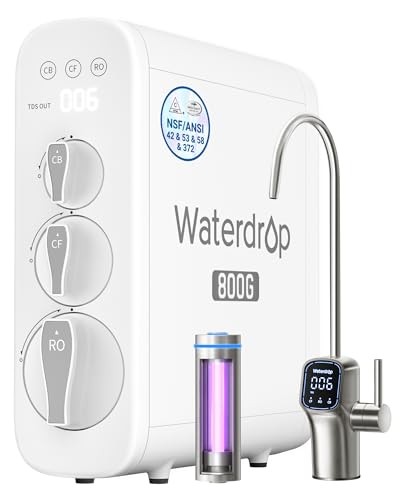
| High-Capacity Fast Flow | System Type: Tankless under-sink RO system | Filtration Stages / Remineralization: 10-stage RO (multi-stage) including post-treatment | Certification / Standards: IAPMO R&T certified to NSF/ANSI 58, also NSF/ANSI 42/53/372 | VIEW LATEST PRICE | Read Our Analysis |
| Waterdrop G2 7-Stage Tankless RO Under-Sink System |

| Space-Saving Efficiency | System Type: Tankless under-sink RO system | Filtration Stages / Remineralization: 7-stage composite RO | Certification / Standards: NSF/ANSI 372 certified (lead-free materials) and RO membrane claims | VIEW LATEST PRICE | Read Our Analysis |
| VIOMI Tankless 9-Stage Reverse Osmosis Water System |
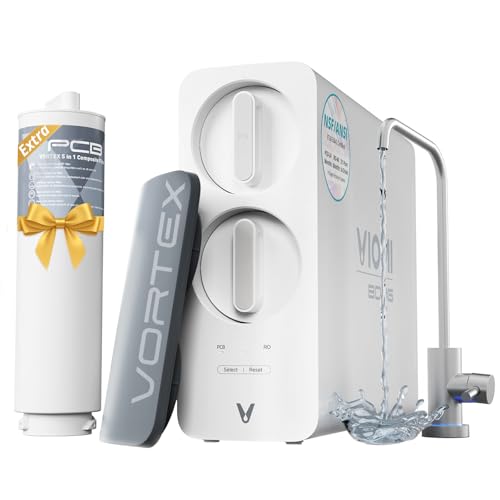
| Advanced Filtration | System Type: Tankless under-sink RO system | Filtration Stages / Remineralization: 9-stage RO | Certification / Standards: NSF/ANSI 372, 53, 42 certified | VIEW LATEST PRICE | Read Our Analysis |
More Details on Our Top Picks
Bluevua RO100ROPOT 5-Stage Countertop Reverse Osmosis System
Should you want a truly portable RO unit that gives near–bottled quality without any plumbing, the Bluevua RO100ROPOT is a smart pick: its 5-stage countertop system, glass carafe, and 2:1 pure-to-drain efficiency make it ideal for renters, small kitchens, or anyone who wants powerful contaminant removal and easy setup without permanent installation. You’ll get 99.9% contaminant removal plus remineralization for balanced taste and health. It plugs in, uses an automatic power-saving standby, and treats leftover cycle water as usable to conserve resources. Filters last 12–24 months with a built-in monitor, and a ClimatePartner-certified design reduces plastic waste.
- System Type:Countertop RO system (portable)
- Filtration Stages / Remineralization:5-stage RO with remineralization
- Certification / Standards:ClimatePartner certification (manufacturer-certified sustainability) and manufacturer testing claim
- Waste Efficiency (Pure-to-Drain Ratio):2:1 pure-to-drain ratio
- Installation Requirements / Location:No plumbing; portable countertop (plugs into any power source)
- Filter Life / Maintenance:Filters last ~12–24 months; built-in filter life/water-quality monitor
- Additional Feature:Portable countertop design
- Additional Feature:High borosilicate carafe
- Additional Feature:Automatic power-saving standby
iSpring RCC7AK 6-Stage Alkaline RO System Under-Sink
In case you want near-complete contaminant removal plus restored mineral balance, the iSpring RCC7AK is a strong under-sink choice: its NSF/ANSI 58–certified RO stages cut TDS, PFAS, chlorine, and heavy metals at well over 90%, then a patent-pending alkaline stage reintroduces minerals and raises pH for a spring-water taste. You’ll appreciate DIY-friendly quick-fit connections, a clear manual, and top-mounted fastener that lets you install the faucet entirely from above. The clear first-stage housing helps you monitor buildup. It delivers 75 GPD, removes fluoride, lead, chromium and many others at >97–99% rates, and offers staggered replacement kits plus lifetime Atlanta support.
- System Type:Under-sink RO system (under-sink with top-mounted fastener)
- Filtration Stages / Remineralization:6-stage RO with alkaline (AK) remineralization
- Certification / Standards:NSF/ANSI 58 certified (entire RO system)
- Waste Efficiency (Pure-to-Drain Ratio):(Not explicitly stated) High-efficiency RO (system specs: 75 GPD production) — no explicit ratio provided
- Installation Requirements / Location:Under-sink installation (patented top-mounted fastener allows above-counter installation from top)
- Filter Life / Maintenance:Replacement schedules (F4AK 6-month, F9K 1-year, F19K75 2-year, F28K75 3-year); lifetime tech support
- Additional Feature:Top-mounted fastener
- Additional Feature:Transparent prefilter housing
- Additional Feature:75 GPD production capacity
Waterdrop G3P800 Tankless Under-Sink RO System
Should you want fast, on-demand purified water without a bulky storage tank, the Waterdrop G3P800 is a strong pick—its tankless design delivers up to 800 GPD and fills a cup in about five seconds, so you won’t have to wait for filtered water. You get 10-stage SGS-verified filtration and an RO membrane that trims PFAS, fluoride, lead, chromium, nitrates, radium, and other contaminants. Certifications include NSF/ANSI 58, 42, 53, and lead-free NSF/ANSI 372. The smart faucet shows TDS and water quality with a long-life LED. Installation needs two drilled holes; a 30-day price protection applies. The pure-to-drain ratio is 3:1.
- System Type:Tankless under-sink RO system
- Filtration Stages / Remineralization:10-stage RO (multi-stage) including post-treatment
- Certification / Standards:IAPMO R&T certified to NSF/ANSI 58, also NSF/ANSI 42/53/372
- Waste Efficiency (Pure-to-Drain Ratio):3:1 pure-to-drain ratio
- Installation Requirements / Location:Under-sink installation; requires drilling holes for faucet and drain; needs electricity
- Filter Life / Maintenance:Multi-stage filters with long service intervals (manufacturer lab-verified 10-stage) — smart faucet indicates quality (replacement intervals implied)
- Additional Feature:800 GPD capacity
- Additional Feature:Smart LED TDS faucet
- Additional Feature:Tankless continuous flow
Waterdrop G2 7-Stage Tankless RO Under-Sink System
Should you want a compact, fast, and efficient under‑sink RO that saves space and cuts waste, the Waterdrop G2 is built for small kitchens and busy households. You’ll get NSF/ANSI 372 lead-free materials and a 7-stage composite filter that lowers TDS and removes PFAS, PFOA, PFOS, vinyl chloride, and other contaminants per the RO membrane manual. The tankless unit delivers up to 400 GPD, a cup in ~12 seconds, and a 1:1 drain ratio that cuts waste dramatically. It’s tankless to save over 70% under‑sink space, uses integrated circuits to limit leaks and noise, and swaps filters in seconds.
- System Type:Tankless under-sink RO system
- Filtration Stages / Remineralization:7-stage composite RO
- Certification / Standards:NSF/ANSI 372 certified (lead-free materials) and RO membrane claims
- Waste Efficiency (Pure-to-Drain Ratio):1:1 low drain ratio
- Installation Requirements / Location:Under-sink installation; requires electrical outlet and drilling holes
- Filter Life / Maintenance:Two replacement filters included; twist-and-pull filters with quick replacement; install time under 30 minutes
- Additional Feature:1:1 low drain ratio
- Additional Feature:Twist-and-pull filters
- Additional Feature:Under-30-minute install
VIOMI Tankless 9-Stage Reverse Osmosis Water System
Choose the VIOMI Tankless 9-Stage RO whether you want fast, space-saving purified water—its tankless under-sink design frees up 65% of cabinet space while supplying an 800 GPD-equivalent flow that fills a 7 oz cup in about 6 seconds. You get NSF/ANSI 372, 53, and 42 certified 9-stage RO with 0.0001 μm precision, cutting TDS up to 90.35% and PFOS/PFOA up to 99.60% (SGS tested). Installation is compact and quick—four steps, ~20 minutes—though it needs power and two drilled holes. It delivers a 3:1 pure-to-drain ratio, tool-free filter changes, and a 48-month combined filter life.
- System Type:Tankless under-sink RO system
- Filtration Stages / Remineralization:9-stage RO
- Certification / Standards:NSF/ANSI 372, 53, 42 certified
- Waste Efficiency (Pure-to-Drain Ratio):3:1 pure-to-drain ratio
- Installation Requirements / Location:Under-sink installation; requires electrical outlet and two drilled holes
- Filter Life / Maintenance:Includes multiple pre-installed filters; total filter service life up to 48 months; tool-free replacement with LED indicator
- Additional Feature:800 GPD equivalent flow
- Additional Feature:Tool-free replacements
- Additional Feature:Long 48-month filter life
Factors to Consider When Choosing an RO Water Purifier for Home
Upon selecting an RO purifier for your home, you’ll want to compare filtration performance metrics and contaminant removal capabilities to match your water quality needs. Consider installation and space needs plus water efficiency ratios so the system fits your kitchen and won’t waste water. Don’t forget maintenance and filter life, since ongoing costs and service frequency affect long-term value.
Filtration Performance Metrics
Although performance specs can feel technical, focusing on a few key metrics will make it easy to compare RO systems and pick one that fits your home’s needs. Check TDS reduction—effective units remove >90%, many achieving 93–99%—so you know overall mineral and salt removal. Look for third-party or NSF/ANSI certifications (58, 42, 53) that verify claims. Review lab-verified removal rates for specific concerns like PFAS, fluoride, lead, chromium and nitrates; targeted reductions are often >95% or >99%. Consider the pure-to-drain (recovery) ratio: a 1:1–3:1 or better reduces wastewater and operating cost. Finally, guarantee production capacity and flow rate (GPD or fill-times ~5–12 seconds per cup) meet your household demand.
Contaminant Removal Capabilities
After checking performance metrics, you’ll want to confirm which specific contaminants the system actually removes and through how much. Check certified reduction rates—RO membranes often cut TDS by 90%+, fluoride ~97%, and PFAS 95%+ in validated tests—so match those figures to your water report. Look for third‑party certifications (NSF/ANSI 58, 42, 53) that verify claims for chlorine, lead, VOCs, and microbial contaminants. Confirm stated removal percentages for heavy metals and ions (lead, chromium, barium, cadmium) — many show >95% removal upon validation. Consider membrane pore size (typical RO ≈0.0001 μm) and pre/post filters, since finer ratings remove bacteria, viruses, and dissolved solids. Finally, review lab reports for emerging contaminants (PFAS, nitrates, VOCs) to make certain real-world efficacy.
Installation And Space Needs
Because space and access determine how smoothly an RO system fits into your home, measure under‑sink or countertop areas initially and decide whether a tankless or tanked model will work. Tankless units save about 65–70% of under‑sink space, but you’ll still need a nearby electrical outlet for many models. Check plumbing access and expect to drill one or two holes for a dedicated faucet and drain on most installations. For countertop or portable units, confirm they don’t need permanent hookups and can sit or be moved easily. Account for faucet clearance and countertop thickness so mounting and maintenance are practical. In case you install under‑sink, allow a few inches front‑to‑back for filter changes and routing around pipes or a garbage disposal.
Water Efficiency Ratios
Often, you’ll want to start checking a system’s pure-to-drain (recovery) ratio, since it directly affects how much usable water you get versus waste. Look for modern RO units with recovery around 1:1 to 3:1; older models can be 1:2 or worse, producing much more wastewater per liter purified. A higher recovery (for example 3:1) gives you more potable water and lowers monthly water use. Consider whether the concentrate (waste) can be routed for non-potable uses like toilet flushing or irrigation to effectively improve overall efficiency. Keep in mind actual recovery depends on feed TDS, incoming pressure, and membrane type, so verify realistic performance.
Maintenance And Filter Life
Whenever you’re choosing an RO system, plan for staggered filter replacements and routine checks so the unit keeps producing safe, good-tasting water. Expect pre-filters to last about 6–12 months, RO membranes 12–36 months, and remineralization or chemical cartridges varying between those intervals. Monitor life with built-in indicators or whenever testing TDS; rising TDS or taste changes usually signal membrane or post-filter decline even before scheduled swaps. Follow manufacturer flush and sterilization routines—sanitize and flush after changes to prevent biofilm. Keep spare filters and log installation dates; many systems use color-coded or time-based intervals (6, 12, 24 months) to simplify planning. Prioritize tool-free, easy-replacement designs to cut downtime and installation errors that shorten component life.
Certifications And Safety
While you’re comparing RO units, prioritize verified certifications and independent test results so you know a system actually removes the contaminants you care about and won’t introduce new ones. Look for NSF/ANSI labels—42 for chlorine/taste, 53 for health-related contaminants, 58 for RO performance, and 372 for lead-free materials. Don’t accept manufacturer claims alone: request third‑party lab reports showing reductions for PFAS, fluoride, lead, and TDS percentage. Make certain all wetted materials are certified lead‑free and low‑leach to avoid secondary contamination from housings, faucets, or tubing. Choose systems with TDS or sensor readouts and filter‑life indicators so you’ll replace cartridges on schedule. Finally, confirm warranty coverage and third‑party validations (IAPMO, SGS) that back performance and provide recourse.
