

You’ll want a thermostat that’s compatible with your HVAC and smart home, easy to control remotely, and energy-efficient. Top picks include ecobee Smart Thermostat Essential and Google Nest for seamless voice and app control. DIGITEN suits specialized needs like greenhouses. Vine and Heagstat offer versatile Wi-Fi control, while Sensi Touch adds Alexa support and flexible scheduling. Each balances convenience, savings, and smart features. Keep exploring to find the perfect fit for your setup.
| ecobee Smart Thermostat Essential Wi-Fi Compatible |

| Best for Energy Savings | Connectivity Type: Wi-Fi | HVAC System Compatibility: ~85% of 24 VAC HVAC systems (gas, oil, electric, dual fuel, forced air) | Remote Control Capability: Via ecobee app and voice assistants (Alexa, Google Assistant, Siri) | VIEW LATEST PRICE | Read Our Analysis |
| Google Nest Smart Programmable WiFi Thermostat |

| Best Smart Integration | Connectivity Type: Wi-Fi, Bluetooth Low Energy (BLE) | HVAC System Compatibility: Most systems; some require C-wire or power accessory (heat pump, heating/cooling, zone controlled) | Remote Control Capability: Via Google Home app, voice control (Google Assistant, Alexa, Matter-certified) | VIEW LATEST PRICE | Read Our Analysis |
| DIGITEN Wireless Programmable Thermostat for Home & Greenhouse |
| Best for Specialty Use | Connectivity Type: Infrared (IR) | HVAC System Compatibility: Heating and cooling devices, air conditioners; general thermostat plug/receiver | Remote Control Capability: Remote control via IR remote included | VIEW LATEST PRICE | Read Our Analysis |
| Vine Smart WiFi Thermostat for Home Alexa Compatible |

| Best Compatibility | Connectivity Type: Wi-Fi | HVAC System Compatibility: Compatible with 90% of 24V AC systems including conventional and heat pump | Remote Control Capability: Via Vine Thermostat App, Smart Life App, voice assistants (Alexa, Google Home) | VIEW LATEST PRICE | Read Our Analysis |
| Heagstat WiFi Single-Stage Thermostat with App Control |

| Best Single-Stage Control | Connectivity Type: Wi-Fi | HVAC System Compatibility: Single-stage heating and cooling (1H/1C) only | Remote Control Capability: Via smartphone app | VIEW LATEST PRICE | Read Our Analysis |
| Sensi Touch 2 Smart Thermostat with Alexa Support |

| Best User-Friendly Setup | Connectivity Type: Wi-Fi, Bluetooth | HVAC System Compatibility: Most residential HVAC equipment (C-wire required) | Remote Control Capability: Via Sensi app and Alexa voice control | VIEW LATEST PRICE | Read Our Analysis |
More Details on Our Top Picks
ecobee Smart Thermostat Essential Wi-Fi Compatible
On occasions you often want to save on heating and cooling costs without sacrificing comfort, the ecobee Smart Thermostat Essential is an ideal choice. It can cut your energy bills up to 23% annually through adjusting to your schedule and using built-in eco+ features like indoor humidity sensing and time-of-use preheat. You can control it via a color touchscreen or the ecobee app, which also tracks your energy consumption. Compatible with about 85% of HVAC systems, it supports gas, oil, electric, and heat pumps. Plus, it works with Siri, Alexa, and Google Assistant for seamless smart home integration.
- Connectivity Type:Wi-Fi
- HVAC System Compatibility:~85% of 24 VAC HVAC systems (gas, oil, electric, dual fuel, forced air)
- Remote Control Capability:Via ecobee app and voice assistants (Alexa, Google Assistant, Siri)
- Programmability:Schedule assistant with eco+ features for energy savings
- Power Requirements:No C-wire required (with Power Extender Kit option)
- Display Type:Color touchscreen
- Additional Feature:Built-in eco+ features
- Additional Feature:Supports SmartSensor add-ons
- Additional Feature:Free software upgrades
Google Nest Smart Programmable WiFi Thermostat
You’ll appreciate the Google Nest Smart Programmable WiFi Thermostat provided that you want seamless control over your home’s temperature from anywhere. This sleek, round device offers voice control via Google Assistant, Alexa, or Matter-certified assistants, plus app access on Android, iOS, and web. Its ENERGY STAR certification and Auto Eco mode help lower energy use through adjusting settings while you’re away. Installation is straightforward and DIY-friendly, usually under 30 minutes. You’ll get HVAC alerts, maintenance notifications, and smart scheduling to optimize comfort and savings. Just confirm compatibility with your system, especially provided that you lack a C wire or have specialized HVAC setups.
- Connectivity Type:Wi-Fi, Bluetooth Low Energy (BLE)
- HVAC System Compatibility:Most systems; some require C-wire or power accessory (heat pump, heating/cooling, zone controlled)
- Remote Control Capability:Via Google Home app, voice control (Google Assistant, Alexa, Matter-certified)
- Programmability:Programmable schedules with Savings Finder suggestions
- Power Requirements:Designed to work without C-wire in most homes; some systems may require C-wire or power accessory
- Display Type:LCD with backlight, button control
- Additional Feature:ENERGY STAR certified
- Additional Feature:HVAC system alerts
- Additional Feature:Nest Renew clean energy
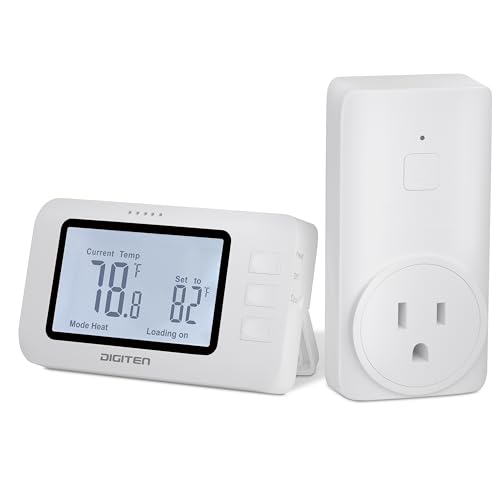
DIGITEN Wireless Programmable Thermostat for Home & Greenhouse
Control your home or greenhouse climate effortlessly with the DIGITEN Wireless Programmable Thermostat WTC100 Pro, designed for those who need precise temperature management across various environments. You’ll appreciate its built-in accurate sensor and IR remote control, allowing you to switch between heating and cooling modes easily. The large backlit LCD screen guarantees clear readings even in low light. Compatible with various devices, it works great for homes, greenhouses, or reptile habitats. Its compact design fits wall or surface mounts, and you can choose ℃ or ℉ units. With a strong 4.2-star rating, it’s a reliable choice for 2026.
- Connectivity Type:Infrared (IR)
- HVAC System Compatibility:Heating and cooling devices, air conditioners; general thermostat plug/receiver
- Remote Control Capability:Remote control via IR remote included
- Programmability:Programmable thermostat with built-in sensors
- Power Requirements:Corded electric power source
- Display Type:Large LCD screen with backlight
- Additional Feature:Infrared remote control
- Additional Feature:Large backlit LCD screen
- Additional Feature:Multi-use for greenhouses
Vine Smart WiFi Thermostat for Home Alexa Compatible
The Vine Smart WiFi Thermostat for Home, Alexa Compatible, is perfect for homeowners looking to streamline their heating and cooling systems with easy remote access. It works with 90% of 24V AC systems, but you’ll need a common wire (C-wire). You can check compatibility via a QR code before buying. Control it remotely through the Vine or Smart Life app, and use Alexa or Google Home for hands-free commands. Set custom 7-day schedules, enjoy Auto Home/Away mode to save energy, and get alerts for temperature changes or filter replacements. Installation takes about 20 minutes with online guides.
- Connectivity Type:Wi-Fi
- HVAC System Compatibility:Compatible with 90% of 24V AC systems including conventional and heat pump
- Remote Control Capability:Via Vine Thermostat App, Smart Life App, voice assistants (Alexa, Google Home)
- Programmability:7-day, 8-period programmable schedules
- Power Requirements:Requires C-wire
- Display Type:Not specified (likely touchscreen or digital)
- Additional Feature:Auto Home/Away mode
- Additional Feature:Child lock functionality
- Additional Feature:Filter change reminders
Heagstat WiFi Single-Stage Thermostat with App Control
Should you need a straightforward thermostat that works seamlessly with single-stage heating and cooling systems, the Heagstat WiFi Thermostat is a solid pick. It offers Wi-Fi connectivity, letting you control your home’s temperature remotely via its easy-to-use smartphone app. You can program customized 7-day or daily schedules for precise temperature management. This off-white, matte-finished rectangular device requires a C-wire for power and mounts easily on your wall. Keep in mind, it doesn’t support battery operation. With a clear LCD display and solid customer ratings, it’s a reliable, modern choice for single-stage HVAC setups.
- Connectivity Type:Wi-Fi
- HVAC System Compatibility:Single-stage heating and cooling (1H/1C) only
- Remote Control Capability:Via smartphone app
- Programmability:7-day or 0-day programmable schedules, customized daily settings
- Power Requirements:Requires C-wire (no battery operation)
- Display Type:LCD
- Additional Feature:7-day or 0-day scheduling
- Additional Feature:Precise temperature control
- Additional Feature:Includes cable label
Sensi Touch 2 Smart Thermostat with Alexa Support
In case you’re looking for a smart thermostat that hooks up seamlessly with Alexa and offers a vivid touchscreen display, the Sensi Touch 2 Smart Thermostat (model ST76W) fits the bill perfectly. It works with most HVAC systems and requires a common wire (c-wire) for installation. You’ll save around 23% on energy thanks to flexible scheduling, remote access, and detailed usage reports. The top-rated app guides you through easy DIY setup, using universal Bluetooth tech. Plus, it supports Sensi Room Sensors sold separately. With 100 years of know-how backing it, your data stays private and secure.
- Connectivity Type:Wi-Fi, Bluetooth
- HVAC System Compatibility:Most residential HVAC equipment (C-wire required)
- Remote Control Capability:Via Sensi app and Alexa voice control
- Programmability:Flexible scheduling
- Power Requirements:Requires C-wire
- Display Type:Touchscreen color display
- Additional Feature:Smart maintenance alerts
- Additional Feature:Universal Bluetooth setup
- Additional Feature:Strong data privacy
Factors to Consider When Choosing Remote Programmable Thermostats
When choosing a remote programmable thermostat, you’ll want to check whether it’s compatible with your HVAC system and offers reliable remote control features. Don’t forget to weigh energy efficiency benefits and how flexible the scheduling options are. Also, reflect about the installation process to make sure it fits your setup without hassle.
Compatibility With HVAC Systems
Because HVAC systems vary widely, you’ll need to make certain your remote programmable thermostat matches your specific setup. Start by confirming your system type—whether it’s a single-stage, multi-stage, heat pump, boiler, or dual-fuel system—since control wiring and staging differ. Check the voltage and control signals; most smart thermostats require 24 VAC, so battery-only or line-voltage systems might need special models or relays. Verify the wiring, especially if you have a common “C-wire,” as many smart thermostats require it or a power adapter. Should you have a multi-zone system, make certain the thermostat supports zone control or integrates with your zone controller. Also, in case your system includes auxiliary heat or two-stage compressors, confirm the thermostat supports those features and wiring requirements for safe operation.
Remote Control Features
You’ll often rely on remote control features to get the most convenience from your programmable thermostat. To begin, check which methods it supports—phone app, physical remote, IR, Wi‑Fi, Bluetooth, or voice—as this affects range and whether you can control it off-site. Make sure it supports multi-user or multi-device control with customizable permissions, so everyone in your household can adjust settings securely. Look for real-time feedback like current temperature, system status, and alerts in the remote interface to stay informed. Confirm compatibility with your home network and smart ecosystem, including Wi‑Fi bands and voice assistants, for smooth integration. In conclusion, prioritize security features like encrypted connections and two-factor authentication to protect your data and remote access.
Energy Efficiency Benefits
Remote programmable thermostats frequently deliver significant energy savings through adjusting heating and cooling based on your schedule and occupancy. Through lowering setpoints during unoccupied times and raising them in summer, you can cut energy use up to 20–23% annually. Features like adaptive scheduling, away sensing, and time-of-use preheat or pre-cool help shift HVAC operation to off-peak hours, reducing peak energy costs. Using room or remote sensors targets temperature control only where you need it, avoiding wasted conditioning of unused spaces and enhancing efficiency. Monitoring runtime and energy helps you spot inefficient schedules or equipment issues. Keeping consistent setbacks of 7–10°F during away or sleeping periods strikes the right balance between comfort and savings, making your system smarter and more cost-effective.
Installation Requirements
At the time choosing a programmable thermostat, you need to confirm your HVAC system’s wiring and compatibility details initially. Check whether your system uses 24 VAC control wiring and identify its configuration—single-stage, multi-stage, or heat pump—to make certain the thermostat supports the needed terminals. Verify whether a common “C” wire is present; many smart thermostats require it for reliable power and Wi-Fi. Confirm compatibility with zone controllers, relay panels, or proprietary HVAC controls, as some thermostats don’t interface with specialized equipment. Assess physical mounting factors like wall cavity depth, mounting holes, and wire length; you could need a trim plate or wire extensions. Finally, consider installation time and your skill level—while many installs take 20–60 minutes, complex systems would necessitate a licensed HVAC professional.
Scheduling Flexibility Options
Whenever choosing a programmable thermostat, consider how many daily schedule periods it supports to match your household’s routine for wake, leave, return, and sleep times. Look for devices offering 4 to 8 periods per day, plus separate weekday and weekend programming or full 7-day scheduling for more precise control. Check whether it supports multiple schedule profiles or Auto-Away triggers that adjust settings based on presence. Confirm the thermostat allows different temperature setpoints for heat and cool modes and per time period, including temporary hold or vacation modes that override schedules without deleting them. Finally, make certain you can edit schedules remotely via an app or voice assistant, and see whether changes apply instantly or require confirmation at the device to make certain smooth control.
Smart Home Integration
Since smart thermostats often serve as central hubs in connected homes, you’ll want to verify which platforms and voice assistants they support to guarantee seamless integration with your existing devices and routines. Check for compatibility with popular systems like HomeKit, Google Assistant, Alexa, or the Matter standard. You should also confirm whether the thermostat works with your smart home hub protocols—Wi-Fi, Zigbee, Z-Wave, Bluetooth, or Matter—since some require specific wireless standards or hubs. Look for native automation features like geofencing, schedules, and presence sensing that can link to other devices, such as motion sensors or locks. In case you desire custom automations or improved privacy, opt for models offering open APIs, local control, or third-party service support like IFTTT or Home Assistant. Finally, consider data-sharing and cloud requirements to match your privacy preferences.
Maintenance And Alerts
Whenever you choose a remote programmable thermostat, prioritizing maintenance and alert features helps you keep your HVAC system running smoothly and efficiently. Look for devices offering configurable filter and maintenance notifications, so you replace filters on time. Choose one that detects HVAC issues like irregular cycling or low refrigerant and sends push or email alerts, prompting timely repairs. A thermostat that logs runtime and energy use lets you spot trends and anticipate maintenance needs. Make sure the device supports automatic firmware updates to stay secure and compatible. Also, verify communication methods—push notifications, SMS, or email—and customizable alert thresholds for temperature, humidity, or sensor status. This way, you get actionable warnings without annoying false alarms, ensuring your system’s longevity and comfort.
