

Funny enough, you happen to be shopping just as four standout pool vacuums hit 2026—each built for a different job. You’ll want something that fits your pool size, maintenance style, and tech comfort, and these models range from a quick handheld to high‑end robotic options. Keep going to see which one matches your routine and budget—and which features actually matter.
| T403 Rechargeable Handheld Pool Vacuum for Above-Ground |

| Best for Above‑Ground Pools | Power Source: Rechargeable battery (20V removable pack) | Runtime: Up to 60 minutes per charge | Suitable Pool Types: Above-ground pools, hot tubs, spas | VIEW LATEST PRICE | Read Our Analysis |
| Cordless Robotic Pool Vacuum with Sonar Navigation |

| Professional‑Grade Autonomy | Power Source: Rechargeable battery (cordless robotic internal battery) | Runtime: Up to 150 minutes per charge | Suitable Pool Types: Inground and above-ground pools (up to 2,150 sq. ft.) | VIEW LATEST PRICE | Read Our Analysis |
| iGarden K Series Robotic Pool Cleaner (Cordless) |

| Best for Large Pools | Power Source: Rechargeable battery (cordless robotic internal battery) | Runtime: Up to 220 minutes (floor) / 150 minutes (full coverage) | Suitable Pool Types: Inground and above-ground pools (up to 3,814 sq. ft.) | VIEW LATEST PRICE | Read Our Analysis |
| Aiper Scuba S1 Robotic Pool Cleaner (2026 Upgrade) |
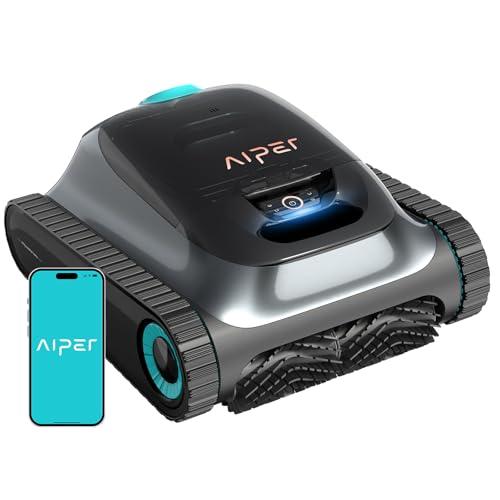
| Best for Fine Filtration | Power Source: Rechargeable battery (cordless robotic internal battery) | Runtime: Up to 180 minutes per charge | Suitable Pool Types: Inground and above-ground pools (implied; wall/waterline capable) | VIEW LATEST PRICE | Read Our Analysis |
More Details on Our Top Picks
T403 Rechargeable Handheld Pool Vacuum for Above-Ground
Provided you’ve got an above-ground pool, hot tub, or spa and want a portable cleaner that’s easy to handle, the T403 is a smart pick — it packs a 20V/40W motor that pulls up to about 4,200 L/h (≈18.5 gpm) and runs up to 60 minutes on a fast-recharging battery, so you can clear leaves, sand, and small debris without getting tangled in cords or swapping batteries. You get a 5×2000 mAh pack that recharges in ~1.5 hours, four reusable filter bags (two 180-, two 500-mesh), and removable handles plus a 3–7.3 ft telescopic pole for reach. Clean and dry after use.
- Power Source:Rechargeable battery (20V removable pack)
- Runtime:Up to 60 minutes per charge
- Suitable Pool Types:Above-ground pools, hot tubs, spas
- Wall/Waterline Cleaning:Not specified / focused on floor/above-ground cleaning
- Filtration / Debris Capture:Four reusable filter bags (180- and 500-mesh)
- Navigation / Cleaning Modes:Manual/handheld with telescopic pole — user-directed cleaning
- Additional Feature:Fast ~1.5h recharge
- Additional Feature:Telescopic 3–7.3 ft
- Additional Feature:Four reusable filter bags
Cordless Robotic Pool Vacuum with Sonar Navigation
In case you want a truly hands-off clean for pools up to 2,150 sq. ft., the cordless robotic vacuum with sonar guidance is ideal because its sonar mapping and selectable Floor/Wall/Full modes deliver edge-to-edge coverage without constant monitoring. You’ll appreciate industrial-grade caterpillar treads that grip drains, steps, and corners, plus wall and waterline climbing. Dual independent 180W brushless motors provide strong suction for leaves and fine debris while IP68 reinforcement keeps noise low and lifespan high. It runs up to 150 minutes per charge, starts with one touch, needs no setup, and works on tiled, concrete, vinyl, and fiberglass pools.
- Power Source:Rechargeable battery (cordless robotic internal battery)
- Runtime:Up to 150 minutes per charge
- Suitable Pool Types:Inground and above-ground pools (up to 2,150 sq. ft.)
- Wall/Waterline Cleaning:Yes — wall and waterline climbing capable
- Filtration / Debris Capture:Internal debris filter system (robotic dust/debris capture)
- Navigation / Cleaning Modes:Sonar-based navigation with three cleaning modes (Floor, Wall, Full)
- Additional Feature:Industrial caterpillar treads
- Additional Feature:One-touch start
- Additional Feature:IP68 reinforced architecture
iGarden K Series Robotic Pool Cleaner (Cordless)
Should you want cordless power and long runtimes for large pools, the iGarden K Series delivers—up to 220 minutes of focused floor cleaning (150 minutes for full coverage) and a turbine-grade impeller that pushes as much as 5,810 GPH to tackle leaves, stains, and dense debris. You’ll get three brushless motors, dual rubber brushes, and anti-slip tracks for reliable wall climbing and complete coverage. AI S-path planning, Turbo 200% mode, and a smart touchscreen plus app control make scheduling and peak cleaning simple. The top-load 4 L 180 μm basket drains automatically; underwater parking, OTA updates, a 3-year warranty, and 30-day returns round it out.
- Power Source:Rechargeable battery (cordless robotic internal battery)
- Runtime:Up to 220 minutes (floor) / 150 minutes (full coverage)
- Suitable Pool Types:Inground and above-ground pools (up to 3,814 sq. ft.)
- Wall/Waterline Cleaning:Yes — wall-climbing and waterline cleaning (full coverage mode)
- Filtration / Debris Capture:Top-load 4 L debris basket with 180 μm mesh
- Navigation / Cleaning Modes:AI S-path planning with selectable modes, Turbo mode and timers
- Additional Feature:Turbo 200% mode
- Additional Feature:Touchscreen + app
- Additional Feature:Automatic underwater parking
Aiper Scuba S1 Robotic Pool Cleaner (2026 Upgrade)
Provided that you want a reliable, low-maintenance robotic cleaner that handles fine dust and scrubs walls as well as floors, the Aiper Scuba S1 (2026 Upgrade) is built for you. You’ll join 500,000+ owners who trust its durable build and 2-year warranty backed with responsive support. Dual filtration—including a replaceable 3-micron ultra-fine and 180-micron standard filter—captures dust, sand, algae, leaves, and improves water clarity. You’ll get wall and waterline cleaning with upgraded dual-path modes and an optimized WavePath pattern that minimizes overlap. Intelligent adaptive routing adjusts routes in real time, 180-minute runtime keeps it cleaning longer, and OTA app control adds updates.
- Power Source:Rechargeable battery (cordless robotic internal battery)
- Runtime:Up to 180 minutes per charge
- Suitable Pool Types:Inground and above-ground pools (implied; wall/waterline capable)
- Wall/Waterline Cleaning:Yes — wall and waterline cleaning capable
- Filtration / Debris Capture:Dual filtration: 3-micron ultra-fine + 180-micron standard filter
- Navigation / Cleaning Modes:Intelligent adaptive navigation with dual-path/WavePath modes and selectable performance modes
- Additional Feature:3-micron ultra-fine filter
- Additional Feature:WavePath dual-path pattern
- Additional Feature:Trusted by 500,000+ owners
Factors to Consider When Choosing a Pool Vacuum
Whenever choosing a pool vacuum, you’ll want to weigh suction power and flow against the size of your pool to make certain full cleaning coverage. Check battery life and runtime for cordless models, plus filtration fineness options to trap the debris you get most often. Also consider maneuvering and controls so the cleaner handles corners, walls, and your schedule with minimal fuss.
Suction Power & Flow
Pick a vacuum with the right suction power and flow for your pool size and debris type, because those specs determine how quickly and thoroughly the unit will clean. Measure suction through flow rate (liters/hour or gallons/minute); choose higher flow for faster pickup of heavy debris and sand. Check motor power (watts/volts) and impeller design—higher wattage and optimized impellers give stronger, steadier suction. Match capability to debris: fine particles need sustained high flow plus fine filtration, while leaves and twigs benefit from strong peak suction and larger debris handling. Look for peak/turbo modes but make certain average runtime suction meets needs. Finally, prefer sealed, reinforced suction paths and clog-resistant intakes to reduce suction loss as filters fill.
Cleaning Coverage Area
Suction and flow set how well a cleaner pulls debris, but coverage determines whether it actually reaches every spot that needs cleaning. Match the vacuum’s maximum coverage to your pool size—handhelds or short-run units suit pools under ~500 sq ft, while robotic cleaners handle 2,000–4,000+ sq ft per charge. Decide whether you need floor-only or full-coverage (floor, walls, waterline); wall and waterline capability prevents missed algae and grime. Prioritize guidance and path-planning—systematic, sonar, or AI mapping reduces overlap and guarantees edge-to-edge cleaning. Check climb and traction for your pool finish and slope; reliable wall-climbing and anti-slip tracks reach corners and waterline. Make certain runtimes and recharge behavior let a single cycle finish larger pools without frequent interruptions.
Battery Life & Runtime
Match the vacuum’s runtime to your pool and cleaning goals so a single charge finishes the job instead of forcing repeat sessions. For small hot tubs ~60-minute runtimes often suffice; large pools typically need 150–220 minutes or staged charges. Keep in mind wall-climbing and waterline cycles can add 20–50% to total runtime, so factor that into estimates.
Check recharge time versus runtime—fast charging (~1.5 hours) minimizes downtime between runs. Evaluate battery capacity and cell configuration (mAh and cell count) as practical indicators of sustained power under load. Prefer models with intelligent power management—low-battery parking, turbo and eco modes—that extend usable runtime or deliver bursts for heavy debris. That balance guarantees complete coverage without unnecessary recharges.
Filtration Fineness Options
At the moment you’re choosing a pool vacuum, filtration fineness determines what gets trapped and how hard the unit has to work. You’ll pick a finer mesh (e.g., 180 μm) to catch sand, algae and fine debris, or a coarser one (e.g., 500‑mesh) for leaves and twigs—match the rating to the smallest particles you need removed. Dual or multi‑stage systems pair a coarse prefilter with ultra‑fine media to prevent clogs and extend runtime. Keep in mind very fine filters raise flow resistance, which can cut suction or runtime unless the motor/pump can compensate. Reusable mesh bags or baskets with clear micron/mesh ratings offer cost and environmental benefits; use very fine disposable cartridges (down to ~3 μm) only when targeting microscopic contaminants. Check access and cleaning frequency—fine meshes need more attention.
Navigation & Controls
Whenever you’re evaluating guidance and controls, focus on systems that map the pool and adapt their behavior so cleaning is systematic rather than random; autonomous maneuvering (sonar, AI path‑planning, or S‑path algorithms) minimizes missed spots and redundant overlap while selectable modes and turbo options let you tailor runs to specific debris and surfaces. You’ll want reliable underwater parking or low‑battery return so the cleaner stops along the wall for easy retrieval and avoids incomplete cycles. Look for straightforward setup and control: one‑touch starts, clear mode buttons, or companion apps with timers and remote control to cut hands‑on time. Finally, confirm sensors plus traction systems—tracks or treads—that support wall climbing and corner coverage so steering performs across pool shapes and surfaces.
Build Quality & Durability
Good controls mean little provided the cleaner itself can’t take regular use, so next look closely at build quality and durability. Check motor and drive ratings—watts, torque, or stated load capacity—and favor sealed or brushless motors that resist wear and keep suction consistent. Inspect chassis materials for UV‑resistant ABS, reinforced polymers, or corrosion‑proof metals and verify IP or waterproof ratings to prevent water intrusion. Evaluate traction hardware: reinforced tracks, durable rubber brushes, and stainless or reinforced drive gears handle abrasive debris and repeated climbs. Confirm battery construction—Li‑ion with balanced cells, protective BMS, and rated cycle life—to avoid premature capacity loss. Finally, prefer modular, tool‑accessible designs with replaceable filters/brushes and solid warranty or repair support to minimize downtime.
Pool Type Compatibility
Upon choosing a pool vacuum, match the cleaner to your pool’s type and size so it can reach every surface without damaging finishes or overtaxing your pump. For above-ground pools, pick lightweight handhelds or telescoping-handle units with extendable poles and suction in the several-hundred to few-thousand liters-per-hour range so you reach the bottom without straining equipment. Inground pools usually need more powerful or autonomous cleaners with strong traction and wall-climbing ability to cover larger areas and vertical walls. Hot tubs and spas require compact, low-flow or handheld cleaners with fine filtration that won’t overwhelm small-capacity pumps. Consider surface material: use soft brushes or tracks for vinyl and delicate liners, and sturdy treads or brushes for rough concrete or tile. Match runtime and maneuvering to pool size and shape.
Maintenance And Ease
Because routine upkeep determines how often you’ll need to stop cleaning, choose a vacuum with easy-access filters, washable components, and sealed electronics that cut down on repairs. Check filter type and access—top-load or removable baskets and mesh rating (e.g., 180 µm vs 3 µm) dictate emptying frequency and fine-particle capture. Prefer washable, reusable filter bags or cartridges and clear-access lids so you can rinse without tools. Consider battery runtime and charge time; longer runs (150–220 minutes) mean fewer interruptions, while fast charging limits downtime. Inspect drive and brush parts for removable brushes, debris traps, and simple replacement. Finally, verify corrosion and water resistance (IP ratings or sealed motor housings) to reduce repair frequency and prevent water ingress complications.
