

I’ve tested a range of dimmers to find the seven that balance smooth performance, easy installation, and wide bulb compatibility for 2026. Whether you want smart control, no-neutral convenience, or a classic slide, these picks cover common needs and tricky setups like 3-way circuits. Keep scrolling and I’ll show which models stood out and why one of them could be the right fit for your space.
Maxxima Dimmer Light Switch with Blue Indicator (Gray)

Should you want a straightforward, budget-friendly dimmer that handles both single-pole and 3-way setups, the Maxxima Dimmer with its blue LED off-indicator and adjustable sensitivity dial is a solid pick—it’s especially useful should you’re switching to dimmable LEDs, since the trim control helps prevent flicker. You’ll get a vertical slide for intuitive dimming, a blue LED that shows during lights are off, and compatibility with dimmable LED, CFL, halogen, and incandescent bulbs. Rated 120VAC 60Hz, it supports up to 600W incandescent or 150W LED/CFL, needs a 4.5W minimum, includes a gray wall plate, screws, UL listing, and a one-year warranty.
Best For: Homeowners or DIYers seeking an affordable, easy-to-install dimmer that works with both single-pole and 3-way circuits and is optimized for dimmable LED/CFL bulbs.
Pros:
- Compatible with dimmable LED, CFL, halogen, and incandescent bulbs and supports both single-pole and 3-way setups.
- Adjustable sensitivity trim dial reduces LED flicker; blue LED indicator shows when load is off for easy status visibility.
- Includes gray wall plate and mounting screws, UL listed, and backed by a 1-year warranty.
Cons:
- Maximum dimmable LED/CFL load is limited to 150W, which may be insufficient for larger lighting circuits.
- Not suitable for ceiling fans or non-dimmable bulbs.
- Minimum bulb load of 4.5W could prevent proper dimming with very low-wattage LED fixtures.
BESTTEN Matte Brown Dimmer Wall Light Switch

Should you want a simple, stylish dimmer that blends with warm décor, the BESTTEN Matte Brown Dimmer Wall Light Switch is a solid pick—its smooth, quiet paddle action and 15A/600W rating make it ideal for homeowners or renters who need reliable dimming for LED, CFL, incandescent, or halogen fixtures. You’ll install it in single pole or 3-way circuits (only one dimmer per 3-way), using screw terminals or crimp connectors. It runs on 120VAC, features brass contacts, push-button control, and X-10 connectivity. UL/cUL listed and compact (4.13 x 2.12 x 1.33 in), it excludes fan control; wall plates sold separately.
Best For: Homeowners or renters seeking a compact, stylish matte-brown dimmer for reliable 120VAC, 15A/600W dimming of LED, CFL, incandescent, or halogen fixtures in single-pole or 3-way circuits.
Pros:
- Smooth, quiet paddle action with positive on/off feel and push-button control for easy, tactile operation.
- Wide compatibility with dimmable LED, CFL, incandescent, and halogen bulbs and rated 15A/600W.
- UL/cUL listed, brass contacts, and supports single-pole or 3-way wiring (one dimmer in 3-way) for safe, flexible installation.
Cons:
- Not compatible with fan control, limiting use for ceiling fan/light combos.
- X-10 connectivity is an older protocol and may not integrate with modern smart-home ecosystems.
- Wall plate sold separately and modest IP20 rating limits protection against dust/moisture.
Lutron Maestro LED+ Dimmer Switch MACL-153M-GR

Should you want precise, flicker-free control for a wide range of bulbs, the Lutron Maestro LED+ (MACL-153M-GR) is a smart pick — it’s tested on thousands of LEDs, CFLs, and incandescents and delivers over 150 distinct dimming levels for smooth, customizable lighting. You’ll get compatibility with dimmable LEDs/CFLs up to 150W and incandescents/halogens up to 600W, single-pole or multi-location setups, and patented tech that reduces interference. The rocker adjusts brightness while a tap returns a preset favorite; delayed fade-to-off adds polish. It’s hardwired, needs no neutral, installs quickly, and fits standard 120V circuits.
Best For: homeowners or renters seeking smooth, flicker-free dimming across LEDs, CFLs, and incandescent bulbs with precise control and easy installation in single-pole or multi-location setups.
Pros:
- Tested for flicker-free performance on thousands of bulbs and offers over 150 distinct dimming levels for smooth, precise control.
- Supports up to 150W LED/CFL or 600W incandescent/halogen and works in single-pole or multi-location (with companions), providing broad compatibility.
- Hardwired installation with no neutral required, quick ~15-minute install, rocker/tap controls and delayed fade-to-off for convenient operation.
Cons:
- Requires hardwired installation and is not battery or plug-in powered, so DIYers uncomfortable with wiring may need an electrician.
- Not rated for outdoor or wet locations (IP00) and limited to standard 120V circuits only.
- 2A current rating and 150W LED/CFL limit may be restrictive for very large LED loads or commercial applications.
Kasa Smart Dimmer Switch HS220-LA (Light Almond)

Should you want a straightforward smart dimmer that works with existing Wi‑Fi and voice assistants without adding a hub, the Kasa HS220-LA is a great pick — its neutral-wire design and 2.4 GHz connectivity make it ideal for homeowners upgrading standard single‑pole lighting to app and voice control while keeping installation and integration simple. You’ll control lights via the Kasa app, Alexa, Google Assistant, or SmartThings, set schedules, create scenes, and use Away Mode. It dims 1–100%, offers fade on/off, and supports grouping. UL certified, rated 2.5 A/275 W, it needs a neutral wire and installs with interchangeable screw terminals.
Best For: Homeowners with existing single‑pole lighting who want a simple, hub‑free smart dimmer that works with 2.4 GHz Wi‑Fi and voice assistants and are comfortable (or can hire someone) to install a neutral‑wire switch.
Pros:
- Works with Kasa app, Alexa, Google Assistant, and SmartThings for flexible app and voice control.
- Smooth dimming (1–100%) with fade on/off, schedules, scenes, and Away Mode for convenience and security.
- UL certified, hub‑free 2.4 GHz Wi‑Fi connectivity, compact footprint, and interchangeable screw terminals for straightforward installation.
Cons:
- Requires a neutral wire, so not compatible with older homes without rewiring or an electrician.
- Limited to 2.5 A / 275 W, which may not support heavy multi‑fixture loads or some LED configurations.
- Operates on 2.4 GHz only (no 5 GHz), which could be an issue on congested Wi‑Fi networks.
Leviton Decora Slide Dimmer Switch with Faceplates
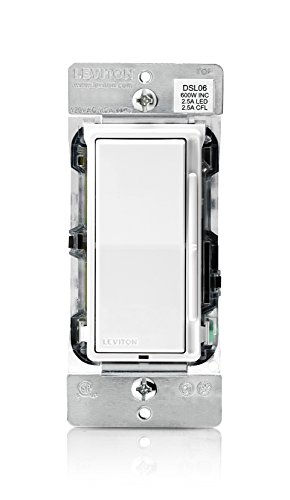
Should you want a simple, reliable dimmer that handles LEDs as well as halogen and incandescent bulbs, the Leviton Decora Slide Dimmer is a great pick — it supports up to 300W of LED or 600W of incandescent/halogen load, fits standard wallboxes without a neutral wire, and comes with three faceplates so you can match your decor. You’ll install it easily into existing wiring, thanks to its slim profile and no-neutral design. Adjust minimum and maximum LED levels to reduce flicker and save energy. Use it with a 3-way companion for multi-location control. Check Leviton’s online tool for bulb pairing.
Best For: Homeowners or renters seeking a simple, reliable dimmer that handles dimmable LEDs as well as halogen and incandescent bulbs and fits standard wallboxes without a neutral wire.
Pros:
- Slim, easy-to-install design fits most standard wallboxes and works with existing wiring (no neutral required).
- Supports up to 300W LED and 600W incandescent/halogen, with adjustable min/max for reduced flicker and better LED performance.
- Includes three faceplates (white, ivory, light almond) for color coordination and can be used in 3-way setups with a companion switch.
Cons:
- Maximum LED capacity is limited to 300W, which may be insufficient for very large LED loads.
- Requires checking compatibility for specific LED bulbs (use Leviton’s online tool) to ensure optimal performance.
- 3-way capability requires purchasing a separate companion switch.
TOPGREENER Gold Dimmer Switch TGDMDS-120-GD

Should you want a simple, high‑capacity dimmer that works without a neutral wire and handles both dimmable LEDs up to 150W and incandescent/halogen up to 600W, the TOPGREENER TGDMDS-120-GD is a smart choice. You’ll get a gold paddle switch with a discreet slider and side wheel for fine tuning; it’s UL listed, 120VAC 60Hz, and fits single‑pole or 3‑way setups. It supports up to 15A, uses wire‑lead connectors, and includes a side adjustment to fix flicker or slow-on issues. Wall plate sells separately. Top Greener backs it with a one‑year warranty.
Best For: Homeowners or electricians who need a high-capacity, no-neutral-required dimmer that reliably controls mixed incandescent/halogen and dimmable LED fixtures in single‑pole or 3‑way setups.
Pros:
- Handles high loads (up to 600W incandescent/halogen, 150W dimmable LED) with a 15A rating.
- No neutral required and compatible with standard wiring; fits single‑pole or 3‑way configurations.
- Paddle switch with discreet slider and side adjustment dial to reduce flicker and fine‑tune low‑end performance.
Cons:
- Wall plate sold separately, so additional purchase may be needed for installation.
- Some dimmable LEDs/CFLs may still flicker or not dim as low as incandescent even after adjustment.
- Limited warranty (one year) and uses X‑10 protocol for app connectivity, which is outdated compared with modern smart protocols.
MOES 3-Way/Single-Pole Dimmer Light Switch (No Neutral)

Should you don’t have a neutral wire but still want reliable dimming, the MOES 3-Way/Single-Pole Dimmer is a smart choice for bedrooms, hallways, or retrofits where wiring is limited. You’ll install it in single-pole or as the lone dimmer in a 3-way circuit; it won’t work with smart fixtures or fans. It handles 120VAC/60Hz and is ETL listed, supporting up to 600W incandescent/halogen or 300W dimmable LED/CFL. You get an independent ON/OFF button, a sliding dimmer for smooth level control, and an adjustable sensitivity dial under the cover to fine-tune LED compatibility during setup.
Best For: Homeowners or renters needing a no-neutral retrofit dimmer for bedrooms, hallways, or other living spaces where only one dimmer is used in a 3-way circuit or a single-pole setup.
Pros:
- No neutral required, making it ideal for older homes and retrofit installations.
- Supports up to 600W incandescent/halogen and 300W dimmable LED/CFL with adjustable sensitivity for LED compatibility.
- Independent ON/OFF button plus smooth sliding dimmer for precise control.
Cons:
- Only one dimmer allowed in a 3-way circuit (not suitable for multi-dimmer 3-way setups).
- Not compatible with smart lighting fixtures or ceiling fans.
- May require fine-tuning of the sensitivity dial during installation for some LED lamps.
Factors to Consider When Choosing Light Dimmers
Before you pick a dimmer, I’ll walk you through the essentials: whether it’s compatible with your bulb types, what your wiring and neutral situation looks like, and the load capacity limits you need to respect. I’ll also cover control type preferences—like rotary, paddle, or touch—and how well a dimmer integrates with smart home systems. Understanding these factors up front will save you headaches and guarantee smooth performance.
Compatibility With Bulbs
Upon I pick a dimmer, I focus initially on bulb compatibility because using the wrong type can cause flicker, limited range, or even damage; dimmers must explicitly support the bulb types you use—dimmable LEDs or CFLs, incandescent, or halogen—and meet the wattage limits for those lamps. I check the dimmer’s rated wattage: many handle up to 600W for incandescent but only 150–300W for LED/CFL loads. I also look for models with adjustable sensitivity or trim dials, which help tame LED flicker and widen smooth dimming range. I never pair dimmers with non-dimmable bulbs or ceiling fans. Finally, I review manufacturer compatibility lists and tested bulb brands to guarantee reliable, flicker-free performance across my chosen lamps.
Wiring And Neutral Needs
Questioning whether your switch box has a neutral wire can save you a lot of time and hassle while selecting a dimmer. I always check the box before buying: some dimmers need a neutral to work and support advanced features like smart connectivity, while others are built to operate without one. Should your box lack neutral, non-neutral dimmers use mechanical or electronic methods to handle LEDs and CFLs. For smart or feature-rich units a neutral could be required, and you may need an electrician to add one. In 3-way setups, wiring matters more—only one dimmer might be allowed without neutral support, so verify compatibility for both locations. Being aware of your wiring guarantees safe, compatible installation and avoids returns or rewiring costs.
Load Capacity Limits
Before you’re choosing a dimmer, I always check its load capacity limits initially because they tell you the maximum—and minimum—wattage the switch can safely handle for each bulb type. Look at the max rating per bulb type: incandescent dimmers often handle much higher loads (for example, up to 600W) while dimmers rated for dimmable LEDs or CFLs commonly top out lower (around 150W). Never exceed the maximum—doing so risks overheating, malfunction, or damage to the dimmer and fixtures. Equally crucial is the minimum load: too little total wattage can cause flicker or prevent proper operation. Add up the total wattage of all compatible bulbs on the circuit and choose a dimmer whose load range matches that total.
Control Type Preference
Should you want dimming that feels natural for your space, start through deciding how you want to interact with the switch: slide controls give me fine, continuous adjustment, rocker and paddle switches combine simple on/off action with tactile dimming, and touch-sensitive panels let you tap or swipe for presets and smooth fades. I prefer slides for areas where precise ambiance matters, like dining or reading nooks. Rocker and paddle units work well in high-traffic spots because the tactile feedback makes operation instinctive. Touch controls feel modern and support quick presets, though they can be less intuitive for guests. Some dimmers separate on/off buttons from the dimming control, which I find useful whenever you want straightforward switching without losing your preferred intensity.
Smart Home Integration
During the period I’m choosing a dimmer for a smart home, I focus on how well it will actually fit into my ecosystem and daily routines. I want Wi‑Fi or app control so I can adjust lights remotely and save trips to switches. Voice assistant compatibility with Alexa or Google Assistant is a must for hands‑free changes, and I check which ecosystems the dimmer supports to avoid surprises. Customizable scenes and schedules let me automate brightness for energy savings and consistent ambiance throughout the day. I also verify integration with other devices so lights can act in groups or trigger with sensors. Finally, I confirm whether a neutral wire is required before committing, since that affects compatibility.
Installation And Safety
While good smart-home integration makes a dimmer convenient, I also pay close attention to installation and safety because a poorly installed switch can create hazards or frustrate performance. I always verify wiring compatibility initially—does the dimmer require a neutral?—so I match it to existing circuits. I check for UL or ETL listing to guarantee it passed rigorous safety testing. I follow manufacturer instructions carefully, selecting the correct wiring configuration for single-pole or 3-way setups to avoid shocks or faults. During setup, I use sensitivity or trim adjustments to stop flicker and address bulb compatibility. In case I’m unsure about wiring, I hire a licensed electrician—it’s safer and reduces fire or shock risk while preserving dimmer performance.
