

Like a well-tuned instrument, your grinder shapes every note of your cup, and choosing the right hand mill matters more than you believe. You’ll want precision burrs, smooth low-friction action, and a sturdy, travel-ready build that won’t falter after months of use. I’ll walk you through top Comandante-style picks and what to observe so you can narrow choices fast—starting with compact daily drivers and ending with café-grade options.
| JavaPresse Manual Stainless Steel Conical Burr Coffee Grinder |

| Travel-Friendly Pick | Grinding Mechanism: Ceramic conical burr | Adjustability (Grind Settings): 18+ manual grind settings | Portability: Compact, travel/camping ready, no cord/battery | VIEW LATEST PRICE | Read Our Analysis |
| Hario Ceramic Coffee Mill-Original Black |
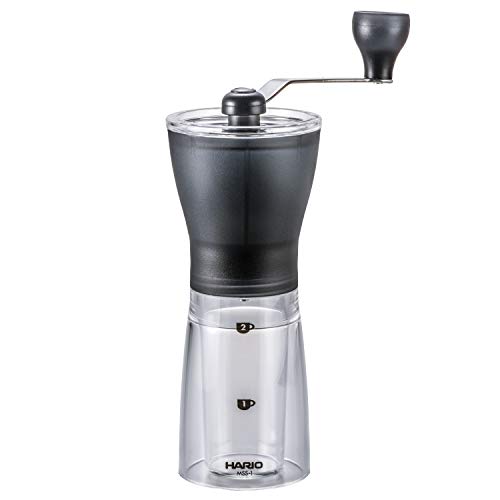
| Slim & Portable | Grinding Mechanism: Ceramic burr (conical) | Adjustability (Grind Settings): Adjustable (stepped/variable) via knob | Portability: Slim profile, removable handle for packing | VIEW LATEST PRICE | Read Our Analysis |
| TIMEMORE Chestnut C2 Manual Coffee Grinder (25g) |

| Best Budget Performance | Grinding Mechanism: 420 stainless steel burrs (tapered/conical) | Adjustability (Grind Settings): Built-in adjustment knob (clockwise finer/countercoarser) | Portability: Compact 25 g capacity, includes cloth bag for travel | VIEW LATEST PRICE | Read Our Analysis |
| TIMEMORE C5 Pro Manual Coffee Grinder (All-Metal) |
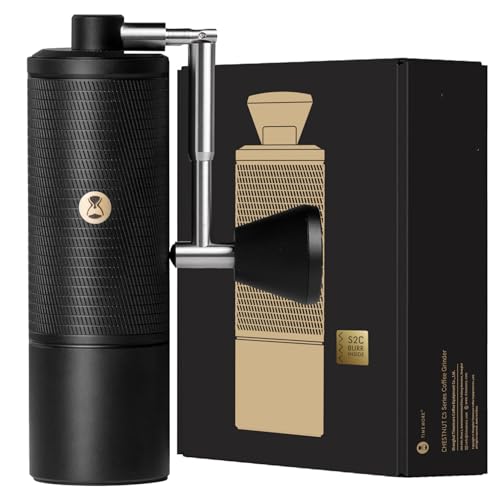
| Precision Pro | Grinding Mechanism: 42 mm stainless steel conical burrs (CNC) | Adjustability (Grind Settings): ~48 coarseness levels, 0.031 mm pitch per click | Portability: Compact body, folding handle for travel | VIEW LATEST PRICE | Read Our Analysis |
| TIMEMORE Chestnut C2S Manual Stainless Steel Coffee Grinder |

| Durable All-Metal | Grinding Mechanism: 38 mm stainless steel conical burr (CNC) | Adjustability (Grind Settings): ~36 coarseness levels via adjustment nut | Portability: 25 g capacity, compact body, travel/outdoor suitable | VIEW LATEST PRICE | Read Our Analysis |
More Details on Our Top Picks
JavaPresse Manual Stainless Steel Conical Burr Coffee Grinder
Looking for a compact, travel-ready grinder that still delivers consistent grinds? You’ll appreciate the JavaPresse Manual Stainless Steel Conical Burr Coffee Grinder: a stainless body with a patented ceramic conical burr offering over 18 grind settings for espresso to French press. You crank it manually, cutting about 90% of electric noise, no cords or batteries, and it’s sized for travel and camping. The burr’s triple-tested quality lasts up to five times longer than similar steel burrs, so you get reliable extraction and aroma. A portion of profits supports coffee supply chains, making it a thoughtful gift for travelers.
- Grinding Mechanism:Ceramic conical burr
- Adjustability (Grind Settings):18+ manual grind settings
- Portability:Compact, travel/camping ready, no cord/battery
- Construction Material:Stainless steel body with ceramic burr assembly
- Ease of Use / Maintenance:Manual hand-crank, easy to use; durable burrs
- Intended Brew Methods (Versatility):Espresso, drip, French press, pour-over, single-serve
- Additional Feature:Supports social impact
- Additional Feature:Hand-crank silence (~90% quieter)
- Additional Feature:Ceramic burr longevity
Hario Ceramic Coffee Mill-Original Black
Should you want a slim, travel-ready grinder that’s simple to operate, the Hario Ceramic Coffee Mill-Original in black is a smart pick — its removable handle and compact profile tuck neatly into luggage or a kitchen drawer. You’ll appreciate the ceramic burr for consistent grinds and the methacrylic resin body that keeps weight down (400 g). It holds about two cups or roughly 24 g of beans, and stainless steel shaft and spring add durability. Nylon adjustment knob, polypropylene hopper grip, and easy-clean design make daily use straightforward. Imported materials suit travel and regular brewing without rust concerns.
- Grinding Mechanism:Ceramic burr (conical)
- Adjustability (Grind Settings):Adjustable (stepped/variable) via knob
- Portability:Slim profile, removable handle for packing
- Construction Material:Methacrylic resin body + ceramic mortar, stainless steel shaft/handle
- Ease of Use / Maintenance:Easy to use and clean; removable handle
- Intended Brew Methods (Versatility):Fresh coffee preparation (suitable for manual brew methods)
- Additional Feature:Removable storable handle
- Additional Feature:Slim compact profile
- Additional Feature:Methacrylic resin body
TIMEMORE Chestnut C2 Manual Coffee Grinder (25g)
Should you want a compact, travel-ready grinder that still delivers precise, fast grinding, the TIMEMORE Chestnut C2 is a smart pick—its five-axis CNC 420 stainless steel burrs and dual-bearing center axis give consistent, efficient cuts ideal for pour-over, moka, and other manual methods. You’ll appreciate the 55–58 HRC burr hardness and CNC-tapered profile that shaves beans quickly. The 25 g capacity and 430 g weight keep it portable; a cloth bag adds convenience. Turn the adjustment knob clockwise for finer, counterclockwise for coarser grinds. Disassemble easily without tools, clean with the included brush, and contact support via Amazon should necessary.
- Grinding Mechanism:420 stainless steel burrs (tapered/conical)
- Adjustability (Grind Settings):Built-in adjustment knob (clockwise finer/countercoarser)
- Portability:Compact 25 g capacity, includes cloth bag for travel
- Construction Material:Metal body (2024 upgrade) with 420 stainless steel burrs
- Ease of Use / Maintenance:Easy disassembly (no tools), brush-clean recommended
- Intended Brew Methods (Versatility):Pour-over, moka pot, French press, other manual methods
- Additional Feature:Includes cloth bag
- Additional Feature:Tool-free disassembly
- Additional Feature:Five-axis CNC burrs
TIMEMORE C5 Pro Manual Coffee Grinder (All-Metal)
Should you want a travel-ready grinder that still delivers café-quality consistency, the TIMEMORE C5 Pro is a smart pick — its all-metal, 53 mm compact body and folding handle make it easy to pack, while the patented 42 mm S2C-042-III conical burrs and CNC machining give uniform grounds across espresso-to-French-press settings. You’ll fine-tune with 48 roughly spaced steps (0.031 mm per click): clockwise to finer, anti-clockwise to coarser. The double-bearing axis and built-in bearing make rotation smooth and low-effort; the handle coasts after release. It disassembles and brushes clean easily, balancing portability, durability, and café-grade performance.
- Grinding Mechanism:42 mm stainless steel conical burrs (CNC)
- Adjustability (Grind Settings):~48 coarseness levels, 0.031 mm pitch per click
- Portability:Compact body, folding handle for travel
- Construction Material:All-metal one-piece body with stainless steel burrs
- Ease of Use / Maintenance:Easy disassembly for cleaning; brush-cleanable
- Intended Brew Methods (Versatility):Range from espresso to French press
- Additional Feature:Folding handle design
- Additional Feature:48 grind levels
- Additional Feature:Low torque bearing
TIMEMORE Chestnut C2S Manual Stainless Steel Coffee Grinder
Should you value a durable, precise grinder that handles daily home use and travel, the TIMEMORE Chestnut C2S is built for you. You get a full metal unibody and CNC-machined stainless steel parts that fix the C2’s top-cover weakness. The 38 mm conical burr, 55–58 HRC, produces uniform particles and limits fines. Double-bearing axis keeps alignment, so the handle coasts briefly after release. About 36 grind steps let you dial from fine to coarse (clockwise finer). It’s compact (52 mm), light-torque, 25 g capacity, 700 g body—easy to clean, portable, and reliable for consistent daily grinding.
- Grinding Mechanism:38 mm stainless steel conical burr (CNC)
- Adjustability (Grind Settings):~36 coarseness levels via adjustment nut
- Portability:25 g capacity, compact body, travel/outdoor suitable
- Construction Material:Full metal unibody, CNC stainless steel components
- Ease of Use / Maintenance:Easy disassembly; brush-cleanable components
- Intended Brew Methods (Versatility):Grind range suitable from fine (espresso) to coarse (French press)
- Additional Feature:Full-metal unibody upgrade
- Additional Feature:38 mm conical burr
- Additional Feature:700 g premium heft
Factors to Consider When Choosing a Hand Coffee Grinder Comandante
At the point you pick a Comandante grinder, check the grind size range to make sure it covers espresso through French press. You’ll want high-quality burrs and precise grind consistency for repeatable extraction, plus a capacity that fits your routine without sacrificing portability. Finally, inspect build quality and materials so the grinder stays durable through frequent use.
Grind Size Range
Should you want one Comandante grinder to handle everything from espresso to French press, the grind size range is the most pivotal spec to check: it determines how fine and how coarse you can go, how repeatable each setting will be, and whether you’ll need to re‑adjust whenever switching brew methods. A wide range covers espresso (~200–400 μm) up to French press (~1000–1400 μm) so you can hit consistent particle distributions across methods. Espresso demands very fine, repeatable settings—look for tight burr tolerances and sub‑0.05 mm pitch increments. Coarse grinding benefits from larger burr diameter and steeper geometry to move beans fast while reducing fines and clogging. Count click positions (30–50+) and make sure usable overlap between espresso, pour‑over, drip, and press to avoid constant re‑dialing.
Burr Material Type
Grind range and adjustment precision matter, but the burr material itself determines how that range performs over time—how quickly edges dull, how the grinder handles hard beans, and how much static or heat you’ll notice during long sessions. You might choose between hardened stainless steel and ceramic: steel offers higher durability, faster grinding, and better tolerance for hard beans and high volume; its hardness is often rated in HRC—mid-50s means excellent wear resistance and long edge life. Ceramic resists corrosion and can retain sharpness against chemical wear, but it’s more brittle and can chip should you hit a stone or drop the grinder. Also consider heat and static: steel conducts more heat and could warm grounds under heavy use, while ceramic usually produces less static cling.
Grind Consistency Precision
Because precision governs how consistently your coffee extracts, you should focus on the parts that actually control particle uniformity: burr material and machining, burr diameter and geometry, stable center-axis alignment with solid bearing support, fine adjustment resolution, and tight grind-chamber tolerances that limit retention and variability between runs. Choose burrs cut with multi-axis CNC and high Rockwell hardness to reduce fines and improve uniformity. Larger, well-shaped conical or flat burrs widen throughput and even out particle distribution. Look for dual- or double-bearing support to minimize wobble and runout so grind size stays repeatable. Prefer fine, many-step adjustments (small pitch per detent) for precise dialing. Finally, guarantee low internal clearance and well-mated components to cut retention and keep successive doses consistent.
Capacity And Portability
Upon choosing a Comandante for travel or daily use, pick a bean capacity and form factor that match how you brew: small portable hoppers (20–30 g) keep weight and bulk down for solo cups and hikes, while 40–60 g models save refills as you’re making multiple servings at home or camping alongside car. Match capacity to your typical batch so you don’t refill mid-pour. Consider packed weight—200–450 g units suit backpacking, 600–800 g all-metal grinders fit car trips or countertop use. Check diameter and handle design; ~50–60 mm widths and foldable or removable handles slip into luggage easier. Look for slim profiles, removable components, and a carrying pouch to protect parts. Balance hopper size against portability for the best daily or travel setup.
Build Quality Durability
As you’re choosing a Comandante, prioritize construction that’ll stand up to years of use: all-metal or stainless-steel bodies with CNC-machined parts keep tolerances tight and stop components from deforming, while high-hardness burrs resist dulling so your grind profile stays consistent. You should favor burrs rated for high HRC or ceramic options for extended edge retention. Check for sturdy bearings and a centered spindle to eliminate lateral play, which preserves consistent particle size and reduces uneven wear. Solid unibody shells or reinforced top covers cut stress points and lower breakage risk during travel or frequent disassembly. Finally, choose grinders with durable fasteners, corrosion-resistant finishes, and straightforward tool-free disassembly so you can maintain internals without accelerating component degradation.
Ease Of Adjustment
At the point you’re dialing in a Comandante, ease of adjustment makes the difference between quick, repeatable results and a lot of wasted beans; prioritize a clearly indexed mechanism with tactile detents or numbered clicks so you can return to exact settings, especially during shifting between espresso and French press. You’ll want roughly 0.03 mm-per-click precision for fine control and dozens of discrete steps so the grinder spans espresso to French-press without losing repeatability. Look for clockwise/fine and counterclockwise/coarse (or the reverse) that’s intuitive, with short travel between settings and visible or tactile markers to speed changes. Smooth, low-friction adjustment knobs prevent sudden jumps and let you make single-handed, small increments while tuning brews efficiently.
Noise And Effort
Once you’ve locked in settings that give repeatable results, pay attention to noise and effort—two practical factors that shape the daily grind experience. Manual grinders cut noise about 80–95% versus electric units, so you’ll get a much quieter morning routine. Effort depends on burr type, burr diameter, roast level and grind setting: larger, sharper burrs usually need less torque. Expect steady throughput around 20–60 g/min, but finer settings can multiply force and time 2–5× compared with coarse. Look for ergonomic features—a longer handle, comfy grip and low-friction bearings—to lower perceived effort and protect your wrist during repetition. Match the grinder’s effort profile to your typical doses and grind range to avoid tiring or noisy sessions.
Maintenance And Cleaning
Regularly cleaning and maintaining your Comandante keeps grind consistency and flavor stable, so plan to dry‑brush the burrs and hopper every 0.5–1 kg of beans and fully disassemble per the manual every 4–8 weeks (more often with oily beans) to clear trapped fines. You should dry‑brush after every 1–2 pounds to prevent oil and fines from altering particle distribution. Whenever you disassemble, remove grounds from crevices and the grind chamber with a stiff brush and compressed air; avoid soaking metal burrs or internals in water. Lightly wipe non‑metal parts with a damp cloth. Reassemble carefully, check burr alignment and tension, and lubricate specified bearings or threads sparingly with a food‑safe lubricant per the manual to keep adjustments smooth.
