Dovetail saws give wood joints that tight, clean, “how did you do that?” look. The best ones feel light, cut straight, and slice through hardwood like a razor.
In this guide, we’ll look at nine favorites woodworkers keep reaching for, from ultra-thin SUIZAN Dozuki pull saws and compact JORGENSEN folders to the Temple Tool Co. Dozuki and the classic IVY Classic 11111 push saw. Each brings its own mix of blade stiffness, tooth pattern, and handle comfort to help you cut precise, repeatable dovetails.
| SUIZAN Dozuki Dovetail Japanese Pull Saw |

| Precision Crosscut Master | Blade length: 6″ | Teeth per inch (TPI): 25 TPI | Saw stroke direction: Pull stroke | VIEW LATEST PRICE | Read Our Analysis |
| JORGENSEN 6″ Folding Japanese Pull Saw for Wood |
| Best Folding Option | Blade length: 6″ | Teeth per inch (TPI): 21 TPI | Saw stroke direction: Pull stroke | VIEW LATEST PRICE | Read Our Analysis |
| SUIZAN 7″ Dozuki Japanese Pull Saw |

| Best All‑Purpose Dozuki | Blade length: 7″ | Teeth per inch (TPI): 17 TPI | Saw stroke direction: Pull stroke | VIEW LATEST PRICE | Read Our Analysis |
| Japanese Dozuki Pull Saw for Fine Joinery |

| Premium Hybrid Teeth | Blade length: 150mm (≈6″) | Teeth per inch (TPI): 25 TPI (universal teeth) | Saw stroke direction: Pull stroke | VIEW LATEST PRICE | Read Our Analysis |
| IVY Classic 11111 10″ Dovetail Saw Hardwood Handle |

| Classic Western Style | Blade length: 10″ | Teeth per inch (TPI): 12 PPI | Saw stroke direction: Push stroke | VIEW LATEST PRICE | Read Our Analysis |
| WORKPRO 6″ Japanese Pull Saw with Flexible Blade |

| Best Compact Pull Saw | Blade length: 6″ | Teeth per inch (TPI): 23 TPI | Saw stroke direction: Pull stroke | VIEW LATEST PRICE | Read Our Analysis |
| Japanese Pull Saw for Dovetails and Fine Joinery |

| Rip‑Cut Specialist | Blade length: 9.5″ | Teeth per inch (TPI): 18 TPI | Saw stroke direction: Pull stroke | VIEW LATEST PRICE | Read Our Analysis |
| SUIZAN 6″ Japanese Dozuki Dovetail Pull Saw |

| Compact Dozuki Favorite | Blade length: 6″ | Teeth per inch (TPI): 17 TPI | Saw stroke direction: Pull stroke | VIEW LATEST PRICE | Read Our Analysis |
| JORGENSEN 10″ Reversible Dovetail Flush Cut Saw |

| Best Flush‑Cut Saw | Blade length: 10″ | Teeth per inch (TPI): 13 TPI | Saw stroke direction: Push stroke | VIEW LATEST PRICE | Read Our Analysis |
More Details on Our Top Picks
SUIZAN Dozuki Dovetail Japanese Pull Saw
Should you be a detail‑oriented woodworker who wants glass‑smooth, razor‑thin dovetail cuts, the SUIZAN Dozuki Dovetail Japanese Pull Saw stands out for its ultra‑thin 0.012″ blade and 25 TPI tooth pattern that excels at precise crosscuts. You pull to cut, so you’ll use less power, keep better control, and get cleaner shoulders in tight joinery. The 6″ rectangular blade and 0.02″ kerf let you sneak into layout lines with confidence. Made in Japan from top‑quality steel with a traditional wooden handle, it feels precise, not bulky. With a 4.7‑star average across thousands of reviews, it’s a reliable dovetail workhorse.
- Blade length:6″
- Teeth per inch (TPI):25 TPI
- Saw stroke direction:Pull stroke
- Intended use:Fine crosscuts, dovetails, precise joinery
- Blade material:Top-quality Japanese steel
- Handle material:Wood handle
- Additional Feature:Ultra-fine 25 TPI kerf
- Additional Feature:Made entirely in Japan
- Additional Feature:High user rating
JORGENSEN 6″ Folding Japanese Pull Saw for Wood
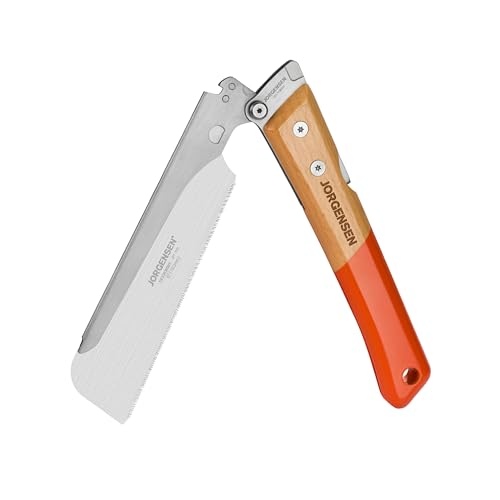
Compact, precise, and highly portable, the JORGENSEN 6″ Folding Japanese Pull Saw is ideal should you’re a detail-focused woodworker who needs clean dovetail cuts in tight spaces or on the go. Its 0.3mm extra-thin SK5 Japanese steel blade and 21 TPI hardened teeth slice narrow kerfs with impressive control.
You’ll appreciate the geometric ground teeth and heat treatment, which keep cuts fast, smooth, and sharp longer. The nickel-plated blade reduces friction and resists wear. A 6-inch European beech handle supports comfortable one-handed use, while the tool-less folding blade change system makes swapping and packing it effortless.
- Blade length:6″
- Teeth per inch (TPI):21 TPI
- Saw stroke direction:Pull stroke
- Intended use:Dovetails, tenons, instrument making, furniture restoration
- Blade material:SK5 Japanese steel with nickel plating
- Handle material:European beech wood handle
- Additional Feature:Folding for portability
- Additional Feature:Tool-less blade change
- Additional Feature:Nickel-plated wear resistance
SUIZAN 7″ Dozuki Japanese Pull Saw
Woodworkers who value ultra‑clean, precise cuts will appreciate the SUIZAN 7″ Dozuki Japanese Pull Saw for fine dovetailing and joinery. With its 7″ blade and 17 TPI, you get crisp control for rip, cross, and angle cuts in hardwoods and softwoods alike. The ultra‑thin 0.012″ blade and 0.02″ kerf minimize waste and effort.
Because it cuts on the pull stroke, you apply less power while gaining more accuracy and smoother edges. Made from high‑quality Japanese steel and crafted in a town with a century‑long toolmaking tradition, it delivers durability, reliability, and pro‑level performance for any skill level.
- Blade length:7″
- Teeth per inch (TPI):17 TPI
- Saw stroke direction:Pull stroke
- Intended use:Rip, cross, and angle cuts for joinery
- Blade material:Top-quality Japanese steel
- Handle material:Traditional Japanese handle (wood; material not specifically named)
- Additional Feature:Versatile rip/cross/angle cuts
- Additional Feature:Thin 0.02″ kerf
- Additional Feature:Tradition-rich craft origin
Japanese Dozuki Pull Saw for Fine Joinery
Should you prize ultra-precise joinery and want a saw that feels like a surgical instrument in your hand, this Japanese Dozuki pull saw from Temple Tool Co. deserves a spot at your bench. Its 150mm blade gives you tight control, while the thin, pull-stroke design delivers clean, effortless cuts.
You’ll get universal 25 TPI teeth plus specialized Oni-Ba “demon-teeth,” so you can crosscut, rip, or work diagonally without switching tools. It excels at dovetails, tenons, and kumiko in both softwoods and hardwoods. SK85 steel, a solid brass back, Wingnut wood handle, and Nagata-made craftsmanship tie performance to heritage.
- Blade length:150mm (≈6″)
- Teeth per inch (TPI):25 TPI (universal teeth)
- Saw stroke direction:Pull stroke
- Intended use:Dovetails, tenons, kumiko, fine joinery (cross/rip/diagonal)
- Blade material:High-grade Japanese SK85 steel
- Handle material:Dark brown Wingnut wood handle with brass fittings
- Additional Feature:Hybrid Oni-Ba teeth
- Additional Feature:Solid brass back
- Additional Feature:Aesthetic brass fittings
IVY Classic 11111 10″ Dovetail Saw Hardwood Handle
Should you want a straightforward, accurate dovetail saw for fine joinery without paying premium-brand prices, the IVY Classic 11111 10″ Dovetail Saw with its hardwood handle is a strong candidate. Its alloy-steel blade is hardened and tempered, so it holds up well to repeated use on both softwoods and hardwoods.
The reinforced steel back keeps the 10-inch blade rigid, helping you track perfectly straight lines at a cutting depth up to 1-1/2 inches. With 12 points per inch and push-cut Swift Cut® teeth, you get smooth, controlled cuts ideal for dovetails, fine carpentry, and accurate trimming.
- Blade length:10″
- Teeth per inch (TPI):12 PPI
- Saw stroke direction:Push stroke
- Intended use:Dovetail joints, fine carpentry, accurate trimming
- Blade material:Hardened and tempered alloy-steel blade
- Handle material:Hardwood handle
- Additional Feature:Reinforced steel spine
- Additional Feature:Swift Cut® tooth design
- Additional Feature:1-1/2″ cutting depth
WORKPRO 6″ Japanese Pull Saw with Flexible Blade
Precision-obsessed detailers who love ultra-clean joinery will gravitate to the WORKPRO 6″ Japanese Pull Saw with Flexible Blade. You get a razor-ready 23 TPI blade with triple-tooth geometry, hardened to HRC 60–65 so it stays sharp cut after cut. The ultra-thin 0.017″ SK5 steel blade slices with almost no resistance, while the reinforced spine keeps your kerfs dead straight.
The flexible, gold-coated blade shrugs off rust and lets you sneak into tight spots. A non-slip beech handle gives you secure, comfortable control. It’s ideal for dovetails, tenons, and gift-worthy precision work.
- Blade length:6″
- Teeth per inch (TPI):23 TPI
- Saw stroke direction:Pull stroke
- Intended use:Dovetails, tenons, precision woodworking
- Blade material:High-quality SK5 steel with gold coating
- Handle material:Beech wood handle with non-slip design
- Additional Feature:Triple-tooth geometry
- Additional Feature:Gold anti-rust coating
- Additional Feature:Flexible precision blade
Japanese Pull Saw for Dovetails and Fine Joinery
In case you value glass-smooth dovetails and effortless control, a Japanese pull saw like Temple Tool Co.’s Rip-Cut 9.5 belongs in your toolkit. You get a thin, narrow-kerf blade with 18 TPI rip teeth that cuts on the pull stroke, so the blade stays straight while you track precise lines on dovetails, tenon cheeks, and other fine joinery.
The dark brown Wingnut wood handle, accented with brass, feels refined yet solid. A high-grade Japanese steel blade holds a keen edge in both softwoods and hardwoods, and it’s handcrafted in a historic Japanese city with a century of saw-making tradition.
- Blade length:9.5″
- Teeth per inch (TPI):18 TPI
- Saw stroke direction:Pull stroke
- Intended use:Dovetails, small tenons, fine joinery (rip cuts)
- Blade material:High-grade Japanese steel
- Handle material:Dark brown Wingnut wood handle with brass components
- Additional Feature:18 TPI rip teeth
- Additional Feature:Brass-accented wood handle
- Additional Feature:Handcrafted by artisans
SUIZAN 6″ Japanese Dozuki Dovetail Pull Saw
Woodworkers who want ultra-clean dovetails without wrestling a heavy Western backsaw will appreciate the SUIZAN 6″ Japanese Dozuki Dovetail Pull Saw. You’ll cut on the pull stroke, so the thin 0.012″ blade and 0.02″ kerf stay straight and controlled without muscle.
The high-quality Japanese steel and 17 TPI teeth leave crisp, glass-smooth walls that help your dovetails slide together perfectly. At 6″, it’s compact enough for tight layouts yet versatile for rip, cross, and angle cuts. Made in Japan under expert craftsmen in a town with a century of toolmaking tradition, it suits both beginners and experts.
- Blade length:6″
- Teeth per inch (TPI):17 TPI
- Saw stroke direction:Pull stroke
- Intended use:Rip, cross, and angle cuts for dovetails/joinery
- Blade material:High-quality Japanese steel
- Handle material:Traditional wood handle (Japanese style)
- Additional Feature:Suited to angle cuts
- Additional Feature:Lightweight, low-effort cutting
- Additional Feature:Traditional Japanese manufacture
JORGENSEN 10″ Reversible Dovetail Flush Cut Saw
Should you be trimming jambs, flooring, or millwork in tight spots, the JORGENSEN 10″ Reversible Dovetail Flush Cut Saw stands out due to its reversible, spring‑loaded blade that works equally well left- or right-handed. The 10″ SK5 blade is just 0.6mm thick, flexible enough for true flush cuts yet supported through a carbon‑steel back for straight, accurate tracking. With 13TPI double‑ground, induction‑hardened teeth, it stays sharp but demands a light touch to avoid surface scratches.
You’ll appreciate the soft, bi‑material handle during long sessions and the protective tooth cover whenever you toss it in your tool bag.
- Blade length:10″
- Teeth per inch (TPI):13 TPI
- Saw stroke direction:Push stroke
- Intended use:Dovetail/jamb work, door frames, flooring, millwork
- Blade material:SK5 steel (carbon back reinforced)
- Handle material:Bi-material PP+TPR soft-grip handle
- Additional Feature:Reversible spring-loaded blade
- Additional Feature:Flexible flush-cut design
- Additional Feature:Ergonomic bi-material handle
Factors to Consider When Choosing Dovetail Saws
Upon selecting a dovetail saw, several technical factors directly affect accuracy, speed, and control. Blade length and depth, TPI and tooth geometry, pull versus push action, and blade thickness with resulting kerf all influence how the saw performs in different woods and joint sizes. Handle comfort and control afterwards determine how consistently a user can guide that performance at the workbench.
Blade Length and Depth
Although often overlooked, blade length and depth largely determine how effectively a dovetail saw will handle different joinery tasks. Most dovetail saws span 6 to 10 inches in blade length. Around 6 inches is common for fine dovetail work, where tight spaces and delicate layout lines demand maximum control and precise tracking.
Longer blades, in the 7 to 10 inch range, suit users who also cut larger stock or need to extend beyond small drawer sides and carcass components. They allow longer strokes and deeper cuts, increasing efficiency on bigger parts.
Blade depth governs maximum cutting depth, typically enabling cuts from about 0.5 to 1.5 inches. Matching blade depth to stock thickness helps maintain control while still reaching full joint depth efficiently.
TPI and Tooth Geometry
Choosing an effective dovetail saw depends heavily on matching TPI (teeth per inch) and tooth geometry to the intended work. Higher TPI counts, often 20–25 TPI, yield finer, cleaner cuts that suit precise dovetail and tenon joinery, while lower TPI cuts faster but more roughly.
Tooth geometry further refines performance. Rip-style or hybrid teeth are commonly favored for dovetails because they track cleanly along the grain, whereas crosscut teeth suit trimming across fibers. Some blades incorporate advanced forms-such as triple-tooth or geometrically ground patterns-to enhance cutting speed while preserving a smooth surface. A thin kerf paired with efficient tooth design lowers resistance and aids control, and hardened, heat-treated teeth (around HRC 58–68) preserve sharpness in both hardwoods and softwoods.
Pull Versus Push Action
How a dovetail saw engages the wood-on the pull stroke or the push stroke-directly affects control, accuracy, and user fatigue. Pull-action dovetail saws cut as the user draws the blade toward the body, keeping the blade in tension. This reduces deflection, allows for thinner plates, and helps produce clean, precise edges with less effort. Many woodworkers find this motion more intuitive and stable for laying out tight dovetails.
Push-action Western saws cut as the blade moves away from the body. Because the blade is then in compression, it generally must be thicker and is more prone to bending should excessive force be applied. This can demand greater physical effort and might slightly compromise accuracy during delicate joinery.
Blade Thickness and Kerf
Beyond pull versus push action, the physical dimensions of the blade itself-especially thickness and kerf-strongly influence how a dovetail saw performs. Blade thickness on quality dovetail saws commonly hovers around 0.012 inches (0.3 mm), thin enough for delicate work yet stout enough to stay on line. Thinner blades reduce cutting resistance, demanding less effort and yielding cleaner, more accurate cuts essential for tight-fitting joinery.
Kerf width, often near 0.02 inches (0.5 mm), defines how much wood is removed in each pass. A narrower kerf minimizes waste and produces finer, more controlled cuts, but it also relies on sharp teeth and adequate blade stiffness. Users must weigh ultimate fineness against durability and smooth, predictable tracking.
Handle Comfort and Control
While tooth geometry and blade specs determine how a dovetail saw cuts, handle comfort and control largely dictate how well a user can apply that performance. Handle material directly affects grip; many woodworkers favor smooth, contoured wooden handles for their ergonomic feel and reduced fatigue during long dovetail sessions.
Size and shape must fit the user’s hand securely, promoting precise tracking and minimizing slippage on delicate baseline and shoulder cuts. Textured or non-slip surfaces become especially beneficial whenever hands are sweaty or oily, preserving accuracy and safety. Lightweight handles improve maneuverability and lessen strain during repetitive, fine strokes. Equally crucial is comprehensive balance between handle and blade, which helps the saw feel neutral in the hand and supports consistent, controlled cutting.
Steel Quality and Hardness
Although often overlooked in favor of tooth count or handle design, steel quality and hardness largely determine a dovetail saw’s cutting precision, edge life, and general durability. High‑quality steels-such as Japanese SK5 or other top‑tier Japanese alloys-are prized for holding a keen edge through repeated dovetail work.
Hardness, typically expressed in HRC between about 58 and 68, governs how well the teeth resist wear. Proper heat treatment is critical; it refines the steel structure so teeth stay sharp longer in both hardwoods and softwoods.
Rust‑resistant finishes, including nickel or gold plating, shield the blade from corrosion, preserving its smooth cut. Thin blades with consistent hardness produce a narrow kerf, yielding cleaner, more accurate joints and less waste.
Replaceability and Portability
During the evaluation of dovetail saws, replaceability and portability directly influence how smoothly a project progresses at the bench or on-site. A saw equipped with a tool-less, quick blade change system minimizes downtime, enabling fast swapping between blades with different tooth configurations or replacing damaged ones without extra tools. The specific removal and insertion mechanism-whether a positive locking system or a simple tap-to-release design-should hold the blade securely while remaining intuitive.
Portability further shapes real-world usability. Folding dovetail saws increase safety and transport convenience through enclosing the blade during storage. Compact handles reduce overall length yet preserve an ergonomic, single-hand grip. Lightweight, non‑battery‑dependent designs simplify maneuvering in tight spaces and across varied job locations while keeping user fatigue in check.