

In case you want to make your home smarter without rewiring or a bulky hub, these six Bluetooth light switches offer simple, practical upgrades you can actually use. They cover snap‑on adapters, hub‑free in‑wall options, multi‑gang panels, and smart relays—plus app schedules and voice compatibility provided that paired through bridges. Consider power requirements, BLE security, and app features to pick the right one for your setup—and I’ll help you narrow it down.
| GHome WiFi Smart Light Switch (Single-Pole Alexa/Google) |

| Best for Stability | Voice Control: Alexa and Google Assistant | App Control: GHome App (SW5) | Remote Control / Scheduling: Remote control, group control, schedules and timers (sunrise/sunset) | VIEW LATEST PRICE | Read Our Analysis |
| TREATLIFE Smart Wi‑Fi Light Switch 4-Pack |

| Best Multi-Pack Value | Voice Control: Amazon Alexa and Google Assistant (also SmartThings) | App Control: Smart Life app | Remote Control / Scheduling: Remote control via app, schedules, timers, occupancy simulation | VIEW LATEST PRICE | Read Our Analysis |
| Switchmate Snap-On Smart Rocker Light Switch Adapter |

| Easiest Installation | Voice Control: Google Assistant (Alexa via Power by SimplySmart Home) | App Control: Switchmate mobile app (iOS/Android) | Remote Control / Scheduling: App-controlled timer and remote on/off | VIEW LATEST PRICE | Read Our Analysis |
| GE CYNC Smart No-Neutral WiFi Light Switch (White) |
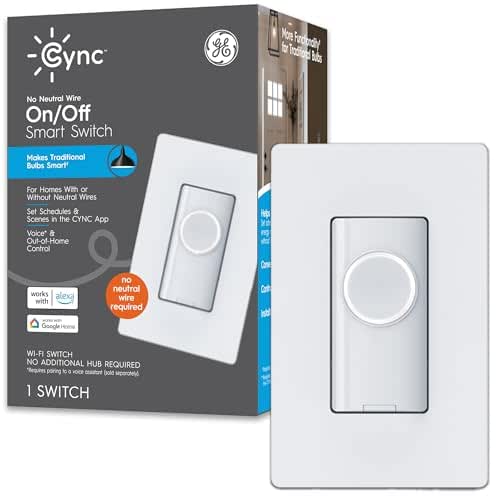
| Best No‑Neutral Option | Voice Control: Amazon Alexa and Google Home | App Control: Cync App (powered by Savant) | Remote Control / Scheduling: App control with scheduling (via Cync app/voice) | VIEW LATEST PRICE | Read Our Analysis |
| WiFi Smart Light Switch (Neutral Alexa & Google) |

| Best Compatibility | Voice Control: Amazon Alexa and Google Assistant | App Control: Smart Life app | Remote Control / Scheduling: Remote control via Smart Life, schedules, sunrise/sunset | VIEW LATEST PRICE | Read Our Analysis |
| MoesGo WiFi 4-Gang Smart Touch Wall Switch |
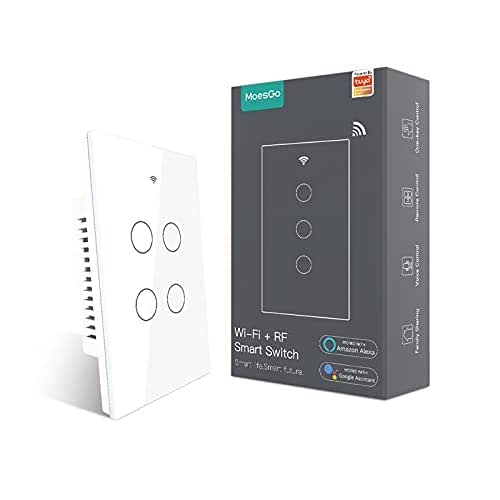
| Best for Control Panels | Voice Control: Alexa and Google Home | App Control: Smart Life / Tuya apps | Remote Control / Scheduling: Remote control via app, timer/countdown schedules | VIEW LATEST PRICE | Read Our Analysis |
More Details on Our Top Picks
GHome WiFi Smart Light Switch (Single-Pole Alexa/Google)
Should you want a straightforward, hub‑free smart switch that works with Alexa and Google, the GHome SW5 is a solid pick—just make sure your wiring includes a neutral. You’ll get UL and FCC listings, 120V/60Hz operation, 15A max (up to 1800W), and 2.4 GHz Wi‑Fi only. The single‑pole unit isn’t compatible with smart bulbs and needs the provided jumper wires for installation. Control it via the GHome app, voice, remote, or groups, and set schedules, timers, or sunrise/sunset automations. Update to firmware V1.1.3 whenever prompted to improve feature stability and performance.
- Voice Control:Alexa and Google Assistant
- App Control:GHome App (SW5)
- Remote Control / Scheduling:Remote control, group control, schedules and timers (sunrise/sunset)
- No Hub Required:No hub required (Wi‑Fi)
- 2.4 GHz Wi‑Fi Support:2.4 GHz only
- Works with Standard Non‑Smart Bulbs / Lights:Controls wired light circuits (not compatible with smart bulbs)
- Additional Feature:Neutral wire required
- Additional Feature:Firmware updates available
- Additional Feature:Sunrise/sunset automation
TREATLIFE Smart Wi‑Fi Light Switch 4-Pack
Should you want reliable, app‑controlled lighting for standard single‑pole circuits, the TREATLIFE Smart Wi‑Fi Light Switch 4‑Pack is a practical choice—especially should your home already have a neutral wire and runs on 2.4 GHz Wi‑Fi. You’ll get four on/off switches (no dimming) that work with standard bulbs and require single‑pole wiring only. They integrate with Alexa, Google Assistant, and SmartThings for voice control. Use the Smart Life app to control remotely, monitor real‑time status, share devices, group switches, and set schedules, timers, or occupancy simulations. Each unit is rated 1250 W/10 A, FCC certified, and ships with a screwless wall plate.
- Voice Control:Amazon Alexa and Google Assistant (also SmartThings)
- App Control:Smart Life app
- Remote Control / Scheduling:Remote control via app, schedules, timers, occupancy simulation
- No Hub Required:No hub required (Wi‑Fi)
- 2.4 GHz Wi‑Fi Support:2.4 GHz only
- Works with Standard Non‑Smart Bulbs / Lights:Compatible with standard non‑smart bulbs (on/off only)
- Additional Feature:Occupancy-simulation schedules
- Additional Feature:Real-time status monitoring
- Additional Feature:Screwless snap-on plate
Switchmate Snap-On Smart Rocker Light Switch Adapter
Should you want a no-fuss way to make rocker-style switches smart without cutting wires or calling an electrician, the Switchmate Snap-On adapter is a great choice — it literally snaps over your existing switch and runs on included batteries. You’ll install it in seconds: no tools, no wiring, no pro. It magnetically attaches to wall plate screws, maintains a clean look, and keeps a manual rocker for direct control. Use the free Switchmate app on Android or iOS for timers and remote on/off, and enable voice control via Google Assistant—or add Power through SimplySmart Home for Alexa and broader Google Home integration.
- Voice Control:Google Assistant (Alexa via Power by SimplySmart Home)
- App Control:Switchmate mobile app (iOS/Android)
- Remote Control / Scheduling:App-controlled timer and remote on/off
- No Hub Required:No wiring or hub required (magnetic snap-on)
- 2.4 GHz Wi‑Fi Support:(Wireless via app — integrates with assistants; mobile app connectivity implied)
- Works with Standard Non‑Smart Bulbs / Lights:Adds app/voice control to existing rocker switches (controls standard lights)
- Additional Feature:Tool-free magnetic installation
- Additional Feature:Battery powered included
- Additional Feature:Built-in manual switch
GE CYNC Smart No-Neutral WiFi Light Switch (White)
In case you want a simple smart switch that skips the neutral wire, the GE CYNC Smart No‑Neutral WiFi Light Switch (White) is a practical choice for older homes and DIY installs. You’ll get a white, rectangular push‑button switch that fits standard boxes and runs on 120V with a 5A rating. It needs a ground but no neutral, works via 2.4 GHz Wi‑Fi and Bluetooth, and uses the Cync app (no hub). It supports Alexa and Google Home, handles single‑pole or compatible 3‑way setups, and carries a two‑year limited warranty for peace of mind.
- Voice Control:Amazon Alexa and Google Home
- App Control:Cync App (powered by Savant)
- Remote Control / Scheduling:App control with scheduling (via Cync app/voice)
- No Hub Required:No standalone bridge or hub required
- 2.4 GHz Wi‑Fi Support:2.4 GHz Wi‑Fi (also Bluetooth)
- Works with Standard Non‑Smart Bulbs / Lights:Controls standard on/off circuits (push-button switch)
- Additional Feature:No neutral required
- Additional Feature:Bluetooth + Wi‑Fi connectivity
- Additional Feature:2‑year limited warranty
WiFi Smart Light Switch (Neutral Alexa & Google)
Should you want hands-free control and easy remote access, the WiFi Smart Light Switch (neutral required) is ideal for Alexa and Google users who already have 2.4 GHz home WiFi and single-pole wiring. You’ll get voice control via Alexa or Google Assistant and remote access through the Smart Life app without a hub. Install only in single-pole setups with a neutral wire; it fits 1/2/3/4-gang boxes and doesn’t support 3-way or 5 GHz networks. Use the app to schedule, set timers, follow sunrise/sunset automations, share devices, and group control. CE and FCC approvals guarantee safety and quality.
- Voice Control:Amazon Alexa and Google Assistant
- App Control:Smart Life app
- Remote Control / Scheduling:Remote control via Smart Life, schedules, sunrise/sunset
- No Hub Required:No hub required (Wi‑Fi)
- 2.4 GHz Wi‑Fi Support:2.4 GHz only
- Works with Standard Non‑Smart Bulbs / Lights:Controls regular wired lights (single-pole)
- Additional Feature:Fits 1–4 gang boxes
- Additional Feature:CE certified
- Additional Feature:Sunrise/sunset scheduling
MoesGo WiFi 4-Gang Smart Touch Wall Switch
Provided that you want a 4‑gang smart switch that blends a sleek glass panel with full remote and voice control, the MoesGo WiFi 4‑Gang Smart Touch Wall Switch is a solid choice—especially provided that your home wiring includes a neutral and your network runs on 2.4 GHz. You get four touch glass switches with optional backlight, plus single‑pole and multi‑control (3‑way) wiring so multiple switches can operate one light. It pairs with Smart Life/Tuya, works with Alexa and Google Home, and lets you control lights remotely, set timers, countdowns, and auto on/off. It can retain relay status after power loss.
- Voice Control:Alexa and Google Home
- App Control:Smart Life / Tuya apps
- Remote Control / Scheduling:Remote control via app, timer/countdown schedules
- No Hub Required:No hub required (Wi‑Fi via Tuya/Smart Life)
- 2.4 GHz Wi‑Fi Support:2.4 GHz only
- Works with Standard Non‑Smart Bulbs / Lights:Controls standard lighting circuits (single/multi‑control options)
- Additional Feature:Glass touch panel
- Additional Feature:Multi‑control (3‑way) support
- Additional Feature:Last‑relay state memory
Factors to Consider When Choosing a Bluetooth Light Switch
Upon choosing a Bluetooth light switch, you’ll want to check device compatibility and whether it supports the phones and smart hubs you already use. Consider range, signal strength, power and wiring requirements, and how complex the installation will be for your setup. Also evaluate the app and interface quality since that’s how you’ll control and customize your lights.
Compatibility With Devices
Before you buy, check that your phone, tablet, or hub actually speaks the same Bluetooth language as the switch—Bluetooth version mismatches (e.g., BLE vs. older stacks) can stop pairing or block features—then confirm OS/app compatibility, platform and voice-assistant integration, multi-user support, and whether your home’s range and interference will let the switch work reliably. Next, verify your devices support the switch’s Bluetooth version (Bluetooth 4.0/LE vs. 5.x) so pairing and features function. Make sure the vendor’s app runs on your OS and that permissions and firmware updates are available. Should you want voice control or cloud automations, confirm integrations with Alexa, Google Assistant, HomeKit, or your hub. Finally, check multi-device pairing and centralized hub support for household sharing and automation.
Range And Signal Strength
After confirming device and platform compatibility, you’ll want to check how far and how well the switch will actually communicate within your home. Typical Bluetooth Classic reaches about 10 meters (33 ft) unobstructed; BLE can hit ~30 meters (100 ft) in open air but drops with walls and floors. Signal strength is measured in dBm: stronger signals (e.g., −60 dBm) give reliable responsiveness, while weak ones (e.g., −90 dBm) risk latency and dropouts. Dense materials — concrete, brick, metal studs, foil‑backed insulation — can cut range dramatically, often that much by 50% or more versus drywall. Also avoid locating switches near heavy 2.4 GHz sources (Wi‑Fi, microwaves) to reduce packet loss. For multiroom setups, plan for Bluetooth mesh or repeaters to extend consistent coverage.
Power And Wiring Needs
In deciding on a Bluetooth light switch, focus initially on how it ties into your home’s wiring and power needs: confirm whether it requires a neutral or ground, match its line voltage and current rating to your circuit, and pick a model rated for single‑pole or multi‑way use as needed. Check neutral versus no‑neutral designs—some switches need a neutral, others use ground or alternative wiring. Verify line voltage (e.g., 120 V/60 Hz) and current limits (commonly 10–15 A) so the switch safely handles the load. Confirm single‑pole or 3‑way compatibility or whether an auxiliary unit is required. Compare power consumption and standby draw for battery backup or energy goals. In multi‑gang boxes, verify enclosure depth, conductor space, wire gauge, and code compliance for combined circuits.
Installation Complexity Level
Because installation can vary widely across home and model, assess complexity ahead so you know what skills and time you’ll need. Initially, check whether the switch requires a neutral—adding that wire in older homes can turn a quick swap into a rewiring job. Confirm whether you need single‑pole or multi‑way support; 3‑way circuits demand extra wiring and coordination with other switches. Expect to cut power and work inside the wall box; tight spaces or crowded conduit slow you down and might require an electrician. Prefer models that pair directly over Bluetooth without a separate hub to reduce hardware complexity. Finally, factor in smartphone pairing and firmware updates—limited Bluetooth range, retries, and update time can lengthen the total install.
App And Interface Quality
How will you know the switch is actually doing what you told it to do? Check the companion app on iOS and Android and confirm recent updates and changelogs. You’ll want remote control, real‑time status, and push notifications so you can see state changes and get alerts. Make sure the interface supports grouping, scenes, schedules (including sunrise/sunset), and simple device sharing for multiple users. Test responsiveness: latency should be under 1–2 seconds and the app should reconnect automatically after Bluetooth drops. Verify there are clear setup instructions, in‑app firmware updates, and accessible troubleshooting resources—step‑by‑step guides, FAQs, and contact options. A well‑designed app makes the switch reliable and keeps management straightforward.
Voice Assistant Integration
In case you rely on voice control, make sure the switch actually speaks the same language as your assistant and that it can be reached the way you expect—directly via Bluetooth, through a local bridge, or through routing commands via your phone or cloud. Check that the switch supports your assistant’s protocol (Google, Alexa, etc.), since compatibility isn’t universal. Verify whether voice control needs a hub, bridge, or a nearby smartphone, and plan for that extra hardware. Test latency and reliability: Bluetooth-only paths can be slower or fail when assistants route through the cloud. Confirm multi-user and multi-device behavior so shared accounts won’t block commands. Finally, guarantee the assistant can access the features you want—on/off, dimming, scenes, schedules, or multi-gang control.
Security And Privacy Features
Voice control is convenient, but you should also pay close attention to security and privacy—especially with Bluetooth devices that sit on your home network. Pick switches using Bluetooth 4.2+ or BLE with Secure Connections so pairing and traffic are encrypted. Prefer authenticated pairing (passkey entry or numeric comparison) over unauthenticated “just-press” methods to prevent unauthorized access. Confirm the device supports bonding with unique keys and limits advertising/connection windows to shrink the attack surface and resist replay or brute‑force attempts. Make certain firmware supports secure, signed over‑the‑air updates so vendors can patch vulnerabilities promptly. Finally, review the manufacturer’s privacy policy: choose devices that minimize telemetry and offer local control to avoid unnecessary transmission of usage or personal data.
Frequently Asked Questions
Can Bluetooth Switches Work With Multi-Room Audio Systems?
Yes — they can, but it depends on system compatibility and protocols. You’ll need switches and audio hubs supporting the same Bluetooth profiles or bridging via a smart hub. Otherwise, latency and grouping limitations might arise.
Do Bluetooth Light Switches Support Energy Usage Logging?
Yes — and maybe more than you expect. You’ll find many Bluetooth switches log consumption locally or to an app, letting you track usage and patterns, though advanced metering or cloud analytics often require specific models or companion hubs.
Can I Integrate Bluetooth Switches With Zigbee or Z-Wave Hubs?
No, you usually can’t directly integrate Bluetooth switches with Zigbee or Z‑Wave hubs; you’ll need a bridge or hub that translates protocols, or use a smart home platform that supports both via cloud or local integrations to link them.
Are Firmware Updates Applied Automatically Over Bluetooth?
Usually they’re not automatic; you’ll need the switch’s app or hub to push Bluetooth firmware updates. Some devices can auto-update whenever paired and charging, but you should check settings and manually approve critical updates.
Do Bluetooth Switches Interfere With Medical Devices?
About 1% of reported interference cases involve Bluetooth, and you generally won’t experience problems; modern Bluetooth switches use low-power signals, but you should still keep them a few inches from sensitive medical devices and consult device makers.
Final Thoughts
You’ve got plenty of easy, budget-friendly options to make your home smarter without rewiring. Pick a switch that matches your wiring (neutral or no-neutral), current needs, and desired controls—app features, timers, and voice support matter. Check BLE security, reliable pairing, and whether you need a bridge for assistant integration. With the right choice, your lighting will be as easy as pie to manage, saving time and adding convenience every day.
