

You want a thermostat that fits your schedule, saves energy, and won’t give you headaches during installation. These six 7‑day programmable models balance intuitive programming, smart features, and broad compatibility so you can set reliable comfort week after week. I’ll walk you through their key strengths and who each one suits best—so you can pick the right match for your system and routine.
| Honeywell Home RTH6580WF Wi-Fi 7-Day Programmable Thermostat White |

| Best Budget Smart | Programmable (7‑day): 7‑day programmable scheduling | Display: Big backlit digital display | Power requirement / C‑wire: Requires C‑wire (20–30 VAC) | VIEW LATEST PRICE | Read Our Analysis |
| Honeywell Home RTH9585WF1004 Wi‑Fi Smart Color Thermostat |
| Premium Smart Pick | Programmable (7‑day): 7‑day programmable scheduling | Display: Customizable color touchscreen | Power requirement / C‑wire: Requires C‑wire (120V AC power; needs C‑wire) | VIEW LATEST PRICE | Read Our Analysis |
| VEVOR 7-Day Programmable Thermostat for Underfloor Heating |
| Best for Underfloor | Programmable (7‑day): 7‑day programmable scheduling | Display: LED backlit screen | Power requirement / C‑wire: Requires 120/240V AC power (high/low voltage) | VIEW LATEST PRICE | Read Our Analysis |
| Honeywell RTH7560E 7-Day Programmable Thermostat (White) |
| Reliable Classic Choice | Programmable (7‑day): 7‑day flexible programmable scheduling | Display: Extra‑large backlit display | Power requirement / C‑wire: Standard low‑voltage wiring (retains program on power loss) – typical HVAC wiring/C‑wire systems | VIEW LATEST PRICE | Read Our Analysis |
| Honeywell Home RTH7600D 7-Day Programmable Touchscreen Thermostat White |

| Best Feature-Rich | Programmable (7‑day): 7‑day programmable (4 periods/day) | Display: Large backlit touchscreen display | Power requirement / C‑wire: Standard low‑voltage HVAC wiring (uses system power; battery optional) | VIEW LATEST PRICE | Read Our Analysis |
| Robertshaw RS10420T 7-Day Wi‑Fi Programmable Touchscreen Thermostat |
| Pro-Level Control | Programmable (7‑day): 7‑day programmable (wake/leave/return/sleep) | Display: 8.8‑sq‑in blue backlit touchscreen | Power requirement / C‑wire: Requires C‑wire; battery backup included | VIEW LATEST PRICE | Read Our Analysis |
More Details on Our Top Picks
Honeywell Home RTH6580WF Wi-Fi 7-Day Programmable Thermostat White
Should you want reliable remote control and customizable weekly schedules, the Honeywell Home RTH6580WF is a strong pick — its Wi‑Fi connectivity and 7‑day programming let you adjust temperature from anywhere and set different weekday/weekend routines to match your lifestyle. You’ll control it via the Total Connect Comfort or Honeywell Home app, and use Alexa, Google Assistant or Cortana for hands‑free changes. Installation’s DIY friendly but needs a C‑wire (or adapter). It suits forced‑air, hot water, steam, and heat‑pump systems, not electric baseboard heat. Smart Response, a large backlit display, and ENERGY STAR efficiency help save energy and stay comfortable.
- Programmable (7‑day):7‑day programmable scheduling
- Display:Big backlit digital display
- Power requirement / C‑wire:Requires C‑wire (20–30 VAC)
- Compatibility (common HVAC types):Forced air, hot water, steam, heat pumps with electric backup (not 120–240V baseboard)
- Energy‑saving / Smart response:Smart Response technology; ENERGY STAR certified
- Remote / app or local control:Wi‑Fi remote control via Total Connect Comfort / Honeywell Home app
- Additional Feature:Big backlit digital display
- Additional Feature:ENERGY STAR certified
- Additional Feature:Smart Response learning
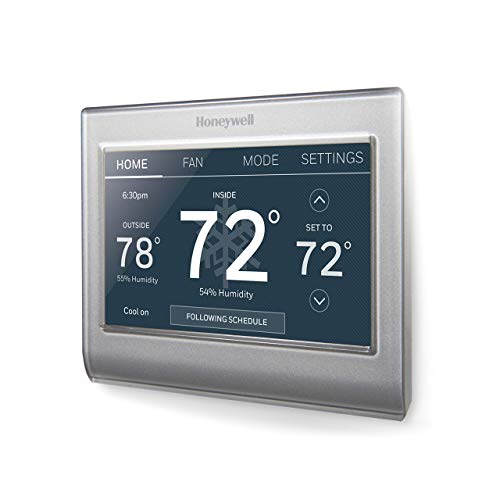
Honeywell Home RTH9585WF1004 Wi‑Fi Smart Color Thermostat
Should you want a feature-rich, smart thermostat that blends touchscreen convenience with sturdy scheduling, the Honeywell Home RTH9585WF1004 is a strong choice for tech-savvy homeowners with common HVAC systems. You’ll get a customizable color touchscreen, 7-day programming, and Smart Response Technology to balance comfort and savings. It works with forced air, hot water/steam, and heat pumps with electric backup but needs a C‑wire and won’t support electric baseboard heat. You can control it via app, Alexa, or Google Home, view local forecasts, receive maintenance alerts, and access monthly energy reports. Includes one-year warranty and mounting hardware.
- Programmable (7‑day):7‑day programmable scheduling
- Display:Customizable color touchscreen
- Power requirement / C‑wire:Requires C‑wire (120V AC power; needs C‑wire)
- Compatibility (common HVAC types):Forced air, hot water, steam, heat pumps with electric backup (not 120–240V baseboard)
- Energy‑saving / Smart response:Smart Response technology; Energy Star; monthly reports and tips
- Remote / app or local control:Wi‑Fi remote control via Honeywell app; voice assistant support
- Additional Feature:Customizable color touchscreen
- Additional Feature:Local weather forecast
- Additional Feature:Filter and extreme alerts
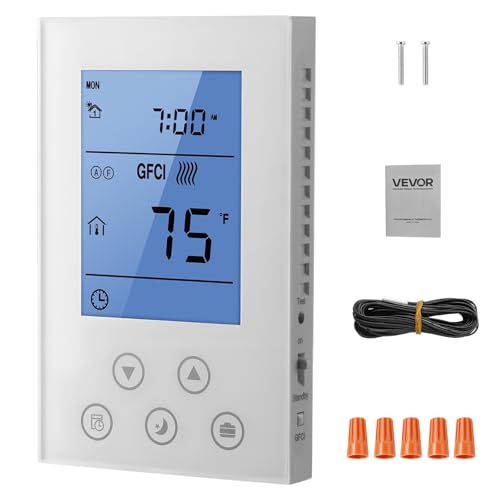
VEVOR 7-Day Programmable Thermostat for Underfloor Heating
Should you want flexible, room-by-room comfort without constantly fiddling with controls, the VEVOR 7-Day Programmable Thermostat is built for you — it lets you set precise temperature schedules for each day of the week so your underfloor heating, snow-melt system, or heat pump only runs whenever you need it. You’ll appreciate the built-in sensitive sensor and option to use floor or indoor probes for accurate feedback, keeping temperatures stable. It supports 120V/240V high/low-voltage systems, reduces manual adjustments and energy waste, and shows settings on an LED backlit screen. Quick-response buttons and sleep mode make it straightforward and durable.
- Programmable (7‑day):7‑day programmable scheduling
- Display:LED backlit screen
- Power requirement / C‑wire:Requires 120/240V AC power (high/low voltage)
- Compatibility (common HVAC types):Radiant underfloor heating, snow melting, heat pumps, other floor/indoor sensor systems
- Energy‑saving / Smart response:Programmable scheduling to reduce energy waste (energy‑saving sleep mode for display)
- Remote / app or local control:Local control via buttons (no Wi‑Fi indicated)
- Additional Feature:Supports 120/240V systems
- Additional Feature:Floor and indoor sensors
- Additional Feature:Energy‑saving sleep mode
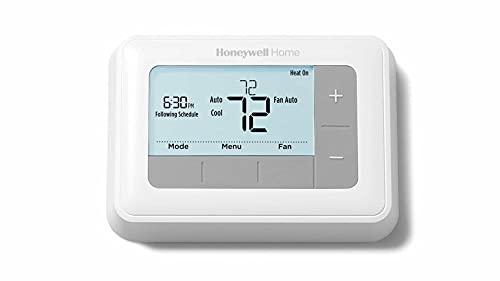
Honeywell RTH7560E 7-Day Programmable Thermostat (White)
Should you want a programmable thermostat that adapts to your schedule and keeps things simple to use, the Honeywell RTH7560E is a strong choice. You’ll get 7-day flexible programming—day-to-day, weekends-only, or one schedule for the week—plus Smart Response Learning that times heating and cooling so rooms reach your set temperature whenever scheduled. The extra-large backlit display shows time, current temp, and set point at once, so you won’t page through menus. Installation’s easier with the UWP mounting system, and maintenance’s simpler with filter-change prompts, low-battery alerts, and program memory that survives power outages.
- Programmable (7‑day):7‑day flexible programmable scheduling
- Display:Extra‑large backlit display
- Power requirement / C‑wire:Standard low‑voltage wiring (retains program on power loss) – typical HVAC wiring/C‑wire systems
- Compatibility (common HVAC types):Works with common systems (forced air, heat pumps, hot water, steam, etc.)
- Energy‑saving / Smart response:Smart Response Learning; programs to manage run times
- Remote / app or local control:Local control with easy on‑device interface (no Wi‑Fi indicated)
- Additional Feature:Extra‑large backlit display
- Additional Feature:UWP uniform wiring mount
- Additional Feature:Memory retention during outages
Honeywell Home RTH7600D 7-Day Programmable Touchscreen Thermostat White
Should you want precise, day-by-day control over your home’s temperature, the Honeywell Home RTH7600D is a great choice—its 7-day, four-period programming lets you set different schedules for each day so you can save energy without sacrificing comfort. You’ll use the large backlit touchscreen to view current and set-point temperatures simultaneously and program via a menu-driven interface. Smart Response Technology learns system run-times to hit your setpoints on schedule, while compressor protection prevents short-cycling. You can set temporary or permanent holds, enable filter and low-battery alerts, and rely on broad compatibility with virtually all heating and cooling systems. Installation is straightforward.
- Programmable (7‑day):7‑day programmable (4 periods/day)
- Display:Large backlit touchscreen display
- Power requirement / C‑wire:Standard low‑voltage HVAC wiring (uses system power; battery optional)
- Compatibility (common HVAC types):Works with single/multistage heat/cool, heat pumps, hot water, steam, gravity systems, 750 mV, gas fireplaces
- Energy‑saving / Smart response:Smart Response Technology; compressor protection and energy savings modes
- Remote / app or local control:Local touchscreen control (no Wi‑Fi indicated in summary)
- Additional Feature:4 periods per day
- Additional Feature:Compressor short‑cycle protection
- Additional Feature:Auto Daylight‑Saving adjustment
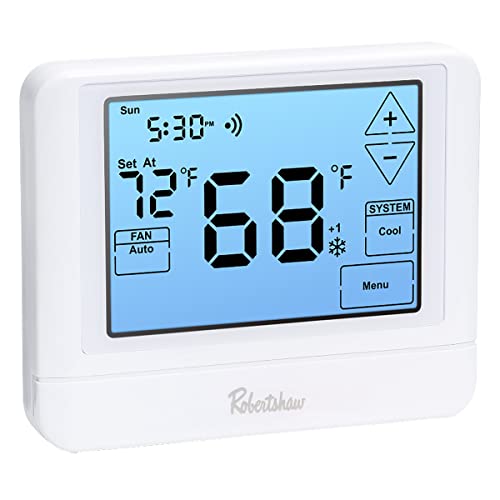
Robertshaw RS10420T 7-Day Wi‑Fi Programmable Touchscreen Thermostat
Should you want a touchscreen Wi‑Fi thermostat that handles multi‑stage systems and gives smartphone control plus Alexa compatibility, the Robertshaw RS10420T is a strong pick. You’ll get 4‑heat/2‑cool multi‑stage support and an 8.8‑sq‑in blue backlit touchscreen for clear interaction. Wi‑Fi connects to the Robertshaw iOS/Android app with Alexa voice control and auto changeover. Program seven days with wake/leave/return/sleep icons, use the factory energy program, set swing and setpoint limits, and enable compressor short‑cycle delay and keypad lockout. Installation uses a universal sub‑base and large terminals; C‑wire required, battery backup included. Six‑year limited warranty.
- Programmable (7‑day):7‑day programmable (wake/leave/return/sleep)
- Display:8.8‑sq‑in blue backlit touchscreen
- Power requirement / C‑wire:Requires C‑wire; battery backup included
- Compatibility (common HVAC types):Multi‑stage support (4 heat / 2 cool); universal sub‑base for common HVAC systems
- Energy‑saving / Smart response:Factory energy‑efficiency program; adjustable swing and setpoint limits
- Remote / app or local control:Wi‑Fi remote control via Robertshaw app; Alexa compatible
- Additional Feature:Multi‑stage (4H/2C) support
- Additional Feature:Large blue backlit screen
- Additional Feature:Five‑minute compressor delay
Factors to Consider When Choosing a 7 Day Programmable Thermostat
Before you pick a 7-day programmable thermostat, check compatibility with your HVAC system and whether it needs a C‑wire for power. Consider the programmability options and energy‑saving features that match your schedule and goals. Also consider smart home integration should you want remote control or voice commands.
Compatibility With HVAC
Because your HVAC’s wiring and control logic vary depending on system type, confirm the thermostat supports forced air, heat pump, hydronic/steam, or radiant systems so you don’t end up with incompatible controls. Next, make sure the unit matches your voltage — some underfloor or electric systems use 120/240 VAC while most residential systems run on 24 VAC — to avoid safety issues. Check terminal compatibility (R/RC, W, Y, G, O/B, AUX, L, etc.) against your existing wiring so you don’t lose functions or need adapters. Verify multistage support, auxiliary/backup heat, and auto changeover for multi‑stage or heat pump setups. Finally, confirm whether the thermostat requires or supplies a C‑wire so you can plan for power needs ahead of installation.
Power Requirements (C‑Wire)
Often you’ll find that modern 7‑day programmable thermostats need a common (C) wire to get continuous 24 VAC power for Wi‑Fi, color displays, and background functions; without a C‑wire the unit might not power on reliably or will drop advanced features. Before buying, check your HVAC control board for a C terminal and confirm the transformer supplies the standard 24–30 VAC most thermostats expect. If you lack a C‑wire, you can sometimes use a compatible power adapter or a power‑sharing kit, but compatibility and function vary. Battery‑only models could limit connectivity, dim displays, and need frequent replacements. Incorrect or missing wiring can cause erratic behavior, reboots, or damage, so obtain professional verification when you’re unsure.
Programmability Options
Upon choosing a 7‑day programmable thermostat, check whether it truly lets you set individual schedules for each day and how many temperature periods per day it supports so you can match wake/leave/return/sleep routines. You’ll want true 7‑day versus 5‑2 or 5‑1‑1 formats so weekend days can differ, and look for 2–4 programmable periods to cover typical daily activities. Verify temporary and permanent hold options so you can override settings briefly or until you clear them. Confirm auto changeover between heating and cooling to avoid switching modes during shoulder seasons. Finally, consider learning or adaptive scheduling features that fine‑tune run times and optimize comfort and efficiency over days or weeks.
Smart Home Integration
Once you’ve confirmed the scheduling features you need, look at how the thermostat fits into your broader smart‑home setup so you can control and automate comfort from anywhere. Make sure it supports the platforms and voice assistants you already use—local hubs or cloud services— so you’re able to adjust schedules and temperature remotely. Verify compatibility with Wi‑Fi, Zigbee, Z‑Wave, Thread, or proprietary APIs to enable scenes, routines, and device triggers. Check for secure cloud services, encryption, and options like two‑factor authentication or unique device passwords to protect remote access. Prefer models with open APIs, IFTTT, webhooks, or MQTT should you plan to build custom automations. Finally, choose devices offering multi‑user accounts, role controls, and activity logs to manage access and troubleshoot interactions.
Energy‑Saving Features
At the time you prioritize energy‑saving features in a 7‑day programmable thermostat, you’ll get more comfort for less cost through combining precise scheduling, smart run‑time adjustments, and actionable usage feedback. Choose true 7‑day schedulability with multiple daily periods (wake/leave/return/sleep) so you can lower setpoints during unoccupied times and maximize off‑peak savings. Prefer models with Smart Response or learned run‑time to anticipate system lag, reduce overshoot, and cut runtime. Look for energy reports, usage tracking, and alerts (filter or extreme temp) to spot wasteful patterns and prompt corrective action. Make certain compatibility with demand‑response programs, utility rebates, and remote Wi‑Fi/app control to join peak‑saving events. Finally, pick units that protect equipment—compressor short‑cycle delay and configurable temperature swing limits—to prevent wasteful cycling.
Display And Interface
Saving energy is easier should you can see and control your thermostat quickly, so your next focus should be the display and interface. Choose a large, backlit screen that shows current temperature and setpoint at once to cut menu digging and stay readable in low light. Touchscreen controls with clear icons make programming seven-day schedules and multiple periods straightforward, while tactile buttons give fast manual overrides and work with gloves. Look for adjustable color or brightness and an ambient light sensor so the display matches decor and auto-adjusts visibility. Built-in status indicators or on-screen alerts for filter changes, low battery, or connectivity problems keep you informed without steering through menus, reducing maintenance hassles and preventing unexpected comfort setbacks.
Installation Ease
Consider through installation initially so you won’t run into surprises that keep your new thermostat from working. First, verify whether the model requires a C‑wire and confirm your HVAC control board offers a 24 VAC C terminal; that avoids needing an external power adapter. Check system compatibility—single‑stage, multi‑stage, heat pump, or high‑voltage—so relays and wiring match. Inspect your existing wiring layout and terminal labeling (R/RC, W, Y, G, C) and make certain wire gauge is adequate for a DIY swap. Choose a wall location with nearby power, a level mounting surface, and clearance from sunlight, drafts, or heat sources to prevent sensor errors. Prefer thermostats with clear wiring diagrams and user‑friendly mounting systems to cut installation time and wiring mistakes.
Alerts And Diagnostics
Because alerts and diagnostics keep small problems from turning into big repairs, you’ll want a thermostat that not only warns you about extreme temps or humidity but also reports connectivity, power issues (like a failing C‑wire or low battery), and compressor/short‑cycle events for troubleshooting. Choose a model that sends configurable push/email/SMS notifications so you can set thresholds for temperature, humidity, or malfunctions. Prefer units that log historical fault codes and sensor readings or let you download reports for HVAC techs to diagnose recurring issues quickly. Also look for maintenance prompts and filter/humidifier pad change notifications based on runtime or calendar intervals to preserve efficiency. These features save time, prevent damage, and simplify service calls.
Frequently Asked Questions
Can a Programmable Thermostat Control Multiple Zones Independently?
Yes — you can control multiple zones independently provided each zone has its own thermostat or a multi-zone system. You’ll need dampers, zone controllers, or smart thermostats wired or networked together, and proper HVAC compatibility.
Do These Thermostats Work With Heat Pumps and Dual-Fuel Systems?
Yes — many 7-day programmable thermostats work with heat pumps and dual-fuel systems. You’ll need to verify compatibility, make certain proper wiring and settings for auxiliary/emergency heat, and sometimes update firmware or use a model designed for heat-pump control.
How Secure Is the Wi‑Fi Connection Against Hacking?
Wi‑Fi security varies, but you’re generally protected provided you use strong passwords, update firmware, enable WPA3/WPA2, disable remote access whenever unused, and enable two‑factor auth where available; weak defaults leave devices vulnerable to hacking.
Can I Retain Manual Control During Scheduled Programs?
Yes — you can retain manual control during scheduled programs. You’ll be able to override schedules temporarily or permanently, and the thermostat will usually offer options to resume the program after a set time or at the next scheduled event.
Do These Models Require Professional Installation or Are They Diy-Friendly?
About 70% of homeowners install thermostats themselves. You can DIY most models—you’re able to install many with common wiring and clear guides—but you should hire a pro should you lack wiring confidence, have complex HVAC, or need smart-home integration.
Final Thoughts
So you want simplicity with a side of smarts — and, shockingly, thermostats deliver. Pick one that matches your wiring, system type, and desire to tinker; the Honeywell and Robertshaw models give app control and learning features, VEVOR handles underfloor or high‑voltage needs, and the simpler Honeywell units keep things fuss‑free. You’ll save energy, avoid comfort drama, and still get to pretend the thermostat is doing all the hard work for you.
