

You want efficiency, you want reliable heating, and you want smart controls that actually work. You’ll find models—from ductless mini‑splits like Senville’s LETO and TABU to budget‑friendly Goodman split systems—that balance SEER2 ratings, inverter tech, and warranties. I’ll walk you through their strengths, where each fits best, and what pros should install, so you can pick the right two‑ton unit for 2026 and avoid costly mistakes.
| Senville LETO 24,000 BTU Mini Split Heat Pump |
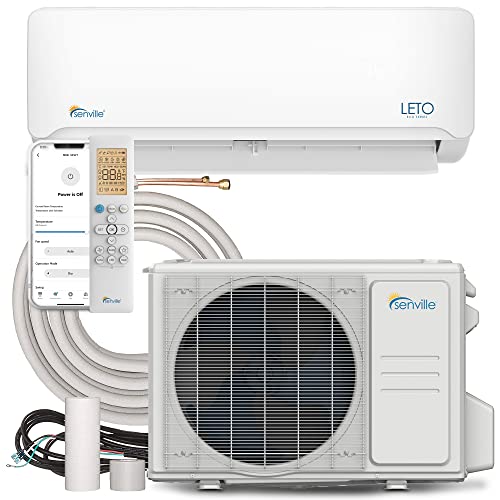
| Smart Home Ready | Capacity: 24,000 BTU (2 ton) | Voltage: 208/230 V | Heat Pump / Heating Capability: Heat pump (operational to 5°F / -15°C) | VIEW LATEST PRICE | Read Our Analysis |
| Senville 28000 BTU Dual Zone Mini Split Heat Pump |

| Cold-Climate Power | Capacity: 28,000 BTU (listed as 2 ton) | Voltage: 208–230 V | Heat Pump / Heating Capability: Arctic heat pump (operational to -22°F / -30°C) | VIEW LATEST PRICE | Read Our Analysis |
| TABU 24000BTU Mini Split Heat Pump AC |

| High-Efficiency Performer | Capacity: 24,000 BTU (2 ton) | Voltage: 220–230 V | Heat Pump / Heating Capability: Heat pump (rapid heat; 4‑in‑1 functions) | VIEW LATEST PRICE | Read Our Analysis |
| Goodman 2 Ton 13.4 SEER2 AC with 96% Furnace |

| Reliable Bundle | Capacity: 2 ton (air conditioner in bundle) | Voltage: (standard residential)—matches 208/230 V system (2 ton AC) | Heat Pump / Heating Capability: Paired with 96% AFUE gas furnace (heating via furnace; AC bundle) | VIEW LATEST PRICE | Read Our Analysis |
| Cooper & Hunter 24,000 BTU Ducted Mini Split |

| Flexible Ducted Solution | Capacity: 24,000 BTU (2 ton) | Voltage: 230 V | Heat Pump / Heating Capability: Hyper Heat heat pump (low-temperature heating) | VIEW LATEST PRICE | Read Our Analysis |
More Details on Our Top Picks
Senville LETO 24,000 BTU Mini Split Heat Pump
Should you need efficient, year‑round climate control for a medium‑sized home or open-plan space, the Senville LETO 24,000 BTU mini split delivers: a 2‑ton, 18 SEER2 heat pump that cools, heats down to 5°F, dehumidifies, and responds quickly with a turbo mode—plus smart controls (Alexa and app) for convenient, remote operation. You’ll get a white, 208/230V unit with DC inverter tech, UL listing, and AHRI certification. The kit includes indoor and outdoor units, remote, and a 16 ft. precharged line set (refrigerant covers up to 25 ft.). Professional install is required; warranty covers five years.
- Capacity:24,000 BTU (2 ton)
- Voltage:208/230 V
- Heat Pump / Heating Capability:Heat pump (operational to 5°F / -15°C)
- Wi‑Fi / Smart Control:Alexa enabled; app control; remote
- Installation Requirement:Professional installation required; installation kit included
- Warranty / Support:5 years parts; 5 years compressor; complimentary technical assistance
- Additional Feature:Turbo rapid cooling/heating
- Additional Feature:AHRI certified performance
- Additional Feature:16 ft pre-charged line
Senville 28000 BTU Dual Zone Mini Split Heat Pump
Should you need reliable cooling and heating for two rooms or a small commercial space, the Senville 28,000 BTU dual-zone mini split delivers strong, year-round comfort while cutting energy use—its Arctic-capable heat pump runs down to -22°F and can save up to 40% on energy bills. You get dual indoor handlers powered via a single outdoor unit, ideal for bedrooms, additions, inhabited areas, stores, or restaurants. The 28,000 BTU (2-ton) system is Energy Star rated, AHRI certified, UL/ETL listed, and uses 208–230V. It supports Alexa voice and app control, includes free technical support, and offers 5-year parts plus 10-year compressor warranty.
- Capacity:28,000 BTU (listed as 2 ton)
- Voltage:208–230 V
- Heat Pump / Heating Capability:Arctic heat pump (operational to -22°F / -30°C)
- Wi‑Fi / Smart Control:Works with Alexa; app control; remote
- Installation Requirement:Professional installation supported; free installation support included
- Warranty / Support:5 years parts; 10 years compressor; free technical/installation support
- Additional Feature:Dual-zone multi-handlers
- Additional Feature:Arctic -22°F operation
- Additional Feature:Energy Star certified
TABU 24000BTU Mini Split Heat Pump AC
Provided that you need a quiet, space-saving 2-ton solution for cooling and heating up to about 1,500 sq. ft., the TABU 24000BTU mini split is a strong choice—its 21 SEER2 efficiency and rapid cool/heat response make it ideal for homeowners who want year-round comfort without ductwork. You’ll get 24,000 BTU capacity, 220–230 V operation, and a wall-mounted design that saves floor space. It offers 4-in-1 modes (cool/heat/dehumidify/fan), fan speed control, Wi‑Fi with Alexa/Google compatibility, and a remote. Installation kit’s included, performance is quiet, and dehumidifying improves indoor comfort and air quality.
- Capacity:24,000 BTU (2 ton)
- Voltage:220–230 V
- Heat Pump / Heating Capability:Heat pump (rapid heat; 4‑in‑1 functions)
- Wi‑Fi / Smart Control:Wi‑Fi enabled; Alexa and Google Assistant compatible; remote
- Installation Requirement:Installation kit included (professional installation implied)
- Warranty / Support:(manufacturer support implied) — standard product support; warranty not specified in summary
- Additional Feature:21 SEER2 efficiency
- Additional Feature:~30s cool response
- Additional Feature:Alexa and Google compatible
Goodman 2 Ton 13.4 SEER2 AC with 96% Furnace
Should you need a reliable, budget-friendly split system for a moderately sized home, the Goodman 2 Ton 13.4 SEER2 paired with a 96% AFUE 80,000 BTU furnace is a solid choice—offering straightforward cooling capacity and high-efficiency heating for colder months. You get the GLXS3BN2410 condensing unit, GR9S960803BN furnace, and CAPTA3022B3 coil as a bundled option. The AC delivers 2 tons at 13.4 SEER2 while the furnace provides 80,000 BTU at 96% efficiency. A 10-year parts limited warranty applies provided a qualified installer fits and you register online. Take note of sales restrictions in many states; accessories sell separately.
- Capacity:2 ton (air conditioner in bundle)
- Voltage:(standard residential)—matches 208/230 V system (2 ton AC)
- Heat Pump / Heating Capability:Paired with 96% AFUE gas furnace (heating via furnace; AC bundle)
- Wi‑Fi / Smart Control:Thermostat sold separately (accessories), supports smart thermostats (requires installer)
- Installation Requirement:Must be installed by qualified installer for warranty eligibility
- Warranty / Support:10-year parts limited warranty (when installed and registered)
- Additional Feature:Packaged AC + furnace
- Additional Feature:96% AFUE furnace
- Additional Feature:Sales-restricted states list
Cooper & Hunter 24,000 BTU Ducted Mini Split
Should you need a compact 2-ton system that handles both ducted central cooling and reliable low-temperature heating, the Cooper & Hunter 24,000 BTU Hyper Heat ducted mini split is a strong choice. You get a 230V inverter outdoor condenser and multi-position air handler offering upflow, downflow, or horizontal installs, so it fits attics, basements, retrofits, or new ducted setups. At 18.7 SEER2 it’s efficient, and Hyper Heat cuts dependence on resistance heat. A Smart Kit and wall thermostat enable smartphone control. It ships freight to an external delivery point, requires professional installation, and includes a 25 ft line set and drain extension.
- Capacity:24,000 BTU (2 ton)
- Voltage:230 V
- Heat Pump / Heating Capability:Hyper Heat heat pump (low-temperature heating)
- Wi‑Fi / Smart Control:Smart Kit included; wall thermostat; smartphone control
- Installation Requirement:Professional installation required; multi-position air handler for flexible installs
- Warranty / Support:Manufacturer support / free US-based technical support (warranty specifics not listed in summary)
- Additional Feature:Multi-position air handler
- Additional Feature:18.7 SEER2 efficiency
- Additional Feature:Includes Smart Kit
Factors to Consider When Choosing a 2 Ton Central Air Conditioner
Upon choosing a 2 ton central air conditioner, you’ll want to match capacity and sizing to your home’s layout so the unit cools efficiently without short-cycling. Check energy efficiency ratings and heating performance range to keep operating costs down and guarantee reliable warmth in cooler months. Also consider installation requirements, noise levels, and all-around comfort features to make sure the system fits your space and lifestyle.
Capacity And Sizing
Because a 2-ton central air conditioner delivers about 24,000 BTU/hr, you need to match that capacity to your home’s actual heat load rather than just its square footage. Start with a Manual J load calculation that factors square footage, ceiling height, insulation, windows (area and orientation), occupancy, and internal gains. Don’t oversize: short cycling raises humidity, cuts comfort, and increases wear. Don’t undersize either: continuous runtime and inadequate cooling follow. Check design conditions—climate, target indoor temperature, and peak outdoor temps—to confirm a 2-ton unit will meet extremes (and heating needs assuming it’s a heat pump). Finally, verify your duct system can supply roughly 800–1,000 CFM for a two-ton system to make certain proper airflow and dehumidification.
Energy Efficiency Ratings
Sizing a system correctly is only part of the decision—you’ll also want to compare how efficiently a 2-ton unit will operate across real-world conditions. Check SEER2: higher numbers (18–22+) mean lower electricity use and operating costs over the cooling season. Should you’re looking at heat-pump models, evaluate HSPF2 too—better HSPF2 reduces winter electricity for heating. Energy Star certification is a quick filter; it shows the unit meets government-backed efficiency thresholds and typically saves more than baseline models. For gas-furnace combos, AFUE matters—90%+ AFUE cuts gas bills when paired with a 2-ton cooling system. Finally, don’t chase peak numbers alone: compare part-load performance and prioritize inverter/variable-speed technology for realistic, day-to-day savings.
Heating Performance Range
Should you live where winters dip into single digits, check a 2‑ton unit’s heating performance range so you’ll know how reliably it will keep your home comfortable without costly backup. Look for the rated low‑ambient heating capability (for example, operation to −5°F, −15°C, or −30°C) so you match the unit to local extremes. Verify manufacturer performance curves or rated capacity at various outdoor temps to see how capacity falls off and whether you’ll need oversizing or auxiliary heat. Compare heat pump backup requirements: what supplemental source is used and at what outdoor temp electric resistance kicks in. Use AFUE for furnaces or HSPF/COP for heat pumps to estimate seasonal efficiency and running costs across the heating range. Confirm 2‑ton output meets your design temp.
Installation Requirements
Whenever you install a 2‑ton central air conditioner, plan around several site‑specific requirements to guarantee safe, efficient operation and to protect your warranty. Initially, verify your home’s electrical capacity: these units usually require a dedicated 208–230V circuit and breaker sized to the unit’s MCA and max fuse (check the nameplate). Confirm ductwork compatibility—expect roughly 1,000–1,200 CFM and seal, insulate, or resize ducts to balance supply and return pressures. Plan refrigerant line routing within factory length limits; longer runs might need additional charge. Provide level, vibration‑isolated mounting and required clearance for the outdoor condenser and indoor coil or air handler. Finally, obtain permits and hire an HVAC‑licensed technician to commission the system (refrigerant charge, airflow, thermostat calibration) for code and warranty compliance.
Noise And Comfort Levels
Often you’ll judge a 2‑ton central air conditioner based on how quietly it runs and how evenly it keeps your home comfortable. Check indoor dB(A) ratings—quiet air handlers sit around 25–40 dB(A); louder ones can exceed 50 dB(A). Don’t forget outdoor condenser noise (typically 55–75 dB(A) at 3–10 feet), which affects yard use and neighbors. Favor variable‑speed or inverter fans for lower noise and consistent, draft‑free comfort versus single‑speed units. Inspect vibration isolation and mounting: rubber grommets, anti‑vibration pads, and secure duct/coil installation cut structure‑borne noise and rattles. Finally, account for duct layout, return‑air grille placement, and insulation—poor designs create whistling, pressure imbalances, and uneven temperatures that undermine comfort.
Controls And Connectivity
After you’ve assessed noise and comfort, consider how you’ll control that performance: modern 2‑ton central units pair hardware with smart controls that let you manage temperature, schedules, and diagnostics from anywhere. Check for thermostats supporting Wi‑Fi, Zigbee, Z‑Wave, or BACnet so the system fits your smart‑home or building automation. Confirm mobile app capabilities—remote temp control, scheduling, geofencing, and energy reports—for convenience and operational understanding. In case you rely on voice assistants, pick units compatible with Alexa, Google Assistant, or Siri and with routine integration for hands‑free control. Look for multi‑zone or smart zoning support to set independent room temperatures and enhance efficiency. Finally, verify local/cloud control options, OTA firmware updates, and secure authentication like two‑factor or OAuth to keep features reliable and protected.
Warranty And Support
Protection matters whenever you invest in a 2‑ton central AC, so check warranty and support details before you buy. Look at parts and compressor warranties separately—compressors often get longer coverage (commonly 5–10 years) while parts might be shorter. Confirm any conditions that require professional installation and online registration to keep coverage valid, since improper installation can void claims. Check whether labor, travel, and diagnostic fees are excluded from the manufacturer warranty and whether your dealer or installer provides complementary labor or extended service plans. Make sure accessible technical support and local authorized service networks exist to speed repairs and parts replacement. Finally, review transferability and whether coverage becomes prorated after the initial full-coverage term in case you sell the home.
