

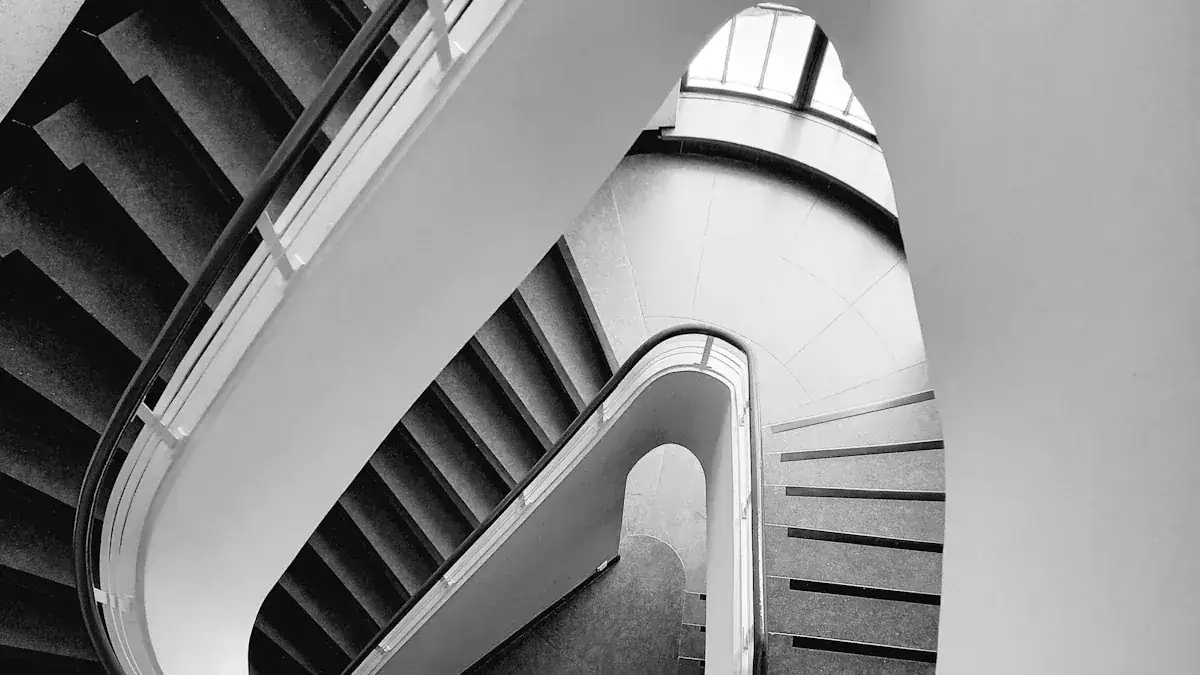
Stairs are both functional connectors and significant architectural features. They connect different levels. They also define your space’s architectural design. The right choice of stairs profoundly impacts a building’s aesthetics, flow, and overall design. This guide explores various staircase types, their unique staircase design nuances, and layout considerations. You will discover different types of stairs and material options for your staircase. This helps you make informed stair design decisions for your projects. Choose the best stairs for your needs. A well-chosen staircase elevates your space.
Key Takeaways
Stairs connect different levels and define a space’s look. Choosing the right type of stair improves a building’s beauty and how people move through it.
Many stair types exist, like straight, L-shaped, U-shaped, and spiral stairs. Each type has its own design, benefits, and challenges, especially for space saving.
Stair design needs careful thought about safety, comfort, and how it looks. Important things are the step size, handrails, and enough head space.
Materials like wood, metal, concrete, glass, and stone each offer different looks and strengths. Pick materials based on how long they last, how they look, and how much they cost.
You can make stairs special with different railings, step finishes, and lights. You can also add storage under the stairs to save space.
Exploring Different Types of Stairs
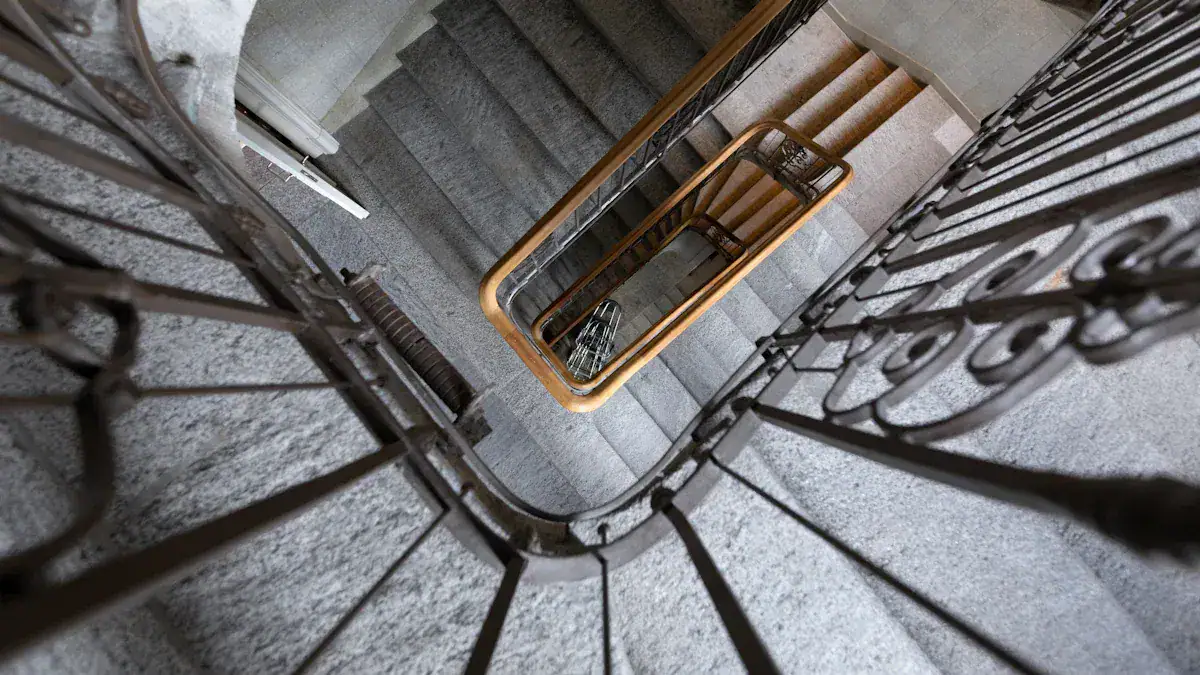
You will find many different staircase types, each with its own unique design and purpose. Understanding these types helps you choose the best one for your project. Each type impacts space and how people move through a building.
Straight Stairs
Straight stairs are the most common type. They go from one floor to another without changing direction.
Design and Layout: These stairs offer a simple, linear path. You need a long, clear space for them.
Benefits: Straight stairs are easy to build. They allow for good traffic flow.
Challenges: They take up a lot of linear space. This can be a problem in smaller areas.
Space and Traffic Flow: They create a direct path. They can make a space feel open or closed, depending on their placement.
You need to consider space requirements for straight stairs.
User Capacity | Minimum Width (inches) | Minimum Width (cm) |
|---|---|---|
Single user (residential) | 36 | 91 |
General public (one person, tight two) | 44 | 112 |
Comfortable two persons | 49-60 | 125-152 |
Three simultaneous users | 74 | 188 |
L-Shaped Stairs (Quarter-Turn)
L-shaped stairs have a straight flight, then a landing, and then another straight flight at a 90-degree angle.
Design and Layout: These stairs fit well into corners. They change direction, which can be visually interesting.
Benefits: They break up a long flight of stairs. The landing makes them safer.
Challenges: They need a landing, which takes up more floor space than straight stairs.
Space and Traffic Flow: They redirect traffic. They can create a natural pause point in your journey.
Here are some typical dimensions for L-shaped stairs:
Stair Widths:
Single user (residential): Minimum 36 inches (91 cm)
Public spaces: Minimum 44 inches (112 cm)
Comfortable for two people: 49 inches (125 cm) to 60 inches (152 cm)
For three simultaneous users: Minimum 74 inches (188 cm)
Rise (Maximum): 7 inches (18 cm)
Run (Minimum): 11 inches (28 cm)
Landing (Minimum): 36 inches (91.4 cm)
Handrail Height: 34-38 inches (86.5-96.5 cm)
Handrail Placement: Every 60 inches (152 cm)
The turning radius for L-shaped stairs is not available in this information.
U-Shaped Stairs (Half-Turn/180-Degree Return)
U-shaped stairs feature two parallel flights. A landing connects them, creating a 180-degree turn.
Design and Layout: These stairs are compact. They fit into a U-shaped space.
Benefits: U-shaped stairs are very space-efficient. They fit into tighter areas than straight staircases. They work well for multi-story residential buildings where you need to save space.
Challenges: They require a larger landing area compared to L-shaped stairs.
Space and Traffic Flow: They offer efficient vertical travel. They can become a central focal point in a room.
Switchback Stairs
Switchback stairs are similar to U-shaped stairs. They often have a longer landing or multiple landings. You often see them in commercial buildings.
Design and Layout: These stairs are efficient for high traffic. You find them in public spaces.
Benefits: They handle many people. They provide rest points during a long climb.
Challenges: They need a lot of space.
Space and Traffic Flow: They manage large crowds well. They ensure clear traffic flow.
For switchback stairs in commercial settings, engineers use advanced design techniques. They ensure safety and functionality. These stairs can use materials like timber, steel, and glass. Professional engineers combine these materials to meet specific needs. The goal is to achieve great looks, good function, and safety. A key structural concern for switchback stairs is making sure they are strong and follow building codes. The installation is complex. It needs careful planning and skilled work.
Winder Stairs
Winder stairs have treads that are wider on one side and narrower on the other. They form a turn without a landing.
Design and Layout: These stairs save space. They fit into tight corners.
Benefits: They save space. They offer a continuous flow.
Challenges: They can be less safe. They are sometimes difficult to use.
Space and Traffic Flow: They are compact. However, they can be tricky for people to navigate.
Winder stairs have some safety concerns. It is hard to calculate their structure. The narrowest part of the angled steps can be too small for walking. This limits use to one direction. Taller people might find them uncomfortable, depending on the shape and turn angle.
Design guidelines for winder stairs include:
The width of the sections.
The maximum and minimum width of the footprint in curved sections.
The minimum size of the staircase opening.
The distance to cover compared to the staircase size.
The slope.
The relationship between the tread and riser.
Winder treads must have a minimum depth of 6 inches at any point within the clear width of the stair. This rule ensures enough space for your feet. It provides stability and reduces slipping. This 6-inch measurement is taken at the narrowest point of the winder tread, usually along the inner curve.
Spiral Stairs
Spiral stairs have treads that spread out from a central pole. They form a tight corkscrew shape.
Design and Layout: These stairs are very compact. They fit into small circular openings.
Benefits: They save a lot of space. They look visually striking.
Challenges: It can be hard to move furniture up or down them. They can feel cramped.
Space and Traffic Flow: They have a minimal footprint. They offer a unique look.
A minimum clear walking path of 26 inches is required for spiral stairs. A 5-foot diameter spiral stair or larger usually provides this.
Stair Diameter | Footprint |
|---|---|
3′-6″ | 42″ x 42″ |
4′-0″ | 48″ x 48″ |
4′-6″ | 54″ x 54″ |
5′-0″ | 60″ x 60″ |
5′-6″ | 66″ x 66″ |
6′-0″ | 72″ x 72″ |
Salter Spiral Stair offers stairs starting from 3 feet 6 inches (42″ x 42″) in diameter. Standard diameters increase in six-inch steps. A 3′-6″ diameter stair gives a 17″ clear walking path. People often use it as a secondary access. A 5′ diameter stair meets code and offers 26″ of clear walking space.
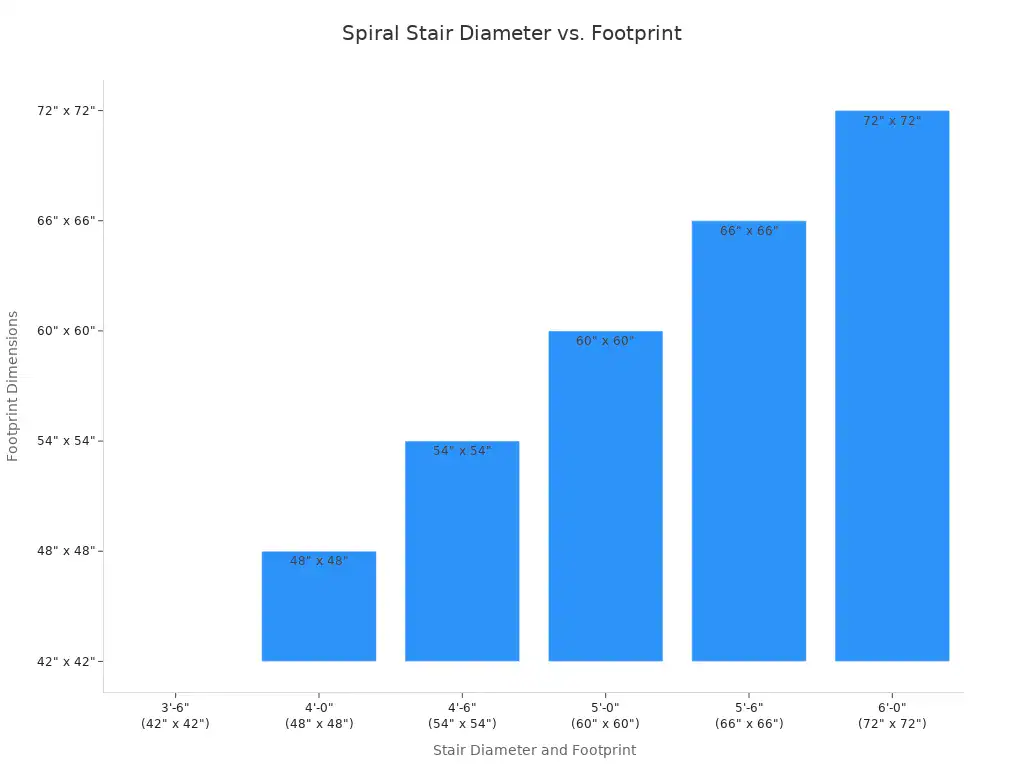
For metal spiral stairs, the minimum diameter is 60 inches. For wood spiral stairs, the minimum diameter is 64 inches. These different staircase types offer unique space-saving solutions.
Curved Stairs
Curved stairs have a gentle, sweeping curve. They do not have a central pole.
Design and Layout: These stairs need more space than spiral stairs. They create a grand entrance.
Benefits: They look elegant and luxurious. They allow for smooth traffic flow.
Challenges: They are complex to build. They are expensive. They require a lot of space.
Space and Traffic Flow: They make a grand statement. They provide a smooth transition between floors.
The cost of curved stairs can vary greatly. A basic pine stair for a basement might cost a few hundred dollars. Artistic or custom designs can cost much more. Milled stairs can range from about $2,000 for a hardwood stair with wall rails to $200,000 for high-end options. Most people usually shop in the $5,000 to $20,000 range. You should consider the stair’s shape, style, and materials when budgeting.
The staircase shape and design greatly affect the final cost. If your building lacks strong structural supports, you need special fixings. This increases the price. Free-standing stairways are also an option. Special engineering and smart design can make curved staircase solutions more affordable. This includes using a central or double curved spine for support. Materials like wood, metal, crystal, fiberglass, or polycarbonate can be used for parts. Smaller radius designs can look like spiral staircases. Larger radii create helical staircases. Not having an inner railing on smaller diameters can also lower costs.
Pine, fir wood, and beech are cheap choices for steps. You can finish them naturally or stain them to look like more expensive woods. For cost-effective solutions, wooden half-risers or L-shaped tubular brackets are good. This is especially true if building codes allow open risers. The railing material also affects the price. A wooden railing with a curved handrail costs more than a powder-coated steel railing. Wrought iron spindles give a classic look. Powder-coated spindles offer a modern, simple design. The landing balustrade should match the staircase railing in materials and colors. Framed straight glass balustrades are an affordable and popular choice.
For premium curved stairs, laser-cut technology shapes steel stringers for custom designs. This ranges from small twisted staircases to large helical ones. Options include side stringers (fascias) as main supports. Steps can be made from beech, oak, or iroko wood. Stainless steel non-slip strips add design and safety. Mild steel steps and risers can be powder-coated and covered with various materials. Stainless steel railings are good for value, elegance, and durability. Stainless steel balustrades also work well for landings.
Site preparation affects the final price. If your building’s structure cannot support the curved staircase, engineers might need to design thicker stringers, special fixing plates, or middle landings. All these add to the cost. Reinforcing the site with concrete pad stones, steel props, or I-beams can help reduce these extra costs.
Cantilever Stairs
Cantilever stairs have treads that seem to float. They are anchored only at one end into a wall.
Design and Layout: These stairs look open and minimalist. They create a sense of lightness.
Benefits: They offer a modern, open feel. They have a unique look.
Challenges: They need complex engineering. They require strong wall support. They are expensive.
Space and Traffic Flow: They are visually striking. They make a space feel very open.
Structural analysis is very important for cantilever stairs. The single-end fixing puts a lot of uneven weight on the wall and fixings. The analysis aims to find the maximum movement on stair treads. It ensures the steel structure can handle the load. Engineers use Finite Element Analysis (FEA) to see how parts act under load. For example, they simulate an 85kg person putting weight on the stair tip. FEA results show stress and movement. The highest movement is at the free end. The highest stress is at the fixed end. A maximum movement of 1.06 mm at the tread’s end means no bounce. This assumes no movement at fixing points. It shows the need for strong stringers and reinforced walls. Stress calculations ensure that stress values stay below the material’s strength. This prevents permanent bending of the steel treads.
Cantilever structures use internal forces like bending and twisting to stay stable. They stick out from a fixed support without extra braces. Proper structural analysis is key to prevent too much bending or failure. Engineers must estimate loads. They account for the stair’s own weight, other fixed weights (finishes), and moving weights (people, furniture). They also consider wind, snow, and earthquake effects. Reinforced concrete cantilevers must follow specific span-to-depth rules. This controls bending and makes them stronger. Good reinforcement anchoring is vital. Poor anchoring can lead to early failure. You should also control cracks. Avoid putting pipes or wires inside cantilever parts. This prevents weakening the structure.
Cantilevered stairs are securely fixed at one end. This is usually into a reinforced wall or a hidden frame. This allows the tread to stick out into open space. This design needs precision, load calculations, and the right materials to prevent failure. Strong, reinforced walls (concrete cores or special steel frames) are essential for fixing them. Engineers must control twisting and bending. This ensures they last a long time, especially in busy areas. Material strength and stability are crucial. Steel, reinforced concrete, and engineered wood are common choices. They balance looks, strength, and upkeep.
Floating Stairs
Floating stairs create an illusion of openness. They often have hidden stringers or supports.
Design and Layout: These stairs look open, airy, and modern.
Benefits: They create an illusion of openness because you do not see the supports. This helps maximize space in small or odd-shaped areas. They become captivating architectural focal points. They turn ordinary spaces into visually stunning environments. Their design is versatile. You can have straight or spiral configurations. This allows customization to match a building’s overall look. Their unique and eye-catching design boosts brand visibility. They can become a signature design element for a commercial space.
Challenges: Building floating stairs needs precise engineering. This ensures they are strong and meet safety rules. This precision means it is challenging to build them to these high standards. They must support expected loads safely. This shows a challenge in making sure they can hold enough weight. You must follow secure installation rules to keep them safe and stable. This highlights how complex the installation process is.
Space and Traffic Flow: They contribute to an open and spacious feeling. They remove bulky support structures. Their clean and sleek look fits modern architectural styles.
Alternating Tread Stairs
Alternating tread stairs have treads that are half-width. They alternate sides. This allows for a steeper climb.
Design and Layout: These stairs are very steep. They save space. People use them for secondary access.
Benefits: They are extremely space-efficient for steep climbs.
Challenges: They are awkward to use. They are not for main access. They have strict building codes.
Space and Traffic Flow: They have a minimal footprint. They are for specific uses.
Alternating tread stairs have limitations as a means of escape. They are limited to certain building types (Groups F, H, and S) from a mezzanine not bigger than 250 sq ft and serving no more than five people. In Group I-3 buildings, they are limited to guard towers, observation stations, or control rooms not bigger than 250 sq ft. They are also for access to unoccupied roofs. The maximum rise is 20 feet between floors or landings when used for escape.
Tread and riser dimensions are specific. You measure tread depth horizontally between the front edges of nearby treads. You measure riser height vertically between the leading edges of nearby treads. The angle of ascent from horizontal must be between 50 and 70 degrees. The minimum tread depth is 5 inches. The minimum projected tread depth is 8 1/2 inches. The minimum tread width is 7 inches. The maximum riser height is 9 1/2 inches. For mezzanines (not more than 250 sq ft, max 5 occupants), there is an exception. The minimum tread depth is 3 inches. The minimum projected tread depth is 10 1/2 inches. The rise to the next alternating tread surface cannot be more than 8 inches. Handrails are required on both sides of alternating tread devices. They must follow Section 1014 rules.
Ladder Stairs
Ladder stairs are very steep. They are like a ladder but have wider treads.
Design and Layout: They take up minimal space. They are for occasional access.
Benefits: They are the ultimate space-saver for vertical access.
Challenges: They are not comfortable. They are not for frequent use. They have safety concerns.
Space and Traffic Flow: They have a very small footprint. They have limited use.
OSHA has safety standards for ladders. These include:
Selection: Equipment must meet federal rules for commercial use. Different ladder types (step, extension, platform) have different uses and weight limits.
Proper Use and Maintenance: You must keep three points of contact. Face the ladder while climbing. Avoid reaching too far. Inspect regularly for defects.
Placement: Place ladders on secure surfaces at the right angles. Avoid placing them in front of doors. Ladders over 24 feet need cages or safety systems.
Fall Protection: For ladders over 24 feet, employers must ensure good fall protection. This includes personal fall arrest systems or guardrails.
Training: Employers must train workers on relevant standards for the job and equipment.
Hazard Communication: You must tell employees about possible dangers and needed precautions.
Recordkeeping: Employers must keep records of inspections, training, and accidents for compliance.
Practical uses for different ladder types:
Stepladders: They stand on their own and are portable. Use them for short boosts (e.g., household chores, light building). Place all four legs firmly. Lock spreaders. Do not stand on the top two rungs. Face the ladder while climbing.
Extension Ladders: They slide to adjust height. Use them for taller areas (e.g., building, painting). Place them against a secure vertical surface. They should extend at least three feet above the landing. Follow the 4-to-1 rule for base placement.
Fixed Ladders: These are permanent. Use them for high platforms or rooftops. Those over 24 feet need a cage or safety system. Inspect them regularly. They must extend at least 42 inches above the landing.
Platform Ladders: They are versatile and self-supporting with a wide platform. Use them for long work at height (e.g., maintenance, warehouse). Use them on a flat, level surface. Lock the platform and guardrail. Avoid reaching too far.
Rolling Ladders: They have wheels and move easily. Use them for tasks needing frequent movement (e.g., shelves in libraries). Lock wheels before climbing. Use them only on stable surfaces. Do not move them while someone is on them.
Common ladder hazards and how to prevent them:
Missing the last step when climbing down: Always be careful and do not skip steps.
Overreaching: Keep your body between the side rails. Move the ladder instead of reaching too far.
Using the wrong ladder: Choose a ladder with the right reach height (about four feet higher than the ladder’s height). This avoids unsafe reaching.
Ladder not on firm ground: Clear the area around the base. Make sure it is secure to prevent accidental movement.
Three-point contact not used: Always keep two hands and a foot, or two feet and a hand, on the ladder while climbing.
General OSHA requirements for ladders:
You need a ladder or stairway when there is a height difference of 19 inches or more. This is true if no other access is available.
Keep access points clear of obstacles.
Securing Ladders: Secure ladders on unstable surfaces. Use slip-resistant feet. Barricade them in busy areas. Keep areas around the top and bottom clear. Do not move ladders while in use.
Condition of Treads: Treads must be clear of grease, ice, and debris. You cannot paint wood ladders (except for labels). Rungs, cleats, and steps must be parallel, evenly spaced, and level.
Extending Working Height: If you need two or more ladders, offset them with a landing between them. This is not needed if portable ladders access fixed ones. Never tie ladders together to make a longer one.
Loads, Overloads, & Safe Use: Use ladders only for their intended purpose. Do not exceed the manufacturer’s weight limit. Face the ladder with three-point contact. Avoid carrying loads that make you lose balance. Use non-conductive sides if electrical contact is possible.
Specific OSHA rules for portable ladders, including stepladders:
Never use the top of a stepladder as a step.
Do not use the cross braces on the back of a stepladder for climbing. This is unless it is designed for climbing on both sides.
Stepladders must have locks to keep sections open when in use.
You cannot use stepladders longer than 20 feet.
Essential Staircase Design Principles
You must consider several key principles when you plan your staircase. These principles ensure your staircase is safe, functional, and beautiful. You balance safety with aesthetic appeal. You also consider key dimensions like rise and run. Typical angles are between 30 and 37 degrees. Landings are important for rest and direction changes.
Aesthetic Considerations
Your staircase is a major focal point in your home. Its design greatly influences the overall look and feel of your space. You can choose a staircase that complements your existing decor.
Modern minimalist interior designs benefit from specific staircase styles. These styles focus on transparency, clean lines, and using space well. Glass staircases remove boundaries. They let light flow freely. This creates an open, airy feel. This works well in open-plan layouts and with neutral colors. Minimalist staircases follow the “less is more” rule. They focus on clarity and simplicity. You see features like straight wooden treads or floating steps. These are perfect for calm spaces and small homes. They reduce visual clutter. Hybrid staircases mix materials. They use wood with glass or steel with stone. This offers flexibility and personal touches. They can also include storage or lighting. Suspended staircases look bold and floating. They make heavy materials seem light. They open up space underneath them. These designs turn staircases into central elements. They match and improve your home’s minimalist look.
Staircase Style/Feature | Integration with Modern Minimalist Design |
|---|---|
Open and Floating Stairs | These revolutionize design. They remove closed risers. They create a captivating, spacious, and fluid experience. They maximize space in small homes. They fit seamlessly with sleek, minimalist aesthetics. |
Minimalistic Concepts | These use sleek, clean lines. They have metal bars or vertical white railings. This creates a visually light and airy look. It blends seamlessly into the surrounding space. |
Wood Accents | These add natural beauty and warmth. They blend materials well within modern staircase design. |
Artistic Steel Frames/Metal Railings | These add a bold and sculptural element. They become captivating focal points. They also provide safety. |
LED Strip Lighting | This provides a subtle glow along edges or undersides of steps. It enhances visual appeal and safety. |
Recessed Lighting | This offers focused beams from the ceiling or walls. It improves aesthetics and safety. |
Pendant Lights | These add elegance. They can be focal points. |
Step Lighting and Wall Sconces | These ensure visibility. They highlight architectural features. |
Built-in Storage Solutions | These maximize home space. They integrate pull-out drawers, cabinets, shelving units, or bookcases. This uses space well and reduces clutter. |
Circular Staircases | These do not have a central support column. They create an open and clear view. This adds to a sense of airiness and lightness. |
Organic Shapes (e.g., Spiral, Curvilinear) | These move away from traditional straight lines. They add fluidity. They create captivating visual elements. |
Bold Color Choices | These add energy and personality to modern staircase designs. You can use painted steps or colorful handrails. |
Mixed Materials (e.g., wood with metal or glass) | These combine different textures and finishes. They add visual interest. They create a contemporary look. |
Open Risers | These let more light through. They add to overall openness. They create a sense of modernity. |
Statement Handrails | These are unique and eye-catching. Examples include sculptural metal or glass balustrades. They add personality. They are also functional art pieces. |
Technology Integration (Smart Home, Accessibility, Safety) | This improves function and looks. Features include programmable RGB lights, remote control, motorized lifts, and anti-slip materials. |
Ergonomics and Comfort
You want your stairs to be comfortable and easy to use. This means paying attention to the rise and run. The rise is the vertical height of each step. The run is the horizontal depth of each step.
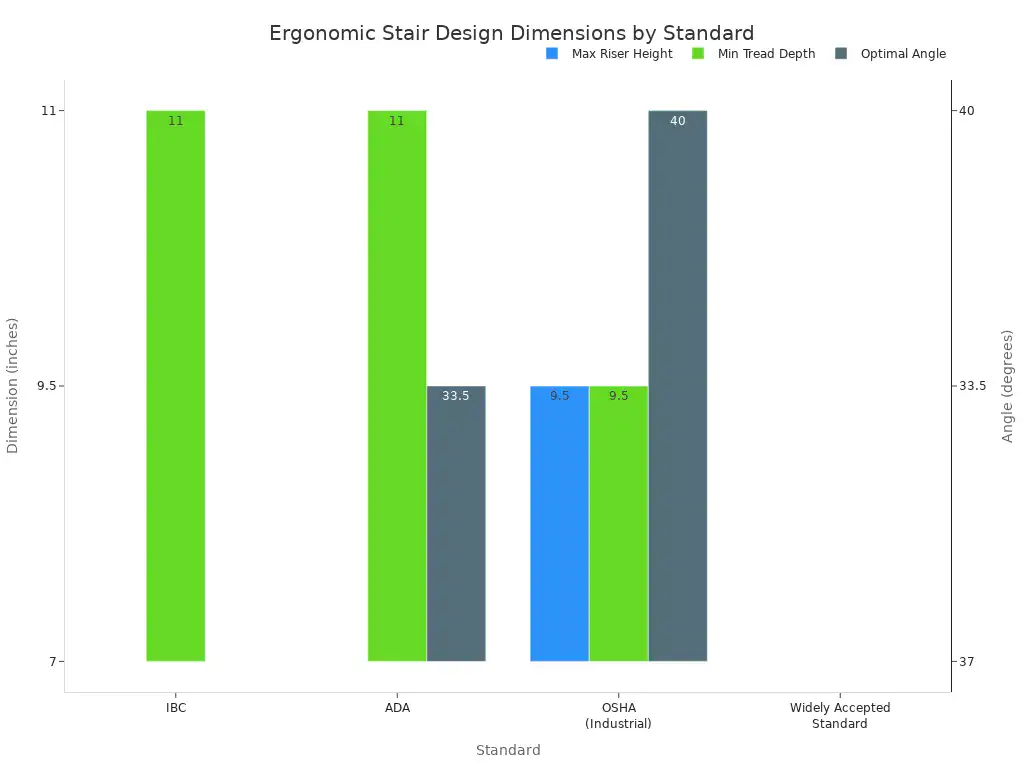
A 37-degree angle is often ideal for staircase design. This angle makes the ratio of tread to riser best for average human stride lengths. This ensures a natural and comfortable way to go up and down. Stairs steeper than 37 degrees increase your risk of falling. Shallower stairs take up too much horizontal space. This angle balances vertical and horizontal space. It allows for a comfortable rise without making the staircase too long.
Here are some optimal dimensions for ergonomic stair design:
Standard | Optimal Angle | Max Riser Height | Min Tread Depth |
|---|---|---|---|
Widely Accepted Standard | 37 degrees | N/A | N/A |
IBC | ~37 degrees (7:11 ratio) | 7 inches | 11 inches |
ADA | 30 to 37 degrees | 7 inches | 11 inches |
OSHA (Industrial) | 30 to 50 degrees | 9.5 inches | 9.5 inches |
Structural Integrity
Your staircase must be strong and safe. Engineers calculate different loads to ensure this. These calculations prevent your staircase from failing.
Common structural loads include:
Uniform Load: Most building codes specify this as 100 pounds per square foot (psf). This load controls the design of stringers and other parts that support treads and landings.
Concentrated Load: Most building codes specify this as 300 pounds. You can apply this load anywhere on the stair system. Concentrated forces usually control the design of treads and other horizontal parts that people walk on.
OSHA has specific criteria for stairs:
Each stair must support at least five times the normal expected live load. It must never be less than a concentrated load of 1,000 pounds (454 kg) applied at any point.
The 1,000-pound point load accounts for the impact of a person running down the stairs.
You must base the design of fixed stairways and their parts on their ultimate strength. This means using yield stress or ultimate stress, not just allowable stresses.
The 100 psf uniform and 300 pounds concentrated loads use allowable stress design. The higher 1,000-pound concentrated load from OSHA uses ultimate strength design. The OSHA rule for concentrated load will control the design of stair treads and landing pans. The 100 psf uniform live load will control the design of stringers and other supports. For residential buildings, staircases and corridors have a live load of 3 kN/m². This ensures your staircase is robust.
Optimizing Stair Design for Space
You can make your stair design work well even in small areas. Many types of stairs help you save space.
Stair Design | Space-Saving Benefit |
|---|---|
L-Shaped Stairs | These are ideal for tight corners. They change direction midway. They take up less floor space than straight stairs. |
Winder Stairs | These have a compact form. They use wedge-shaped steps that turn. They are perfect for narrow homes. |
U-Shaped Stairs | These have a double-flight design. They reverse direction with a 180° turn. They are visually dynamic and use space well. |
Spiral Stairs | These are charming and compact. They are ideal for very small spaces or for secondary access. |
Staircase with Storage | This design includes drawers or cabinets beneath steps. It offers smart, seamless storage. |
Floating Stairs | These look sleek, minimalist, and open. Adjusting tread angles can reduce the incline. This enhances visual appeal. |
You can also use the space under your stairs. You can create a compact study area. You can add a wine or bar station. You can have shoe storage or a small closet. Corner staircases can have pull-out pantries. This turns unused space into functional kitchen storage. Sliding shelves make items easy to reach. You can also add staircase seating and relaxation zones. Integrated benches, window seats, or cushioned platforms can include storage. You can store shoes, blankets, or toys there. Modern designs use advanced storage solutions. These include modular units, pull-out drawers, built-in cabinets, and specialized compartments. These hold various household items. You can also use vertical storage. This uses the height beneath staircases for shelving and integrated workspaces.
Minimalist, modern, and industrial designs take up less visual space. They create an uncluttered look. Open riser staircases let light pass through steps. This reduces the feeling of being closed in. Glass railings or slim metal balustrades make the space feel more open and bright. Transparent or semi-transparent railings and open risers create visual space. Floating or open-riser designs make open-plan living spaces feel more open.
Integration with Interior Styles
Your staircase should fit seamlessly with your home design. It should enhance the overall look of your home. You choose materials and styles that match your existing decor. For example, a modern home might feature a sleek metal staircase. A traditional home might have a classic wooden staircase. The right staircase can become a central feature. It can tie different elements of your interior together. This creates a cohesive and inviting atmosphere. You can also consider improving accessibility. This ensures your staircase works for everyone in your home.
Stair Layout Considerations
You must carefully plan your staircase layout. This ensures it fits your building’s purpose and available space. Different settings require different approaches to stair design.
Residential Applications
When you plan stairs for your home, consider both function and comfort. Residential stairs have specific space allocations. You need a minimum width of 36 inches (91 cm). The stairs should be at least 4 feet long. You need a minimum height of 6 feet. Tread depth is around 10 inches (25 cm). Riser height is typically about 7.5 inches (19 cm). You also need a minimum headroom of 80 inches (203 cm). Landings must be at least as wide as the stairs and at least 36 inches (91 cm) deep. To calculate the minimum width space your stairs will need, use this formula: (width + height + depth) x 2 + 9 inches. This helps you fit the staircase perfectly into your home.
Commercial Applications
Commercial buildings have different needs. They often handle more traffic. You need wider stairs and more robust materials. Safety codes are usually stricter. The stair design must prioritize efficient movement for many people.
Small Space Solutions
You can still have functional stairs in a small home. Many innovative solutions exist for very small living spaces. Modular stairs are customizable and easy to install. They can even include storage. Loft ladders are compact and affordable. Some models fold away. Storage stairs use each step as a drawer or cabinet. Retractable ladders extend when you need them. They retract to free up floor space. Alternating tread stairs have a zigzag pattern. This reduces the stair’s footprint. Foldable steps tuck away easily. Compact staircase units, like spiral staircases, fit into corners. These options help you maximize space in your home.
Open-Concept Integration
Integrating a staircase into an open-concept home requires careful design. You want the staircase to complement your home’s overall aesthetic. Choose a design that harmonizes with your existing style. This could be modern, traditional, or eclectic. Material selection is important. Wood, glass, or metal can add warmth or spaciousness. Decide if the staircase is mainly for access or a design focal point. Floating staircases offer a minimalistic feel. Spiral staircases provide a striking architectural feature. Ensure the staircase is safe and sturdy. Consider the load-bearing capacity of materials. Use secure handrails and balustrades. Prioritize safety and practicality in your home.
Exterior Stair Placement
Exterior stairs connect different levels outside your home. You must consider weather resistance and drainage. Materials like treated wood, concrete, or metal work well. The design should blend with your home’s exterior.
Staircase Material Guide
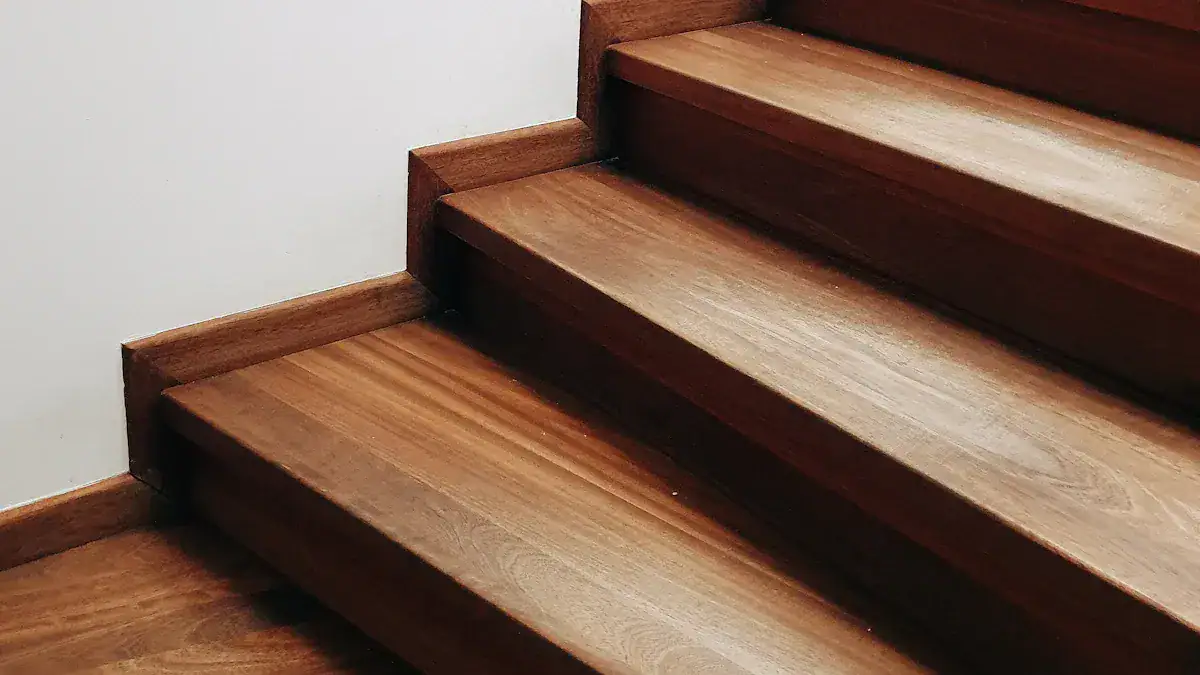
You choose materials for your staircase based on many factors. These include durability, appearance, cost, and maintenance. Each material offers unique properties. You will find the right one for your project.
Wood Stairs
Wood brings natural warmth and beauty to any space. You find it in many types, from soft pine to hard oak. Wood is versatile. You can shape it easily. It fits many design styles. Wood stairs work well in traditional homes. They also suit rustic or even modern designs.
However, wood can scratch or dent. It needs regular care. For exterior wood stairs, regular staining and sealing are crucial. Think of it like sunscreen for wood. You should stain and seal annually, or more often in harsh weather. This prevents water and UV damage. It stops cracking and splintering. Good drainage also helps. Clear leaves and debris to prevent rot. Inspect your stairs regularly for wear. Look for cracks, splinters, or loose steps. Address issues quickly to avoid costly repairs. Even durable wood needs annual attention. Pressure-treated wood offers better water resistance. Shading can protect against UV damage.
Metal Stairs
Metal is strong and durable. It gives a modern look. Metal stairs have a high strength-to-weight ratio. They look sleek. Metal stairs fit industrial, modern, and minimalist designs.
Metal can feel cold. It might be noisy. Some metals can rust. You can choose from different metals. Stainless steel is very popular. It resists corrosion well. It lasts long and looks shiny. Iron is classic and strong. You must use an anti-rust coating on iron. Aluminum is light but sturdy. It does not rust, but it is less durable than stainless steel or iron. Carbon steel is very strong. It carries heavy loads. It needs careful care to prevent rust.
For outdoor use, stainless steel, especially grades 304 or 316, is best. It resists rust from weather and pollution. Galvanized steel has a zinc coating. This protects it from rust. But if you scratch the coating, the steel underneath can rust. Powder-coated steel also protects against rust. The quality of the coating matters. Chips can expose the steel. Stainless steel does not need extra coatings. Its chromium content prevents rust.
Metal Type | Corrosion Resistance |
|---|---|
Galvanized Steel | Offers good corrosion resistance due to the zinc coating, which acts as a sacrificial layer. However, if the coating is scratched or damaged, the underlying steel can rust. |
Powder Coated Steel | Provides a protective barrier against corrosion. The effectiveness depends on the quality of the coating and its application. Chips or scratches can expose the steel to rust. |
Stainless Steel | Excellent corrosion resistance due to its chromium content, which forms a passive layer. It does not require additional coatings for rust prevention and is highly durable in various environments. |
Concrete Stairs
Concrete is very strong and heavy. You can shape it in many ways. Concrete stairs are very durable. They resist fire. They need little maintenance. They offer great structural integrity. They resist rot, rust, and weather. They will not sag. They are stable and minimize vibrations. They carry heavy loads. This makes them good for commercial use. Their non-porous surface makes cleaning easy.
Concrete is heavy. It can feel cold. Building concrete stairs can be complex. Concrete stairs are great for commercial, industrial, modern, and outdoor settings. Concrete stairs offer consistent quality. Factories make them in controlled settings. They have exceptional load-bearing capacity. This makes them ideal for demanding applications. They are fire-resistant. This is important for safe building evacuations. You will find minimal maintenance needs. This saves money over time. You do not need frequent painting or pest control. Concrete resists stains and water damage. You can add non-slip surfaces. Textured finishes or anti-slip coatings reduce accident risks. This is good for outdoor or basement stairs. Concrete is naturally fire-resistant. It keeps its strength in extreme heat. This offers a safer escape route. Its solid construction ensures stability. It prevents bending or collapsing. Precast concrete stairs handle various climates. They resist extreme temperatures and freeze-thaw cycles. They offer many surface finishes, textures, and colors. This allows for visually appealing stairs.
Glass Stairs
Glass stairs look transparent and modern. They seem delicate. They create an open feel. They let light pass through. They offer a unique look. Glass stairs fit modern, high-end, and minimalist designs.
Glass stairs are expensive. They can show fingerprints easily. Some people worry about their strength. Glass stairs use laminated or tempered glass. This glass supports human traffic and weight. Engineers must calculate the structure carefully. They consider glass thickness, type, and expected load. The support system is also key. Steel frameworks must work with the glass. This ensures stability. You must follow local building codes. International safety standards are also important. These rules ensure glass structures are safe. Walkable glass floors use high-strength, laminated glass. It often has multiple layers. Tempering makes it tougher. It can withstand heavy loads. The structural design is crucial. Supporting frameworks, like steel, distribute weight. They maintain the glass’s integrity. Glass thickness and type affect load capacity. The strength of the support system matters. Environmental factors like temperature can affect performance. How weight spreads across the surface is critical. Actual load testing confirms the theoretical capacity.
Stone Stairs
Stone is natural, heavy, and luxurious. Stone stairs are very durable. They have unique patterns. They add elegance. Natural stone offers unbeatable durability. It lasts decades with little care. Its density means it stays put. Natural texture gives good grip, even when wet. This is good for areas with rain or snow. Stone stairs are great for grand, traditional, outdoor, and luxurious settings.
Stone stairs are costly. They are heavy. Some finishes can be slippery. Bluestone has exceptional weather durability. It resists freeze-thaw cycles well. It has a naturally slip-resistant surface. This makes it a popular choice for stair treads. Granite offers unmatched strength. It resists weather, stains, and scratches. It is a premium choice for maximum durability. It works well in high-traffic areas. Limestone is good for moderate climates. Sandstone’s roughness creates friction. This makes it good for rustic decks. Travertine is softer. It is typical around pools. Slate is naturally slip-resistant. It works well in moist places. Quartzite is very hard. It resists weathering. It is good for both indoor and outdoor use. Polished finishes can be slippery. You might need nosing or mats. Flamed finishes are very slip-resistant. They create a rough texture. Bush-hammered finishes give good grip. Sandblasted finishes are not slippery. They are good near doorways. Poorly selected finishes can be a slip hazard. Stone stairs can last generations. They add resale value.
Stone Type | Durability | Slip Resistance | Notes |
|---|---|---|---|
Bluestone | Exceptional weather durability; excellent freeze-thaw resistance | Naturally slip-resistant surface | Most popular choice for stair treads |
Granite | Unmatched strength and weather resistance; exceptional hardness and durability; highly resistant to staining and scratching | N/A | Premium choice when maximum durability is the priority; ideal for high-traffic areas or where longevity is paramount |
Limestone | Softer, easily abraded and marked | N/A | Excellent for moderate climates; suitable for indoor or plush poolside usage |
Sandstone | N/A | Roughness creates friction | Appropriate for rustic decks or garden staircases |
Travertine | Rough limestone, softer touch underfoot | Natural texture provides good traction | Typical around pools or patios, should be used in mild weather |
Slate | N/A | Naturally slip-resistant | Perfect in moist locations: patio, garden; layering makes thickness and strength less predictable |
Quartzite | Hard metamorphic stone, more strenuous than marble, more powerful than granite | N/A | Suitable for polished staircases indoors or robust outdoor tread steps; flamed or honed finishes available |
Composite Materials
Composite materials are man-made. They blend different materials. They offer great durability. They need little maintenance. They are eco-friendly. Composite decking uses wood fibers and recycled plastics. This reduces environmental impact. It supports sustainable building. It resists weather, insects, and rot better than wood. It can last 25 years or more. Composite materials work well for modern, outdoor, and sustainable designs.
They might not feel as natural as real wood. The initial cost can be higher. Sustainable composites are popular in stair construction. They are eco-friendly. They reduce the use of natural resources. They are part of a larger sustainable approach. This includes reducing carbon footprint. It involves optimizing production. It uses renewable energy. It considers the product’s entire life cycle. This means durability, easy care, and recyclability.
Material Combinations
Combining materials blends their strengths. You get unique aesthetics. You can customize the look. Material combinations are great for custom designs. They help achieve specific looks.
Design and stair construction can be complex. Costs can be higher. Metal and glass combinations create a modern look. They balance transparency. You need strong metal parts, like steel or aluminum. These support the glass. Safety glass, like tempered or laminated, prevents shattering. Slip resistance for glass treads is vital. Cleaning glass surfaces is important. This minimizes fingerprints. This combination is often more costly. Lighting integration works well with transparency. Mixed material designs, like wood and metal, need careful planning. Materials should complement each other. Think about color and texture. Each material’s strength matters for stability. Materials must work well together. They must resist environmental conditions. Safety standards are key. Balustrades and handrails must give good support. Choose durable, easy-to-clean materials. Strategic use of materials creates visual interest. This can highlight unique features. These designs can be more costly. You must balance impact and budget.
Stair Safety and Building Codes
You must follow strict rules for stair construction. These rules ensure safety for everyone. Building code regulations cover many parts of your stairs. You need to understand these essential safety features.
Tread and Riser Dimensions
Tread and riser dimensions are crucial for safety. They make sure each step is comfortable and safe. You must keep these measurements consistent.
Code | Tread Depth (Minimum) | Riser Height (Minimum) | Riser Height (Maximum) | Max Variation (Tread/Riser) |
|---|---|---|---|---|
IBC | 11 inches | 4 inches | 7 inches | 3/8 inch |
For IBC, if your stairs have nosings, you measure from the nosing’s leading edge to the next step’s nosing. IBC stairs must have uniform riser and tread sizes.
Code | Tread Depth (Minimum) | Nosing (Required/Maximum) | Riser Height (Maximum) | Riser Height (Minimum) | Max Variation (Tread/Riser) |
|---|---|---|---|---|---|
IRC | 10 inches (plus ¾ inch nosing) or 11 inches (no nosing) | ¾ inch (required if tread < 11″), 1.25 inches (maximum) | 7.75 inches | N/A | ⅜ inch |
IBC | 11 inches | 1.25 inches (maximum, not required if tread ≥ 11″) | 7 inches | 4 inches | ⅜ inch |
Some stairs have exceptions. These include spiral stairways and stairs in certain dwelling units.
Handrail and Baluster Rules
Handrails and balusters provide critical safety. They prevent falls. Handrails must be easy to grasp. Balusters must be close enough to prevent small children from falling through.
Headroom Clearance
You need enough headroom above your stairs. This prevents people from hitting their heads. Building codes specify minimum heights. This ensures comfortable and safe passage.
Landing Requirements
Landings offer a place to rest. They also allow you to change direction. Landings must be wide and deep enough. This prevents accidents and improves traffic flow.
Fire Safety Standards
Fire safety is vital for stairs in multi-story buildings. Stairwells serve as escape routes.
Stairwells must be well-lit.
Stairwells must be properly ventilated.
Stairwells must be wide enough for many people.
Stairwells must remain clear of obstacles.
Stairwells must have proper signs and lighting for evacuation.
Pressurized stairwells are special systems. They keep smoke out. They maintain higher air pressure inside the stairwell. This ensures a clear escape path during a fire. The National Fire Protection Association (NFPA) requires buildings over four stories to have at least two exit stairwells. They also need other fire safety features. The International Building Code (IBC) mandates smoke-control systems in high-rise building stairwells. These systems are called smokeproof enclosures.
Stair Customization Options
You can personalize your staircase in many ways. These options allow you to match your unique style. They also improve functionality.
Balustrade Styles
You can choose from many balustrade styles. These styles greatly change your staircase’s overall look. Metal balusters offer a modern design. Wood balusters give a classic, warm feel. Glass panels create an open, sleek design. They allow light to pass through. Consider your home’s overall style. This helps you pick the best option for your staircase.
Tread Finishes
You can select various finishes for your treads. Hardwood treads can be stained in many colors. You can choose a glossy or matte finish. Carpet runners add comfort and reduce noise. They also provide extra grip. Tile or stone treads offer great durability. Your choice impacts both the look and safety of your steps.
Integrated Lighting
Integrated lighting enhances your stairs. It improves safety, especially at night. It also adds to the aesthetic design. LED strips can illuminate each step’s edge. Recessed lights in walls provide a soft glow. This makes your staircase a beautiful focal point. It highlights its unique features.
Storage Solutions
You can add clever storage to your staircase. Drawers built into risers save valuable space. Shelves under the stairs offer perfect display areas for books or decor. A small closet can fit neatly there. This maximizes functionality in your living area. It keeps your space tidy.
Unique Architectural Features
You can include unique architectural features. A custom newel post adds distinct character. Special carvings or inlays personalize your stairs. These elements make your design truly unique. They reflect your personal style. They turn a functional element into art.
You have explored many types of stairs, design possibilities, and material choices. Remember, the ideal stair solution balances aesthetics, functionality, and safety for your home. Consider your specific home space, budget, and design vision when selecting staircase types. A well-chosen staircase design elevates your home. It transforms your home from functional to extraordinary. This guide helps you choose the right types of stairs for your home. Your home deserves the best stair design. Think about all the staircase types for your home. The right design makes your home beautiful. Your home will feel complete. This design makes your home special.

