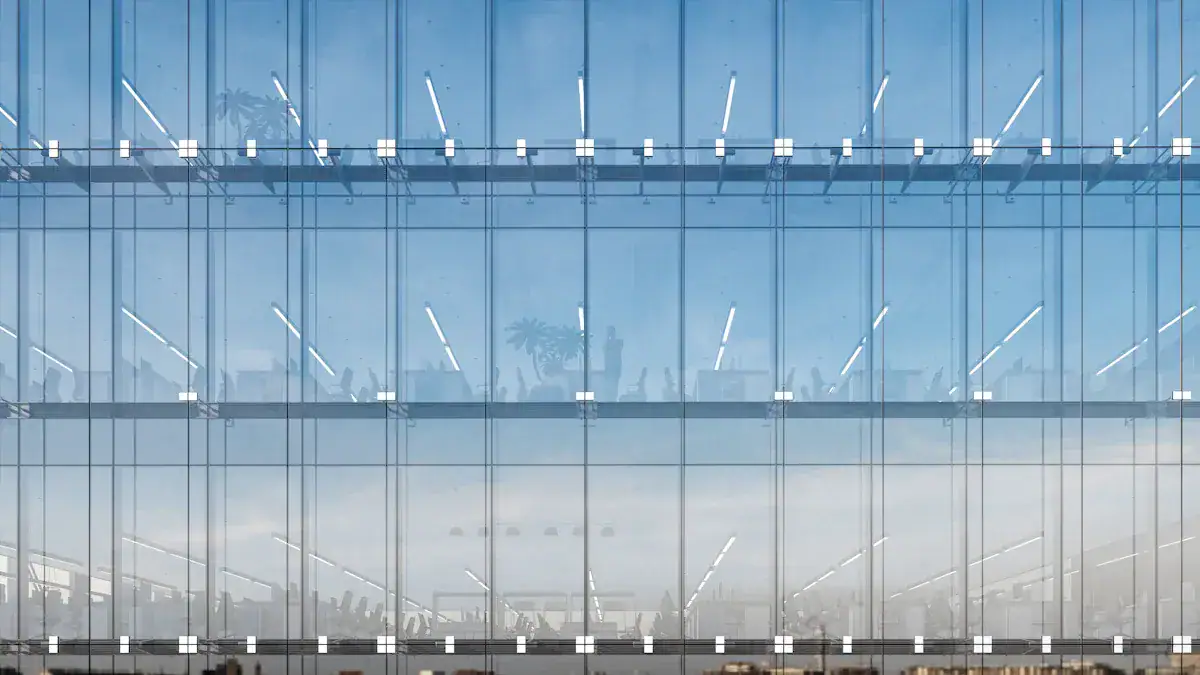
A curtain wall and a window wall serve as exterior enclosures for a building. However, they differ significantly in their structural integration. Understanding these distinctions is essential for successful building projects. These systems deeply impact design, performance, and overall cost. For example, consider the average cost difference between these systems:
System Type | Average Cost per Square Foot |
|---|---|
Unitized Curtain Wall | $104.9 |
Double-Glazed Window Wall | $54.6 |
This building systems guide provides information on each system’s characteristics and applications. It helps readers make informed decisions for their building.
Key Takeaways
Curtain walls are exterior walls that do not hold up the building. They attach to the outside of floors and support only their own weight.
Window walls fit between a building’s floors. They use the building’s frame for support and are built one floor at a time.
Curtain walls cost more to install but offer better energy savings and protection. Window walls cost less at first but may have higher long-term costs.
Curtain walls give buildings a smooth, modern look. Window walls can look more broken up because they fit between floors.
Choose a system based on your project’s needs, budget, and design goals. Talk to experts like architects for help.
Curtain Wall System Overview

Curtain Wall Definition
A curtain wall is a non-load-bearing exterior covering for a building. It acts like a “curtain” that hangs off the structure. This system attaches to the outside of floor slabs. It supports only its own weight and the weight of the materials it carries. A typical curtain wall often features aluminum framing and holds glass, panels, or louvers. A glass curtain wall creates a sleek, modern facade.
Key Characteristics
Curtain walls possess several defining characteristics. They are non-load-bearing, meaning they do not support the building’s roof or floors. This curtain wall system offers superior structural strength, providing excellent protection against high wind loads and earthquakes. It handles larger glass sizes due to its robust nature. Builders can construct a curtain wall using various methods, including stick-built (assembled on-site) or panelized/unitized (prefabricated units). Standard depths for these systems typically range from 6 to 10 inches, with options for deeper systems offering more support. A glass curtain wall allows for a continuous “curtain” of glass on the exterior, creating an impressive visual effect. This system requires fire-stopping because it creates a void between floors.
Structural Independence
A curtain wall maintains independence from the building’s primary structure. Curtain wall anchors are specifically designed to accommodate differential movement between the main building structure and the curtain wall itself. Anchor points and brackets are installed on the building’s beams and columns. These components receive the facade, facilitating its attachment while allowing for this crucial independence.
Installation Process
Installing a curtain wall system involves several key steps. First, workers establish control lines. They determine the precise location of the wall using contractor benchmarks painted on floors. This ensures visibility throughout construction. Next, they accurately define the exact wall placement using offset lines and finished floor levels. This step requires careful double-checking. Then, workers install anchor plates. These critical components are bolted, welded, or cast into the building’s structure. Finally, contractors arrange for material delivery, storage, and hoisting. They position metal components and heavy glass units on their respective floors to minimize handling.
Advantages
A curtain wall offers many benefits. It transforms a building’s appearance, creating a sleek, modern aesthetic. This allows ample natural light and wide views. When treated for efficiency, a curtain wall stabilizes building temperatures, making heating systems easier to control. It prevents rain and polluted air from entering the building. This system also significantly improves fire safety by reducing the spread of fire, especially in high-rise buildings. Curtain walls offer enhanced structural protection against wind by distributing stress across the building’s structure. The design flexibility of a glass curtain wall allows for bespoke solutions tailored to exact building dimensions.
Disadvantages
Despite its advantages, a curtain wall system has some drawbacks. It is generally more expensive to install and maintain compared to other building envelopes. Its relative heaviness can necessitate additional structural support, increasing construction costs. Improper installation or maintenance can lead to leaks, causing water damage. Gaskets and sealants degrade over time due to UV radiation and freeze-thaw cycles. This leads to drying, shrinking, cracking, and loss of watertight seals. Missing, incorrectly applied, or deficient sealants can also cause significant water infiltration. Alignment between unitized panels and projecting slabs presents a principal challenge in new construction.
Window Wall System Overview
Window Wall Definition
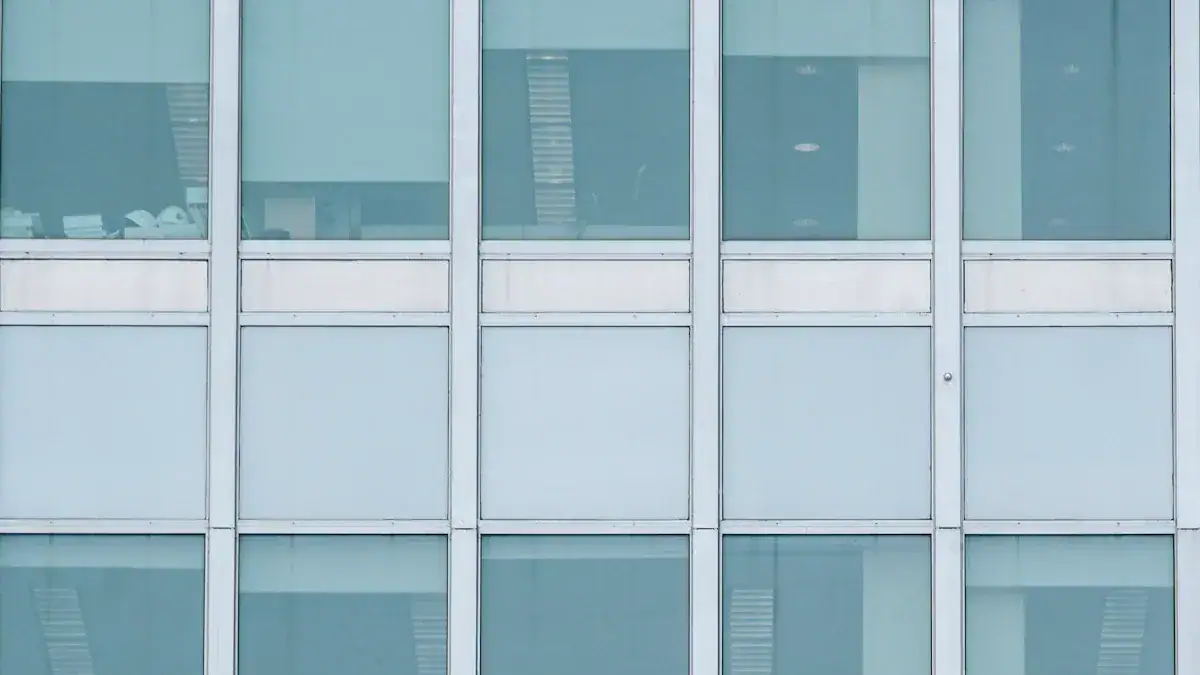
A window wall fits between a building’s floor slabs. It relies on the building’s structural support. This system is also non-load-bearing. It does not carry the weight of the building itself. Workers build a window wall within the slab edge, one floor at a time.
Key Characteristics
Window wall systems offer many distinct features. They provide stunning floor-to-ceiling views on every level. They can also accommodate balcony requirements. These systems integrate seamlessly with doors and vents. Workers install them between floors or in vertical stacks. Designers create them for mid- to high-rise buildings. A window wall can be prefabricated, pre-glazed, or site-glazed. It can even give the appearance of a curtain wall. These systems offer uninterrupted views and ample natural light. This increases occupant comfort and reduces energy costs. They also provide installation flexibility.
Integration with Structure
Window wall systems are positioned near slab edges. Horizontal structural members called ‘tracks’ support them. The ‘base’ track anchors to the top of each floor. The ‘ceiling’ track anchors to the underside of the upper floor slab. Spandrel panels often conceal structural elements. These opaque panels hide columns and slab edges. They also cover interstitial spaces. Perimeter frame anchors for a window wall must coordinate with the building structure. This ensures proper integration of steel embeds or additional supports. It also prevents conflicts with structural elements like tendons. Newer window wall designs use ‘bypass’ frames. These frames allow the glazing assembly to extend beyond the slab edge. This happens without needing extra support.
Installation Process
Installing a window wall involves specific steps.
Method Selection: Workers install window wall systems using concealed anchors, clips, and fasteners, or nailing flanges.
Securing the System: The system fastens to the sides, top, and bottom of the wall framing. It connects to studs, blocking, and headers. Alternatively, the window secures to the wall by fastening it through the exterior sheathing.
Flashing and Water-Resistive Barrier Integration: Flashing and the water-resistive barrier extend into the window opening. Workers seal small gaps around the window with sealant and backer rods. For nailing flanges, flashing installs over the nailing fin. This directs water away from the opening.
Importance of Sequence: The precise order of installing windows, flashing, and water/air barriers is critical. This prevents issues like leaks and mold.
Advantages
A window wall offers many benefits.
“This opens up competition to a wide variety of glazing contractors and the competition can help keep costs down,” Harrington says. “The more sophisticated a project, the fewer the contractors that are able to bid it.” Window wall systems require less material and reinforcing. They rest inside the building and span floor-to-floor. Installation can happen from inside the building. Pre-glazing further reduces installation time and labor. Window walls also allow for drying-in by floor. This shortens the construction cycle. They offer improved acoustical performance. Being a slab-to-slab application, a window wall stops at each floor. This prevents sound wave transmission between floors. It leads to better sound attenuation. This is good for residential buildings. The Standard New Orleans, a luxury condominium, used hurricane-impact window walls. This was due to critical acoustical needs and its coastal location. The system stopped at each floor. This eliminated sound transmission. It achieved an STC rating of 39. This was crucial for occupant comfort. Window wall systems offer maximum design versatility. They can achieve a sleek, modern look similar to a curtain wall. This is especially true with innovative slab edge covers. They also have anchoring flexibility. This adapts to challenging wall conditions. Window wall systems are compartmentalized between floors. This helps contain flame spread better. It reduces the need for extensive firesafing and engineering reviews. A curtain wall typically needs edge of slab mineral wool and smoke sealant. Generally, window wall systems have lower costs per square foot. This is due to pre-assembly and glazing. Many pre-engineered systems are available. Shallower system designs require less aluminum. They also integrate operable windows and doors more easily.
Disadvantages
Window wall systems also have some drawbacks. Regular movement through glass wall systems can be bothersome. Some systems offer integrated swing doors for convenience. These systems are best for large doorways. They may not work for smaller or narrower entryways. Quality glass wall systems are expensive. Cheaper options are often not durable or well-insulated. Wood window walls are prone to rot. This happens especially when less durable wood is used and not properly maintained.
Curtain Wall vs. Window Wall: Comparison
Choosing between a curtain wall and a window wall system involves understanding their fundamental differences. These distinctions impact a building’s structure, installation, cost, appearance, and overall performance. This section provides a detailed comparison to help in selecting the right building envelope systems.
Structural Differences
A primary difference lies in structural support. Curtain walls are structurally independent. They span multiple floors and attach to the building’s main structure. They do not carry floor or roof loads. Instead, they support only their own weight and the weight of the glass or panels they hold. Window walls, however, fit between floor slabs. They rely on the building’s structural frame for support. Workers build a window wall within the slab edge, one floor at a time. This means the window wall system integrates directly with the floor structure.
Installation Differences
Installation processes for curtain walls and window walls vary significantly. The method chosen impacts project timelines and labor requirements.
Feature | Curtain Wall Installation | Window Wall Installation |
|---|---|---|
Structural Independence | Self-supporting, attached to the building’s structure, but does not carry floor or roof loads. | Integrated into the building’s structural frame, often carrying some load from the floor above. |
Installation Sequence | Typically installed after the main structural frame is complete, from the outside of the building. | Installed floor by floor, often from the inside, as the building’s structure progresses. |
Thermal Movement | Designed to accommodate significant thermal expansion and contraction independently of the main structure. | Thermal movement is more constrained by the surrounding structural elements. |
Water Management | Advanced drainage systems, often with pressure equalization, to manage water infiltration. | Relies more on sealants and gaskets for water tightness, with less sophisticated drainage. |
Air Barrier | Often incorporates a continuous air barrier system as part of the curtain wall assembly. | Air barrier continuity can be more challenging to achieve due to interruptions by floor slabs and columns. |
Fire Stopping | Requires specific firestopping at floor lines to prevent fire spread between floors. | Firestopping is typically integrated into the floor slab construction. |
Glazing Installation | Glazing units are often pre-assembled into frames off-site and then installed as larger units. | Glazing is typically installed on-site into frames that are already part of the building’s structure. |
Access for Maintenance | Exterior access (e.g., scaffolding, window washing equipment) is generally required for maintenance and cleaning. | Interior access is often sufficient for cleaning and some maintenance, especially for operable windows. |
Building Movement Accommodation | Designed to accommodate inter-story drift and other building movements without transferring stress to the glazing. | More susceptible to stress from building movements due to direct integration with the building structure. |
Cost of Installation | Generally higher installation costs due to specialized equipment and labor for exterior work. | Generally lower installation costs due to simpler installation methods and less specialized equipment. |
Speed of Installation | Can be faster for large, repetitive facades once the structure is ready, as large units can be installed quickly. | Can be slower overall as it is tied to the floor-by-floor construction progress. |
Weather Protection During Installation | The building interior is typically enclosed later in the process, potentially exposing the interior to weather during construction. | Provides earlier enclosure of the building interior, offering better weather protection during construction. |
Aesthetics | Creates a continuous, sleek glass facade, often with minimal visible framing from the exterior. | Can have more visible framing and a more segmented appearance due to integration with floor slabs. |
Structural Interface | Connects to the building structure via anchors and clips, allowing for movement. | Directly abuts or is built into the floor slabs and columns. |
On-site vs. Off-site Fabrication | Higher degree of off-site fabrication and assembly, leading to better quality control. | More on-site fabrication and assembly, which can be more susceptible to site conditions. |
Thermal Performance | Can achieve very high thermal performance with advanced glazing and framing systems. | Thermal performance can be more challenging to optimize due to thermal bridging at floor slabs. |
Acoustic Performance | Can offer excellent acoustic performance due to continuous seals and insulated glazing. | Acoustic performance can be compromised by sound transmission paths through floor slabs and structural connections. |
Pressure Equalization | Often incorporates pressure-equalized rainscreen principles for superior water resistance. | Typically relies on face-sealed systems, which are less effective at managing wind-driven rain. |
Building Height Suitability | Preferred for high-rise buildings due to its ability to handle wind loads and building movement. | More commonly used for mid-rise to low-rise buildings. |
Replacement/Repair | Individual units or panels can often be replaced from the exterior. | Replacement or repair can be more complex due to integration with the building structure. |
Cost Implications
Cost is a significant factor in any building systems guide. Window walls are generally more cost-effective upfront. Their assembly from pre-fabricated components on-site reduces labor expenses. Curtain walls have higher initial costs. This is due to their materials and potentially complex installation. The specialized equipment and labor for exterior work contribute to the higher cost of a curtain wall.
Aesthetic Impact
Curtain walls offer unmatched aesthetic freedom. They are ideal for large commercial projects where visual impact is a priority. They create a continuous, sleek glass facade with minimal visible framing. This results in a cleaner, more pleasing design. Window walls, however, can appear more segmented. They have more pieces and joints due to their integration with floor slabs.
Feature | Curtain Wall | Window Wall |
|---|---|---|
Aesthetic Freedom | Unmatched, more pleasing design | Less aesthetically pleasing |
Mullions & Joints | Fewer, resulting in a cleaner look | More pieces and joints, can appear cluttered |
Glass Panel Size | Can accommodate larger panels | Limited by structural integrity |
Structural Integrity | Superior, due to fewer components | Weaker, due to more pieces and joints |
Slab Edges | Not exposed | Exposed, requiring design and insulation consideration |
Performance Metrics
Both systems aim for high performance, but they achieve it differently. Curtain walls often provide better thermal performance. They use advanced glazing and framing systems. This contributes to overall energy efficiency. Window walls can face challenges in optimizing thermal performance due to thermal bridging at floor slabs. Regarding acoustic performance, the type of glass primarily determines it. For similar glass makeup, glass lite size, and aspect ratio, windows and curtain walls will show similar performance. This means the glass configuration, not the system type, dictates sound insulation.
Operability and Ventilation
Operability and ventilation options differ between the two systems. Window walls often provide operable windows. These allow for natural ventilation. This helps improve air quality and reduces reliance on artificial climate control. Curtain walls are typically non-operable. However, designers can integrate various solutions to enhance ventilation and energy efficiency:
Fixed Louvers: These stationary elements provide constant ventilation. They suit large buildings needing continuous airflow without adjustable control.
Operable Louvers: These offer flexibility. Users can adjust airflow manually or automatically. This provides enhanced control over ventilation and light entry. They are ideal for buildings requiring variable airflow.
Incorporating Operable Windows: These can integrate into curtain wall systems. They enhance natural ventilation, reduce reliance on artificial climate control, and allow occupants to control light. This improves air quality and energy savings.
Smart Glass Technologies: Also known as dynamic glass, these systems change tint based on sunlight exposure. They significantly reduce glare and heat gain while maintaining natural lighting. This promotes energy efficiency and occupant comfort.
Adaptive Smart Glass/Climate-Adaptive Glazing: This glass adjusts its tint based on sunlight or temperature. It improves comfort, reduces glare, and cuts energy use by controlling heat and light entry automatically.
Kinetic Façades: These advanced systems feature panels that move (rotate, fold, or shift) in response to the environment. They control airflow, shade, or sunlight, making the building facade dynamic.
Solar-Responsive Systems: These curtain walls integrate photovoltaic panels or shading elements that track the sun’s path. They improve comfort and lighting, and potentially generate energy or reduce HVAC loads.
Integrated Operable Vents: These allow for controlled natural ventilation while maintaining the facade’s design. They improve occupant comfort and air quality.
Sunshades & Louvers: These can be fixed or adjustable. They reduce glare and solar heat gain, which helps lower cooling costs and improves daylight control, especially on sun-facing facades.
Choosing the Right Building System
Selecting the correct exterior enclosure system is a critical decision for any construction project. This choice impacts a building’s appearance, cost, and long-term performance. Project teams must carefully evaluate several factors. This section of the building systems guide helps make informed decisions.
Project Needs
Every building project has unique requirements. These needs guide the selection between a curtain wall and a window wall. Consider the building’s purpose. Think about its location and expected lifespan. High-rise commercial buildings often have different needs than mid-rise residential structures. Understanding these core project needs forms the foundation for system selection.
Budget Considerations
Budget plays a significant role in choosing a building system. Window walls generally offer a more cost-effective solution upfront. Curtain walls, however, represent a larger initial investment.
Here is a comparison of cost factors:
Factor | Curtain Walls | Window Walls |
|---|---|---|
Initial Installation Cost | Higher (custom design, premium materials, complex installation) | Lower (prefabricated units simplify installation, reduce labor) |
Material Costs | Premium materials (aluminum, steel, high-performance glass) | Less expensive materials, standard prefabricated panels |
Labor Costs | Skilled labor required for structural integration and sealing | Quicker installation with less specialized labor |
Long-Term Value | High (superior insulation, durability, aesthetic appeal) | Moderate (cost-effective but with potential higher energy and repair expenses) |
This chart further illustrates the cost differences:
Curtain walls have higher upfront costs for installation and materials. They are an investment in durability and performance. They offer superior insulation, energy efficiency, and weather resistance. This leads to lower energy bills and fewer repairs over time. They are ideal for high-rise buildings or projects prioritizing longevity and low maintenance. Window walls have a lower initial cost. This makes them a more budget-friendly choice for smaller buildings or those with less demanding requirements. However, their lower energy efficiency and potential for higher maintenance needs might result in higher long-term costs. This is especially true in buildings experiencing significant wear and tear or requiring frequent repairs.
Design Goals
The desired aesthetic and functional design of a building heavily influence the choice.
Curtain Wall Design Goals:
Wind Force Management: Curtain walls transfer lateral wind loads around a building. This reduces damage during natural disasters.
Leak Prevention: They act as a protective barrier against heavy rains. This safeguards the main structure from leaks.
Sway Management: Thoughtful material placement allows curtain walls to absorb sway during events like hurricanes and earthquakes. This prevents cracking or crumbling.
Flexibility: Curtain walls offer greater design flexibility compared to concrete or stone load-bearing walls. They allow for easy panel replacement. For example, one can change clear glass to tinted or opaque materials.
Aesthetic Freedom: They enhance a building’s cohesiveness and beauty. They enable features like floor-to-ceiling windows for a more open and connected feel.
Sustainability: Primarily made from glass, curtain walls increase natural light. This reduces the need for artificial lighting. They also improve thermal efficiency to lower energy costs.
Window Wall Design Goals:
Natural Light: Window walls flood interior spaces with abundant natural light. This reduces the need for artificial lighting during daylight hours. It enhances ambiance and energy efficiency.
Panoramic Views: They offer breathtaking panoramic views of the outdoors. This includes scenic landscapes or urban skylines.
Indoor-Outdoor Integration: Window walls blur the boundary between inside and outside. This promotes a sense of unity with nature or the cityscape.
Thermal Efficiency: Properly designed window walls use energy-efficient glass and framing systems. This minimizes heat gain or loss, ensuring comfort and sustainability.
Architectural Aesthetics: Window walls can be a striking architectural feature. They contribute to a building’s overall design and aesthetic appeal.
Performance Requirements
Performance is a key differentiator. Different systems excel in various performance aspects.
Curtain Wall Performance Requirements:
Curtain wall systems are designed for structural and weather performances. This includes air, water, structural, and seismic aspects. They are often customized for project requirements.
Key design parameters include air permeability, water tightness (static/dynamic), wind, impact resistance, and seismic resistance. They adhere to relevant codes (ASTM/BS).
Understanding wind patterns is crucial for façade design. This includes pressure exertion, airflow changes, down draughts, vortices, high suctions at edges and corners, and funnelling effects. Principles for wind loading follow standards like Indian Standard IS:875 (Part-3).
Basic tests include air infiltration, water penetration, and structural load tests. Additional tests cover dynamic water penetration, seismic, and thermal cyclic tests.
Curtain walls must resist wind loads and seismic actions. Structural strength is key to addressing dead weight, wind, and seismic forces. Low-rise buildings are more affected by seismic forces. Tall buildings are more affected by wind.
For tall buildings, wind tunnel tests or CFD analysis are necessary. These determine forces and address increased wind pressure zones.
Other critical performance aspects include:
Structural Loads: Wind, seismic, dead loads, live loads, barrier loads, accidental loads, façade access equipment impact loads, and snow, ice, and rain loads.
Deflections: Wind and seismic inter-story drift, differential building structural movement, and deflections normal and parallel to the curtain wall plane.
Thermal Movement: Expansion and contraction due to temperature changes.
Airtightness and Watertightness Performance: Maximum air leakage rates and resistance to water penetration under differential pressure.
Solar, Thermal, and Condensation Performance: Solar Heat Gain Coefficient (SHGC), Visible Light Transmittance (VLT), U-factor, and condensation resistance.
Wind load transfer occurs at multiple connection points. This requires redundancy and multiple anchor points to distribute forces evenly.
Robust fixing details are critical for curtain wall manufacturers. They prevent catastrophic failures.
Material choice directly impacts wind resistance. Examples include aluminum alloys like 6061-T6 for strength, laminated or tempered glass for resistance, structural silicone bonding for stability, and composite materials for reduced weight.
Design oversights can lead to failures. These include underestimating wind pressure variations, neglecting deflection limits, inadequate fixings, ignoring wind tunnel testing data, and lacking expansion joints.
Window Wall Performance Requirements:
Energy Efficiency (Thermal Performance):
Selecting higher performing glass, such as triple-pane systems, significantly improves thermal performance.
Designing window wall systems with larger glass units and less framing material enhances thermal efficiency. Glass is generally more energy-efficient than frames.
Utilizing thermally broken systems, especially for metal frames (aluminum, steel), prevents heat transfer. They incorporate an insulating PVC piece between interior and exterior frame sections. This is becoming a requirement in many areas due to stricter energy codes.
Sound Insulation (Acoustical Performance):
Window walls typically have lower sound transmission coefficient (STC) ratings (around 27) compared to insulated solid walls (34-38).
To improve acoustical performance, options include increasing total glass thickness, increasing the air space thickness in insulated glass units, evaluating different gas fills, or using different glass thicknesses for individual lites or a laminated interlayer.
Curtain Wall Applications
Curtain wall systems are ideal for projects demanding high performance and a striking aesthetic. They are commonly found in:
High-rise commercial office buildings: These buildings benefit from the curtain wall’s ability to handle extreme wind loads and provide expansive views.
Luxury hotels: A curtain wall offers a premium look and superior weather protection.
Institutional buildings: Universities and hospitals often use curtain walls for their durability and energy efficiency.
Large public buildings: Convention centers and museums utilize curtain walls for their grand appearance and natural light.
Window Wall Applications
Window wall systems are predominantly used in residential and mixed-use buildings. They are favored for their ability to provide panoramic views, natural light, and enhanced ventilation. Their cost-effectiveness and ease of installation make them a popular choice for these types of structures. Common applications include:
Mid-rise residential condominiums: These projects benefit from the system’s balance of cost, aesthetics, and performance.
Apartment complexes: Window walls offer residents ample natural light and views.
Mixed-use developments: These buildings combine retail, office, and residential spaces. Window walls provide flexibility and cost efficiency.
Hotels (mid-range): They offer good performance and aesthetics within budget constraints.
This building systems guide has detailed the differences between a curtain wall and a window wall. A curtain wall offers structural independence and high performance for large-scale projects. Window walls integrate with the building structure, providing a cost-effective solution for many applications. The optimal choice for any project depends on specific needs, budget, and performance objectives. Readers should carefully evaluate all factors. They should also consult experts like architects and structural engineers for optimal decision-making.
FAQ
What is the primary structural difference between a curtain wall and a window wall?
A curtain wall is structurally independent. It attaches to the building’s main structure but does not carry floor loads. A window wall fits between floor slabs. It relies on the building’s structural frame for support.
Which system typically offers better thermal performance?
Curtain walls often provide superior thermal performance. They use advanced glazing and framing systems. This contributes to overall energy efficiency. Window walls can face challenges with thermal bridging at floor slabs.
Can window walls include operable windows for ventilation?
Yes, window walls often include operable windows. These allow for natural ventilation. This helps improve air quality and reduces reliance on artificial climate control. Curtain walls are typically non-operable.
Which building system is generally more expensive to install initially?
Curtain walls typically have higher initial installation costs. This is due to specialized materials and complex installation processes. Window walls are generally more cost-effective upfront. They use prefabricated components and simpler installation methods.