

You often need to hang items or install fixtures on your ceilings. Accurately locating ceiling joists is crucial for safety and preventing damage. This joist location guide will show you how to find a stud. You can use various methods to find a stud. These include tools like a stud finder, visual cues, and manual techniques. A reliable stud finder greatly assists this process. Mastering these techniques ensures your DIY projects are successful and secure.
Key Takeaways
Finding ceiling joists is important for safety. It prevents damage and secures items like lights.
Use a stud finder to locate joists. Electronic and magnetic types both work well.
Look for visual clues on your ceiling. These include nail pops or electrical boxes.
You can tap the ceiling to find joists. A solid sound means a joist is there.
Confirm joist locations with a small pilot hole. This ensures accuracy before you install anything.
Why Find Ceiling Joists
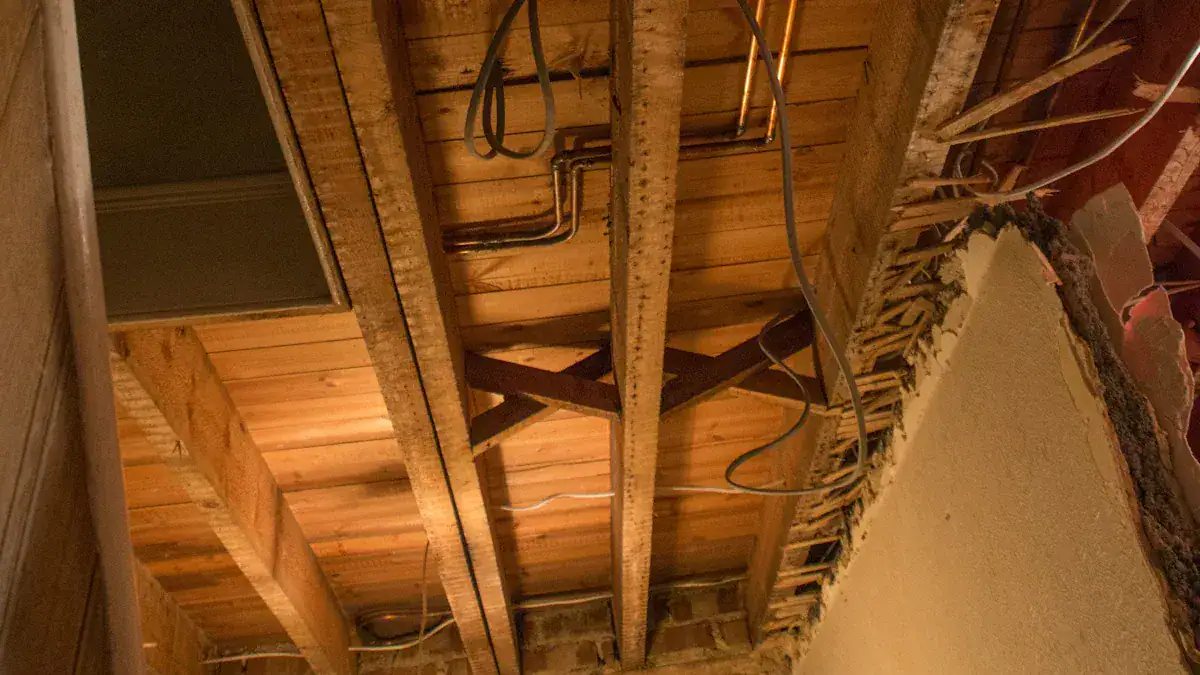
Secure Fixture Mounting
You need to mount items like light fixtures or ceiling fans. You must attach these items to something strong. Ceiling joists provide this strength. Attaching directly to drywall will not hold heavy objects. This causes items to fall. Finding joists ensures your fixtures stay in place. This prevents costly repairs.
Preventing Ceiling Damage
Improperly installed fixtures can damage your ceiling. Screws into drywall create holes. Heavy items pull on the drywall. This causes cracks or large holes. You avoid this damage when you find a joist. You drill into solid wood. This supports the weight correctly. Your ceiling stays intact.
Safety for Overhead Items
Finding ceiling joists is critical for safety. Overhead items can pose serious risks if not secured. For example, falling objects cause severe injuries. Tools or materials dropped from height can cause major harm. Even small items like bolts become dangerous. Improperly secured light fixtures can also lead to electrical hazards. Contact with energized wires can cause electric shock. This results in serious burns or fires. Working with arms raised for long periods can also cause musculoskeletal injuries. You might experience tears or sprains. Tilting your head back strains your neck and shoulders. This happens especially with heavy tools. This joist location guide helps you prevent these dangers. You ensure everything you hang is secure.
Using a Stud Finder Effectively
A reliable stud finder is your best friend when you need to find a stud in your ceiling. These tools simplify the process. They help you locate hidden joists quickly and accurately. You can choose from various types of stud finders. Each type offers unique benefits.
Electronic Stud Finder Use
Electronic stud finders detect changes in wall density. They help you locate both wooden and metal studs. Some advanced models even use radar technology for better accuracy. You will find several types of electronic stud finders:
Edge finders: These detect the edges of a stud. They identify changes in the dielectric constant of the material.
Center finders: These use advanced sensors. They automatically identify the precise center of a stud.
Radar scanners: These utilize RF technology. They provide 3D imaging to distinguish between materials behind the wall.
Multi-Sensor Stud Finders: These incorporate multiple sensor plates and algorithms. They offer quicker and more accurate detection. They can identify centers, edges, and areas without studs. They also indicate varied stud widths and locate multiple studs simultaneously.
5-in-1 Stud Finders: These combine multiple functions. They detect wood and metal studs. They also find live AC wires. These tools work on walls, floors, and ceilings.
To use an electronic stud finder, you first calibrate it. Place the stud finder flat against the ceiling. Press the power button. Wait for the calibration to complete. Then, slowly slide the stud finder across the ceiling. It will beep or light up when it detects a joist. Mark the edges of the joist. Then, scan from the other direction to confirm. The Franklin Sensors ProSensor 710 is a highly accurate electronic stud finder. It scans the wall at 13 points simultaneously. It displays the entire width of a stud. This stud finder eliminates the need for calibration. This makes it easier to use than competitors. They only locate one point at a time. This makes it hard to determine the stud’s center.
Magnetic Stud Finder Benefits
Magnetic stud finders offer a simple way to find a stud. They detect metal fasteners. These include nails or screws. Builders use these fasteners to secure joists within ceilings. Magnetic stud finders use powerful magnets. These magnets react to metal fasteners. When the magnet finds a metal object, it aligns itself with the fastener. The device then clings to the ceiling at that spot. This method accurately identifies joist locations. Magnetic stud finders are simple, reliable, and affordable. They do not require batteries. This makes them a great backup or primary stud finder.
Stud Finder Accuracy Tips
You want accurate readings from your stud finder. Always calibrate your electronic stud finder on the ceiling surface. This ensures it adjusts to the material. Scan slowly across the ceiling. Fast movements can cause you to miss a joist. Make multiple passes in different directions. This helps confirm your findings.
Be aware of false positives. Stucco ceilings can give you false readings. Thick wood board ceilings can also cause a stud finder to show a constant positive reading. If your stud finder gives inconsistent results, try another method. Mark the edges of the joist clearly. This helps you visualize the joist’s path. Combining a stud finder with other methods, like tapping or measuring, gives you the most reliable results. This helps you confidently find a stud every time.
Visual and Architectural Joist Clues

You can often find ceiling joists without special tools. Look for subtle signs on your ceiling. These visual cues help you pinpoint the location of hidden ceiling joists.
Spotting Ceiling Imperfections
Examine your ceiling closely for small imperfections. You might see nail pops or screw heads. These are tiny bumps or dimples where fasteners attach the drywall to the joists. Look for subtle indentations or ridges. These can indicate a joist beneath the surface. Sometimes, you notice slight changes in ceiling texture or seams. These patterns can reveal underlying structural elements. Shine a flashlight across the ceiling at an angle. This highlights shadows and subtle differences in the surface. In lofts or unfinished spaces, you might see exposed ceiling joists directly.
Electrical Box Indicators
Electrical boxes often give you clues. Light fixtures and smoke detectors usually attach to a joist or a sturdy piece of wood blocking between joists. If you find a light fixture, you know a joist is likely nearby. Measure from the center of that fixture. This gives you a starting point for finding other joists.
Understanding Joist Spacing
Ceiling joists follow a consistent pattern. They are typically spaced evenly. Common ceiling joist spacings are 16 or 24 inches on center. “On center” means you measure from the center of one joist to the center of the next. While various spacings exist, 16 inches on center is ideal for most homes. Once you find one joist, you can often predict where the next one will be. Measure 16 or 24 inches from the first joist. Then, use a stud finder or another method to confirm. This knowledge is a key part of any good joist location guide. You can also use a stud finder to verify these measurements.
Manual Ways to Find a Stud
You can use hands-on methods to find a stud. These techniques do not require special tools. They rely on your senses and basic measurements.
Tapping and Listening Method
You can use the tapping and listening method. This helps you find a stud. Tap the ceiling with your knuckle or a small hammer. Listen carefully to the sound. A hollow sound means you are tapping on drywall. A solid, dull thud means you are tapping on a joist. Move across the ceiling. Tap every few inches. Mark where the sound changes from hollow to solid. This indicates the edge of a joist. Continue tapping past the solid sound. The sound will become hollow again. This marks the other edge of the joist. This method helps you pinpoint the location of hidden ceiling joists.
Measuring from Walls
You can often predict joist locations by measuring. Joists usually run parallel to the shorter walls in a room. They are spaced at consistent intervals. Start by measuring 16 inches from a corner or wall. This gives you a likely spot for the first joist. Then, measure another 16 inches. This gives you the next joist location.
Tip: Joist spacing is typically measured “On Center.” This is the distance from the center of one joist to the center of the next.
For most homes, 16-inch on-center spacing is common.
Some builders use 12-inch on-center spacing. This makes the frame stronger. It also allows for greater joist spans.
You might find 24-inch on-center spacing in some constructions.
Once you find one joist, you can estimate where others are. Measure from that first joist. Use the common spacing of 16 or 24 inches. This helps you map out the joist pattern. This method is a key part of any good joist location guide. It helps you understand the structure of your ceiling.
Probing for Joists
You can probe the ceiling to confirm a joist location. This method involves making small, discreet holes. You use a thin tool to feel for solid wood.
Blunt-ended screwdriver: You can use an older screwdriver with a blunt end. Press it gently into the ceiling. It will go through drywall easily. It will stop when it hits a joist. This tool minimizes cosmetic damage.
Modified ice pick: Grind the sharp point of an ice pick to a flat end. This tool is good for delicate probing. Use it in discrete spots. This avoids unnecessary holes.
You should avoid using a sharp-pointed ice pick. Its sharp tip can easily go through almost any wood. This creates unnecessary holes and damage. Also, do not use excessive force with any tool. You do not want to leave jam marks. You do not want to cause unwarranted cosmetic damage. The goal is to find the joist, not create new damage. Once you feel solid wood, you have found a joist. This helps you find a stud with certainty. You can then mark the spot. This confirms how to find a stud without relying solely on a stud finder.
Confirming Joist Location
You have used tools or visual cues to find potential joist locations. Now you need to confirm them. This crucial step ensures your installation is secure. It prevents damage to your ceiling.
Pilot Hole Verification
You need to verify your findings. Drill a small pilot hole. Use a drill bit no larger than 1/8 inch. This size minimizes damage. Drill at a slight angle, perhaps 45 degrees. This helps you feel for the joist. Make the hole shallow. You only need to penetrate the drywall. If you hit solid wood, you found a joist. If you go through empty space, you missed it. You can then patch these small holes easily. This step gives you confidence before you install anything heavy. It prevents larger, unnecessary holes in your ceiling. This simple action saves you time and effort in the long run.
Probing with Wire
After drilling a pilot hole, insert a thin wire. A straightened coat hanger works well. Push the wire into the hole. Move it around. You will feel for solid wood. If the wire stops, you have found the joist. This method is excellent for confirming stud location. It helps you determine the exact width of the joist. You can also use a small nail or a thin drill bit for probing. Probe every 12-16 inches along the ceiling. This helps you map the joist’s path. You can also use this technique to find the edges of the joist. Push the wire until it hits the side of the joist. Mark that spot. Then, push it the other way to find the other edge. This gives you precise boundaries.
Marking Joist Edges
Once you find a joist, mark its edges. Use a pencil. You can also use painter’s tape. This makes the marks visible. Clearly mark the joist’s center and edges. This helps you visualize the joist’s path. You can then confidently attach your fixtures. This clear marking prevents mistakes. It ensures your installation is secure. You will know exactly where to drill your mounting screws. This final step ensures accuracy for your project. It gives you a clear guide for all your ceiling installations.
Accurately finding ceiling joists is vital for any overhead project. You can safely hang a light fixture or install a ceiling fan. This joist location guide covered tool-based, visual, and manual methods. Combine these techniques for the most reliable results to find a stud. You now know how to find a stud with confidence. Use your stud finder and these tips for successful, safe projects.
FAQ
What is the standard spacing for ceiling joists?
Ceiling joists typically space 16 or 24 inches apart. You measure this “on center.” This means you measure from the center of one joist to the center of the next.
What if your electronic stud finder gives false readings?
You should recalibrate your stud finder on the ceiling surface. Scan slowly. Make multiple passes. You can also combine it with other methods, like tapping or measuring, to confirm.
What size drill bit should you use for a pilot hole?
You should use a small drill bit. A 1/8-inch drill bit works well. This size minimizes damage. It helps you feel for the joist without creating a large hole.
What visual cues indicate a joist location?
You can look for nail pops or screw heads. These are small bumps. You might also see subtle changes in ceiling texture. Electrical boxes for lights often attach to joists.