

Funny coincidence: you just bought a speaker and now need bulbs that can match its vibe. You’ll want color, tunable white, reliable local control and energy savings without fuss. These six picks balance those needs with smooth dimming, music sync and failover so your lights behave even in case the network doesn’t. Keep going to find which bulb fits your room, routines and budget.
| Govee Smart A19 Color-Changing LED Bulbs (4-Pack) |

| Versatile Smart Option | Connectivity: Wi‑Fi (2.4 GHz) + Bluetooth | Voice Assistant Support: Amazon Alexa & Google Assistant | Color Capability: RGBWW — 16 million colors + warm white | VIEW LATEST PRICE | Read Our Analysis |
| Linkind Smart A19 RGBW Wi‑Fi Light Bulbs (4-Pack) |

| Feature‑Packed Performer | Connectivity: Wi‑Fi (2.4 GHz) + Bluetooth | Voice Assistant Support: Amazon Alexa & Google Home | Color Capability: RGBW — 16 million colors + tunable white (1800K–6500K) | VIEW LATEST PRICE | Read Our Analysis |
| Govee RGBWW Smart A19 LED Bulbs (4-Pack) |

| Brightness Champion | Connectivity: Wi‑Fi (2.4 GHz) + Bluetooth | Voice Assistant Support: Amazon Alexa & Google Assistant | Color Capability: RGBWW — 16 million colors + tunable white (2700K–6500K) | VIEW LATEST PRICE | Read Our Analysis |
| OHLUX Color-Changing Smart LED Bulbs 4-Pack (E26) |

| Reliable Everyday Pick | Connectivity: Wi‑Fi (2.4 GHz) + Bluetooth | Voice Assistant Support: Amazon Alexa & Google Assistant | Color Capability: RGBCW — 16 million colors + warm/cool white | VIEW LATEST PRICE | Read Our Analysis |
| Sengled Solo RGBW Bluetooth Music Light Bulb (E26) |

| Best for Music Lovers | Connectivity: Bluetooth (no Wi‑Fi) | Voice Assistant Support: Amazon Alexa (audio via Bluetooth) | Color Capability: RGBW — color changing (RGBW) | VIEW LATEST PRICE | Read Our Analysis |
| TJOY Smart RGB Wi‑Fi LED Bulbs (A19 4-Pack) |
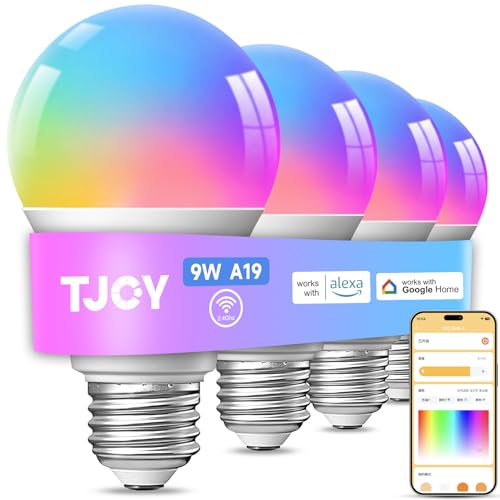
| App‑Focused Budget Pick | Connectivity: Wi‑Fi (2.4 GHz) + Bluetooth | Voice Assistant Support: Amazon Alexa & Google Assistant | Color Capability: RGB — 16 million colors + tunable white (2700K–6500K) | VIEW LATEST PRICE | Read Our Analysis |
More Details on Our Top Picks
Govee Smart A19 Color-Changing LED Bulbs (4-Pack)
Should you want budget-friendly, color-rich smart lighting that’s easy to set up and control from your phone or with voice, the Govee Smart A19 4-pack is a strong pick—offering 16 million colors, warm white, and 800 lumens per bulb while connecting over Bluetooth or 2.4 GHz Wi‑Fi for app control, Alexa/Google voice commands, and music-sync scenes. You’ll get 54 presets, DIY colors, timers, schedules, sunrise/sunset fades, and group control across Govee devices. Music sync uses your phone microphone and won’t work provided another app occupies it. Take into account it won’t join 5G Wi‑Fi or work with smart switches.
- Connectivity:Wi‑Fi (2.4 GHz) + Bluetooth
- Voice Assistant Support:Amazon Alexa & Google Assistant
- Color Capability:RGBWW — 16 million colors + warm white
- App Control & Scenes:Govee Home App — color, brightness, 54 scene modes, timers
- Music / Audio Sync:Music sync via phone microphone (Govee app)
- Form Factor / Base:A19 bulb, E26 base, 120V
- Additional Feature:54 preset scene modes
- Additional Feature:Sunrise/sunset gradual modes
- Additional Feature:800 lumens per bulb
Linkind Smart A19 RGBW Wi‑Fi Light Bulbs (4-Pack)
Should you want reliable smart lighting with local backup and rich color options, the Linkind Smart A19 RGBW 4‑pack is a strong pick. You’ll get Alexa and Google Home voice control without a hub, using the AiDot app for setup on 2.4 GHz Wi‑Fi; bulbs also use Bluetooth for local control in case Wi‑Fi drops. Each A19 E26 delivers 800 lumens, 16 million colors plus 1800K–6500K tunable white, high CRI, and a 25,000‑hour life. Enjoy 104 scenes, timers, group control, music sync with low latency, Light Show/DIY effects, and claimed energy savings up to 85% versus incandescents.
- Connectivity:Wi‑Fi (2.4 GHz) + Bluetooth
- Voice Assistant Support:Amazon Alexa & Google Home
- Color Capability:RGBW — 16 million colors + tunable white (1800K–6500K)
- App Control & Scenes:AiDot App — color/brightness, 104 preset scenes, Light Show
- Music / Audio Sync:Music sync via phone microphone + low‑latency modes
- Form Factor / Base:A19 bulb, E26 base, 120V
- Additional Feature:Dual WiFi + Bluetooth
- Additional Feature:104 preset scenes
- Additional Feature:25,000‑hour lifespan
Govee RGBWW Smart A19 LED Bulbs (4-Pack)
In case you want versatile, app-driven color and tunable white lighting for indoor lamps, the Govee RGBWW A19 4-pack is a strong pick—each bulb delivers up to 1,000 lumens, 16 million colors plus 2700K–6500K white, and CRI 90+ for accurate color. You’ll get energy-efficient 9W LED performance (75W equivalent) with dimming, timers, and 54 scene modes via the Govee Home app. Connect over 2.4 GHz Wi‑Fi or Bluetooth, use Alexa or Google Assistant, and sync lights to music. Reminder: presets require Wi‑Fi and these bulbs don’t work with smart switches.
- Connectivity:Wi‑Fi (2.4 GHz) + Bluetooth
- Voice Assistant Support:Amazon Alexa & Google Assistant
- Color Capability:RGBWW — 16 million colors + tunable white (2700K–6500K)
- App Control & Scenes:Govee Home App — color/brightness, 54 scene modes, presets
- Music / Audio Sync:Music Mode via phone microphone (Govee app)
- Form Factor / Base:A19 bulb, E26 base, 100–120V
- Additional Feature:1000 lumens brightness
- Additional Feature:CRI 90+ color rendering
- Additional Feature:9W (75W equivalent)
OHLUX Color-Changing Smart LED Bulbs 4-Pack (E26)
Should you want easy, hub-free smart lighting that plays well with Alexa and Google, the OHLUX Color-Changing 4-pack is a strong pick — it connects via 2.4 GHz Wi‑Fi/Bluetooth, lets you pick from 16 million colors plus warm/cool whites, and you can group bulbs, set schedules, or sync them to music right from the Smart Life app. You’ll get A19/E26 bulbs (works in E27 sockets), 120V, and 60–80W incandescent equivalence with up to 90% energy savings. Dimmable to 1%, supports scenes, sunset–sunrise timing, voice control, and reliable operation without flicker; Amazon handles customer support.
- Connectivity:Wi‑Fi (2.4 GHz) + Bluetooth
- Voice Assistant Support:Amazon Alexa & Google Assistant
- Color Capability:RGBCW — 16 million colors + warm/cool white
- App Control & Scenes:Smart Life App — color/brightness, scene presets, scheduling
- Music / Audio Sync:Music sync (Smart Life app)
- Form Factor / Base:A19 bulb, E26 base, 120V
- Additional Feature:Smart Life app support
- Additional Feature:No droning/flashing claim
- Additional Feature:Up to 90% energy savings
Sengled Solo RGBW Bluetooth Music Light Bulb (E26)
Pick the Sengled Solo RGBW provided you want a simple plug-and-play bulb that doubles as a decent Bluetooth speaker, letting you stream music and sync color-changing light effects without extra hubs. You screw the A19 bulb into any E26 socket, pair via Bluetooth, and control lighting with the Sengled Pulse app while music plays through the built-in 1.58-inch driver. It delivers 550 lumens (7W, 60W equivalent), CRI 100, dimming, RGBW color, and a rhythm mode that pulses colors to audio. Designed for indoor use, it’s lightweight, covered with a one-year warranty, and not sold in California.
- Connectivity:Bluetooth (no Wi‑Fi)
- Voice Assistant Support:Amazon Alexa (audio via Bluetooth)
- Color Capability:RGBW — color changing (RGBW)
- App Control & Scenes:Sengled Pulse App — light control, rhythm mode (music sync)
- Music / Audio Sync:Built‑in Bluetooth speaker — streams audio and rhythm light mode
- Form Factor / Base:A19 bulb, E26 base, indoor, 120V equivalent
- Additional Feature:Built‑in Bluetooth speaker
- Additional Feature:550 lumens output
- Additional Feature:1‑year warranty
TJOY Smart RGB Wi‑Fi LED Bulbs (A19 4-Pack)
Should you want easy voice-controlled color and tunable white lighting without adding a hub, the TJOY Smart RGB Wi‑Fi A19 four‑pack is a strong pick—just connect each bulb over 2.4 GHz Wi‑Fi (or Bluetooth) and control them with Alexa, Google Assistant, or the Daybetter app. You’ll get 800 lumens at 9W, 16 million colors, and tunable white from 2700K–6500K. Use preset scenes, timers, groups, and real-time music sync via your phone mic. bulbs use an E26 base and aren’t compatible with traditional dimmer switches or third‑party apps like Tuya or Home Assistant. One‑year warranty included.
- Connectivity:Wi‑Fi (2.4 GHz) + Bluetooth
- Voice Assistant Support:Amazon Alexa & Google Assistant
- Color Capability:RGB — 16 million colors + tunable white (2700K–6500K)
- App Control & Scenes:Daybetter App — color/brightness, preset scenes, timers
- Music / Audio Sync:Real‑time music sync via phone microphone
- Form Factor / Base:A19 bulb, E26 base, 120V
- Additional Feature:Daybetter app required
- Additional Feature:2700K–6500K tunable white
- Additional Feature:One‑year warranty
Factors to Consider When Choosing a Bluetooth Bulb
Upon choosing a Bluetooth bulb, you’ll want to check connectivity options and whether it supports sound interaction for music-sync features. Make sure the bulb’s app ecosystem and voice assistant integration work with your phone and smart home setup. Also compare brightness and color range to match the rooms and moods you plan to light.
Connectivity Options
Curious how a Bluetooth bulb will fit into your home setup? Consider which connection modes you need: many bulbs offer Bluetooth for direct, low-latency phone control and 2.4 GHz Wi‑Fi for remote access and cloud features. Bluetooth control usually requires proximity — roughly 10–30 meters depending on walls — while Wi‑Fi removes that range limit once the bulb’s on your network. Look for dual‑mode bulbs and automatic failover so Bluetooth can handle local control in case Wi‑Fi drops. Take into account that Bluetooth‑only bulbs can complicate multi‑user or multi‑room setups and often need a phone as the controller for scenes or music sync. Finally, verify compatibility: standard Bluetooth Mesh, proprietary Bluetooth, or a required hub will affect integration with assistants and third‑party apps.
Sound Interaction Support
Often you’ll want a bulb that reacts to sound as well as lights up, so check exactly how it handles audio: does it sync via your phone’s microphone, accept a direct Bluetooth audio stream, or include a built‑in speaker? Decide which method suits you—mic‑sync needs mic access and can fail when another app uses the mic, while bulbs with speakers or direct audio stream actually play sound. Check latency and responsiveness specs; low‑latency modes or dedicated audio processing give tighter sync for music and gaming. Look for multiple sound modes (Party, Calm, Energetic) and adjustable sensitivity so reactions match volume and frequency. Finally, confirm the control app documents limits—mic‑only sync, keeping the app foregrounded, or incompatibility with other audio apps—to avoid surprises.
App Ecosystem Compatibility
Because the app is your main interface for setup, scenes, and remote access, you should confirm it offers both local Bluetooth control and optional cloud/Wi‑Fi bridging should you want remote access or multi‑room sync. Next, check that the app supports grouping, scenes, and scheduling—look for explicit details like preset counts or custom scene creation so you know what’s possible. Verify cross‑platform availability (iOS and Android) and whether the app forces extra accounts, intrusive permissions, or constant background access that could affect privacy or battery life. Make sure the app supports linking to third‑party ecosystems through account integration in case you’ll expand automation. Finally, review update history, user reviews, and vendor support channels to guarantee regular firmware updates and responsive troubleshooting.
Voice Assistant Integration
Having checked the app’s capabilities and account requirements, you should also confirm how the bulb works with voice assistants. In the first instance, verify whether it supports direct Bluetooth voice control or needs a cloud‑connected Wi‑Fi bridge—Bluetooth‑only bulbs often rely on your phone or a hub for assistant access. Next, confirm compatibility with your voice platform (Alexa, Google Assistant, Siri/HomeKit) and whether linking through a specific app is required. Check which features the assistant can control: basic on/off, dimming, color temperature, full RGB scenes, or only limited commands. Make sure setup and firmware updates fit your assistant’s process—some require registration in the assistant app or periodic app‑based updates. Provided local control and privacy matter, prefer bulbs offering local voice integration.
Brightness And Color Range
Whenever you’re choosing a Bluetooth bulb, prioritize lumen output and color capabilities so the light fits each room’s purpose — aim for about 800–1,000 lumens in inhabited areas and 500–600 for bedside or accent lighting. Also pick bulbs that combine RGB color with tunable white (roughly 2700K–6500K) so you get vivid hues plus warm-to-cool whites for tasks and ambiance. Check CRI; choose 90+ in accurate color rendering matters for reading, work, or art. Verify the dimming range—ideally 1–100%—to avoid abrupt steps and make certain smooth low‑light performance. Should you want lively effects or music‑sync, confirm the bulb supports rapid color/brightness changes and low-latency response over Bluetooth or local control.
Power And Lifespan
At any time you’re comparing Bluetooth bulbs, focus on wattage versus lumens and the rated lifetime so you know how bright and efficient each option really is; LEDs typically deliver 550–1,000 lumens on 7–12W and often last 20,000–25,000+ hours, which cuts replacement frequency and operating costs dramatically. Also confirm the bulb’s rated power input (voltage/frequency) matches your home—many A19s use 100–120V at 60Hz. Use manufacturer lifetime and claimed energy savings (often 70–90% vs incandescent) to estimate operating cost and replacement intervals. Finally, check power-related limitations: some smart LEDs require continuous power to retain remote or scheduled control and aren’t compatible with legacy dimmers, so verify those constraints before you buy to avoid functionality loss.
Smart Switch Compatibility
Because Bluetooth bulbs need constant power to keep their app and voice features alive, you should plan how wall switches will interact with them before you buy. Most bulbs lose connectivity when a physical switch cuts power, so leave switches on or install ones that maintain feed. Avoid legacy dimmers and multi-way dimming circuits that alter voltage or phase — they can cause flicker, shortened lifespan, or erratic behavior. Opt for smart switches or wall controllers labeled compatible with smart-bulb mode, or choose switches that only interrupt neutral where code allows. In case you want physical control without cutting power, use in-line smart modules or wireless companion switches that send commands while preserving constant power to the bulb. Always verify Bluetooth-only compatibility before replacing hardware.
Scheduling And Automation
Now that you’ve planned how switches will keep Bluetooth bulbs powered, consider how you’ll automate them day-to-day. Make sure the bulb and its app support timers, schedules, and sunrise/sunset modes so you can automate on/off times and gradual dimming. Check whether scheduling runs locally over Bluetooth—so automation keeps working without internet—or requires cloud/Wi‑Fi, which can fail if offline. Verify grouped scheduling so multiple bulbs follow one routine instead of programming each separately. Look for flexible features: recurring daily/weekly timers, scene activation, and preset saving to simplify repeats. Finally, confirm any limitations whenever microphone or music‑sync features are active, since those can sometimes disable scheduling or preset functions.
Frequently Asked Questions
Do Bluetooth Bulbs Reduce Wi‑Fi Network Congestion?
Yes — they can. You’ll offload lighting traffic from Wi‑Fi because Bluetooth bulbs communicate directly with your phone or a hub, reducing Wi‑Fi device count and interference, though total improvement depends on network size and device mix.
Can Bluetooth Bulbs Work With Home Assistants Without a Hub?
Good news: yes, many Bluetooth bulbs will play nicely with home assistants without a hub, though you’ll sometimes need the manufacturer’s app or a bridge for voice control, and range or features could be a bit tamer.
How Do Bluetooth Bulbs Handle Firmware Security Updates?
They usually get updates via the manufacturer’s app over Bluetooth or Wi‑Fi; you’ll be prompted to install patches, and they’ll apply provided the vendor signs firmware and uses encrypted transfer—otherwise you’re vulnerable.
Are Bluetooth Bulbs Compatible With Dimmer Wall Switches?
Generally, no — you shouldn’t use standard dimmer wall switches with Bluetooth smart bulbs. You’ll risk flicker or damage. Instead, keep the switch always on and dim or control the bulbs using their app, voice, or hub.
What Is the Expected Lifespan Under Frequent Color-Changing Use?
Don’t worry about rapid burnout — you’ll typically get 15,000–25,000 hours even with frequent color changes. You’ll be swapping bulbs years from now, not months, though extreme heat or cheap LEDs can shorten that lifespan.
Final Thoughts
Choosing the right Bluetooth bulb is like picking a lighthouse for your home — it guides mood and motion through color and warmth. You’ll want bulbs that stay bright whenever the tide’s rough (local failover), play well with your crew (compatibility), and last through many nights at sea (efficiency, lifespan). Trust the picks above to steer you toward reliable, tunable light so your rooms always find their true north.
