

You want more outlets, more USB ports, and more safety—but you don’t want bulky blocks or messy cords. You’ll find travel-friendly angled extenders, high-joule surge protectors, and slick multi-port strips that fit modern tech. Each pick balances compact design with sturdy protection, and one choice even works on cruise ships. Keep going to see which option matches your devices and space.
| TROND 3-Way Angled Wall Outlet Extender (2-Pack) |

| Travel-Friendly Pack | AC Outlets (count/arrangement): Converts 1 into 3 AC sockets (3-way, on 3 sides) | USB Ports (presence/type): No USB ports | Surge Protection (yes/no / Joules where provided): No surge protection (cruise-ship approved) | VIEW LATEST PRICE | Read Our Analysis |
| One Beat 1680J 3-Side Power Strip with USB-C |

| Surge-Protected Workhorse | AC Outlets (count/arrangement): 5 AC outlets (3-sided spread across duplex fit) | USB Ports (presence/type): 4 USB ports (including 2 USB-C) | Surge Protection (yes/no / Joules where provided): Yes — 1680 Joules | VIEW LATEST PRICE | Read Our Analysis |
| 3-Sided Surge Protector with 6 AC and USB-C |

| Best for Power-Hungry Setups | AC Outlets (count/arrangement): 6 AC outlets (3 sides) | USB Ports (presence/type): 4 USB ports (2 USB-C + 2 USB-A) | Surge Protection (yes/no / Joules where provided): Yes — 1800 Joules | VIEW LATEST PRICE | Read Our Analysis |
| Anker 10-in-1 Power Strip with Surge Protection |

| Compact Powerhouse | AC Outlets (count/arrangement): 6 AC outlets | USB Ports (presence/type): 4 USB ports (2 USB-C + 2 USB-A) | Surge Protection (yes/no / Joules where provided): Yes — 300 Joules | VIEW LATEST PRICE | Read Our Analysis |
| TESSAN Multi Plug Surge Protector with USB-C |
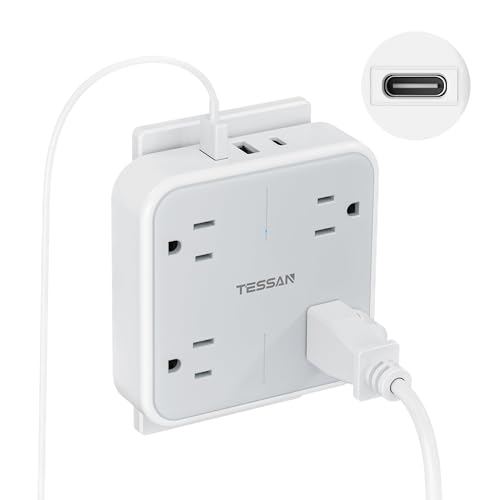
| Stable Everyday Extender | AC Outlets (count/arrangement): Converts 2 into 4 AC outlets | USB Ports (presence/type): 2 USB ports (1 USB-C + 1 USB-A) | Surge Protection (yes/no / Joules where provided): Yes — built-in surge protection (Joules not specified) | VIEW LATEST PRICE | Read Our Analysis |
More Details on Our Top Picks
TROND 3-Way Angled Wall Outlet Extender (2-Pack)
Should you need to power several bulky chargers in a tight spot, the TROND 3-Way Angled Extender is ideal: its trapezoid, three-sided sockets let you plug in laptops, phones, and cameras simultaneously without blocked plugs, and the two-pack turns one outlet into three (six total) while staying compact enough for behind furniture or in a suitcase. You’ll appreciate its 1875W/125V/15A capacity, cheese-like trapezoid design, and 3.48 x 1.73 x 1.42-inch footprint that fits tight spaces. It’s cruise-ship approved since it lacks surge protection and cords, and it makes a simple, portable charging station for travel, dorms, and hotels.
- AC Outlets (count/arrangement):Converts 1 into 3 AC sockets (3-way, on 3 sides)
- USB Ports (presence/type):No USB ports
- Surge Protection (yes/no / Joules where provided):No surge protection (cruise-ship approved)
- Safety Certification / Build:Designed without surge/cord (cruise-compatible); no listed ETL
- Form Factor / Size Notes:Trapezoid “cheese” shape; compact 3.48 x 1.73 x 1.42 in
- Travel / Use-case Suitability:Travel and cruise-ship friendly (approved for cruise use)
- Additional Feature:Trapezoid “cheese” shape
- Additional Feature:Cruise-ship approved
- Additional Feature:Two-pack convenience
One Beat 1680J 3-Side Power Strip with USB-C
Should you need a compact solution that turns a duplex outlet into a multi-device charging station, the One Beat 1680J is a smart pick — it gives you five well-spaced AC sockets plus four USB ports (two USB‑C) and secures to the wall with a center screw and rear prong so everything stays put while charging up to nine devices. You get 1680J surge protection, an indicator light, and ETL certification. USB total is 5V/3.1A with auto-detect and up to 3A from USB‑C (no QC3.0 or 9–22V profiles). Spacing at 1.78″ accommodates bulky adapters. Warranty covers 30 days returns and 12 months replacement.
- AC Outlets (count/arrangement):5 AC outlets (3-sided spread across duplex fit)
- USB Ports (presence/type):4 USB ports (including 2 USB-C)
- Surge Protection (yes/no / Joules where provided):Yes — 1680 Joules
- Safety Certification / Build:ETL certified; fire-resistant ABS (1382°F)
- Form Factor / Size Notes:3-sided expander fits duplex outlet; outlets spaced 1.78 in apart
- Travel / Use-case Suitability:Home, travel, and office use
- Additional Feature:1680J surge rating
- Additional Feature:Screw + prong mount
- Additional Feature:ETL certified
3-Sided Surge Protector with 6 AC and USB-C
Should you need a compact yet powerful solution for crowded outlets, the 3-sided surge protector with six AC outlets and USB-C ports is ideal for tech-heavy rooms and travel kits. You get six widely spaced AC outlets across three sides so bulky adapters won’t block neighbors, plus a 180° swivel plug that fits horizontal or vertical sockets. Two USB-C (3A) and two USB-A (2.4A) ports use smart IC to optimize charging. Safety-wise it offers 1,800 J energy absorption, TVS/MOV/GDT protection, <1 ns response, ETL certification, and thermal-resistant ABS housing—follow the manual and the 15A/125V rating.
- AC Outlets (count/arrangement):6 AC outlets (3 sides)
- USB Ports (presence/type):4 USB ports (2 USB-C + 2 USB-A)
- Surge Protection (yes/no / Joules where provided):Yes — 1800 Joules
- Safety Certification / Build:ETL certified; fire-resistant ABS (1382°F)
- Form Factor / Size Notes:3-sided with swivel plug; compact 5.7 x 1.9 x 1.7 in
- Travel / Use-case Suitability:Home and office use; compact for varied sockets (rotating plug)
- Additional Feature:1800J surge rating
- Additional Feature:180° swivel plug
- Additional Feature:Triple-stage surge circuitry
Anker 10-in-1 Power Strip with Surge Protection
Should you need a compact, travel-ready power solution that still handles multiple devices, the Anker 10-in-1 is a smart pick—its ultra-thin, low-profile design and wide-spaced, 15° angled outlets make it easy to plug in bulky adapters without blocking neighboring sockets. You get six AC outlets plus two USB-A and two USB-C ports in a 1.19-inch profile that stays close to the wall and won’t sag. USB-C1 delivers 20W fast charging (iPhone 15: 0–53% in 30 minutes). Built-in 300J surge protection and an 18-month plus $200,000 connected equipment warranty add peace of mind.
- AC Outlets (count/arrangement):6 AC outlets
- USB Ports (presence/type):4 USB ports (2 USB-C + 2 USB-A)
- Surge Protection (yes/no / Joules where provided):Yes — 300 Joules
- Safety Certification / Build:Covered warranty; fire-resistant construction implied (specs provided)
- Form Factor / Size Notes:Ultra-thin low-profile 1.19 in thick; angled outlets
- Travel / Use-case Suitability:Travel-friendly, dorms, home offices
- Additional Feature:Ultra-thin 1.19″ profile
- Additional Feature:15° angled outlets
- Additional Feature:$200K connected warranty
TESSAN Multi Plug Surge Protector with USB-C
In case you need to power multiple bulky plugs and still charge a phone or tablet, the TESSAN Multi Plug Surge Protector with USB-C is a strong pick because it converts two sockets into four widely spaced outlets while adding a USB-C port (15W) and a USB-A port for convenient device charging. You’ll get a 15W USB‑C (3A) and a 2.4A USB‑A, though USB‑C won’t support devices needing 14–22V. Built-in surge protection guards electronics, and a stabilizing rod keeps the unit firmly attached. It fits standard and decorator outlets but won’t work with GFCI or 2‑prong receptacles. Great for indoor rooms.
- AC Outlets (count/arrangement):Converts 2 into 4 AC outlets
- USB Ports (presence/type):2 USB ports (1 USB-C + 1 USB-A)
- Surge Protection (yes/no / Joules where provided):Yes — built-in surge protection (Joules not specified)
- Safety Certification / Build:Stabilizing rod and surge protection; compatibility limits noted (no GFCI/2-prong)
- Form Factor / Size Notes:Wall-mounted extender with stabilizing rod; fits standard/decorator outlets
- Travel / Use-case Suitability:Indoor use (homes, hotels, dorms); stable wall attachment
- Additional Feature:Stabilizing rod support
- Additional Feature:Compatible with decorator outlets
- Additional Feature:Not GFCI/2-prong compatible
Factors to Consider When Choosing a Wall Outlet Extender
Upon choosing an outlet extender, you’ll want to match the outlet capacity to how many devices you actually use and check whether it includes surge protection for sensitive gear. Look for built-in USB ports and smart plug spacing so bulky adapters won’t block neighboring sockets. Finally, pick a unit made from solid, heat-resistant materials for long-term safety and durability.
Outlet Capacity Needed
Curious how many plugs and ports you actually need? To begin, count every device you’ll plug in simultaneously so you choose an extender with enough AC outlets. Decide whether you want built-in USB ports too—those free up AC slots and speed charging for phones, tablets, and accessories. Check outlet spacing: bulky adapters and transformers need room or they’ll block adjacent sockets. Consider the layout—do you need outlets on multiple sides to fit tight corners or behind furniture? Finally, confirm the extender’s total power rating and compatibility with surge protection so high-draw or sensitive electronics get safe, reliable power. Balancing outlet count, port types, spacing, and power limits prevents overcrowding and unsafe setups.
Surge Protection Presence
Because power spikes can fry electronics in an instant, you’ll want an extender with built-in surge protection that can absorb excess voltage—usually specified in joules—to keep your devices safe. Check the joule rating: typical ranges run from about 300 to 1,800, and higher numbers mean more energy absorption during repeated or large surges. Look for multiple suppression technologies like TVS, MOV, and GDT working together for faster, more reliable clamping. Confirm active protection with indicator lights so you know the surge circuitry is functioning. Verify safety certifications (ETL, etc.) and fire‑resistant construction to reduce risk during faults. Prioritize an extender whose surge features match the value of the gear you’ll plug into it.
USB Port Availability
How many USB ports do you really need on a wall outlet extender? Consider the devices you regularly charge and whether you want to ditch bulky adapters. Extenders offer anywhere from one USB to multiple ports, often mixing USB-A and USB-C so you can charge phones, tablets, and accessories simultaneously. USB-C typically delivers higher current—up to 3A—and faster charging than USB-A’s common ~2.4A output. Look for Smart IC tech so the unit detects devices and allocates power efficiently across ports. Also confirm supported charging standards and voltage ranges; some ports won’t handle higher-voltage quick-charge protocols. Choosing the right mix and number of ports guarantees convenient, optimized charging without overloading the extender’s power budget.
Plug Spacing Design
You’ve just decided how many USB ports you need, so now consider how those chargers will fit on the extender itself—plug spacing matters as much as port count. You’ll want spacing that prevents bulky adapters from blocking adjacent outlets so every socket can be used at once. Aim for distances greater than standard—over about 1.5 inches—to accommodate larger plugs without overlap. Look for extenders with outlets arranged on multiple sides or angled faces; those layouts give distinct physical separation and use space efficiently. In compact models, wide spacing is especially crucial to avoid crowding while keeping many usable sockets. Proper spacing also reduces stress on plugs and outlets, lowering damage risk and making charging safer and more convenient.
Build Material Quality
Materials matter whenever you pick a wall outlet extender, so prioritize units built from fire-resistant ABS and sturdy internal components that stand up to heat and wear. You’ll want ABS that tolerates extreme temperatures (up to 1382°F) to reduce fire risk should something goes wrong. Inspect the casing and connections for solid construction so the extender resists drops, frequent plugging, and travel use without cracking or loosening. Reliable internal parts help prevent short circuits, overheating, and over-current faults. In case the extender includes surge components like MOVs, GDTs, or TVS diodes, make sure they’re integrated into a durable housing that lets them absorb and dissipate spikes effectively. Good materials extend service life and maintain consistent electrical performance.
Safety Certifications Present
Upon you’re choosing a wall outlet extender, look initially for recognized safety certifications like ETL, UL, or CSA, because they mean the device has passed independent electrical and fire-safety testing. You should favor certified models since they signal compliance with industry standards and lower the risk of electrical hazards. Certified surge protectors commonly include over-current, over-charge, short-circuit, and overheating protections, plus grounded indicator lights and built-in circuit safeguards to guarantee safe operation. Check that materials meet fire-resistance requirements—standards often demand components withstand very high temperatures. Seeing a certification mark gives you verifiable assurance the extender underwent rigorous testing for electrical safety and performance, so prioritize those labels whenever comparing options to protect your devices and home.
Travel And Portability
While safety certifications should be your primary filter, you’ll also want to take into account how the extender fits your travel needs. Choose compact, lightweight designs that slip into luggage or a laptop bag without adding bulk. Prefer miniature extenders with multiple angled outlets so bulky chargers don’t block neighboring sockets in hotels or dorms. Look for space-saving dimensions that hide behind furniture or in confined areas common on the road. Portable models often include secure attachment mechanisms to prevent dislodging during movement and work across varied outlet configurations you’ll encounter overseas or in different buildings. Should you plan to take extenders into restricted environments, bear in mind that units without surge protection or cords might be more suitable where regulations limit certain equipment.
Cruise Ship Compatibility
Because cruise ships enforce strict electrical rules, choose extenders that have no surge protection or cords and meet common US ratings like 125V/15A. You’ll avoid denied use or tripping ship systems through selecting models built specifically for marine compliance. Pick compact units that won’t block adjacent outlets or crowd tiny cabin walls; slim profiles save space and reduce snag risks. Confirm the manufacturer states cruise compatibility and that the device lacks surge circuitry, since onboard power management differs from shore systems. Prioritize simple, sturdy construction and clear labeling of voltage and amperage to prevent overloads. At times of doubt, consult the cruise line’s electrical policy before packing an extender to guarantee safe, permitted operation.
Final Thoughts
You’ll want an extender that fits your gear and keeps everything safe, so pick one that balances ports, surge protection and compactness. Whether you travel with TROND’s angled pair, power a tech hub with One Beat or Anker, or choose the 3-sided or TESSAN options, you’ll get dependable charging. Consider the right extender as a reliable bridge—compact, sturdy, and always there to carry your devices through the day.
