

You may suppose smarter thermostats mainly save energy, but that’s only part of the story. You’ll want a device that fits your HVAC, privacy needs, and daily habits — and some models do that better than others. I’ll outline top picks from radar‑sensing ecobee to budget Sensi and Nest, so you can spot the best balance of features and compatibility for your home.
| Smart WiFi Programmable Thermostat with Room Sensor |

| Best for Multi‑Room Control | Connectivity: Wi‑Fi (2.4 GHz) + Bluetooth (BT Mesh) | Power Type / Voltage: 24 V AC (C‑wire required) | Smart Home Integration: SmartThings compatible; app control (Prodigytec) | VIEW LATEST PRICE | Read Our Analysis |
| ecobee Smart Thermostat Premium with Sensor & Air Monitor |

| Best for Air Quality | Connectivity: Wi‑Fi + Bluetooth | Power Type / Voltage: 24 V (PEK included for C‑wire‑less homes) | Smart Home Integration: Siri, Alexa, Google Assistant, HomeKit, SmartThings | VIEW LATEST PRICE | Read Our Analysis |
| Honeywell Home RTH7600D 7-Day Programmable Touchscreen Thermostat White |

| Best for Simple Programming | Connectivity: BACnet MS/TP (digital connectivity listed) | Power Type / Voltage: 24 Volts (battery powered) | Smart Home Integration: (No mainstream voice apps listed) Touch control; BACnet integration | VIEW LATEST PRICE | Read Our Analysis |
| Sensi Lite Smart WiFi Thermostat (ST25) Black |

| Best Budget Smart Pick | Connectivity: Wi‑Fi | Power Type / Voltage: 24 Volts (battery or C‑wire; 2 AAA included) | Smart Home Integration: Amazon Alexa, Google Assistant, SmartThings | VIEW LATEST PRICE | Read Our Analysis |
| Honeywell Home T5 WiFi Smart Thermostat (RTH8800WF) |

| Best for Geofencing | Connectivity: Wi‑Fi | Power Type / Voltage: 24 Volts (requires C‑wire or adapter; 1 AAA battery) | Smart Home Integration: Amazon Alexa, Apple HomeKit, Google Assistant | VIEW LATEST PRICE | Read Our Analysis |
| Google Nest Thermostat Smart Wi‑Fi Programmable (Fog) |

| Best for Minimalist Design | Connectivity: Wi‑Fi | Power Type / Voltage: 24 Volts (corded; 2 AAA batteries included) | Smart Home Integration: Google Home, Google Assistant, Alexa, Matter‑certified assistants | VIEW LATEST PRICE | Read Our Analysis |
| ecobee Smart Thermostat Enhanced — Wi‑Fi Voice Control |
| Best Energy Saver | Connectivity: Wi‑Fi | Power Type / Voltage: 24 V (hardwired; PEK included) | Smart Home Integration: Siri, Alexa, Google Assistant, HomeKit, SmartThings | VIEW LATEST PRICE | Read Our Analysis |
More Details on Our Top Picks
Smart WiFi Programmable Thermostat with Room Sensor
In case you want an easy-to-use, sensor-driven thermostat that keeps rooms comfortable based on real occupancy, the Provirtec TH-01 is a smart pick — its included thermo‑hygrometer and body‑location temperature sensing let the unit and app fine‑tune heating and cooling for where people actually are, and it’ll keep running locally should your Wi‑Fi drops. You’ll mount the sleek black square (3.95‑inch LED touchscreen) and connect 24VAC with a C wire. The Prodigytec app manages 7‑day schedules, modes (Home/Away/Sleep), firmware updates, and pairing; BT Mesh and auto‑away add resilience for most HVAC systems.
- Connectivity:Wi‑Fi (2.4 GHz) + Bluetooth (BT Mesh)
- Power Type / Voltage:24 V AC (C‑wire required)
- Smart Home Integration:SmartThings compatible; app control (Prodigytec)
- Programmable Scheduling:7‑day scheduling
- Included Mounting/Hardware:Wall plate, screws x2, anchors x2, screwdriver x1, wiring label
- Temperature Control (Heating & Cooling):Heating and cooling control (supports 3H/2C, heat pumps, boilers, furnaces)
- Additional Feature:Body-location temperature detection
- Additional Feature:BT Mesh local control
- Additional Feature:Thermo-hygrometer included
ecobee Smart Thermostat Premium with Sensor & Air Monitor
Should you want a thermostat that doubles as an indoor air-quality monitor and smart home hub, the ecobee Smart Thermostat Premium is a top pick. You get a programmable Wi‑Fi thermostat with a SmartSensor (included) for room-specific temperature and occupancy detection via radar, plus a built-in air monitor. It supports Siri, Alexa, Google Assistant, HomeKit and SmartThings, offers Live View with ecobee’s doorbell camera, two-way talk, and alerts for smoke or open doors/windows whenever paired with ecobee Security. ENERGY STAR certified, compatible with ~95% of 24 VAC systems, it includes a PEK for C‑wire‑less installs and a three-year warranty.
- Connectivity:Wi‑Fi + Bluetooth
- Power Type / Voltage:24 V (PEK included for C‑wire‑less homes)
- Smart Home Integration:Siri, Alexa, Google Assistant, HomeKit, SmartThings
- Programmable Scheduling:Programmable schedules (app; supports schedule/eco features)
- Included Mounting/Hardware:Backplate, wire labels, screws and drywall plugs, trim plate, PEK
- Temperature Control (Heating & Cooling):Heating and cooling (2H/2C; heat pump support + AUX; multiple system types)
- Additional Feature:Built-in air monitor
- Additional Feature:Live View doorbell integration
- Additional Feature:Built-in smart speaker
Honeywell Home RTH7600D 7-Day Programmable Touchscreen Thermostat White
Should you want a dependable, programmable touchscreen thermostat that’s easy to set up and fine-tune, the Honeywell Home RTH7600D is a solid choice for homeowners who value week-long scheduling and clear, at-a-glance information. You’ll get a large backlit 15.24 cm touch display showing room temperature and set point, 7-day programming with four periods per day, temporary/permanent holds, and automatic DST. Smart Response Technology learns run times; auto changeover and compressor protection help prevent wear. Battery powered and wall-mounted, it supports many system types—verify wiring before install. It includes mounting hardware, a quick guide, and a one-year warranty.
- Connectivity:BACnet MS/TP (digital connectivity listed)
- Power Type / Voltage:24 Volts (battery powered)
- Smart Home Integration:(No mainstream voice apps listed) Touch control; BACnet integration
- Programmable Scheduling:7‑day programming (4 periods per day)
- Included Mounting/Hardware:Mounting hardware, quick install guide (screws included)
- Temperature Control (Heating & Cooling):Heating and cooling; auto changeover; heat pump support
- Additional Feature:Smart Response learning
- Additional Feature:Compressor protection delay
- Additional Feature:Battery powered operation
Sensi Lite Smart WiFi Thermostat (ST25) Black
Should you want a straightforward, budget-friendly smart thermostat that works with your phone and voice assistant, the Sensi Lite (ST25) Black delivers reliable Wi‑Fi control and easy DIY installation. You’ll program automatic temperature control via the app or the LCD backlit display, and use Alexa, Google Assistant, or SmartThings for voice control. It supports AC, furnace, boiler, and heat pump systems (C‑wire required for some setups), includes filter alerts, auto changeover, DST readiness, and low‑voltage detection. ENERGY STAR certified, it claims about 23% HVAC savings, comes with batteries, a three‑year warranty, and clear mounting hardware and guides.
- Connectivity:Wi‑Fi
- Power Type / Voltage:24 Volts (battery or C‑wire; 2 AAA included)
- Smart Home Integration:Amazon Alexa, Google Assistant, SmartThings
- Programmable Scheduling:Programmable (scheduling via app)
- Included Mounting/Hardware:Mounting hardware, wire labels, installation guide
- Temperature Control (Heating & Cooling):Heating and cooling; supports AC, boiler, furnace, heat pump
- Additional Feature:Batteries included (AAA)
- Additional Feature:Low-voltage detection
- Additional Feature:Filter change indicator
Honeywell Home T5 WiFi Smart Thermostat (RTH8800WF)
Provided you want simple, reliable smart-home control, the Honeywell Home T5 WiFi places geofencing and 7-day flexible scheduling at your fingertips so you can save energy automatically while you’re away. You’ll mount the compact, backlit touchscreen using the included UWP system and power it with 24V C-wire (or the optional adapter) plus one AAA battery. It supports most heat/cool systems, Auto Changeover, Auto-Away, Vacation Mode, fan control, and provides monthly energy reports with ENERGY STAR certification. Connect via Wi‑Fi to Alexa, Google Assistant, or Apple HomeKit, enroll in utility programs for rebates, and rely on a two-year limited warranty.
- Connectivity:Wi‑Fi
- Power Type / Voltage:24 Volts (requires C‑wire or adapter; 1 AAA battery)
- Smart Home Integration:Amazon Alexa, Apple HomeKit, Google Assistant
- Programmable Scheduling:7‑day flexible scheduling
- Included Mounting/Hardware:UWP mounting system, mounting hardware, user manual
- Temperature Control (Heating & Cooling):Heating and cooling; auto changeover; fan control
- Additional Feature:Geofencing Auto-Away
- Additional Feature:Monthly energy reports
- Additional Feature:Utility demand-response eligible
Google Nest Thermostat Smart Wi‑Fi Programmable (Fog)
Should you want an easy, energy‑minded upgrade, the Google Nest Thermostat (Fog) is ideal for tech‑savvy homeowners who want remote control and simple scheduling without complicated wiring. You’ll get a compact, matte‑finish programmable thermostat with backlit display, voice control, and Wi‑Fi connectivity. It works with Google Home, Assistant, Alexa, Matter devices, Android, iOS, and Vera, and supports roughly 85% of HVAC systems—often without a C‑wire. Use the Google Home app to set schedules, enable Auto‑Away, get HVAC alerts, and try Savings Finder. Installation’s about 30 minutes; two AAA batteries and mounting hardware are included.
- Connectivity:Wi‑Fi
- Power Type / Voltage:24 Volts (corded; 2 AAA batteries included)
- Smart Home Integration:Google Home, Google Assistant, Alexa, Matter‑certified assistants
- Programmable Scheduling:Programmable scheduling (via Google Home app)
- Included Mounting/Hardware:Steel plate, mounting screws, documentation bundle
- Temperature Control (Heating & Cooling):Heating and cooling; heat pump and various systems supported
- Additional Feature:Savings Finder suggestions
- Additional Feature:Works without C-wire
- Additional Feature:Nest Renew integration
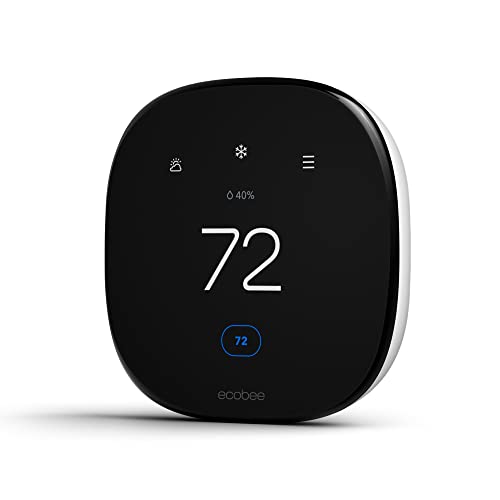
ecobee Smart Thermostat Enhanced — Wi‑Fi Voice Control
In case you want precise, voice‑controlled climate management that integrates with nearly every smart home ecosystem, the ecobee Smart Thermostat Improved is a top pick — it works with Alexa, Siri/HomeKit, Google Assistant and SmartThings, and includes occupancy‑aware radar and a Power Extender Kit for homes without a C‑wire. You’ll get Energy Star efficiency, eco+ automated setbacks, and occupancy sensing that preheats or precools before you arrive. The app (iOS/Android) and Apple Watch support remote control and routines. It’s compatible with about 90% of 24 VAC systems, accepts extra SmartSensors for room balancing, and comes with a three‑year warranty.
- Connectivity:Wi‑Fi
- Power Type / Voltage:24 V (hardwired; PEK included)
- Smart Home Integration:Siri, Alexa, Google Assistant, HomeKit, SmartThings
- Programmable Scheduling:Programmable schedules with learning/eco features
- Included Mounting/Hardware:Backplate, trim plate, wire labels, screws and drywall plugs, PEK
- Temperature Control (Heating & Cooling):Heating and cooling; conventional and heat pump systems supported
- Additional Feature:Built-in radar occupancy
- Additional Feature:Power Extender Kit included
- Additional Feature:eco+ energy features
Factors to Consider When Choosing a Smartphone Thermostat
When choosing a smartphone thermostat, you’ll want to check HVAC compatibility and whether your system needs a C‑wire for reliable power. Make sure it integrates with your smart home platform, and test the app’s functionality and UX for easy scheduling and control. Also confirm it offers both remote access and local control so you can manage comfort even should the internet drop.
Compatibility With HVAC
Although a smart thermostat can add convenience and savings, you’ll need to confirm it’s compatible with your HVAC system before buying. Verify the thermostat supports your system type—furnace/AC, heat pump, boiler, or multi‑stage setups—since some handle only specific configurations (e.g., 2H/2C vs 3H/2C). Confirm wiring labels on your control board and harness (R, Rc, Rh, W, Y, G, O/B) match the thermostat’s terminals using a compatibility checker or wiring diagram. Check voltage and control standards—most residential systems use 24 VAC—and avoid units that require proprietary signals your system doesn’t provide. Make certain the thermostat can manage features you rely on, like auxiliary/backup heat, multiple stages, fan control, or humidification/dehumidification, to guarantee full functionality.
Power Requirements (C‑Wire)
Before you pick a smart thermostat, check its power needs—most models expect a 24V AC common (C) wire to supply constant power for Wi‑Fi, displays, and sensors. Should your home lack a C‑wire, look for alternatives: a manufacturer power‑extender kit, a common‑wire adapter, or adding a dedicated C from the HVAC transformer or fan wiring. Battery‑only or C‑wire‑less units exist, but they often rely on trickle charging and can cause thermostat or system cycling on some setups. Confirm your HVAC type—furnace, heat pump, or multi‑stage—since advanced systems usually need a true C connection. During installation, use a multimeter to verify about 24 VAC between R and C, and call a qualified technician when voltage is absent or unstable.
Smart Home Integration
In choosing a smartphone thermostat, make sure it fits into your existing smart‑home ecosystem and communication stack so you can actually control it the way you already do—via voice, app, or automation. Confirm compatibility with Apple HomeKit, Google Assistant, Alexa, or Matter so your voice assistants and routines work without hacks. Prefer devices that support local control and common protocols (Wi‑Fi, Bluetooth, Thread/Matter) for reliability during outages and smooth device‑to‑device links. Verify integration with room sensors, occupancy or radar sensing, and geofencing so temperature follows real presence and room needs. Be certain the thermostat exposes APIs or plugs into IFTTT, SmartThings, Home Assistant for custom rules and energy reporting. Finally, prioritize end‑to‑end encryption, local processing options, and clear data policies to protect your household data.
App Functionality & UX
Once you’ve confirmed the thermostat will play nicely with your smart‑home gear, look closely at the mobile app—it’s how you’ll interact with the system day to day. Pick an app offering both local (LAN) and cloud control so you keep basic functions during internet outages. Favor intuitive scheduling—7‑day, multi‑period programming—and clear visual cues for modes like Home, Away, and Sleep. Make sure it supports multi‑sensor and room‑specific control with easy sensor pairing and placement management to address hot/cold spots. Check for actionable notifications and maintenance alerts (filter changes, HVAC faults, open doors/windows) with configurable thresholds and history logs. Finally, verify automatic over‑Wi‑Fi firmware updates and accessible in‑app firmware version info for security and feature rollouts.
Remote And Local Control
Don’t rely solely on cloud access—make sure your thermostat supports both remote (cloud over Wi‑Fi) and local control (Bluetooth, Zigbee/Thread, or direct LAN) so you can still change setpoints and run schedules during an outage. Check whether it automatically falls back to local control whenever Wi‑Fi drops and continues core functions like setpoint changes and schedule execution. Confirm required network frequency (2.4 GHz vs 5 GHz) and whether a persistent C‑wire or power accessory is needed to maintain continuous remote connectivity. Review the mobile app to see which features—geofencing, scheduling, firmware updates—need internet versus what’s available locally. Finally, prefer devices that support multiple protocols and clear pairing steps for remote sensors so control stays reliable and responsive.
Energy Saving Features
Many thermostats now include features that actively cut energy use without constant tinkering, and you should prioritize those that learn your schedule, use geofencing, or auto‑adjust whenever the house is empty. Pick models with adaptive or learning schedules and geofencing so your system lowers setpoints automatically when you’re away. Look for ENERGY STAR or manufacturer‑stated savings (commonly ~20–26%) to verify efficiency claims. Favor units with occupancy detection, auto‑away, and vacation modes to suspend HVAC during extended absences. Choose thermostats that participate in utility demand‑response or let you shift runtime to off‑peak periods to save money and reduce grid strain. Together, these features cut wasted conditioning and keep comfort costs down without daily micro‑management.
Sensors And Zoning Support
Considering about sensors and zoning will change how your thermostat manages comfort: instead of a single hallway reading, you can track temperature, humidity, and occupancy across rooms and control each area independently. Choose thermostats that support remote room sensors (temperature and occupancy) so you measure conditions where people actually are. Prefer systems with zoning—built‑in multi‑zone control or compatibility with motorized dampers and multiple units—so you set independent schedules and setpoints per room. Look for occupancy or radar presence sensing to enable automatic Home/Away and preconditioning, cutting runtime when rooms are empty. Verify sensor count, types, and wireless range; mesh Bluetooth or Wi‑Fi helps extend placement. Provided you require balanced comfort, pick systems that aggregate sensor data and allow per‑sensor schedules or temperature offsets.
Installation And Support
While you’re picking a smartphone thermostat, make sure installation requirements and ongoing support match your skills and system: check for a C‑wire or power‑adapter option, confirm compatibility with your HVAC type and stages, and see whether the package includes mounting hardware and clear wiring guides to simplify DIY or pro installation. Verify your system wiring—many thermostats need 24 VAC or a power extender kit—and confirm support for single‑stage, multi‑stage, heat pump, boiler, or fan coil setups. Look for included wall plates, wire labels, and an installation checklist to speed setup. Make certain the device can get firmware updates over Wi‑Fi and has sensible local‑control fallback. Finally, review warranty length, return policy, technical support availability, and online compatibility tools before buying.
Frequently Asked Questions
Do These Thermostats Support Smart Home Presence Detection?
Yes — many do. You’ll find thermostats that use phone GPS, Bluetooth, or Wi‑Fi geofencing, plus integrations with smart home hubs and occupancy sensors. Check each model’s app and compatibility to guarantee reliable presence detection.
Can I Install Them on Home Insurance–Covered HVAC Systems?
Generally, yes — you can install smart thermostats on insurance-covered HVAC systems, but you should check your policy and notify your insurer; improper installation could affect coverage, so get a licensed pro and keep receipts and documentation.
How Do They Handle Multi-Zone HVAC Setups?
They’ll usually support multi-zone setups via wired or wireless zone controllers; you’ll configure each zone’s thermostat in the app, set schedules and priorities, and the system coordinates dampers or valves to maintain independent temperatures across zones.
Are Replacement Batteries Required for Wi‑Fi Features?
Yes — many Wi‑Fi thermostats need replacement batteries provided that they rely on battery power for wireless radios; others draw power from the C‑wire. You’ll check specs: some models charge, others require periodic AA or AAA battery swaps.
Do Any Include Built‑In Air Filtration Controls?
Yes — some do. You’ll find models that integrate fan and MERV-compatible schedule controls, letting you manage filter cycles and IAQ settings from your phone; they won’t replace whole-house purifiers, but they help a lot.
