

I like comfort, I like savings, and I like tech that just works, so I’ve rounded up the seven best Wi‑Fi smart thermostats for 2026. I’ll compare compatibility, installation ease, smart features, and real‑world energy performance to help you pick the right fit. Should you care about voice control, C‑wire requirements, or simple setup, keep going — there’s one option that likely matches your system and habits.
Vine Wi‑Fi Smart Thermostat for Home (C‑Wire)

Should you have a 24V system and can provide a C‑wire, the Vine Wi‑Fi Smart Thermostat is a great pick for homeowners who want straightforward smart control without a complex install; you’ll find it compatible with about 90% of 24V systems (conventional, heat pump, heat- or cool-only) and it needs a C‑wire. You can verify compatibility with a QR code, then follow online guides or videos to install in roughly 20 minutes. Use the Vine or Smart Life app for remote control, enable Alexa or Google voice commands, set 7-day schedules, and rely on Auto Home/Away, alerts, and Energy Star efficiency.
Best For: Homeowners with a 24V HVAC system who can provide a C‑wire and want an easy-to-install, energy-efficient smart thermostat with remote and voice control.
Pros:
- Compatible with ~90% of 24V systems (conventional, heat pump, heat- or cool-only) and Energy Star certified for efficiency.
- Simple installation with C‑wire, QR code compatibility check, and step-by-step online guides/videos (typically ~20 minutes).
- Remote control via Vine or Smart Life app, plus Alexa/Google Home voice control, Auto Home/Away, alerts, and filter reminders.
Cons:
- Requires a C‑wire, so homes without one may need additional wiring or an adapter.
- Not compatible with non-24V systems or some uncommon HVAC configurations.
- Advanced users may find fewer high-end features compared with premium smart thermostats (e.g., learning algorithms or advanced zoning integrations).
Honeywell Home Smart WiFi Thermostat X2S (White)

In case you want a straightforward, compatible smart thermostat that plays well with every major platform, the Honeywell Home Smart WiFi Thermostat X2S is a solid pick—it’s Matter certified and works with Alexa, Google Assistant, and Apple HomeKit so you won’t be locked into a single ecosystem. You’ll connect via 2.4 or 5 GHz Wi‑Fi and control it remotely with the Premier Alert app. It supports common HVAC setups (up to 2 heat/2 cool conventional or heat pump configs) but not electric baseboard heat, and it requires a C‑wire. Energy Star certified, it offers scheduling, auto‑away, humidity monitoring, and a two‑year warranty.
Best For: tech-savvy homeowners who want a Matter-certified, platform-agnostic smart thermostat compatible with Alexa, Google Assistant, and Apple HomeKit for common HVAC systems (with a required C‑wire).
Pros:
- Matter certified and works with Alexa, Google Assistant, and Apple HomeKit for seamless cross-platform integration.
- Supports 2.4/5 GHz Wi‑Fi, remote control via the First Alert app, Energy Star certified, and offers scheduling plus auto-away to save energy.
- Compatible with a wide range of conventional and heat pump systems (up to 2 heat/2 cool) and includes a 2-year warranty.
Cons:
- Requires a C‑wire, which may necessitate wiring changes in some homes.
- Does not support electric baseboard heating (120–240V).
- Some users may prefer a thermostat with a built-in humidity display (humidity monitoring is optional) or more advanced learning features.
Amazon Smart Thermostat (Works with Alexa & Ring)

In case you want a budget-friendly smart thermostat that plays nicely with Alexa and Ring, the Amazon Smart Thermostat is a strong pick—especially in case you already use Echo devices and want simple voice control, presence-based comfort zones, and remote temperature adjustments through the Alexa app. You’ll get ENERGY STAR–level savings (EPA cites about $50/year average) plus potential local rebates Amazon emails after purchase. It uses Honeywell Home tech for reliable control, requires a C-wire, and includes Alexa-guided installation with customer support. Integrate it with Echo, Ring, and Smart Air Quality Monitor to set routines, switch modes automatically, and manage comfort zones.
Best For: budget-conscious smart-home users who already use Echo or Ring devices and want easy Alexa-integrated temperature control, presence-based comfort zones, and remote management via the Alexa app.
Pros:
- ENERGY STAR–level savings (≈$50/year average) with potential local rebates emailed after purchase.
- Seamless Alexa and Ring integration for voice control, routines, and presence-based comfort zones.
- Built on Honeywell Home technology with Alexa-guided installation and customer support.
Cons:
- Requires a C-wire for installation, which may complicate setup for some homes.
- Limited advanced thermostat features compared with higher-end models.
- Best experience relies on having Echo/compatible devices and Smart Air Quality Monitor for full functionality.
Emerson Sensi Touch Wi‑Fi Smart Thermostat (ST75)

Looking for a touchscreen thermostat that’s easy to install and works alongside every major smart home platform? You’ll appreciate the Emerson Sensi Touch ST75: a compact, sleek rectangular thermostat with a 4.3-inch color touchscreen, backlight, and three finish options. It supports Alexa, HomeKit, Google Assistant, SmartThings, and Vera, connects via Wi‑Fi, and offers app and voice control. Installation is DIY-friendly with illuminated terminals, a built-in level, and step-by-step guidance, though a C‑wire is required. ENERGY STAR certified, it can cut HVAC use by about 23%, provides scheduling, geofence, alerts, reports, and a three-year warranty.
Best For: homeowners and DIYers who want an ENERGY STAR touchscreen smart thermostat that’s easy to install and integrates with major smart home platforms.
Pros:
- Sleek 4.3-inch color touchscreen with backlight and intuitive app/voice control (Alexa, HomeKit, Google Assistant, SmartThings, Vera).
- ENERGY STAR certified with features like scheduling, geofence, usage reports, alerts, and potential ~23% HVAC savings.
- DIY-friendly installation (illuminated easy-click terminals, built-in level, step-by-step app guidance) and backed by Emerson support and a 3-year warranty.
Cons:
- Requires a common wire (C‑wire) for power, which may complicate installation in some homes.
- Some functions may need 1 AA battery and continuous Wi‑Fi for full smart features.
- Plastic rectangular design may be less premium-feeling compared with metal or round high-end thermostats.
Honeywell Wi‑Fi 9000 Color Touch Thermostat (TH9320WF5003)

Should you want a thermostat that combines a vivid color touchscreen with advanced multi-stage system support, the Honeywell Wi‑Fi 9000 (TH9320WF5003) is a strong pick. You’ll get a high-definition color touch screen with customizable colors and a white high-gloss frame, plus home-screen indoor/outdoor temperature and humidity. It’s a communicating, digital low-voltage thermostat with 7-day programmability and manual option, supporting up to 3 heat/2 cool stages for heat pumps or 2/2 for conventional systems. You can control it remotely via Total Connect Comfort, enjoy energy-saving scheduling, tool-free installation, time backup through outages, and a 5-year warranty.
Best For: homeowners with multi-stage heat pump or conventional HVAC systems who want a vivid touchscreen thermostat with remote access and easy, tool-free installation.
Pros:
- High-definition color touchscreen with customizable colors and home-screen indoor/outdoor temp and humidity.
- Supports up to 3 heat/2 cool stages (heat pump) or 2/2 (conventional) and 7-day programmability for energy savings.
- Remote control via Total Connect Comfort, maintains time during outages, and includes a redesigned terminal block for tool-free installation + 5-year warranty.
Cons:
- Requires use of Honeywell’s Total Connect Comfort service for full remote features, which may be a drawback for users preferring local-only control.
- Larger, feature-rich interface may be more complex for users seeking a very simple thermostat.
- May be overkill (and more costly) for homes with only single-stage HVAC systems.
Smart WiFi Touchscreen Programmable Thermostat with Voice Control
Should you want a compact, easy-to-install thermostat that you can control hands-free, the Smart WiFi Touchscreen Programmable Thermostat with Voice Control is a great pick because it pairs a responsive touchscreen and voice/app control with simple, tool-free mounting for homes, RVs, dorms, and small businesses. You’ll get reliable temperature management via dual heating and cooling modes, programmability, and remote access through Wi‑Fi. Built from abrasion‑resistant ABS, it tolerates temperature swings and stays durable. Installation is straightforward—wall mount with included hardware, battery powered with optional USB. Model YV3MMYZJY37BK1AL supports smart home systems for seamless integration.
Best For: compact-living residents and small-space property owners (homes, RVs, dorms, and small businesses) who want an easy-to-install, voice- and app-controlled thermostat for convenient remote temperature management.
Pros:
- Responsive touchscreen plus voice and app control enables hands-free and remote operation.
- Tool-free wall-mount installation with included hardware and battery/USB power options simplifies setup.
- Durable ABS construction and dual heating/cooling modes provide reliable year-round performance.
Cons:
- May lack advanced features found in premium thermostats (e.g., energy reports, learning algorithms).
- Compatibility with some HVAC systems or smart home platforms could be limited—confirm before purchase.
- Lightweight, compact design might offer a smaller display and fewer physical controls than larger models.
Honeywell Home RTH9600WF Smart Wi‑Fi Color Thermostat
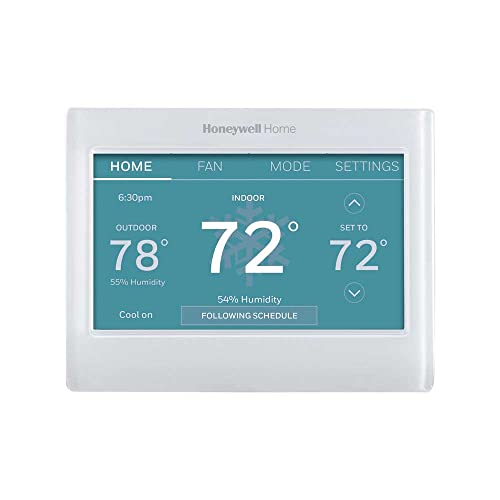
Should you want a dependable, ENERGY STAR‑certified smart thermostat that blends a customizable color touchscreen with broad HVAC compatibility, the Honeywell Home RTH9600WF is a strong pick—especially for homes with forced‑air, hot‑water, steam, or heat‑pump systems. You’ll get a high‑definition LCD touchscreen, Smart Response learning, and ENERGY STAR savings tips plus eligibility for utility rebates. It supports Alexa, Google Assistant, Cortana, remote app control, and alerts for filters, temps, and connectivity. C‑wire is required (verify wiring or use an adapter); it won’t work with electric baseboard heat. Includes wall plate, guides, two‑year warranty, and Wi‑Fi connectivity.
Best For: homeowners with forced‑air, hot‑water, steam, or heat‑pump HVAC systems who want an ENERGY STAR‑certified smart thermostat with a customizable color touchscreen and smart home integration.
Pros:
- ENERGY STAR certified with Smart Response learning for improved efficiency and potential utility rebates.
- Wide smart home and voice assistant compatibility (Alexa, Google Assistant, Cortana) plus remote app control and useful alerts.
- High‑definition customizable color touchscreen and bundled installation hardware/documentation.
Cons:
- Requires a C‑wire (or adapter) and is incompatible with electric baseboard heat, limiting suitability for some homes.
- Not compatible with heating‑only oil furnaces without a C‑wire.
- 2‑year limited warranty may be shorter than some competitors’ coverage.
Factors to Consider When Choosing a Wifi Smart Thermostat
Before you pick a model, I check a few practical things: HVAC compatibility, whether your system needs a C‑wire, and how well the thermostat plays with my smart‑home platform. I also look at scheduling and energy‑saving features plus how straightforward installation and manufacturer support will be. Those factors usually decide whether a thermostat is worth installing.
Compatibility With HVAC
Before I’m choosing a Wi‑Fi smart thermostat, compatibility with my HVAC system is the initial thing I check, because the wrong match can mean poor performance or a refused installation. I confirm the thermostat supports common HVAC types—gas, oil, electric furnaces, heat pumps, boilers, and forced‑air units—so it can control both heating and cooling. I verify supported system voltage (usually 24V AC) and the number of heat/cool stages the unit handles, including auxiliary or emergency heat for heat pumps. I also watch for limits: some thermostats won’t work with high‑voltage electric baseboard systems (120–240V) or other uncommon setups. Thoroughly reviewing manufacturer compatibility lists and installation guides saves time and prevents costly surprises.
Power Requirements (C‑Wire)
Once I pick a Wi‑Fi smart thermostat, I always check the power setup—most models require a C‑wire to get steady 24V power for Wi‑Fi, touchscreens, and advanced features. The C‑wire gives continuous low‑voltage power so the thermostat doesn’t drain batteries or “steal” from the HVAC control circuit, which can cause erratic behavior. Before buying, I verify whether my furnace or air handler has a C‑terminal. Should there be no C‑wire, some thermostats include a power extender kit or can run on battery backup, but those options might limit features or require extra wiring work. Also bear in mind C‑wire–dependent thermostats won’t work with high‑voltage systems like electric baseboard heaters that lack a low‑voltage common.
Smart Home Integration
After you’ve confirmed your C‑wire situation, I also check how a thermostat will play with the rest of my smart home. I prioritize support for Alexa, Google Assistant, and Apple HomeKit so I can use whichever voice platform I prefer. Matter certification is a big plus — it makes pairing and cross‑vendor automation far smoother. I look for direct integrations with air quality monitors, security systems, and smart lighting so temperature changes can trigger wider routines. App‑based remote control is essential: it ties the thermostat into alerts, automations, and remote overrides. Finally, compatibility with hubs like SmartThings or Vera matters whenever I want centralized control or advanced scenes that combine multiple devices into one cohesive system.
Scheduling & Energy Features
Though I care about smart integrations, I pay closest attention to scheduling and energy features because they decide how a thermostat actually saves money and keeps you comfortable. I look for flexible scheduling—seven-day programming with multiple periods—so temperature profiles match my weekday, weekend, and sleep routines. Auto Home/Away or auto-away occupancy sensing is a must; it cuts wasted heating and cooling whenever no one’s home. I value Energy Star certification as evidence the device can lower bills without sacrificing comfort. Extended low-heat setpoints and demand-response compatibility let me join utility programs and earn rebates. Finally, alerts for filter changes and maintenance help keep the HVAC system efficient, ensuring the schedules actually translate into long-term energy savings.
Installation & Support
Good scheduling and energy features matter, but they won’t help in case the thermostat won’t install or stay powered. I always check HVAC compatibility initially and confirm a common wire (C-wire) is present, since many WiFi thermostats need it for reliable power. I favor models with clear, step-by-step guides and video tutorials so I can DIY without guessing. Practical mounting options, included wall plates, screws, and anchors save time and trips to the hardware store. For tricky setups, responsive customer support—phone, chat, or email—makes a big difference, so I test availability prior to buying. Finally, detailed online manuals and warranty info give me confidence that long-term support is available should problems arise.
