

You want reliable CO2 detection that actually helps you act fast, not gadgets that give false alarms. Focus on NDIR sensors, clear real‑time displays, quick response, and durable calibration. I’ll compare five practical models—what they do well, where they fall short, and how they’ll fit into your space—so you can pick the right one and avoid wasting breath.
| Kidde Plug-in Carbon & Explosive Gas Detector |
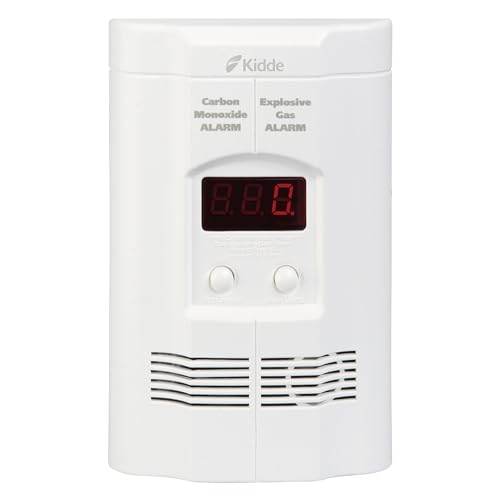
| Best Dual-Protection | Detects Carbon Monoxide: Yes (electrochemical CO sensor) | Audible Alarm: Yes (85 dB) | Plug-in or Mains Power Option: Plug-in 120V AC (with 9V battery backup) | VIEW LATEST PRICE | Our Analysis |
| Hembisen 2-in-1 Gas & Carbon Monoxide Detector | Budget-Friendly Combo | Detects Carbon Monoxide: Yes (electrochemical CO sensor) | Audible Alarm: Yes (85 dB) | Plug-in or Mains Power Option: Plug-in power design | VIEW LATEST PRICE | Our Analysis | |
| 4-in-1 Carbon Monoxide & Gas Leak Detector | Most Feature-Rich | Detects Carbon Monoxide: Yes (CO sensor; display 0–999 ppm) | Audible Alarm: Yes (≥85 dB plus flashing lights) | Plug-in or Mains Power Option: Plug-in (compatible with 110–220V AC) | VIEW LATEST PRICE | Our Analysis | |
| Kidde 10-Year Battery Smoke & Carbon Monoxide Detector |

| Long-Life Reliability | Detects Carbon Monoxide: Yes (CO detection combined with smoke) | Audible Alarm: Yes (85 dB) | Plug-in or Mains Power Option: Hardwired/requires household power with built-in battery (10-year battery) — intended for home mains use | VIEW LATEST PRICE | Our Analysis |
| Kidde Smoke & Carbon Monoxide Detector (AA 1-Pack) |

| Battery-Powered Convenience | Detects Carbon Monoxide: Yes (electrochemical CO sensor) | Audible Alarm: Yes (85 dB with flashing red LEDs) | Plug-in or Mains Power Option: Battery powered (2×AA) and mountable — used for household power-out protection (note: primarily battery but intended for home alarm installation) | VIEW LATEST PRICE | Our Analysis |
More Details on Our Top Picks
Kidde Plug-in Carbon & Explosive Gas Detector
Should you want a simple, plug-in solution that monitors both carbon monoxide and common explosive household gases, the Kidde KN-COEG-3 is a good fit—its electrochemical CO sensor and gas sensor combo give you real-time CO readings on an LED display and a “GAS” alert for propane, natural gas, methane, and sewer gas. You plug it into a 120V outlet, use the included extension cord, and keep a 9V battery backup. It sounds an 85 dB alarm, shows peak CO memory, updates every 15 seconds, and offers Smart-Hush. UL certified with a 6-year limited warranty, install near bedrooms.
- Detects Carbon Monoxide:Yes (electrochemical CO sensor)
- Audible Alarm:Yes (85 dB)
- Plug-in or Mains Power Option:Plug-in 120V AC (with 9V battery backup)
- Portable/Home Use Suitable:Home — install on every level/near bedrooms
- Meets Safety Standards / Certifications:UL certified; meets UL 2034 and UL 1484
- Built-in Alarm Silence / User Controls:Smart-Hush silencing (~8 minutes)
- Additional Feature:Digital LED CO readout
- Additional Feature:Detects explosive gases
- Additional Feature:9V battery backup
Hembisen 2-in-1 Gas & Carbon Monoxide Detector
Budget-Friendly Combo
View Latest PriceShould you need a simple, reliable plug-in unit for both natural gas and carbon monoxide protection, the Hembisen 2-in-1 is a strong choice—especially for homeowners, RVers, and small-business operators who want straightforward monitoring. You’ll get electrochemical CO sensing and a catalytic combustion sensor that detects natural gas, LPG, propane, methane and more. The digital display reports CO in ppm and combustible gas in LEL, while an 85 dB alarm sounds at preset thresholds. It’s plug-and-play, auto-enters a power-saving mode with a green light whenever levels are safe, and fits homes, apartments, campers, offices and light commercial sites.
- Detects Carbon Monoxide:Yes (electrochemical CO sensor)
- Audible Alarm:Yes (85 dB)
- Plug-in or Mains Power Option:Plug-in power design
- Portable/Home Use Suitable:Home/RV/apartment/office/hotel/camper — multi-location
- Meets Safety Standards / Certifications:(Implied standards) sensor types specified; marketed for safety (no specific UL listed in summary)
- Built-in Alarm Silence / User Controls:Simple plug-and-play with standard alarm control (power-saving mode noted)
- Additional Feature:Catalytic combustible sensor
- Additional Feature:PPM and LEL display
- Additional Feature:Power-saving mode
4-in-1 Carbon Monoxide & Gas Leak Detector
Most Feature-Rich
View Latest PriceShould you want an all-in-one safety plug that watches for carbon monoxide, multiple combustible gases, temperature, and humidity, this 4-in-1 detector is a great fit—you can plug it in, flip the screen, and get real-time alerts with audible and visual alarms. You’ll get CO readings 0–999 ppm (±10%), combustible gas levels GAS Lv 1–4 (0–15% LEL), humidity 0–95% RH (±5%), and temperature −10°C–50°C (±1.5°C). Dual sensors trigger ≥85 dB plus flashing lights at CO ≥51 ppm or gas ≥5% LEL. It’s plug-and-play, travel-friendly, fits 110–220V, and manufacturer support helps setup.
- Detects Carbon Monoxide:Yes (CO sensor; display 0–999 ppm)
- Audible Alarm:Yes (≥85 dB plus flashing lights)
- Plug-in or Mains Power Option:Plug-in (compatible with 110–220V AC)
- Portable/Home Use Suitable:Home/kitchen/bedroom/RV/hotel/office/boat — travel-friendly
- Meets Safety Standards / Certifications:(Manufacturer specifications; testing/support noted — no explicit UL in summary)
- Built-in Alarm Silence / User Controls:Alarm with visual indicators and modes; screen and alarm level indicators; user instructions for startup
- Additional Feature:Temperature & humidity sensors
- Additional Feature:Color LCD with icons
- Additional Feature:GAS Lv 1–4 indicator
Kidde 10-Year Battery Smoke & Carbon Monoxide Detector
Should you want a low-maintenance, code-compliant alarm that protects against both smoke and carbon monoxide, the Kidde 10‑Year Battery Smoke & Carbon Monoxide Detector is a strong choice. You get dual sensing with advanced sensors that claim over 25% faster smoke detection*, a red LED status light, and an 85 dB alarm. The built-in 10-year battery eliminates chirps and comes with a 10-year limited warranty from initial power-on. Technology helps reduce false alarms from cooking or steam while meeting UL 217 (10th) and UL 2034 (5th) standards and FCC rules. It suits homeowners, managers, contractors, and pros.
- Detects Carbon Monoxide:Yes (CO detection combined with smoke)
- Audible Alarm:Yes (85 dB)
- Plug-in or Mains Power Option:Hardwired/requires household power with built-in battery (10-year battery) — intended for home mains use
- Portable/Home Use Suitable:Home/property/homeowner use — code-compliant residential
- Meets Safety Standards / Certifications:Tested to meet UL 217 (smoke) and UL 2034 (CO); complies with FCC
- Built-in Alarm Silence / User Controls:End-user controls/automatic operation with long-life battery; designed to reduce false alarms (implies user-facing features)
- Additional Feature:Built-in 10-year battery
- Additional Feature:False-alarm reduction tech
- Additional Feature:Red LED status light
Kidde Smoke & Carbon Monoxide Detector (AA 1-Pack)
Should you want a single, battery-powered unit that watches for both smoke and carbon monoxide, the Kidde 900-CUDR is a solid pick: it uses a photoelectric sensor for smoldering fires and an electrochemical sensor for CO, so you get two critical protections in one compact, easy-to-mount alarm. You’ll get an 85 dB alarm with flashing red LEDs, Smart-Hush silencing for about eight minutes, and continuous self-tests (still push-test manually). It runs on two included AA batteries, mounts on ceiling or wall, meets UL/NFPA standards, announces end-of-life, and carries a 10-year limited warranty.
- Detects Carbon Monoxide:Yes (electrochemical CO sensor)
- Audible Alarm:Yes (85 dB with flashing red LEDs)
- Plug-in or Mains Power Option:Battery powered (2×AA) and mountable — used for household power-out protection (note: primarily battery but intended for home alarm installation)
- Portable/Home Use Suitable:Home/ceiling or wall installation — residential use
- Meets Safety Standards / Certifications:UL Listed; meets UL 217 and UL 2034; NFPA listed
- Built-in Alarm Silence / User Controls:Smart-Hush silencing (~8 minutes) and push-to-test / self-test functions
- Additional Feature:Photoelectric smoke sensor
- Additional Feature:End-of-life “Replace Alarm”
- Additional Feature:Includes mounting bracket
Factors to Consider When Choosing a Carbon Dioxide Detector
Upon choosing a carbon dioxide detector, you’ll want to compare detection accuracy, sensor type, and response time to make sure readings are reliable and timely. Check power options—battery, hardwired, or plug-in—and consider where you’ll place the unit so it detects CO2 effectively without false alarms. These factors together determine performance and suitability for your space.
Detection Accuracy
Because accurate CO2 readings depend on both sensor technology and maintenance, you should pick detectors with proven hardware and clear specs. Prioritize models stating measurement range and resolution—useful indoor ranges are roughly 0–5,000 ppm with 1–10 ppm resolution—so you know what they can detect. Look for explicit accuracy tolerances (for example ±(50 ppm + 3% of reading)) to compare performance. Favor devices that use field‑calibratable or auto‑calibrating sensors and observe recommended recalibration intervals (commonly 1–2 years) to retain accuracy. Verify environmental operating ranges and whether the unit has temperature, humidity compensation and pressure correction; without these features, readings can shift in extremes. Use specs, not marketing claims, whenever judging detection accuracy.
Sensor Type
Pick a detector based on its sensor type, since that choice determines accuracy, stability, power use, and maintenance needs. You’ll usually want an NDIR sensor: it’s the most common and accurate for CO2, giving stable readings across 0–5000+ ppm with typical accuracy around ±(30–50 ppm +3–5% of reading). Avoid electrochemical sensors for CO2—they’re for toxic gases like CO and don’t suit reliable long-term CO2 monitoring. Photoacoustic and metal-oxide options can detect CO2 but typically sacrifice accuracy, stability, or power efficiency, so they’re less ideal for precise indoor air quality. Check how the sensor handles calibration: some models use automatic baseline correction, while others need manual calibration every 6–12 months, which affects upkeep and long-term accuracy.
Response Time
Although response time might seem like a minor spec, it determines how quickly a detector reflects real changes in CO2 and whether you’ll get timely alerts or control signals; look for t50/t90 figures and the test conditions behind them. You’ll see t90 defined as time to reach 90% of the final reading; NDIR units can respond in seconds, while chemical sensors could take minutes. Prioritize faster response (seconds to under a minute) for confined spaces or demand-controlled ventilation where prompt action matters. Check warm-up/stabilization—many devices need 30 seconds to several minutes after power-on before readings are reliable. Compare t50/t90 at relevant concentrations (400–2,000 ppm or higher) and observe test flow, temperature, and humidity to make certain performance meets your use case.
Power Options
Consider how you’ll power the detector: mains (AC) units give continuous operation and often include battery backup, battery-only models (AA/AAA or integrated lithium) let you place sensors anywhere but need replacement or monitoring, and USB/DC options let you run devices from adapters or power banks. You’ll want mains with battery backup provided that uninterrupted monitoring matters, and check backup duration ratings. Should you choose battery-only, observe whether cells are user-replaceable or a sealed long-life pack (some last 5–10 years but require full replacement at end of life). For USB/DC models, confirm the stability and reliability of the external supply and the device’s standby power draw. Match stated standby consumption and backup hours to your outage scenarios to make certain continuous coverage.
Placement Guidelines
Once you decide where to put CO2 detectors, aim for coverage that keeps sensors at breathing height (roughly 3–6 feet) on every level and inside or just outside sleeping areas so occupants will be alerted while sleeping. Mount per manufacturer guidance provided a unit is wall- or ceiling‑designed. Avoid placing detectors within 3–6 feet of doors, windows, vents, or fans where drafts can dilute readings, and stay at least 1–2 feet from HVAC intakes. Don’t install units in very humid spots (near showers or laundry), in direct sunlight, or next to heat sources like ovens, stoves, or unvented combustion appliances. For larger or compartmentalized homes, space detectors so no inhabited-space point is more than about 30–40 feet from a unit, adding extras as needed.
Alarm Features
Often you’ll want a CO2 detector with clear, reliable alarm features that grab your attention and give actionable information. Choose units rated at least 85 dB so alarms are audible throughout your home and during sleep. Prefer models that show real-time CO or CO2 concentrations on a digital readout and update frequently (about every 15 seconds) so you can assess risk quickly. Make sure the detector records peak levels or keeps an event log so you can review the highest concentrations later. Look for a temporary silence or hush function that mutes nuisance alarms for roughly eight minutes while monitoring continues. Verify alarm outputs include both loud audible alerts and distinct visual signals (LEDs or flashing lights) to suit different notification needs.
Maintenance Needs
Regularly maintaining your CO2 detector keeps it reliable whenever you need it most, so set prompts for tests, battery changes, and cleaning. Replace batteries every 6–12 months and plan sensor or unit replacement every 5–10 years per the manufacturer—CO sensors degrade. Test monthly with the unit’s test button to confirm alarm, display, and circuitry; log date/time. Clean housing and vents every 3–6 months with a soft brush or vacuum to remove dust; don’t use solvents or water. After any alarm, ventilate, get a professional inspection, and replace the detector should CO exposure be confirmed or in the event it shows error codes or is at end-of-life. Keep a maintenance log of battery changes, tests, error codes, and installation/manufacture dates.
