

You want lighting that reshapes a room with color, motion, and smart control, without a long DIY headache. These five programmable LED strips cover everything from per‑pixel WS2812B effects to true tunable whites and long, consistent 24V runs. I’ll walk you through what each excels at, the tradeoffs to watch for, and how to avoid common installation pitfalls—so you can pick the right strip and get flawless results.
| Govee RGBIC Strip Light 2 Pro 32.8ft (Matter) |
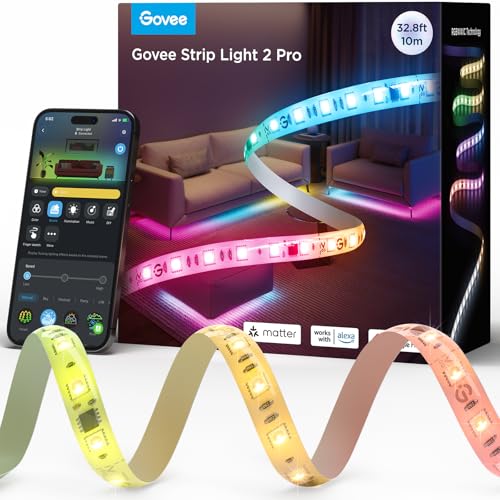
| Best Smart Integration | Addressability / Segment Control: RGBIC, individually controllable segments (up to 100 segments) | Cut-to-Length: Cuttable (must follow guidelines; min length 6.56 ft) | Flexible Strip Form Factor: Flexible LED strip (bendable; avoid tight corner bends) | VIEW LATEST PRICE | Our Analysis |
| ALITOVE WS2812B 5V RGB Addressable LED Strip 120LED |

| Narrow-Profile DIY | Addressability / Segment Control: Individually addressable WS2812B pixels (per-LED control) | Cut-to-Length: Cuttable at marked lines | Flexible Strip Form Factor: Flexible, super-narrow 5 mm strip | VIEW LATEST PRICE | Our Analysis |
| WS2812B 5050 Addressable RGB LED Strip 144 LEDs |
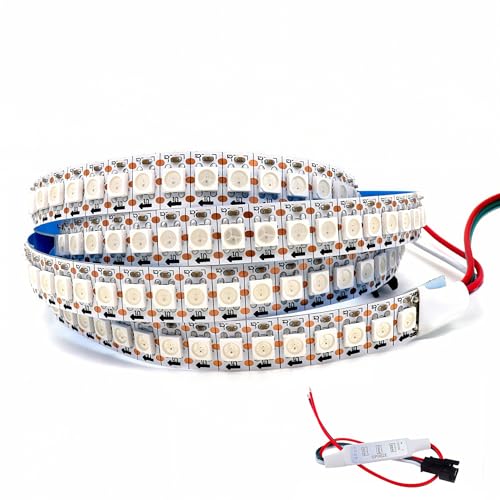
| High-Density Precision | Addressability / Segment Control: Individually addressable WS2812B pixels (per-LED control) | Cut-to-Length: Cuttable per LED | Flexible Strip Form Factor: Flexible SMD5050 strip | VIEW LATEST PRICE | Our Analysis |
| SEZO WS2811 Addressable WS2811 RGB LED Strip (16.4ft) |

| Long-Range Effects | Addressability / Segment Control: Addressable via WS2811 (one IC controls groups of 6 LEDs) | Cut-to-Length: Cuttable | Flexible Strip Form Factor: Flexible SMD5050 strip (8 mm wide) | VIEW LATEST PRICE | Our Analysis |
| 100ft White Dimmable LED Strip Lights (24V) |

| Bulk White Lighting | Addressability / Segment Control: Segmentable/dimmable white zones (app/group control; cut-to-length) | Cut-to-Length: Cut-to-length trimming design | Flexible Strip Form Factor: Flexible roll (self-adhesive) | VIEW LATEST PRICE | Our Analysis |
More Details on Our Top Picks
Govee RGBIC Strip Light 2 Pro 32.8ft (Matter)
Should you want long, high‑precision accent lighting that’s easy to control, the Govee RGBIC Strip Light 2 Pro 32.8 ft (Matter) is a great pick — its 600 LEDs with 5‑in‑1 RGBWWIC chips and Govee’s 16‑bit LuminBlend processing deliver smoother colors and true whites while Matter support gives you reliable voice and smart‑home control. You’ll get 32.8 feet of flexible, cuttable strip with 16 million colors, 2700–6500K whites, and up to 100 independently controlled segments. Use the Govee Home app, voice assistants, or reactive music sync for gaming, TV, parties, or ambient bedroom and cabinet lighting.
- Addressability / Segment Control:RGBIC, individually controllable segments (up to 100 segments)
- Cut-to-Length:Cuttable (must follow guidelines; min length 6.56 ft)
- Flexible Strip Form Factor:Flexible LED strip (bendable; avoid tight corner bends)
- Self-Adhesive / Easy Mounting:Adhesive recommended; clean/dry surface for installation
- Requires External Power Supply (Corded DC):Corded electric, 24 V adapter included (72 W)
- Programmable / App or Controller Control:App control (Govee Home), Matter, Alexa/Google voice control, preset scenes and DIY effects
- Additional Feature:Matter-compatible voice control
- Additional Feature:600 LEDs, high density
- Additional Feature:Built-in microphone music sync
ALITOVE WS2812B 5V RGB Addressable LED Strip 120LED
In case you want ultra-slim, highly controllable accent lighting for tight spaces, the ALITOVE WS2812B 5V RGB strip is a great choice — its 5 mm super-narrow profile and 120 individually addressable WS2812B LEDs let you hide it in grooves while creating complex color and animation effects with fine 24-bit color control. You’ll get a 6.6 ft flexible strip with self-adhesive backing, cut-to-length marks, and 3-pin JST-SM connectors. It supports Raspberry Pi and many Wi‑Fi/Bluetooth controllers (SP108E, SP105E, SP110E, etc.), plus power-injection points to prevent voltage drop. Controller and PSU are sold separately.
- Addressability / Segment Control:Individually addressable WS2812B pixels (per-LED control)
- Cut-to-Length:Cuttable at marked lines
- Flexible Strip Form Factor:Flexible, super-narrow 5 mm strip
- Self-Adhesive / Easy Mounting:Self-adhesive backing included
- Requires External Power Supply (Corded DC):Requires 5 V power supply (not included)
- Programmable / App or Controller Control:Programmable via compatible controllers (SP-series, T1000S, Raspberry Pi) and apps
- Additional Feature:Super-narrow 5mm width
- Additional Feature:3-pin JST-SM connectors
- Additional Feature:Separate power injection ends
WS2812B 5050 Addressable RGB LED Strip 144 LEDs
Should you want pixel-perfect, individually controllable lighting for DIY animations or immersive accent setups, the WS2812B 5050 144‑LED strip delivers—144 addressable pixels on a white PCB at 5 V let you program per‑LED color and brightness for detailed effects while keeping wiring simple. You get a 3.2 ft non‑waterproof (IP30) plastic strip with 5050 SMD LEDs and built‑in WS2812B drivers, cuttable per LED. It needs a 5 V, ~9 A (45 W) supply and a pixel controller compatible with 24‑bit color/256 brightness levels. Connect via 3‑pin JST‑SM, avoid exceeding 6 V, and use indoors for accent, holiday, or custom projects.
- Addressability / Segment Control:Individually addressable WS2812B pixels (per-LED control)
- Cut-to-Length:Cuttable per LED
- Flexible Strip Form Factor:Flexible SMD5050 strip
- Self-Adhesive / Easy Mounting:Typical strip mounting (clips/adhesive implied) — cuttable with connectors (adhesive mounting assumed)
- Requires External Power Supply (Corded DC):Requires 5 V power supply (recommended 5 V 9 A; not included)
- Programmable / App or Controller Control:Programmable with controllers/software (WLED/Arduino/LED editing tools)
- Additional Feature:144 LEDs/ft density
- Additional Feature:Requires 5V 9A supply
- Additional Feature:White PCB non‑waterproof
SEZO WS2811 Addressable WS2811 RGB LED Strip (16.4ft)
In case you want highly detailed, addressable effects for indoor projects, the SEZO WS2811 16.4 ft strip delivers per‑6‑LED control so you can program chasing, raindrop, and mixed “dream color” animations with WLED, Arduino, or common Bluetooth/music controllers. You get 540 SMD5050 LEDs (108/m) driven via 90 WS2811 ICs on a black 8 mm PCB, cuttable every segment. It runs on DC 24V (recommend 5A PSU), includes a 3‑pin connector, clips, and screws, and works with SP611E/SP530E/SP107E and T1000S/K1000C controllers. It’s IP30 for indoor decorative and project use; PSU/controller sold separately.
- Addressability / Segment Control:Addressable via WS2811 (one IC controls groups of 6 LEDs)
- Cut-to-Length:Cuttable
- Flexible Strip Form Factor:Flexible SMD5050 strip (8 mm wide)
- Self-Adhesive / Easy Mounting:Includes fixed clips and screws for mounting
- Requires External Power Supply (Corded DC):Requires DC 24 V power supply (sold separately; recommended 5 A)
- Programmable / App or Controller Control:Programmable with SP-series controllers, WLED, Arduino, Raspberry Pi, etc.
- Additional Feature:1 IC per 6 LEDs
- Additional Feature:Black PCB aesthetic
- Additional Feature:Includes mounting clips/screws
100ft White Dimmable LED Strip Lights (24V)
Should you need long, dimmable white lighting for a large room or commercial run, this 100 ft 24V strip delivers—1440 bright 2835 LEDs with a 2700K–6500K CCT range and smooth 0–100% dimming let you dial the exact warmth and intensity you want. You’ll control color temperature, brightness, timers, and grouped zones via the Lotus Lantern Bluetooth app or the RF remote. The strip runs on a UL/FCC-listed 24V adapter (24W included), features short-circuit protection, low-heat operation, and a touchable surface. Install easily with adhesive backing, mounting brackets, cutting points, and 3-pin connectors; test before mounting.
- Addressability / Segment Control:Segmentable/dimmable white zones (app/group control; cut-to-length)
- Cut-to-Length:Cut-to-length trimming design
- Flexible Strip Form Factor:Flexible roll (self-adhesive)
- Self-Adhesive / Easy Mounting:Self-adhesive backing plus mounting brackets and screws included
- Requires External Power Supply (Corded DC):24 V power adapter included (24 W)
- Programmable / App or Controller Control:Bluetooth app control (Lotus Lantern CCT) plus RF remote
- Additional Feature:100 ft continuous roll
- Additional Feature:CCT 2700K–6500K
- Additional Feature:RF remote + Bluetooth control
Factors to Consider When Choosing Programmable LED Light Strips
Upon choosing programmable LED strips, you’ll want to weigh brightness and LED density against the color accuracy and range you need. Consider voltage and power requirements plus whether the strip is individually addressable and how you’ll control it. Finally, check compatibility with your existing ecosystem and controllers so everything works together.
Brightness And Density
Compare LED density and wattage carefully, because they’ll determine how smooth and bright your strip looks and performs. Higher densities (120–144 LEDs/m) give more uniform light and greater luminous flux per length, so choose them for continuous, hotspot-free illumination. Check wattage and lumens per meter: 14–18 W/m strips deliver usable task brightness compared with 5 W/m options. Keep in mind pixel addressability won’t automatically enhance overall brightness—total output still depends on LED count and drive current. Mind voltage and power distribution: 24 V systems let you run longer lengths with less voltage drop, maintaining brightness across the run. For backlighting or diffused effects, pair high-density strips with a frosted channel or diffuser to smooth out individual LEDs and minimize visible hotspots.
Color Accuracy And Range
Color accuracy and range determine how faithfully your strip renders both vivid hues and natural whites, so prioritize specs that match your needs: look for higher bit depth per channel (16‑bit+), RGBW or RGBWW layouts for true whites across 2700–6500K, and driver/IC support for 24‑bit color or per‑pixel control to access millions of shades. You should check manufacturer‑rated color temperature range and CRI; aim for CRI near 90+ and clearly specified Kelvin limits to get natural whites. Higher bit‑depth processing, dithering, and quality color‑blending firmware reduce banding and improve gradients. Should you plan programmable effects, prefer strips with integrated ICs and per‑pixel control so colors stay accurate during motion and you avoid visible stepping in fades and changes.
Voltage And Power Needs
Because LEDs and their drivers need the correct voltage and sufficient current, you should initially confirm the strip’s operating voltage (5V, 12V, or 24V) and then calculate total wattage by multiplying watts per meter (or per LED) by the run length so you can size the power supply and wiring properly. Next, make certain the PSU can supply enough amps at that voltage—underpowered supplies cause dimming and color shift toward the far end. For long runs plan power injection points to prevent voltage drop; low‑voltage 5V strips need injections much sooner than 12V or 24V. Finally, pick a supply with 20–30% headroom to handle peak currents at full white and to improve reliability under varying loads.
Addressability And Control
After you’ve matched voltage and sized your power system, the next big decision is whether you need addressable control—each pixel or pixel-group can be set independently, letting you create moving patterns, gradients, and per‑pixel effects instead of one uniform color along the strip. Decide on pixel granularity (per LED or per 3–6 LED segment) by checking pixels per meter so effects look smooth. Match the strip’s DC rating (5V, 12V, 24V) and protocol (WS2812, WS2811, etc.) to a compatible controller. Plan for higher power draw: individual pixels need more current and power injection points to avoid voltage drop and color shifts over long runs. Finally, pick control hardware or firmware—dedicated controllers, microcontrollers, or Wi‑Fi/Bluetooth options—and guarantee protocol support for the effects and software you want.
Compatibility And Ecosystem
At the point you pick a programmable LED strip, make sure its electrical, protocol, and software ecosystems actually fit your project so you don’t end up with incompatible power supplies, controllers, or apps. Check voltage and connector standards (5V vs 12V vs 24V; JST‑SM or 3‑pin/4‑pin) so you can safely hook into existing supplies and controllers. Verify protocol and pixel addressing (WS2812/WS2811, individually addressable vs segment drivers) so your controller can drive per‑pixel effects. Confirm controller and app support—Wi‑Fi, Bluetooth, MQTT, Matter, proprietary apps—and voice or third‑party integrations you need. Make certain compatibility with Arduino, Raspberry Pi, WLED, or hardware controllers, including color/bit depth and frame rate. Also confirm power‑injection and wiring options to avoid voltage drop on long runs.
Installation And Flexibility
Reason through how and where you’ll mount and power the strip before you buy, since installation constraints—voltage and power needs, cut points, physical width, and mounting options—determine what lengths, turns, and locations will actually work. Check voltage (5V, 12V, 24V) because higher voltages let you run longer runs between power injections and dictate power supply placement. Confirm cut points and minimum cut length so trimming won’t disable remaining LEDs. Note physical width and mounting—narrow 5 mm vs wider 8–12 mm—and whether adhesive or clips are included to fit grooves and irregular surfaces. Decide whether you need individually addressable pixels or grouped segments; per‑pixel control affects wiring and injection planning. Plan bend radius and extra injection points to avoid brightness drop and solder stress.
Safety And Certifications
Once you’ve mapped out mounting, voltage, and power-injection points, you’ll want to check safety and certifications before buying. Look for UL, CE, RoHS, or FCC marks to confirm electrical safety, EMC compliance, and limits on hazardous substances. Match the strip’s rated voltage and wattage per meter (for example 5V or 24V) to your power supply to avoid overheating or component failure. Verify IP ratings—IP20 for dry indoor use, IP65/IP67 for moisture-prone areas—to prevent short circuits and corrosion. Prefer strips with built‑in short‑circuit, over‑current, and over‑temperature protections to reduce fire and device-damage risk. For addressable strips, follow recommended wiring, power-injection points, and wire gauge to prevent voltage drop and excessive heat.
