

Whenever I set up a Govee RGBIC strip behind my 65″ and synced it via HDMI capture, action scenes suddenly felt like they were bursting off the screen. You’ll see how frame‑capture versus mic or Bluetooth sync changes color accuracy and responsiveness, why RGBIC segmented strips shine for gaming, and whenever tunable RGBWW improves movie comfort — plus the power and placement tips that stop sagging and lag.
| 20FT RGB TV LED Backlight Strip with Remote |

| Budget-Friendly Pick | Power Type: USB powered (5V) | Color Capability: RGB (color changing) | App Control: Mohuan LED app control | VIEW LATEST PRICE | Our Analysis |
| Philips Hue 75″ White & Color Ambiance Light Strip |

| Premium Sync Solution | Power Type: Requires external power via included adapter (mains) / Hue Bridge ecosystem (75″ strip typically powered by adapter) | Color Capability: White & Color Ambiance (millions of colors + tunable white) | App Control: Hue app control (requires Hue Bridge) | VIEW LATEST PRICE | Our Analysis |
| 20ft RGB LED TV Backlight Strip with Remote |

| Reliable Starter Strip | Power Type: USB powered (5V) | Color Capability: RGB (color changing) | App Control: Mohuan LED app control | VIEW LATEST PRICE | Our Analysis |
| Govee RGBIC TV LED Backlight Strip for 55–65″ TVs |
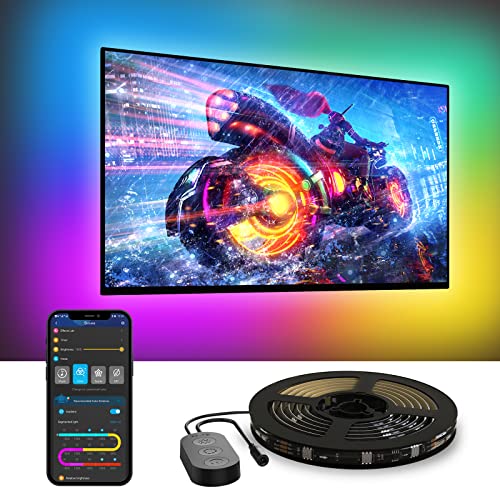
| Advanced Color Dynamics | Power Type: Adapter powered (included) — requires 2.4 GHz Wi‑Fi for smart features | Color Capability: RGBIC (multi-color segmentation) | App Control: Govee Home app (Bluetooth/Wi‑Fi) | VIEW LATEST PRICE | Our Analysis |
| Bluetooth RGBWW LED TV Backlight for 50–55″ with App |
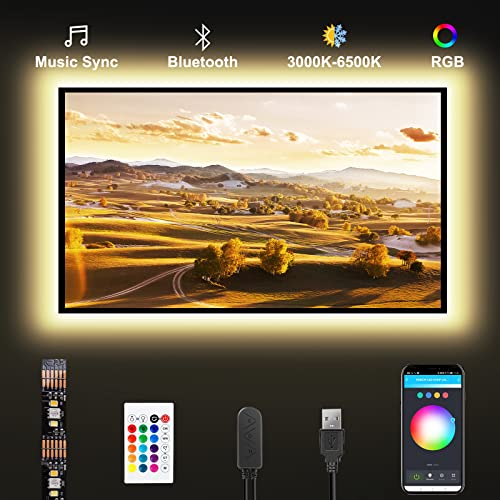
| Best for Tunable Whites | Power Type: USB powered (5V/1A) | Color Capability: RGB + Tunable White (2700K–6500K) | App Control: Tuya / Smart Life app via Bluetooth | VIEW LATEST PRICE | Our Analysis |
More Details on Our Top Picks
20FT RGB TV LED Backlight Strip with Remote
Should you want a simple, plug-and-play backlight that syncs to music and fits TVs from 32″ to 80″, the 20 ft FT RGB TV LED strip is a great pick — it’s USB-powered, uses bright 5050 LEDs, and gives you app or remote control for instant color and music-reactive effects. You’ll stick the single-roll strip with double-sided tape to your TV or backdrop, connect to a USB port, and choose colors or 21 responsive music-sync modes via the Mohuan app or 24-key remote. It’s ideal for gaming, parties, and reducing eye strain; just use indoors and contact support should the need arise.
- Power Type:USB powered (5V)
- Color Capability:RGB (color changing)
- App Control:Mohuan LED app control
- Music Sync:Built-in high‑sensitivity microphone for music sync
- Adhesive Installation:Double‑sided adhesive tape (peel‑and‑stick)
- TV Size / Length Target:20 ft — fits 32–80″ TVs
- Additional Feature:24-key remote included
- Additional Feature:Double-sided adhesive tape
- Additional Feature:USB-powered portability
Philips Hue 75″ White & Color Ambiance Light Strip
Should you want immersive, color-accurate backlighting for a 75″ TV, the Philips Hue 75″ White & Color Ambiance light strip is a top pick—especially should you already use Hue products. You get a 75″ smart LED strip with mounting brackets that bend around corners and attach neatly to your TV. It delivers warm-to-cool white plus millions of colors for gaming, movies, and music. To sync with on-screen content you’ll need a Hue Bridge and Hue Sync Box (sold separately); the app customizes reactions. Voice control works via the Hue app and integrates with Alexa and Google Assistant for hands-free adjustments.
- Power Type:Requires external power via included adapter (mains) / Hue Bridge ecosystem (75″ strip typically powered by adapter)
- Color Capability:White & Color Ambiance (millions of colors + tunable white)
- App Control:Hue app control (requires Hue Bridge)
- Music Sync:Content sync via Hue Sync Box (for on‑screen/music sync; Hue Bridge required)
- Adhesive Installation:Mounting brackets for attaching to TV (adhesive/brackets)
- TV Size / Length Target:75″ strip — designed for 75″ TVs
- Additional Feature:Requires Hue Bridge
- Additional Feature:Includes mounting brackets
- Additional Feature:Voice assistant compatible
20ft RGB LED TV Backlight Strip with Remote
In case you want an easy, budget-friendly way to add lively backlighting to TVs from 32″ to 80″, this 20 ft RGB LED strip with remote is ideal—its USB power and peel‑and‑stick backing let you set it up on TVs, monitors, or gaming rigs in minutes. You’ll find 5050 LEDs (20/m) that aren’t waterproof, so use them in dry indoor spots. Control via the included 24‑key remote or Mohuan app for brightness, timing, and presets. The high‑sensitivity music sensor offers 21 rhythm modes for synced effects. It’s great for gaming, movies, and parties; technical support is available should you require help.
- Power Type:USB powered (5V)
- Color Capability:RGB (color changing)
- App Control:Mohuan LED app control
- Music Sync:Built-in high‑sensitivity microphone for music sync
- Adhesive Installation:Peel‑and‑stick adhesive backing
- TV Size / Length Target:20 ft (6 m) — fits 32–80″ TVs
- Additional Feature:24-key remote included
- Additional Feature:Peel-and-stick backing
- Additional Feature:Scheduled timing function
Govee RGBIC TV LED Backlight Strip for 55–65″ TVs
In case you want lively, multi-color effects that match your shows and music, the Govee RGBIC TV LED Backlight for 55–65″ TVs is a strong pick thanks to its RGBIC color segmentation and built-in mic for real-time music sync. You’ll get a 12.5 ft strip that wraps four sides of compatible TVs, flexible mounting, and cable clips to keep it neat. Use the Govee Home App over 2.4 GHz Wi‑Fi or Bluetooth, choose from 99+ scene modes and 11 music modes, or control lights with Alexa/Google Assistant. Installation is simple and the included adapter gets you started fast.
- Power Type:Adapter powered (included) — requires 2.4 GHz Wi‑Fi for smart features
- Color Capability:RGBIC (multi-color segmentation)
- App Control:Govee Home app (Bluetooth/Wi‑Fi)
- Music Sync:Built‑in microphone for real‑time music sync (11 music modes)
- Adhesive Installation:Flexible strip with cable clips recommended (adhesive mounting)
- TV Size / Length Target:12.5 ft — designed for 55–65″ TVs
- Additional Feature:RGBIC color segmentation
- Additional Feature:99+ preset scenes
- Additional Feature:2.4 GHz Wi‑Fi required
Bluetooth RGBWW LED TV Backlight for 50–55″ with App
In case you want a versatile backlight that gives you both vivid RGB colors and warm-to-cool white for comfortable long viewing sessions, this Bluetooth RGBWW strip for 50–55″ TVs is a great fit—its four-piece layout and app control make it simple to set up and tweak to match movies, games, or ambient lighting. You get RGB plus tunable white (2700–6500K), 16 million colors, brightness control, scene modes, timers, and music sync via a built-in mic. The four flexible strips (2×3.6 ft, 2×1.97 ft) connect with wires and stick with strong adhesive. Power via 5V/1A USB; use a phone charger when needed.
- Power Type:USB powered (5V/1A)
- Color Capability:RGB + Tunable White (2700K–6500K)
- App Control:Tuya / Smart Life app via Bluetooth
- Music Sync:Built‑in microphone for music sync
- Adhesive Installation:Strong adhesive tape with flexible wire connectors for four strips
- TV Size / Length Target:11.14 ft (four strips) — designed for 50–55″ TVs
- Additional Feature:Tunable white 2700–6500K
- Additional Feature:RF remote (no pointing)
- Additional Feature:Four-strip modular design
Factors to Consider When Choosing TV Light Strip Sync
While you’re picking a TV light strip sync, focus initially on sync accuracy and the lighting technology so colors match onscreen action in real time. Check compatibility requirements and control options to make sure the system works with your TV, apps, and devices. Also consider installation flexibility—how the strip mounts, its length, and whether you can reposition or expand it later.
Sync Accuracy
Although different setups can seem similar at a glance, sync accuracy comes down to how quickly and consistently your system converts audio or video events into LED output. You’ll want high refresh/update rates so lighting reacts with minimal lag; more updates per second reduce perceptible delay. On-device processing latency—from microphone or HDMI/frame-capture input to LED output—directly determines how closely lights match real-time action. Prefer wired or local-processing arrangements whenever possible, since wireless delays and network congestion introduce variable latency. Decide between frame-capture and microphone-based sync: frame-capture matches on-screen color precisely, while mic-based systems can lag or misinterpret visuals. Finally, use calibration options (adjustable audio delay, sensitivity, phase) to compensate for system-specific delays so the lights feel aligned.
Lighting Technology
You’ve looked at sync accuracy; now pick lighting hardware that can actually deliver that performance. Choose between RGB and RGBW/RGBWW: RGB gives millions of colors, but RGBW or RGBWW add dedicated white diodes for truer whites and softer pastels. Favor 5050-sized LEDs with higher density (around 20 LEDs/m) to avoid visible dotting and get uniform brightness. Decide whether you need addressable (RGBIC) strips for segment-level, multi-color effects versus non-addressable strips that show one color across the whole strip. Check tunable-white ranges (for example 2700–6500K) so you can match room lighting and reduce eye strain. Finally, evaluate music/sync hardware: built-in mics or external sync boxes and their placement dictate responsiveness and accuracy.
Compatibility Requirements
Because a great sync setup hinges on fit and connectivity, start matching the strip’s length, segmenting, power, control, sync method, and mounting to your TV and home network. Measure your TV perimeter and choose a single long strip or multiple shorter strips with adequate segments for four-sided coverage. Confirm the power interface—USB 5V, DC adapter, or battery—and check voltage/amperage (e.g., 5V/1A) against available outlets or TV USB output. Pick a control type you’ll use: Wi‑Fi, Bluetooth, RF remote, or app, and note whether your smart features require 2.4 GHz. Verify the sync method: built‑in mic, app audio analysis, or external sync box for screen content. Finally, choose adhesive or mounting brackets compatible with the TV’s back surface.
Installation Flexibility
Planning installation means considering beyond just length and color — you’ll want a strip that fits your TV shape, power access, and mounting surfaces without awkward bends or visible cables. Check strip length and segmentation so it covers all sides and any backdrop without gaps or overlap. Prefer flexible connectors or multiple shorter segments for neat corner routing and to avoid sharp bends that damage LEDs. Match the power option (USB, adapter, or battery) to available outlets and plan discreet cable management behind the TV. Look for strong adhesive tape, brackets, or clips to secure the strip to different surfaces. Finally, confirm whether four-sided installation is supported or whether placement is limited to a single roll.
Control Options
While choosing a TV light strip, prioritize flexible control methods so you can still operate the lights in case one option fails—look for app, physical remote, and onboard buttons. You’ll want strips that support multiple control paths so a network outage or lost remote doesn’t leave you in the dark. Check whether the app uses 2.4 GHz Wi‑Fi, Bluetooth, or local-only links: Wi‑Fi lets you control remotely and share across devices, Bluetooth limits range and pairing, and local-only avoids internet dependence. Confirm voice assistant compatibility and whether a hub or bridge is required. Inspect remotes for IR versus RF range and available presets, brightness, and color shortcuts. Finally, pick systems with scheduling, timers, and automation to integrate routines and sync with other devices.
Power Source Needs
Control options matter, but they won’t help provided the lights don’t have a steady power feed—so you should next check the strip’s connector type, voltage, and current requirements to match whatever you’ll plug into (TV USB, wall adapter, or power bank). Verify common 5V USB compatibility and confirm the required amperage (1A, 2A, etc.) so your source can deliver full brightness and effects. For whole‑TV multi‑segment or longer runs, total power draw rises—plan for higher current or an external adapter rather than a single low‑power USB port. In case controllers or mics need continuous power, avoid battery packs that auto‑sleep or cut out during playback.
Music Sensitivity
Because your lights only look as good as the audio they hear, check how the sync system senses music: mic type and placement, available beat‑analysis modes, latency, and whether you can tweak sensitivity or split frequencies all affect how accurately the strip reacts to bass, mids, and treble. You’ll want a high‑sensitivity microphone in case the audio source is quiet or the mic sits farther from speakers, but placing it near the sound improves capture. Compare basic beat‑reactive modes with multi‑mode rhythm analysis to get varied patterns. Prioritize low latency for tight visual timing; noticeable lag ruins immersion. Adjustable gain or sensitivity prevents false triggers across soft dialogue and loud tracks. Frequency‑specific analysis that separates bass, midrange, and treble yields more precise, color‑segmented effects.
Build Durability
Good audio sensing won’t help provided the strip falls off, cracks, or shorts after a few months, so you should weigh build durability alongside sound performance. Check adhesive quality and backing material—strong double‑sided tape or reinforced mounting clips prevent sagging on vertical surfaces. Inspect the substrate and coating for flexibility and tear resistance; repeated bending around corners can crack LEDs or sever traces. Make certain connectors and solder joints are well‑insulated and strain‑relieved, since exposed or weak connections fail under handling. Prefer strips with a protective silicone or epoxy layer for abrasion resistance, appreciating thicker coatings can slightly reduce brightness. Finally, verify the power cable and controller housing are sturdy and heat‑rated—poor wiring or cheap plastics degrade with continuous operation and cause premature failure.
