

Should you’re upgrading for CenturyLink fiber in 2026, pick a router that won’t throttle your connection or leave holes in your network security. Look for gigabit or multi‑gig WAN/SFP, strong NAT throughput, VLAN/PPPoE and IPv6 support, plus Wi‑Fi 6/6E and WPA3 should you want top wireless speeds and future proofing. I’ll outline solid, fiber‑ready options and what to watch for so you can choose with confidence.
| Centurylink C3000A Wireless DSL Modem Router (Renewed) |

| Budget-Friendly Pick | Internet Type Compatibility: DSL (VDSL2 / ADSL2+) | Wireless Bands: Dual-band (2.4 GHz + 5 GHz) | Wi‑Fi Standard / Generation: 802.11ac | VIEW LATEST PRICE | Our Analysis |
| ZYXEL C3510XZ Gigabit Fiber Gateway Modem/Router |

| Best for Fiber | Internet Type Compatibility: Fiber only (not compatible with DSL) | Wireless Bands: Dual-band (2.4 GHz + 5 GHz) | Wi‑Fi Standard / Generation: WiFi 6 (802.11ax) — backwards compatible | VIEW LATEST PRICE | Our Analysis |
| CenturyLink C4000BZ Modem Router 2023 Modem Bright Speed |

| Best Performance | Internet Type Compatibility: DSL (ADSL / VDSL up to 17a) | Wireless Bands: Dual-band (600 Mbps + 2400 Mbps aggregate) | Wi‑Fi Standard / Generation: 802.11ac | VIEW LATEST PRICE | Our Analysis |
| C4000BG CenturyLink Bonded Line Wi Fi DSL Router |

| Best for Streaming | Internet Type Compatibility: DSL (supports ADSL and VDSL up to 17a; bonded line) | Wireless Bands: Dual-band (600 + 2400 Mbps aggregate) | Wi‑Fi Standard / Generation: 802.11ac | VIEW LATEST PRICE | Our Analysis |
| ZyXEL C3000Z Dual-Band 802.11b/g/n Gigabit Modem for CenturyLink (Renewed) |
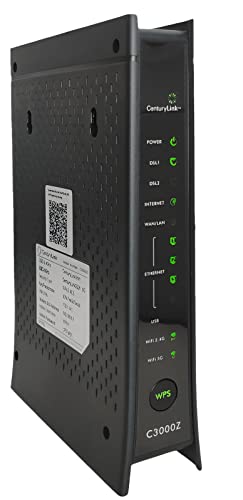
| Best for VDSL/Bonding | Internet Type Compatibility: DSL (Bonded VDSL2 with vectoring; VDSL2 35B) | Wireless Bands: Dual-band (AC2200: 2.4 GHz + 5 GHz) | Wi‑Fi Standard / Generation: 802.11ac (AC2200) | VIEW LATEST PRICE | Our Analysis |
More Details on Our Top Picks
Centurylink C3000A Wireless DSL Modem Router (Renewed)
Should you want a cost‑effective, ISP‑compatible modem router that handles VDSL2/ADSL2+ and modern dual‑band Wi‑Fi, the Centurylink C3000A (renewed) is a strong pick—especially should you’re looking to avoid monthly equipment rental while supporting gaming, HD streaming, and multiple devices. You’ll get 802.11ac dual‑band with smart band steering, WPA3 security, EasyConnect onboarding, and EasyMesh expansion. Four Gigabit Ethernet ports cover wired needs, while the integrated VDSL2/ADSL2+ modem keeps setup simple with major ISPs. It’s renewed and Amazon‑inspected, eligible for replacement/refund, and rated 3.8/5 from 177 reviews—solid value should you desire reliable, budget‑friendly performance.
- Internet Type Compatibility:DSL (VDSL2 / ADSL2+)
- Wireless Bands:Dual-band (2.4 GHz + 5 GHz)
- Wi‑Fi Standard / Generation:802.11ac
- Gigabit Ethernet Ports:Four Gigabit Ethernet ports
- Security / Encryption Support:WPA3, built-in firewall, EasyConnect
- Designed for High‑Bandwidth Use Cases:Designed for gaming, HD streaming, multi-device usage
- Additional Feature:Integrated VDSL2/ADSL2+ modem
- Additional Feature:EasyMesh support
- Additional Feature:Four Gigabit ports
ZYXEL C3510XZ Gigabit Fiber Gateway Modem/Router
Should you want a fiber-only gateway that prioritizes fast wired connections, the ZYXEL C3510XZ is a solid choice — it gives you six gigabit Ethernet ports for multiple high-speed devices while handling CenturyLink fiber natively. You’ll get WiFi 6 dual-band performance with backward compatibility to a/b/g/n/ac, and you can run up to four SSIDs for guest or IoT segmentation. It supports WPA2-PSK security, IPv4 and IPv6, automatic channel selection, and WPS for easy setup. Note: it’s designed exclusively for fiber and won’t work with DSL, so confirm your CenturyLink plan before buying.
- Internet Type Compatibility:Fiber only (not compatible with DSL)
- Wireless Bands:Dual-band (2.4 GHz + 5 GHz)
- Wi‑Fi Standard / Generation:WiFi 6 (802.11ax) — backwards compatible
- Gigabit Ethernet Ports:Six Gigabit Ethernet ports
- Security / Encryption Support:WPA2-PSK, IPv4/IPv6 compliant
- Designed for High‑Bandwidth Use Cases:Designed for high-speed fiber broadband — modern high-throughput use
- Additional Feature:Six Gigabit Ethernet ports
- Additional Feature:WiFi 6 (802.11ax)
- Additional Feature:Fiber-only compatibility
CenturyLink C4000BZ Modem Router 2023 Modem Bright Speed
Should you need a plug-and-play modem router that boosts Wi‑Fi for 4K streaming, gaming, and video calls, the CenturyLink C4000BZ (2023 “Modem Bright Speed”) is a strong pick—its combined up to 3 Gbps throughput (600 Mbps + 2400 Mbps), 160 MHz channel support, and 1024‑QAM make the most of compatible devices, while the dual‑core networking processor keeps wired and WAN‑to‑LAN performance snappy. You’ll get greatly improved performance on compatible phones and laptops despite the 802.11ac label. It supports all ADSL/VDSL profiles up to 17a, so it works in mixed environments and simplifies upgrades.
- Internet Type Compatibility:DSL (ADSL / VDSL up to 17a)
- Wireless Bands:Dual-band (600 Mbps + 2400 Mbps aggregate)
- Wi‑Fi Standard / Generation:802.11ac
- Gigabit Ethernet Ports:(Implied gigabit-capable LAN ports for high throughput) — gateway-class gigabit LAN
- Security / Encryption Support:(Includes modern security features implied by gateway model; supports WPA standards typical for 802.11ac) — processor/firmware optimized for secure networking
- Designed for High‑Bandwidth Use Cases:Targeted at 4K streaming, gaming, video conferencing (up to 3 Gbps aggregate)
- Additional Feature:160 MHz channel support
- Additional Feature:Dual-core networking processor
- Additional Feature:1024‑QAM modulation
C4000BG CenturyLink Bonded Line Wi Fi DSL Router
Should you need gigabit-capable wireless for multiroom 4K streaming and fast mobile devices, the C4000BG delivers—offering up to 3 Gbps aggregate throughput (600 + 2400 Mbps) with 160 MHz channel support and 1024‑QAM to boost data rates over standard 256‑QAM. You’ll get ultra-fast 802.11ac Wi‑Fi optimized for high-bandwidth tasks, with 160 MHz channels doubling throughput versus 80 MHz for compatible clients. The router supports all ADSL and VDSL profiles up to 17a and provides one SSID for whole‑home coverage. It’s ideal should you desire gigabit wireless performance for laptops, phones, and multiroom 4K streaming.
- Internet Type Compatibility:DSL (supports ADSL and VDSL up to 17a; bonded line)
- Wireless Bands:Dual-band (600 + 2400 Mbps aggregate)
- Wi‑Fi Standard / Generation:802.11ac
- Gigabit Ethernet Ports:(Implied gigabit-capable LAN ports for gigabit wireless experience) — gateway-class gigabit LAN
- Security / Encryption Support:(Includes standard WPA security for 802.11ac; firewall and typical gateway protections implied)
- Designed for High‑Bandwidth Use Cases:Targeted at 4K streaming and gigabit-capable wireless for devices
- Additional Feature:Bonded-line DSL support
- Additional Feature:Single whole-home SSID
- Additional Feature:1024‑QAM modulation
ZyXEL C3000Z Dual-Band 802.11b/g/n Gigabit Modem for CenturyLink (Renewed)
Should you need a CenturyLink-compatible modem that augments VDSL2 performance for multi-device homes, the ZyXEL C3000Z is a strong choice — it supports bonded VDSL2 with vectoring to extend range and raise throughput while offering dual-band AC2200 Wi‑Fi for fast 2.4 GHz and 5 GHz connections. You’ll get VDSL2 35B support, a dedicated Gigabit WAN that doubles as a fifth LAN port in DSL mode, and high-powered APs providing up to 1.7 Gbps on 5 GHz and 450 Mbps on 2.4 GHz. Security includes NAT and SPI firewalls plus traffic protection. Renewed condition keeps costs down while maintaining CenturyLink compatibility.
- Internet Type Compatibility:DSL (Bonded VDSL2 with vectoring; VDSL2 35B)
- Wireless Bands:Dual-band (AC2200: 2.4 GHz + 5 GHz)
- Wi‑Fi Standard / Generation:802.11ac (AC2200)
- Gigabit Ethernet Ports:Dedicated Gigabit Ethernet WAN + functions as 5th Gigabit LAN port in DSL mode
- Security / Encryption Support:Dual Ethernet firewalls (NAT and SPI); enhanced WAN-to-LAN traffic protection
- Designed for High‑Bandwidth Use Cases:Optimized for homes with many Wi‑Fi devices; vectoring/bonding increases performance and range
- Additional Feature:VDSL2 bonding with vectoring
- Additional Feature:AC2200 combined Wi‑Fi
- Additional Feature:Dedicated Gigabit WAN port
Factors to Consider When Choosing a Router For Centurylink Fiber
Upon selecting a router for CenturyLink Fiber, you’ll want to match the device to your internet connection type and make certain it supports the latest Wi‑Fi standards for best coverage and compatibility. Check throughput and advertised speeds so the router can handle your plan, and confirm it has enough wired Gigabit ports for any wired devices. Finally, be certain it offers strong security and modern encryption to protect your network.
Internet Connection Type
Connection type matters because CenturyLink’s fiber options can hand off your internet in different ways, and each requires a matching router setup — true fiber-to-the-home (FTTH) uses an ONT with an Ethernet WAN (not a DSL modem), so you’ll need a router that supports a gigabit Ethernet WAN or SFP and can handle your provisioned speed, IPv6, and any ISP-specific settings like VLAN tags or PPPoE. Confirm whether your service is FTTH or another topology so you pick the right interface. Check the provisioned WAN speed and choose a router with sufficient WAN port and CPU throughput to avoid bottlenecks. Verify IPv6 support and whether CenturyLink permits customer-owned routers and requires VLAN tagging or PPPoE so you can configure the device correctly.
Wi‑Fi Standard Support
Pick a router with Wi‑Fi 6 (802.11ax) support to get better efficiency, lower latency, and stronger multi‑device performance than Wi‑Fi 5; also prefer dual‑ or tri‑band models with 80/160 MHz 5 GHz channels, 1024‑QAM, MU‑MIMO, and OFDMA so you’ll be able to maximize throughput and simultaneous connections while enjoying modern features like WPA3 and band steering for safer, easier management. Beyond that, choose dual‑band when you have mainly mixed devices, or tri‑band when you need to isolate heavy 5 GHz traffic and reduce congestion. Confirm 80/160 MHz channel support for peak-capable clients, and verify MU‑MIMO and OFDMA for efficient multi‑client handling. Finally, prioritize WPA3 and easy onboarding to keep your network secure and simple to manage.
Throughput And Speeds
You’ve picked a Wi‑Fi 6 router for better wireless efficiency; now make sure its real‑world throughput and port speeds won’t hold back your CenturyLink fiber plan. Match WAN and LAN port speeds (gigabit or multi‑gig) to your ISP tier so the Ethernet and backhaul don’t bottleneck a 1 Gbps+ connection. Favor routers supporting wider channels (80/160 MHz) and higher QAM to reach multi‑hundred‑Mbps or multi‑Gbps wireless rates on modern clients. Check total concurrent throughput—CPU and chipset routing/NAT performance—not just peak wireless figures, to guarantee sustained WAN‑to‑LAN speeds under load. Consider spatial streams and MU‑MIMO/OFDMA for higher aggregate throughput with many devices. Finally, verify firmware QoS and hardware offloads (NAT acceleration, encryption) to safeguard performance for VPNs and gaming.
Wired Port Availability
Plan your wired layout around the router’s ports so your CenturyLink fiber plan isn’t limited through physical connections. Count on 4–6 true Gigabit LAN ports (1000 Mbps, auto-negotiation, full duplex) to attach PCs, TVs, consoles, and a switch without extra gear. Confirm the WAN port is Gigabit-capable (1 Gbps or higher) so wired devices can use full fiber throughput.
If you need higher local speeds, pick a router with a dedicated multi-gig (2.5G/5G) Ethernet port for a NAS, gaming PC, or multi-gig switch. For servers or storage, verify LAN link aggregation (LACP) is supported to combine ports for greater throughput or redundancy. These port features prevent wired bottlenecks and future-proof your home network.
Security And Encryption
Because your CenturyLink fiber connection can carry lots of data fast, you’ll want a router that locks down access and keeps encryption current — look for WPA3 support, a built‑in firewall with stateful packet inspection, and guest‑network isolation to limit exposure from untrusted devices. You should also prefer routers that support secure onboarding standards (like EasyConnect/Device Provisioning Protocol alternatives) to avoid weak initial setups. Confirm the vendor provides regular firmware updates and an auto‑update option so vulnerabilities and encryption standards stay current. Check for IPv6 security features and strong VPN passthrough or an integrated VPN server for encrypted remote access. Prioritize models with clear security settings and logs so you can monitor and respond to suspicious activity quickly.
Mesh And Expansion Options
Whenever you want to blanket your home with consistent CenturyLink fiber speeds, pick a router that’s built for mesh expansion and seamless roaming so devices don’t drop or hit slow zones as you move around. Choose systems supporting mesh protocols (EasyMesh, vendor mesh, or Wi‑Fi EasyConnect) or documented satellite compatibility so you avoid multiple SSIDs or fiddly bridges. Prefer dual‑band or tri‑band mesh with band steering and automatic backhaul selection to optimize node‑to‑node and client throughput. Confirm centralized management, 802.11k/v/r roaming, and unified SSID/credentials to prevent handoff gaps. Check the maximum supported nodes and wired Ethernet backhaul for reliability and aggregated bandwidth. Finally, verify firmware update policies and mesh security patches to maintain interoperability and fix performance or vulnerability issues.
ISP Compatibility Requirements
In case you pick a router for CenturyLink fiber, make sure it supports a fiber-ready WAN (Ethernet WAN or SFP), the right WAN authentication (DHCP, PPPoE, or static), and VLAN tagging provided your ISP requires a specific VLAN ID; also confirm IPv4/IPv6 compatibility and that the router’s port speeds and maximum throughput meet or exceed your subscribed plan so the device never becomes the bottleneck. Beyond that, verify the router can be configured for VLAN tagging on the WAN port in the event CenturyLink or your regional provider mandates a VLAN ID. Check supported authentication methods against your service paperwork. Confirm dual-stack IPv4/IPv6 or IPv6-only support as required. Finally, match Gigabit or multi-gig port speeds and verified throughput to your plan to avoid throttling.
Future‑Proof Features
Longevity matters whenever you pick a router for CenturyLink fiber, so choose hardware that supports Wi‑Fi 6, multi‑gig Ethernet or link aggregation, and modern security like WPA3 and automatic firmware updates to keep pace with faster plans and developing threats. You’ll want tri‑band radios or support for 160 MHz channels plus MU‑MIMO and OFDMA to serve many concurrent clients and high‑bandwidth apps. Pick devices with multi‑core networking CPUs and ample RAM so QoS, VPNs, and traffic shaping don’t create bottlenecks. Multi‑gig ports (2.5 Gbps or higher) or link aggregation are essential should you expect speeds above 1 Gbps. Finally, prioritize secure onboarding, a strong firewall/NAT, and reliable auto‑update mechanisms to maintain performance and safety over time.
