

You’ll want hardwired smoke detectors that won’t fail while you’re asleep or away, blending solid 120V power with reliable battery backup and smart sensing to cut false alarms. Look for models with true interconnectivity, tamper-resistant mounts, side-load batteries, and low-frequency tones for wakeability. I’ll walk you through top 2026 options, what specs matter, and key trade-offs so you can pick the right setup for your home.
| First Alert 9120B Hardwired Smoke Detector 6-Pack |
| Best for Multi-Room Coverage | Power type: Hardwired (120V) with battery backup | Interconnectivity: Interconnects with compatible BRK/First Alert alarms | Backup battery access: Side-load, easy-access battery drawer | VIEW LATEST PRICE | Read Our Analysis |
| Kidde Hardwired Smoke & CO Detector with Battery Backup |

| Best Voice-Alert Combo | Power type: Hardwired (120V) with 2×AA battery backup | Interconnectivity: Interconnects up to 24 Kidde devices (compatible KN-COSM-IBA) | Backup battery access: Uses accessible 2×AA battery backup | VIEW LATEST PRICE | Read Our Analysis |
| BRK First Alert Hardwired Smoke Alarm 3-Pack |

| Best for Nuisance Reduction | Power type: Hardwired (120V) with battery backup | Interconnectivity: Interconnects with compatible BRK/First Alert alarms (early warning interconnect) | Backup battery access: Battery backup (quick-connect installation noted) | VIEW LATEST PRICE | Read Our Analysis |
| First Alert BRK SC7010B-3 Smoke & CO Detector 3-Pack |
| Best for Hearing-Impaired | Power type: Hardwired (120V) with 2×AA battery backup | Interconnectivity: Interconnects with compatible First Alert/BRK units (intuitive latching) | Backup battery access: Uses 2×AA battery backup; low-battery latch visual indicator | VIEW LATEST PRICE | Read Our Analysis |
| First Alert Hardwired Smoke & Carbon Monoxide Alarm (2-Pack) |
| Best Dual-Function Choice | Power type: Hardwired (120V) with battery backup | Interconnectivity: Interconnects with compatible BRK/First Alert detectors | Backup battery access: Side-load battery compartment for convenient replacement | VIEW LATEST PRICE | Read Our Analysis |
More Details on Our Top Picks
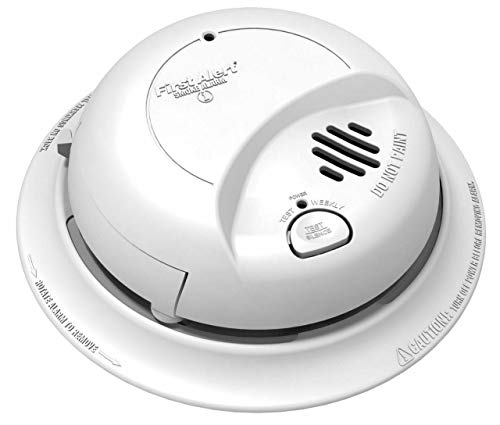
First Alert 9120B Hardwired Smoke Detector 6-Pack
Should you want reliable, whole-home protection, the Primary Alert 9120B 6-pack is a strong choice—its hardwired design with battery backup keeps monitoring active during outages, and the ionization sensors quickly detect fast, flaming fires so bedrooms and every level stay covered at the moment it counts. You get six white units with universal mounting and tamper-resistant locking brackets, an easy side-load battery drawer, and an 85 dB T3 alarm pattern. Linkable with other BRK/First Alert detectors for whole-house alerts, they meet UL standards. Watch connections carefully—loose neutral wiring in junction boxes can cause malfunctions.
- Power type:Hardwired (120V) with battery backup
- Interconnectivity:Interconnects with compatible BRK/First Alert alarms
- Backup battery access:Side-load, easy-access battery drawer
- Alarm loudness:85 dB
- Combination detection (smoke and/or CO):Smoke only (ionization) — not CO
- Tamper / installation features:Tamper-resistant locking brackets; universal mounting brackets
- Additional Feature:Ionization smoke sensing
- Additional Feature:T3 alarm pattern
- Additional Feature:Tamper-resistant brackets
Kidde Hardwired Smoke & CO Detector with Battery Backup
Should you want a single unit that reliably covers both smoke and carbon monoxide risks, the Kidde hardwired Smoke & CO detector with battery backup is an excellent choice for homes that value continuous protection. You get a combo smoke/CO detector with ionization sensing for invisible particles and a voice alarm that clearly announces “Fire! Fire!”, “Warning! Carbon Monoxide!” and “Low Battery!” Its 85 dB alarm, Test-Hush feature (silences ~9 minutes), and 120 VAC primary power with two AA backup batteries keep protection continuous during outages. It interconnects with up to 24 Kidde devices, carries UL certification, a tamper-resistant design, and a 10-year limited warranty.
- Power type:Hardwired (120V) with 2×AA battery backup
- Interconnectivity:Interconnects up to 24 Kidde devices (compatible KN-COSM-IBA)
- Backup battery access:Uses accessible 2×AA battery backup
- Alarm loudness:85 dB (plus voice annunciation)
- Combination detection (smoke and/or CO):Smoke + Carbon Monoxide (combo unit)
- Tamper / installation features:Tamper-resistant technology; hardwired mounting
- Additional Feature:Voice alarm prompts
- Additional Feature:Test‑Hush temporary silence
- Additional Feature:Interconnects up to 24
BRK First Alert Hardwired Smoke Alarm 3-Pack
In case you want reliable, networked protection across multiple rooms, the BRK First Alert Hardwired Smoke Alarm 3-Pack is a smart choice—it’s designed for homeowners who value prompt, whole-house alerts. You’ll get three SMI100-AC interconnect hardwire detectors with battery backup, so one alarm triggers all compatible units and the indicator shows which started. Precision Detection tech meets new industry standards, reducing cooking nuisance alarms while providing earlier fire warnings. Hardwire installation keeps constant power; the battery backup maintains protection during outages. A Quick Connect Plug speeds installation without rewiring, making upgrades straightforward and dependable.
- Power type:Hardwired (120V) with battery backup
- Interconnectivity:Interconnects with compatible BRK/First Alert alarms (early warning interconnect)
- Backup battery access:Battery backup (quick-connect installation noted)
- Alarm loudness:85 dB (standard hardwired alarm level implied)
- Combination detection (smoke and/or CO):Smoke only (advanced sensing)
- Tamper / installation features:Quick Connect Plug for easy installation (no rewiring)
- Additional Feature:Precision Detection sensing
- Additional Feature:Reduces cooking nuisance
- Additional Feature:Quick Connect Plug
First Alert BRK SC7010B-3 Smoke & CO Detector 3-Pack
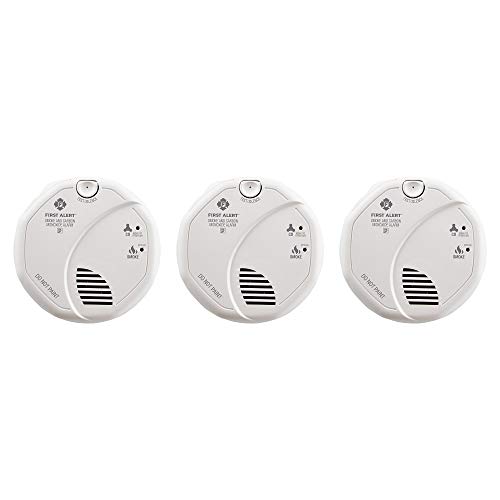
Provided you need a reliable, job-site friendly combo detector that won’t leave you in the dark during a power outage, the First Alert BRK SC7010B-3 is a strong pick: its 120V hardwire setup with dual AA battery backup and low-battery latch keeps protection continuous, while photoelectric smoke and electrochemical CO sensors cover both common risks. You’ll get three units with an 85-decibel alarm and a lower-frequency horn that helps older adults hear alerts. Installation is straightforward for faster job-site turnarounds, and the silence/test button plus latching alarm that recalls the initiating unit make maintenance and troubleshooting simple.
- Power type:Hardwired (120V) with 2×AA battery backup
- Interconnectivity:Interconnects with compatible First Alert/BRK units (intuitive latching)
- Backup battery access:Uses 2×AA battery backup; low-battery latch visual indicator
- Alarm loudness:85 dB (lower-frequency horn option)
- Combination detection (smoke and/or CO):Combination smoke (photoelectric) and CO (electrochemical)
- Tamper / installation features:Easy-to-install design for job sites; latching for unit ID
- Additional Feature:Photoelectric smoke sensing
- Additional Feature:Low‑frequency horn
- Additional Feature:Low‑battery visual latch
First Alert Hardwired Smoke & Carbon Monoxide Alarm (2-Pack)
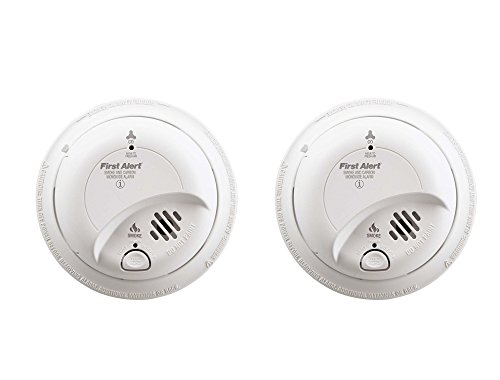
Should you want a reliable, networked solution for both smoke and carbon monoxide protection, the First Alert SC-9120B hardwired 2-pack fits the bill with its dual-function sensors and battery backup so your home stays monitored during outages. You’ll get hardwired primary power with side-load battery compartments for easy replacement and uninterrupted monitoring in case power fails. A single test/silence button simplifies checks and nuisance-silencing. Indicator lights tell you whether smoke or CO triggered the alarm. You can interconnect these with compatible BRK or First Alert detectors to create a coordinated alarm network across your home for faster, clearer alerts.
- Power type:Hardwired (120V) with battery backup
- Interconnectivity:Interconnects with compatible BRK/First Alert detectors
- Backup battery access:Side-load battery compartment for convenient replacement
- Alarm loudness:85 dB (standard for these models)
- Combination detection (smoke and/or CO):Combination smoke and CO
- Tamper / installation features:Side-load battery and compatibility for straightforward hardwired installation
- Additional Feature:Alarm type indicator lights
- Additional Feature:Single test/silence button
- Additional Feature:Side-load battery drawer
Factors to Consider When Choosing a Hardwired Smoke Detector
Upon choosing a hardwired smoke detector, weigh the sensing technology—photoelectric for smoldering fires or ionization for fast-flaming ones—so you get the right detection for your home. Check power and backup options, interconnectivity with other alarms or smart systems, and how easy installation and maintenance will be. Also confirm the alarm’s loudness and tone meet your needs for bedrooms, hearing-impaired occupants, and local code.
Sensing Technology Choice
Because different fires produce different particles, choosing the right sensing technology can mean the difference between prompt warning and frequent false alarms. You’ll pick ionization sensors when you want fastest response to small, fast-flaming fires; they catch tiny combustion particles but can misinterpret cooking as danger. Photoelectric sensors favor smoldering, smoky fires, sensing larger particles and usually cutting down nuisance alarms from steam or kitchen odors. Dual-sensor models combine both approaches for broader initial detection across flame-driven and smoldering events. Some manufacturers add precision or multi-criteria algorithms that analyze particle size and rate-of-rise to reduce false triggers. Finally, consider placement: use photoelectric units near kitchens and bedrooms, ionization where fast flames are likelier, and dual or algorithmic units for mixed-risk areas.
Power And Backup
While hardwired detectors rely on 120‑volt household power for day‑to‑day operation, you’ll want a reliable battery backup so the unit keeps protecting you during outages; check that the backup uses common cells (AA or 9V), offers easy side‑load or drawer access for quick replacement, and includes tamper‑resistant or locking compartments to prevent removal. Also confirm the wiring supports interconnection so alarms share both primary and backup signals whenever one triggers. Review manufacturer specs for battery life and recommended replacement intervals, and choose units with clear low‑battery alerts and long standby ratings. Prioritize designs that simplify routine swaps without detaching the detector, and prefer widely available battery types to avoid downtime.
Interconnectivity Options
Look over interconnectivity options carefully, since the manner alarms talk to each other determines whole‑house warning speed and reliability. You’ll want wired interconnectivity so one triggered unit sounds all alarms within milliseconds for full-home notification. Check the maximum devices supported and limits on initiating versus non‑initiating units to avoid overloading the circuit. Verify signaling protocol compatibility—proprietary versus standard three‑wire—so mixed brands or models reliably trigger together. Confirm whether the system uses a dedicated signal wire, power‑limited wiring, or wireless bridging, and plan wiring runs and power capacity accordingly. Finally, consider units with visual indicators or event memory that identify the initiating device to speed response and simplify troubleshooting once an alarm activates.
Installation And Maintenance
Whenever you install hardwired smoke detectors, prioritize compatibility with your home’s 120-volt wiring and a reliable battery-backup so alarms stay active during outages. Choose units with quick-connect plugs or universal mounting brackets to simplify wiring and cut installation time, reducing the risk of loose neutral connections. Pick alarms with side-load or drawer-style battery compartments so you can replace cells without removing the unit. Look for tamper-resistant or locking mounting brackets to prevent accidental dislodging or unauthorized removal. Follow placement guidance: one detector on every level and in each bedroom. Test alarms monthly and replace batteries annually or per the manufacturer’s timeframe. Proper installation and routine maintenance keep your system reliable and minimize false alarms or failures.
Alarm Loudness And Tone
Good installation and upkeep won’t help much provided you can’t hear the alarm when it matters, so next consider loudness and tone. You should choose alarms that produce at least 85 dB at 10 feet—the industry minimum to reliably wake sleeping adults—and test audibility in realistic conditions: closed doors, ambient noise, and during sleep. Pick units with distinct tone patterns (steady, temporal 3/T3, or voice) so you can tell smoke from CO or low-battery alerts. For households with children or older adults, prefer low-frequency or multi-frequency horns (around 520 Hz or mixed) to improve wakeability. Finally, make certain interlinked systems synchronize volume and tone so every alarm across the network sounds at the same level and pattern.
