

You may believe bigger displays mean smarter control, yet the best thermostats balance simplicity with advanced scheduling so you get both. You’ll want models that handle 5‑2, 5‑1‑1 and full 7‑day programs, protect compressors, and keep settings through power hiccups. I’ll show options that fit single‑stage and heat‑pump systems, include easy mounts, and cut energy waste—stick around to see which features matter most for your setup.
| Honeywell Home Programmable Single-Stage Thermostat RTH20B |

| Simple & Reliable | Programmable schedule: 5-2 day programming (also option non-programmable) | Single-stage support: Single-stage (1 heat / 1 cool) | Backlit/large display: Large LCD with backlit display | VIEW LATEST PRICE | Read Our Analysis |
| Honeywell Home RTH7600D 7-Day Programmable Touchscreen Thermostat White |

| Smart Performance | Programmable schedule: 7-day programming (menu-driven) | Single-stage support: Supports single-stage systems (and multistage too) | Backlit/large display: Large backlit touchscreen display | VIEW LATEST PRICE | Read Our Analysis |
| 5-1-1 Programmable Thermostat for Single-Stage Systems |

| Senior-Friendly Precision | Programmable schedule: 5-1-1 day programming (weekdays / Sat / Sun) | Single-stage support: Designed for single-stage HVAC (1 heat / 1 cool) | Backlit/large display: 3″ large clear digital display with white backlight | VIEW LATEST PRICE | Read Our Analysis |
| ELECTECK 5-1-1 Programmable Digital Thermostat (1 Heat/1 Cool) |

| Easy Setup Budget | Programmable schedule: 5-1-1 day programming (weekdays / Sat / Sun) | Single-stage support: Supports single-stage (1 heat / 1 cool) | Backlit/large display: Large LCD with blue backlight (4.5 sq. in.) | VIEW LATEST PRICE | Read Our Analysis |
| Honeywell Home RTH7560E 7-Day Programmable Thermostat |
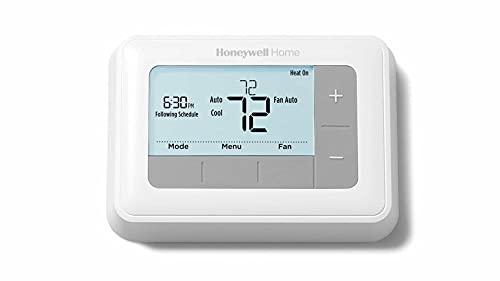
| Flexible & Adaptive | Programmable schedule: 7-day flexible programming (day-to-day or weekend options) | Single-stage support: Supports single-stage systems (typical Honeywell line) | Backlit/large display: Extra-large backlit display | VIEW LATEST PRICE | Read Our Analysis |
More Details on Our Top Picks
Honeywell Home Programmable Single-Stage Thermostat RTH20B
Choose the Honeywell Home RTH20B provided you want a straightforward, budget-friendly programmable thermostat for single-stage systems—its 5-2 day scheduling and clear backlit LCD make daily temperature control simple, and it swaps in easily for older RTH2300/RTH221 models. You’ll set heating or cooling for single-stage systems including 750 mV, hot water, and forced air (gas, oil, electric); avoid electric baseboard heat. The push-button interface, UWP wall plate, and battery power (2 AA) make installation quick. You can opt out of programming, enable filter alerts, and rely on Resideo support with a one-year warranty for peace of mind.
- Programmable schedule:5-2 day programming (also option non-programmable)
- Single-stage support:Single-stage (1 heat / 1 cool)
- Backlit/large display:Large LCD with backlit display
- Battery power option:Battery operated (2 × AA batteries)
- Filter / maintenance reminders:Air filter change reminders available
- Compressor / system protection:Designed for conventional single-stage protection (general compatibility; includes features for system types)
- Additional Feature:Direct replacement for RTH2300/RTH221
- Additional Feature:UWP wall plate included
- Additional Feature:Battery operated (2×AA)
Honeywell Home RTH7600D 7-Day Programmable Touchscreen Thermostat White
Should you want a reliable, programmable thermostat with a clear touchscreen and day-by-day scheduling, the Honeywell Home RTH7600D is made for homes that need precise weekly routines and simple setup. You’ll get a large backlit touchscreen that shows room temperature and set point together, plus a real-time clock that auto-adjusts for Daylight Savings. Program seven days with four periods per day, use temporary or permanent holds, and set home/away temps to save energy. Smart Response learns runtimes for comfort, while compressor-delay protects equipment. Optional alerts warn for filter changes and low batteries. It’s easy to install and suits many system types.
- Programmable schedule:7-day programming (menu-driven)
- Single-stage support:Supports single-stage systems (and multistage too)
- Backlit/large display:Large backlit touchscreen display
- Battery power option:(Includes battery backup/low-battery alert; typically battery-powered backup)
- Filter / maintenance reminders:Optional filter replacement reminder
- Compressor / system protection:Compressor protection delay (multi-minute restart delay)
- Additional Feature:Smart Response Technology
- Additional Feature:Touchscreen interface
- Additional Feature:Daylight savings auto-adjust
5-1-1 Programmable Thermostat for Single-Stage Systems
Should you run a conventional single-stage HVAC system and want precise, easy-to-program temperature control, the Heagstat H705 is a strong pick: it supports one heat and one cool, offers 5-1-1 scheduling with four daily periods, and holds temperature to ±1°F so you’ll get consistent comfort without constant tweaking. You’ll program wake, leave, return, and sleep for weekdays and weekends, set 44–90°F, and view room temp from 41–95°F. It runs on 24VAC or 2 AAA batteries (c-wire needed for heat-only or cool-only), includes compressor delay, filter alerts, calibration, clear 3″ backlit display, and 2-year warranty.
- Programmable schedule:5-1-1 day programming (weekdays / Sat / Sun)
- Single-stage support:Designed for single-stage HVAC (1 heat / 1 cool)
- Backlit/large display:3″ large clear digital display with white backlight
- Battery power option:Dual power: 24VAC or 2 × AAA batteries
- Filter / maintenance reminders:Air filter change reminder included
- Compressor / system protection:5-minute compressor delay protection (optional)
- Additional Feature:Accurate ±1°F control
- Additional Feature:Dual power (24VAC/2×AAA)
- Additional Feature:5-1-1 scheduling format
ELECTECK 5-1-1 Programmable Digital Thermostat (1 Heat/1 Cool)
At the time you want a straightforward, budget-friendly thermostat for a single-stage heating and cooling system, the ELECTECK 5-1-1 is a solid pick — it’s designed for homes with one heat and one cool zone and lets you set separate weekday, Saturday, and Sunday schedules with four daily periods. You’ll get a large 4.5 sq. in. LCD with blue backlight and big tactile buttons, plus ±1° accuracy in Fahrenheit or Celsius. It supports single-stage electric, gas, oil, and heat pump systems (no aux), installs hardwired or with two AAA batteries (no C-wire required), but not for multi-stage, 120/240V baseboard, or RVs.
- Programmable schedule:5-1-1 day programming (weekdays / Sat / Sun)
- Single-stage support:Supports single-stage (1 heat / 1 cool)
- Backlit/large display:Large LCD with blue backlight (4.5 sq. in.)
- Battery power option:Powered by hardwire or 2 × AAA batteries
- Filter / maintenance reminders:Includes reminder (implied by features; typical maintenance alerts)
- Compressor / system protection:5-minute compressor delay protection (implied; standard feature)
- Additional Feature:Large 4.5 sq. in. LCD
- Additional Feature:Big tactile buttons
- Additional Feature:±1° accuracy
Honeywell Home RTH7560E 7-Day Programmable Thermostat
Should you want a flexible weekly schedule and a large, easy-to-read display, the Honeywell Home RTH7560E is a solid choice — it lets you program each day separately (or set weekend-only or one-week schedules) and its extra-large backlit screen shows time, room temperature, and set point at once so you won’t need to hunt through menus. You’ll get Smart Response Learning to preheat or precool so desired temperatures arrive on time, plus program retention during outages. Installation’s straightforward with the UWP mounting system and wiring. It also warns you about low battery and whenever to change filters; the unit comes in white.
- Programmable schedule:7-day flexible programming (day-to-day or weekend options)
- Single-stage support:Supports single-stage systems (typical Honeywell line)
- Backlit/large display:Extra-large backlit display
- Battery power option:Retains program during power outage; includes low-battery signal (works with standard power/battery backup)
- Filter / maintenance reminders:Change reminders for air filter replacement
- Compressor / system protection:Smart Response Learning includes controlled run-time behavior and program memory (provides protection/optimized cycling)
- Additional Feature:Program memory during outages
- Additional Feature:UWP mounting system
- Additional Feature:Smart Response Learning
Factors to Consider When Choosing a Digital Programmable Thermostat
Upon choosing a digital programmable thermostat, you’ll want to check system compatibility and whether the unit supports your HVAC setup. Consider programming flexibility, power requirements, and whether the display and controls suit your day-to-day use. Don’t forget energy-saving features that can lower bills without sacrificing comfort.
System Compatibility
Because your thermostat has to directly talk to your HVAC, you’ll need to verify it supports your exact control type—single- or multi-stage, heat-only, cool-only, or a heat pump with/without auxiliary heat—so it can manage staging and sequencing correctly. Also check voltage and wiring: line-voltage baseboard systems (120–240V) need different thermostats than low-voltage 24VAC or millivolt systems. Verify whether a common “C‑wire” is required for power or advanced features so you won’t be forced to rely on batteries or add wiring. Confirm support for specialized systems like millivolt, hydronic/boiler controls, or gas fireplace interfaces since standard models might not work. For combined or hybrid setups (furnace plus heat pump), make certain the unit understands that exact configuration and control logic.
Programming Flexibility
Once you’ve confirmed the thermostat will communicate correctly with your HVAC, consider how flexible its programming needs to be to match your household routine. Check how many program periods per day it supports (2–4 is common) so you can align comfort and savings with morning, away, evening, and sleep times. Pick multi-day scheduling (7-day, 5‑2, 5‑1‑1) should you want different weekday and weekend profiles or full daily independence. Verify temporary and permanent hold options so vacations or short absences don’t erase your setup. Look for adaptive learning or smart-response algorithms that adjust run-times to hit setpoints on schedule. Finally, confirm the interface is user-friendly—large display, touchscreen, or clear menus—to create and edit multiple schedules easily.
Power Requirements
Should your thermostat doesn’t get the right kind of power, it won’t run the features you expect, so check requirements before you buy. Initially, determine whether the unit needs a common (C) wire for continuous 24VAC or can run on batteries; Wi‑Fi, backlighting, and touchscreens usually require a C‑wire. Verify your HVAC control voltage—most systems use 24VAC, while baseboard heaters use line voltage (120/240V)—because thermostats aren’t interchangeable. Confirm battery backup support, required cell type (AA/AAA), and typical battery life to avoid losing settings. Check for built‑in charging or trickle behaviors so your transformer can handle the load without short‑cycling. For smart units, prioritize steady power (ideally via C‑wire) to keep connectivity, large displays, and learning features functioning.
Display And Controls
Upon choosing a digital programmable thermostat, prioritize a large, backlit display with a clear font so you can read the current temperature and setpoint from across the room and in low light. You’ll want an interface that shows room temperature and setpoint simultaneously to cut menu wayfinding and avoid accidental changes. Pick either a responsive touchscreen or tactile buttons sized for easy use—large buttons and simple menus help older adults and low-vision users. Verify a real-time clock and automatic Daylight Saving Time adjustment so your schedules stay accurate without manual resets. Consider accessibility options like adjustable contrast, a wide temperature display range (for example, 41–95°F), and intuitive programming prompts to simplify setup and daily control.
Energy Saving Features
Several features can cut your heating and cooling bills without sacrificing comfort, so look for programmable schedules (5‑2, 5‑1‑1, or 7‑day) that let you set multiple daily periods to reduce runtime while the house is empty. Also prioritize smart learning or adaptive runtime so the thermostat predicts how long your system must run to hit target temps, trimming unnecessary runtime. Use temperature setback capability with temporary and permanent hold options to widen differentials (7–10°F) during absences for bigger savings. Make certain the unit has compressor protection and minimum‑off delays (3–5 minutes) to prevent short cycling and reduce wear. Finally, get alerts and prompts for filter changes and low batteries so your system stays efficient and reliable.
Installation Ease
Don’t let installation be the reason you avoid upgrading your thermostat—check compatibility and mounting options initially so setup goes smoothly. To start, confirm your HVAC uses low‑voltage 24VAC, note how many wires you have (is there a C‑wire?), and identify whether it’s single‑stage, multistage, or a heat pump. Pick units with universal wall plates or UWP‑style mounts to cover old holes and simplify alignment. Prefer models that accept battery or hard‑wired power, or use power‑stealing, so you won’t need to run a new common wire. Look for clear, labeled terminal blocks and color‑coded wiring diagrams to speed hookup and reduce errors. Finally, verify the thermostat’s size and display placement so it fits without obstructing existing wiring or wall features.
Maintenance Alerts
Regularly getting timely maintenance alerts keeps your system efficient and helps you avoid costly breakdowns, so pick a thermostat that gives clear, customizable notifications like filter‑change prompts and multi‑stage low‑battery warnings. You’ll want alerts tied to run‑time or elapsed operating hours rather than just calendar dates, because runtime-based prompts match real usage and HVAC strain. Make sure low‑battery warnings come in stages well before batteries die so settings and control aren’t lost. Choose models that preserve programming and alert history through power outages so your maintenance schedule stays intact. Finally, confirm alerts and intervals are user‑adjustable or can be disabled so you can set prompts based on filter type, climate, and your household’s HVAC usage.
