

Should you’re building a tight 2026 budget, you can still get a capable desktop under $500 that handles office work, light media, and dual displays. Focus on certified refurbished small‑form‑factor or mini PCs with quad cores (or fast dual cores), 8–16 GB RAM, and an NVMe SSD. I’ll point out a few specific models and the upgrade and warranty checks that really matter—so you don’t buy something you’ll regret.
| Dell OptiPlex 5050 SFF Desktop – i5,16GB,256GB SSD |

| Best Performance | Processor Type: Intel Core i5 (quad-core i5-7500) | RAM: 16 GB RAM | Storage Type: 256 GB M.2 NVMe SSD | VIEW LATEST PRICE | Read Our Analysis |
| Bmax Mini PC B2 — Intel 5205U 8GB 256GB |
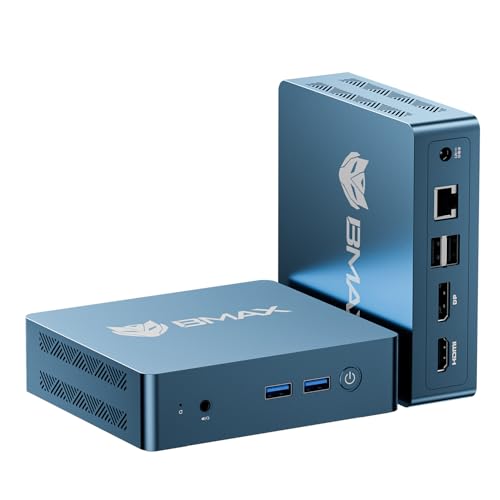
| Compact & Energy-Efficient | Processor Type: Intel Core (Intel 5205U, dual-core) | RAM: 8 GB DDR4 RAM | Storage Type: 256 GB M.2 NVMe SSD | VIEW LATEST PRICE | Read Our Analysis |
| Lenovo ThinkCentre M710 SFF Desktop PC (Renewed) |
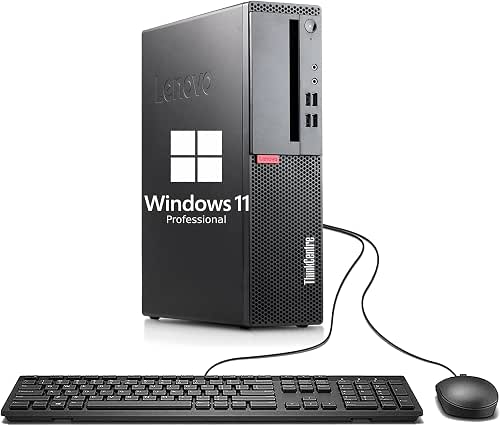
| Budget-Friendly Reliable | Processor Type: Intel Core i3 (dual-core i3-6100) | RAM: 8 GB RAM | Storage Type: 256 GB SSD | VIEW LATEST PRICE | Read Our Analysis |
More Details on Our Top Picks
Dell OptiPlex 5050 SFF Desktop – i5,16GB,256GB SSD
In case you need a compact, business-ready desktop that handles everyday multitasking without breaking the bank, the Dell OptiPlex 5050 SFF is a smart pick: its quad‑core i5-7500 (3.4–3.8 GHz), 16 GB RAM, and 256 GB NVMe SSD give you snappy performance for office work, web browsing, and light content tasks while the small form factor saves desk space. You’ll get Windows 11 Pro and multilingual support (English, Spanish, French). Certified refurbished units are tested, cleaned, and repackaged, include accessories, and carry a minimum 90-day warranty, though they might arrive in a generic box.
- Processor Type:Intel Core i5 (quad-core i5-7500)
- RAM:16 GB RAM
- Storage Type:256 GB M.2 NVMe SSD
- Form Factor:Small Form Factor (SFF)
- Operating System:Windows 11 Pro 64-bit
- Networking Connectivity:Ethernet (RJ45) and likely Wi‑Fi optional (not specified)
- Additional Feature:Intel i5-7500 CPU
- Additional Feature:Certified refurbished condition
- Additional Feature:Minimum 90-day warranty
Bmax Mini PC B2 — Intel 5205U 8GB 256GB
Should you need a compact, energy‑efficient desktop for steady office work, web browsing, and 4K media playback, the Bmax Mini PC B2 delivers with its Intel 5205U processor and Intel UHD Graphics. You get 8 GB DDR4 (expandable to 64 GB) and a 256 GB M.2 NVMe SSD, with a second M.2 slot for up to 4 TB total. Dual displays run via HDMI 1.4b and DisplayPort 1.2, while Gigabit Ethernet, Wi‑Fi 5, and Bluetooth 5.0 cover networking. Ports include two USB 3.2, two USB 2.0, and a 3.5 mm audio jack. A one‑year warranty and support are included.
- Processor Type:Intel Core (Intel 5205U, dual-core)
- RAM:8 GB DDR4 RAM
- Storage Type:256 GB M.2 NVMe SSD
- Form Factor:Mini PC (compact small form)
- Operating System:(Not specified) — assumes no OS preinstalled (warranty/support info only)
- Networking Connectivity:Gigabit Ethernet, Wi‑Fi 5, Bluetooth 5.0
- Additional Feature:Dual M.2 slots
- Additional Feature:Dual-display support
- Additional Feature:Wi‑Fi 5 + Bluetooth 5.0
Lenovo ThinkCentre M710 SFF Desktop PC (Renewed)
Should you need a compact, budget-friendly desktop for everyday tasks, the renewed Lenovo ThinkCentre M710 SFF is a great pick—its small form factor and reliable 6th‑gen Intel Core i3 make it ideal for web browsing, document work, and media without taking up much desk space. You get a dual-core i3-6100 at 3.70 GHz, 8 GB RAM, and a 256 GB SSD for fast boot and smooth multitasking. It includes keyboard and mouse, runs Windows 11 Pro with multilingual support, and offers DisplayPort, VGA, USB 3.1/2.0, Ethernet, and audio jacks for flexible connectivity and modest expansion.
- Processor Type:Intel Core i3 (dual-core i3-6100)
- RAM:8 GB RAM
- Storage Type:256 GB SSD
- Form Factor:Small Form Factor (SFF)
- Operating System:Windows 11 Pro
- Networking Connectivity:RJ‑45 Ethernet (wired); Wi‑Fi not specified
- Additional Feature:Includes keyboard and mouse
- Additional Feature:DisplayPort + VGA outputs
- Additional Feature:6th-gen i3-6100 CPU
Factors to Consider When Choosing a Desktop Pc Under 500dollar
When shopping under $500, you’ll want to match performance needs to what you actually do—office work, light gaming, or media playback. Pick a processor that balances cores and clock speed, make sure you have enough RAM for multitasking, and choose storage that gives you the speed and capacity you need. Also verify connectivity and ports so your peripherals and future upgrades won’t be limited.
Performance Needs
Should you want a desktop under $500 that feels responsive, focus initially on CPU cores and clock speed, RAM size, and fast storage—these three components determine real-world performance more than flashy extras. For general tasks aim for at least a dual‑core/4‑thread chip with base clocks around 1.8–2.0 GHz; choose quad‑core or higher (or strong single‑thread surge ≥3.0 GHz) provided you multitask or do light content work. Match RAM to use: 8 GB minimum, 16 GB provided you keep many tabs, run VMs, or use heavier productivity apps. Pick an SSD—NVMe provided possible, 256 GB+—to slash boot and load times. Consider integrated graphics for 1080p media or light gaming, and buy a system that lets you add RAM or swap drives later.
Processor Choice
Pick a processor that balances cores, clock speed, and efficiency for the best bang‑for‑buck in a sub‑$500 desktop: aim for at least dual‑core/4‑thread designs (or true quad cores) with base clocks around 1.8–2.0 GHz and turbo surges above 3.0 GHz, prefer chips with integrated graphics that handle 1080p/4K decoding, and favor lower‑TDP parts (15–35 W) on a platform that lets you add RAM and storage later so the PC stays useful as your needs grow. You’ll want a CPU that keeps everyday apps responsive and multitasking fluid without needing a discrete GPU. Check integrated GPU codecs for HEVC/UHD support, verify platform sockets for future upgrades, and prioritize low TDP to cut noise and cooling costs in compact budget builds.
Memory Requirements
Memory is one of the most significant choices in a sub‑$500 desktop, so aim for at least 8 GB to keep multitasking and web browsing smooth and plan for 16 GB should you expect light photo editing, VMs, or large spreadsheets. Choose DDR4 whenever possible and favor higher clock speeds (2400–3200 MHz) within your budget—faster RAM can enhance responsiveness and help integrated graphics. Verify the motherboard’s DIMM count and supported maximum: having spare slots lets you start with 8 GB and add modules later without discarding parts. In case the system uses soldered, non‑upgradeable RAM, buy the largest practical capacity you can afford up front. Finally, matching kit sizes and speeds matters when populating two channels; dual‑channel setups improve memory bandwidth.
Storage Options
After sorting RAM, you’ll want to turn attention to storage because it has an outsized effect on everyday snappiness and how much you can keep locally. For sub-$500 desktops, prefer SSDs over HDDs: a 240–256 GB SSD boots and loads apps several× faster than a 5400 RPM drive. NVMe M.2 SSDs deliver much higher sequential and random performance than SATA SSDs (often 2–5×), but budget systems could only include a SATA drive or a single M.2 slot. Check capacity and upgradeability—256 GB fills fast—so look for an extra 2.5″ bay or a second M.2 slot. Consider a hybrid setup (small SSD for OS + 1 TB HDD for bulk) should you require >1 TB. Verify interface, form factor, and NVMe boot support prior to buying.
Connectivity And Ports
Consider the ports and radios you’ll need so your new desktop fits your monitor, network, and peripherals without dongles. Prioritize a gigabit Ethernet port (1000 Mbps) for stable wired networking and faster large-file transfers or video calls. Make sure HDMI or DisplayPort outputs match your monitor’s resolution and refresh rate—look for 4K@60Hz when you plan to run a 4K display. Check for a mix of USB ports: at least two USB 3.0/3.2 ports for fast external drives and extras like USB 2.0 for keyboards and mice. Confirm a 3.5 mm audio jack or separate headphone/microphone jacks, plus a dedicated line-out for external speakers. Should you need wireless convenience, choose built-in dual-band 802.11ac/ax Wi‑Fi and Bluetooth 4.2 or newer.
Build And Form Factor
Once you’ve matched ports and radios to your monitor and peripherals, pick a case and layout that fits your desk and upgrade plans. Should space be tight, choose a small form factor or mini‑PC—these under‑12″×8″×4″ cases save room but usually limit expansion and cooling. In the event you want extra drives, a discrete GPU, or better airflow, go mid‑tower or micro‑ATX, but expect a larger footprint and possible budget strain above $500. Match the power supply to the chassis (SFX/SFX‑L for minis, ATX for larger) and budget for 300–400W on entry builds. Check tool‑less features and front‑panel access: cheap compact cases can block drive bays. Prioritize at least one front intake and one rear exhaust or space for a low‑profile CPU cooler.
Warranty And Support
Though cheaper desktops can save you money up front, you’ll want clear warranty and support terms so a single defect doesn’t become an expensive headache. Verify a minimum warranty—aim for 90 days to one year on refurbished or budget systems so basic defects are covered. Confirm scope: parts, labor, on-site or return-to-base, and who pays shipping. Check included tech support channels (phone, chat, email) and hours so help’s available whenever you need it. Understand the RMA and replacement timeframe—expect 7–30 days—and plan for downtime. Finally, check transferability and exclusions (accidental damage, DIY upgrades) so future resale or upgrades won’t unexpectedly void coverage. Make warranty clarity part of your buying decision.
