

You probably spend more time in your chair than you realize, so picking the right one matters more than you’d reckon. You’ll want breathable materials, adjustable lumbar and head support, a sturdy base, and reliable tilt for long sessions. I’ll compare three top options—two mesh colors from GABRYLLY and a big‑and‑tall OFIKA leatherette model—so you can find the best fit for your needs and budget.
| GABRYLLY Ergonomic High-Back Mesh Office Chair (Dark Grey) |

| Space-Saving Ergonomic | Weight capacity: Supports up to 400 lbs | High-back design: High backrest (full upper-back support) | Adjustable recline/tilt: 3-level tilt lock (recline 90°–120°) | VIEW LATEST PRICE | Read Our Analysis |
| GABRYLLY Ergonomic High-Back Mesh Office Chair (Orange) |
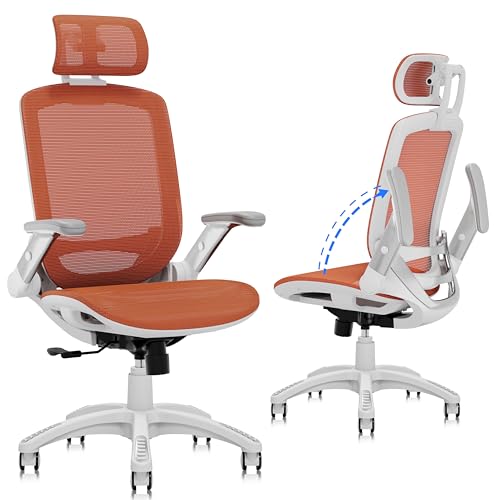
| Bright & Supportive | Weight capacity: Supports up to 400 lbs | High-back design: High-back design (full-back support) | Adjustable recline/tilt: 3-level tilt lock (recline 90°–120°) | VIEW LATEST PRICE | Read Our Analysis |
| OFIKA Big & Tall Ergonomic Leather Office Chair |

| Big‑and‑Tall Executive | Weight capacity: Supports up to 400 lbs | High-back design: High-back design aligned with spine and neck | Adjustable recline/tilt: Backrest recline range 90°–110° (with gentle rocking) | VIEW LATEST PRICE | Read Our Analysis |
More Details on Our Top Picks
GABRYLLY Ergonomic High-Back Mesh Office Chair (Dark Grey)
In case you need a supportive, budget-friendly chair that fits smaller spaces, the GABRYLLY Ergonomic High-Back Mesh is a solid choice — it supports up to 400 lbs, has a breathable mesh build with a high back and adjustable headrest, and its flip-up arms let you tuck it under desks whenever space is tight. You’ll get a wide, curved seat to reduce thigh pressure, a 3-level tilt lock (90°–120°), and a three-mode headrest for height and angle adjustments. The dark grey mesh with white frame looks modern, assembles in 15–20 minutes with included tools, and comes with a 3-year warranty.
- Weight capacity:Supports up to 400 lbs
- High-back design:High backrest (full upper-back support)
- Adjustable recline/tilt:3-level tilt lock (recline 90°–120°)
- Adjustable head/neck support:Adjustable headrest with 3-mode adjustments (height & angle)
- Included tools & assembly:Allen wrench and instruction guide; ~15–20 min assembly
- Intended use:Ergonomic office/home desk chair
- Additional Feature:Breathable mesh construction
- Additional Feature:Flip-up space-saving arms
- Additional Feature:3-year part warranty
GABRYLLY Ergonomic High-Back Mesh Office Chair (Orange)
Should you need a sturdy, breathable chair that supports up to 400 lbs and fits tighter workspaces, the GABRYLLY High-Back Mesh is a smart pick—its wide curved seat and flip-up arms let you sit comfortably without crowding your desk, and the adjustable headrest plus 3-level tilt give full-back support for long sessions. You’ll appreciate the orange breathable mesh, white frame accents, and large 27.5″ base for stability. Flip the arms up to slide closer to a compact desk, tweak the headrest height/angle, lock tilt between 90°–120°, and swivel smoothly. Assembly’s quick, and a 3-year warranty backs parts.
- Weight capacity:Supports up to 400 lbs
- High-back design:High-back design (full-back support)
- Adjustable recline/tilt:3-level tilt lock (recline 90°–120°)
- Adjustable head/neck support:Adjustable headrest with 3-mode adjustments (height & angle)
- Included tools & assembly:Allen wrench and guideline; ~15–20 min assembly
- Intended use:Ergonomic office/home desk chair (suitable for small spaces)
- Additional Feature:Vibrant orange mesh finish
- Additional Feature:Swivel function included
- Additional Feature:Flip-up space-saving arms
OFIKA Big & Tall Ergonomic Leather Office Chair
Provided you need a sturdy, comfortable chair that handles larger frames, the OFIKA Big & Tall Ergonomic Leather Office Chair delivers—supporting up to 400 lbs with a heavy-duty, executive build and reinforced components. You’ll appreciate soft leather upholstery, a double-padded foam seat, and segmented cushioning that cradles your back and hips. The high-back design aligns spine and neck while built-in lumbar support reduces fatigue. Adjust seat height between 42.8 and 46.6 cm, recline 90°–110°, and use the gentle rocking feature for movement. Padded armrests increase comfort, and included tools plus clear instructions make assembly a 10–15 minute task.
- Weight capacity:Supports up to 400 lbs
- High-back design:High-back design aligned with spine and neck
- Adjustable recline/tilt:Backrest recline range 90°–110° (with gentle rocking)
- Adjustable head/neck support:High-back aligned for neck support (head/neck support included)
- Included tools & assembly:Includes required tools and hardware; ~10–15 min assembly
- Intended use:Home/office heavy-duty executive chair (big & tall)
- Additional Feature:Double-padded foam seat
- Additional Feature:Lumbar back support
- Additional Feature:Executive leather upholstery
Factors to Consider When Choosing a Desk Chair Under 400
As you’re picking a desk chair under $400, focus initially on ergonomics and reliable support to protect your posture. Check materials and build quality for durability, plus an adjustability range that matches your height and tasks. Also verify weight capacity and seat dimensions so the chair fits comfortably and safely.
Ergonomics And Support
Because you’ll be spending hours in it, pick a chair that supports your spine and lets you adjust posture easily: look for adjustable lumbar support or a contoured high-back that matches your natural curve, a seat roughly 20 x 20 inches with 2–4 inches of clearance behind your knees, a height range that lets your feet sit flat and knees sit near 90°, and either a headrest/high-back with angle adjustment and a multi-position tilt (about 90°–120°) plus breathable padding or mesh to distribute pressure during long sessions. Check seat depth and width to avoid thigh pressure. Confirm the height-adjustment range matches your stature. Test lumbar positioning and tilt lock for sustained comfort. Should you require neck support, choose an adjustable headrest. Prioritize multi-position recline and breathable support to maintain posture throughout your workday.
Material And Durability
Good support only matters provided the chair’s materials and construction hold up over time, so you should pay attention to what a chair is made of and how it’s built. Choose mesh for breathability and resistance to sagging, but inspect mesh density and stitching quality so it won’t fail after months. Leather or leatherette looks premium and wipes clean; genuine leather will usually outlast PU/vinyl and resist cracking when you maintain it. Check cushion specs—high-density foam or double-padding keeps shape, while low-density foam compresses quickly. Look for metal-reinforced frames and a wide, sturdy base (around 27–28 inches and up to 400 lb capacity) to minimize wobble. Finally, inspect moving parts and warranties—gas lifts, tilt mechanisms, and armrest hinges are common failure points.
Adjustability Range
Prioritize a chair whose adjustments actually fit your body and work habits: you want a seat height that covers about 4–6 inches so people roughly 5’0″–6’3″ can reach their desk. Beyond height, confirm the backrest offers multi-angle recline with a 3-level or continuous tilt lock (about 90°–120°) so you can switch between focused and relaxed positions. Look for headrest height and angle adjustments in case you need neck support during recline. Choose armrests with at least 1.5–2 inches of height adjustment or flip-up capability to clear tight desks and fine-tune forearm support. Finally, make sure lumbar support adjusts in height and firmness or contour so your lower spine stays aligned across the chair’s full recline and height ranges.
Weight Capacity Limits
Should you’re shopping for a desk chair under $400, pick one rated for at least your body weight plus a 10–20% safety margin so the frame, gas lift, and casters aren’t overstressed. Look for chairs labeled 250–300 lbs for standard use or 400+ lbs for big-and-tall buyers. Confirm the capacity applies to the entire assembly: base, gas lift, and casters should each meet the rating, since failures often start there. Check warranty and replacement-part policies tied to weight limits—manufacturers might void coverage should you exceed ratings. Keep in mind height and body shape affect load distribution; a higher-rated chair with a reinforced frame and wider base will better handle varied bodies over time. Prioritize verified specs over appearance.
Seat Size And Comfort
Comfort matters most whenever you’ll be sitting hours at a time, so choose a seat that fits your body and keeps pressure off your thighs. Aim for about 20-inch seat width and 20–21-inch depth to accommodate most users without the edge digging into your legs. A wide, curved profile spreads weight more evenly and lowers thigh pressure during long sessions. Prefer breathable mesh or resilient foam with double-padding to cut heat buildup and maintain comfort. Look for contouring that supports your hips and keeps thighs aligned neutrally to prevent numbness and fatigue. Finally, confirm the seat matches your weight and has durable padding—frequent use should not cause premature sagging in case you desire lasting support and consistent comfort.
Armrest Functionality
Consider armrests as tools that help you keep your shoulders relaxed and your wrists neutral—adjustability is key. You’ll want armrests that move at least 1–2 inches vertically so your forearms align with the desk, reducing shoulder and neck strain. Look for armrests that also pivot or rotate inward/outward to support different typing and mouse tasks, helping keep wrists neutral. Flip-up or foldable armrests are handy should you need to slide closer to the desk or free up space in tight areas. Choose padded armrests with durable coverings to distribute pressure during long sessions; hard plastic can become uncomfortable. Avoid fixed armrests whenever possible—multi-axis adjustment (height plus angle or width) fits more body types and improves overall ergonomics.
Space And Footprint
Armrests that fold or pivot help you tuck the chair in, but you also need to match the chair’s footprint to your space so it can move freely. Measure floor-to-desk clearance and choose a base diameter that fits the free floor area—most bases are about 25–28 inches—so you get full swivel and movement. Check seat-height range against desk and legroom: the seat must lower enough for knees under the desk and raise for proper elbow alignment. Should lateral space be tight, pick flip-up or compact armrests and a narrower seat depth to tuck closer. Account for recline and tilt—chairs that recline beyond 120° need rear clearance—and consider overall stature if you’ll place the chair near shelves or windows.
Warranty And Service
While a low price can be tempting, you’ll want to verify warranty length and what it actually covers before buying: good desk chairs under $400 typically offer 1–3 year warranties that should explicitly cover the frame and mechanical parts. Check whether the warranty includes parts and labor or parts only, since labor can add cost should a repair’s needed. Read exclusions and conditions—weight limits, normal wear, improper assembly, or modifications can void claims. Confirm service responsiveness: clear contact methods, reasonable response times, and accessible replacement parts matter. Also weigh return and trial policies; 30–90 day comfort trials or easy returns let you test fit and reduce risk should the chair proves uncomfortable or fails shortly after purchase.
