

You want reliable advanced warnings without fuss, so pick Wi‑Fi smoke and CO detectors that combine fast multi‑sensor detection, clear alerts, and easy app control. Look for photoelectric and electrochemical sensors, 2.4 GHz connectivity, battery backup or hardwired power, and straightforward installation. I’ll compare five top models and the key features you should prioritize — keep going to find which setup fits your home and routine.
| 5-in-1 Carbon Monoxide & Gas Smoke Detector (Black) | Most Versatile | Smoke Detection: Yes (smoke) | Carbon Monoxide Detection: Yes (CO) | Smart Connectivity / App Alerts: Not app-based but provides digital readout and portable monitoring (plug-and-play; no app specified) | VIEW LATEST PRICE | Read Our Analysis | |
| Kidde Smart Hardwired Smoke & CO Detector with App |
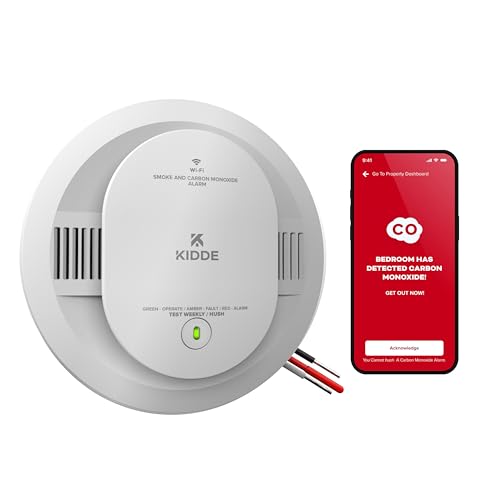
| Best Smart Integration | Smoke Detection: Yes (smoke) | Carbon Monoxide Detection: Yes (CO) | Smart Connectivity / App Alerts: Yes (Kidde app, real-time mobile alerts) | VIEW LATEST PRICE | Read Our Analysis |
| Smart WiFi Smoke Detector with App Control | Easiest Setup | Smoke Detection: Yes (photoelectric smoke) | Carbon Monoxide Detection: Yes (CO) | Smart Connectivity / App Alerts: Yes (Wi‑Fi + mobile app control and alerts) | VIEW LATEST PRICE | Read Our Analysis | |
| Smart WiFi Smoke & CO Detector 3-Pack | Best Multi-Pack | Smoke Detection: Yes (smoke) | Carbon Monoxide Detection: Yes (CO) | Smart Connectivity / App Alerts: Yes (Wi‑Fi notifications to phone) | VIEW LATEST PRICE | Read Our Analysis | |
| Kidde Hardwired Smoke & CO Detector with 10-Year Backup |

| Longest Lifespan | Smoke Detection: Yes (smoke) | Carbon Monoxide Detection: Yes (CO) | Smart Connectivity / App Alerts: Yes (interconnect/notifications via Kidde ecosystem; hardwired smart options implied) | VIEW LATEST PRICE | Read Our Analysis |
More Details on Our Top Picks
5-in-1 Carbon Monoxide & Gas Smoke Detector (Black)
Most Versatile
View Latest PriceShould you want a single, travel-ready unit that covers CO, smoke, and multiple combustible gases while giving clear, real-time readings, the 5-in-1 Carbon Monoxide & Gas Smoke Detector (Black) is a smart choice—its high-precision sensors update every 2 seconds, the HD color LCD displays current CO, temperature, and humidity, and the built-in battery keeps monitoring through outages or on the road. You’ll get auto-calibration within a minute, an ≥85 dB alarm with flashing red LED at danger thresholds, adjustable screen rotation and brightness, and plug-and-play compatibility with 110–240V outlets. It’s compact for bedrooms, kitchens, RVs, and hotels.
- Smoke Detection:Yes (smoke)
- Carbon Monoxide Detection:Yes (CO)
- Smart Connectivity / App Alerts:Not app-based but provides digital readout and portable monitoring (plug-and-play; no app specified)
- Audible Alarm (dB):≥85 dB
- Battery Backup / Replaceable Power:Built-in 1000 mAh battery (up to 24 hours)
- Interconnect / Whole-Home Alerts:Portable/standalone unit (no hardwired interconnect; provides local alarms and visual alerts)
- Additional Feature:Combustible gas detection
- Additional Feature:HD full-color LCD
- Additional Feature:Screen rotation/brightness
Kidde Smart Hardwired Smoke & CO Detector with App
Looking for a reliable whole‑home solution that keeps you connected to both smoke and carbon monoxide risks? The Kidde Smart Hardwired Smoke & CO Detector with App gives you dual sensors for smoke and CO, claiming 3X more precise smoke detection and reduced nuisance alerts from cooking. Once you add one Kidde smart alarm to your hardwired system and 2.4 GHz Wi‑Fi, you get whole‑home mobile alerts and real‑time notifications wherever you are, plus phone hush for false alarms. It’s UL‑ and FCC‑certified, interconnected with AA battery backup, and includes everything needed for straightforward installation.
- Smoke Detection:Yes (smoke)
- Carbon Monoxide Detection:Yes (CO)
- Smart Connectivity / App Alerts:Yes (Kidde app, real-time mobile alerts)
- Audible Alarm (dB):Standard high-volume alarm (specifies alerts; interconnected alarm)
- Battery Backup / Replaceable Power:Hardwired with AA battery backup
- Interconnect / Whole-Home Alerts:Yes (interconnected functionality; whole-home alerts via app)
- Additional Feature:Whole-home mobile alerts
- Additional Feature:Hush via phone
- Additional Feature:Hardwired with AA backup
Smart WiFi Smoke Detector with App Control
Easiest Setup
View Latest PriceShould you want effortless remote monitoring and control, the Smart WiFi Smoke Detector with App Control pairs to your phone over 2.4 GHz Wi‑Fi and sends real‑time smoke and low‑battery alerts so you can test, mute, or check battery status from anywhere—no hub required. You’ll use EZ or AP pairing, install quickly with included screws and anchors, and configure remotely through the app. Photoelectric sensing delivers fast, accurate detection suited for homes, rentals, or eldercare. The unit runs on two AAA batteries accessed via a top cover—no tools, no ceiling removal. Amazon support promises a next-business-day response for pairing or issues.
- Smoke Detection:Yes (photoelectric smoke)
- Carbon Monoxide Detection:Yes (CO)
- Smart Connectivity / App Alerts:Yes (Wi‑Fi + mobile app control and alerts)
- Audible Alarm (dB):Standard high-volume alarm (app-controlled; battery-powered)
- Battery Backup / Replaceable Power:Battery-powered (includes 2× AAA; top-access replaceable)
- Interconnect / Whole-Home Alerts:Yes (Wi‑Fi networked for app alerts; supports multi-unit monitoring)
- Additional Feature:Top-access battery cover
- Additional Feature:No hub required
- Additional Feature:EZ/AP Wi‑Fi pairing
Smart WiFi Smoke & CO Detector 3-Pack
Best Multi-Pack
View Latest PriceShould you want reliable, hands-off protection for a small home or travel setup, this Smart WiFi Smoke & CO Detector 3-Pack is a great fit—it’s ideal for renters, RV owners, or anyone who prefers battery-powered, no-wiring devices. You get 2-in-1 detection for smoke and carbon monoxide, real-time digital LCD readings, and loud 85 dB alarms. WiFi notifications land on your phone so you’ll know immediately provided something’s wrong. Installation is quick with replaceable batteries and a built-in test function. Place them in bedrooms, inhabited areas, kitchens, or campers for continuous monitoring and smarter peace of mind.
- Smoke Detection:Yes (smoke)
- Carbon Monoxide Detection:Yes (CO)
- Smart Connectivity / App Alerts:Yes (Wi‑Fi notifications to phone)
- Audible Alarm (dB):85 dB
- Battery Backup / Replaceable Power:Battery-powered with replaceable batteries
- Interconnect / Whole-Home Alerts:Yes (Wi‑Fi notifications and continuous monitoring across household)
- Additional Feature:3-pack value set
- Additional Feature:Real-time digital LCD
- Additional Feature:Battery-powered, no wiring
Kidde Hardwired Smoke & CO Detector with 10-Year Backup
Provided that you want a long-term, code-compliant solution for whole-home protection, the Kidde Hardwired Smoke & CO Detector with 10‑year backup is a smart pick—it combines fast, dual smoke and CO sensing with hardwired power plus a sealed 10‑year battery so you won’t be replacing batteries every year. You get advanced sensing that detects smoke over 25% faster and reduces false alarms from cooking or steam. The 85 dB alarm and red LED give clear warnings, and interconnect capability lets all Kidde units sound together. It’s UL- and FCC-tested, backed with a 10-year limited warranty, and suits homeowners and pros.
- Smoke Detection:Yes (smoke)
- Carbon Monoxide Detection:Yes (CO)
- Smart Connectivity / App Alerts:Yes (interconnect/notifications via Kidde ecosystem; hardwired smart options implied)
- Audible Alarm (dB):85 dB
- Battery Backup / Replaceable Power:Hardwired with built-in 10-year battery backup
- Interconnect / Whole-Home Alerts:Yes (wired interconnects with other Kidde alarms)
- Additional Feature:Built-in 10-year battery
- Additional Feature:UL 217/2034 tested
- Additional Feature:10-year limited warranty
Factors to Consider When Choosing a Wifi Smoke and Carbon Monoxide Detector
Upon choosing a Wi‑Fi smoke and carbon monoxide detector, you’ll want to compare detection capabilities and how quickly and accurately the sensors respond. Check connectivity and app features for reliable alerts, and confirm the power source, backup options, and installation compatibility with your home. These factors together determine how well the device protects you and fits into your setup.
Detection Capabilities
Because a detector’s job is to warn you quickly and accurately, check that it combines both smoke (photoelectric or ionization) and carbon monoxide sensors so it can spot particulate smoke and CO gas at once, with sensor sensitivity and response times suited to common hazards (photoelectric for smoldering fires; CO alarms that trigger at hazardous concentrations like ~50 ppm within defined exposure periods). Also prefer units that monitor multiple hazards—combustible gases, temperature, humidity—or use multi-sensor algorithms to cut false alarms and improve real-world detection. Look for frequent sensor refresh rates (about every 1–2 seconds) and automatic self-calibration to keep readings reliable. Finally, verify loud local alerts (≥85 dB), clear visual indicators, and prompt mobile push notifications so you’re warned both at home and remotely.
Sensor Accuracy And Speed
Provided you want alarms that catch danger promptly, focus on sensor accuracy and speed: choose multi-sensor designs (photoelectric for smoldering smoke, electrochemical for CO) with refresh rates under about 2–5 seconds, clear accuracy specs (alarm thresholds like ~50 ppm for CO and defined smoke sensitivity ranges), and features such as auto-calibration and baseline compensation to prevent drift. You should pick units tested to trigger reliably at recognized hazard levels and that cite CO thresholds and smoke sensitivity curves. Faster sampling means quicker alerts as concentrations rise, reducing exposure time. Auto-calibration and baseline compensation keep readings stable between tests, while documented false-alarm reduction and certifications (like UL) give independent validation of responsiveness and long-term accuracy you can trust.
Connectivity And App Features
Look for detectors that play nicely with your home network and phone so you can get timely alerts and manage devices remotely. Check that the unit supports your Wi‑Fi band (most use 2.4 GHz) and whether it pairs via EZ/AP or needs a hub for cloud access. Favor apps that send real‑time push notifications, low‑battery alerts, and let you remotely silence or test alarms. Make sure the app supports whole‑home or multi‑device grouping so one event can notify all relevant units. Look for muting/hush features and remote diagnostics—battery levels, sensor status, and event history—to cut unnecessary trips. Finally, verify security: account requirements, encryption, OTA firmware updates, and ongoing vendor support to keep connectivity secure.
Power Source And Backup
When you’re picking a Wi‑Fi smoke and CO detector, prioritize a primary power source that fits your home—AC mains for continuous operation or a high‑capacity sealed battery for locations without wiring—and always confirm the unit’s voltage compatibility. Choose AC‑powered units in case you want uninterrupted monitoring and verify 110–240V support where relevant. Make sure any detector includes a reliable backup—replaceable AA/AAA cells or a sealed long‑life battery—so it keeps working during outages. For hardwired systems, prefer models with multi‑year battery backup. For portable detectors, check stated backup runtime and battery capacity (mAh) to estimate outage longevity. Finally, confirm ease of battery replacement or serviceability—top‑access doors or sealed options reduce maintenance and prevent protection gaps.
Installation And Compatibility
Whenever you install a Wi‑Fi smoke and CO detector, make sure its power type, mounting style, and network needs match your home so the device works reliably and meets code; check whether it’s hardwired (usually 120V) or battery/plug‑in, provided it requires a backup cell, and that its physical size and top‑access or tool‑free battery replacement fit your chosen ceiling or wall location. Next, confirm Wi‑Fi compatibility — most units use 2.4 GHz and won’t join 5 GHz or WPA‑2‑Enterprise SSIDs — and test pairing before final installation. Verify interconnectivity options (wireless or wired) to meet local linked‑alarm rules. Should you plan to use app features or whole‑home alerts, review pairing modes (EZ/AP), hub requirements, and any router or firewall adjustments for reliable remote notifications.
Alarm Volume And Visibility
Because alarms need to both wake you and give clear information, prioritize units that deliver at least 85 dB at 10 feet and combine audible and visible alerts (flashing LEDs or a bright display). You should confirm distinct sound patterns—temporal three for CO, temporal one for smoke—so you can identify the hazard quickly. Make sure the unit offers adjustable or auto-brightness displays to stay readable day and night without disturbing sleep. Visual alerts cover deaf or hard-of-hearing occupants and cut through noisy environments. Finally, check that mobile push notifications mirror the in-home alert with clear text and a timestamp, so whenever you’re away you see the same warning level and exact time as the audible/visual alarm.
Maintenance And Lifespan
Good alarm volume and clear alerts matter, but you also need to keep your detector reliable over years. Replace batteries per the manufacturer—usually every 6–12 months for removable cells or whenever the app flags low battery—to avoid losing Wi‑Fi smoke/CO protection. Test monthly (manually or via app) and clean vents with a soft brush or vacuum every six months to prevent false alarms and preserve sensor response. Keep firmware and app software current for network stability, reliable notifications, and calibration improvements. Recall sensors degrade: replace combination units per safety guidance, typically every 7–10 years. Should you see frequent false alarms, persistent sensor-fault alerts, or inconsistent readings after cleaning and testing, replace the unit rather than attempting repairs.
