

You probably don’t notice the detectors that quietly protect your home until they matter most, and that calm reliability is exactly what you want. Hardwired smoke and CO alarms give steady, unobtrusive monitoring and loud, unmistakable alerts once danger appears. Below are five top-rated options and the key features to weigh so you can pick a setup that stays out of the way but never fails you—keep going to find the right fit.
| Kidde 10-Year Smoke & Carbon Monoxide Detector (3-Pack) |

| Best Long-Life | Power Type: Battery powered (built-in 10-year lithium) | Detects: Smoke and carbon monoxide | Sensor Type: Photoelectric (smoke) + electrochemical (CO) | VIEW LATEST PRICE | Read Our Analysis |
| Kidde Hardwired Smoke & CO Detector with Backup |

| Reliable Hardwired Choice | Power Type: 120 VAC hardwired with 2×AA battery backup | Detects: Smoke and carbon monoxide | Sensor Type: Ionization (smoke) + electrochemical (CO) | VIEW LATEST PRICE | Read Our Analysis |
| First Alert BRK Hardwired Carbon Monoxide Detector (CO5120BN) |

| Solid CO Protection | Power Type: 120 VAC hardwired with battery backup | Detects: Carbon monoxide (CO) — dedicated CO detector | Sensor Type: Electrochemical (CO) | VIEW LATEST PRICE | Read Our Analysis |
| First Alert Onelink Safe & Sound Smoke & CO Alarm |

| Smart Home Premium | Power Type: 120 VAC hardwired (with internal/adapter power options) | Detects: Smoke and carbon monoxide | Sensor Type: Photoelectric (smoke) + electrochemical (CO) | VIEW LATEST PRICE | Read Our Analysis |
| Kidde Hardwired Carbon Monoxide Detector with Battery Backup |
| Best Digital CO Monitor | Power Type: 120 VAC hardwired with 9V battery backup | Detects: Carbon monoxide (CO) — dedicated CO detector | Sensor Type: Electrochemical (CO) | VIEW LATEST PRICE | Read Our Analysis |
More Details on Our Top Picks
Kidde 10-Year Smoke & Carbon Monoxide Detector (3-Pack)
Should you want a low‑maintenance, code‑compliant alarm that covers both smoke and carbon monoxide, the Kidde 30CUD10 3‑pack is a smart pick — it combines photoelectric smoke and electrochemical CO sensors with a built‑in 10‑year lithium battery so you won’t be changing batteries or chasing chirps for a decade. You’ll get three 5‑inch, 7.7‑ounce white units with mounting bases, wiring cable, and guide. The photoelectric sensor detects smoke quickly while advanced sensing cuts cooking false alarms; the electrochemical CO sensor watches for toxic gas. It meets UL 217/2034 and FCC standards, sounds at 85 dB, and carries a 10‑year warranty.
- Power Type:Battery powered (built-in 10-year lithium)
- Detects:Smoke and carbon monoxide
- Sensor Type:Photoelectric (smoke) + electrochemical (CO)
- Audible Alarm Volume:85 dB
- Interconnectability:— (3-pack not specified as hardwired-interconnect; standalone interconnected via included wiring harness for pack)
- Warranty Length:10-year limited warranty (from first power-on)
- Additional Feature:Built-in 10-year battery
- Additional Feature:Photoelectric + electrochemical
- Additional Feature:Includes 3-unit pack
Kidde Hardwired Smoke & CO Detector with Backup
Should you want reliable, always-on protection with a battery backup for outages, the Kidde hardwired Smoke & CO combo is a strong choice for homeowners and landlords who prioritize safety and simplicity. You get a single unit that monitors smoke (ionization sensor) and carbon monoxide, runs on 120 VAC with two AA batteries for backup, and delivers an 85 dB alarm plus voice alerts: “Fire! Fire!”, “Warning! Carbon Monoxide!” and “Low Battery!” The tamper-resistant design, Test-Hush feature, and LED indicators add usability. It interconnects with up to 24 Kidde devices (18 initiators), is UL certified, and includes a ten-year limited warranty.
- Power Type:120 VAC hardwired with 2×AA battery backup
- Detects:Smoke and carbon monoxide
- Sensor Type:Ionization (smoke) + electrochemical (CO)
- Audible Alarm Volume:85 dB
- Interconnectability:Interconnects with up to 24 Kidde devices (up to 18 initiating)
- Warranty Length:10-year limited warranty
- Additional Feature:Voice alarm messages
- Additional Feature:Test-Hush (~9 minutes)
- Additional Feature:Tamper-resistant design
First Alert BRK Hardwired Carbon Monoxide Detector (CO5120BN)
Provided you want a reliable, always-on CO defense for a household or multi-room installation, the First Alert BRK CO5120BN hardwired detector is a solid choice—its 120-volt hardwired connection with battery backup keeps monitoring active during power outages, and the electrochemical sensor gives accurate CO readings while the microprocessor-controlled circuitry cuts down on false alarms. You’ll mount the white plastic unit into your home electrical system for continuous protection, with the battery backup offering peace of mind in case power fails. The CO5120BN alerts occupants to dangerous carbon monoxide levels, uses tested sensing tech, and fits standard installations for straightforward replacement or expansion.
- Power Type:120 VAC hardwired with battery backup
- Detects:Carbon monoxide (CO) — dedicated CO detector
- Sensor Type:Electrochemical (CO)
- Audible Alarm Volume:(not specified numerically) — standard hardwired CO alarm (typical loud audible alarm)
- Interconnectability:Hardwired — connects into home system (interconnect implied)
- Warranty Length:(warranty not specified in summary)
- Additional Feature:Microprocessor-controlled circuitry
- Additional Feature:Electrochemical CO sensor
- Additional Feature:120V hardwired with backup
First Alert Onelink Safe & Sound Smoke & CO Alarm
In case you want a hardwired smoke and CO detector that also doubles as a smart speaker, the Premier Alert Onelink Safe & Sound is a strong choice—its built‑in Alexa and AirPlay 2 let you stream music and control smart devices while the photoelectric smoke and electrochemical CO sensors protect your home. You’ll hardwire it using included AC adapter plugs and ideally mount it on a ceiling for best sound. It interconnects with compatible BRK/First Alert hardwired alarms so all units alarm together. Use voice commands, the Onelink app, or AirPlay 2 for audio; get voice danger alerts, CO tracking, and 10‑year warranty coverage.
- Power Type:120 VAC hardwired (with internal/adapter power options)
- Detects:Smoke and carbon monoxide
- Sensor Type:Photoelectric (smoke) + electrochemical (CO)
- Audible Alarm Volume:(not specified numerically) — premium speaker with voice alerts and alarm
- Interconnectability:Interconnects with compatible BRK/First Alert hardwired detectors
- Warranty Length:10-year warranty from date of purchase (with proof)
- Additional Feature:Built-in Alexa voice
- Additional Feature:Apple HomeKit compatible
- Additional Feature:Omni-directional premium speaker
Kidde Hardwired Carbon Monoxide Detector with Battery Backup
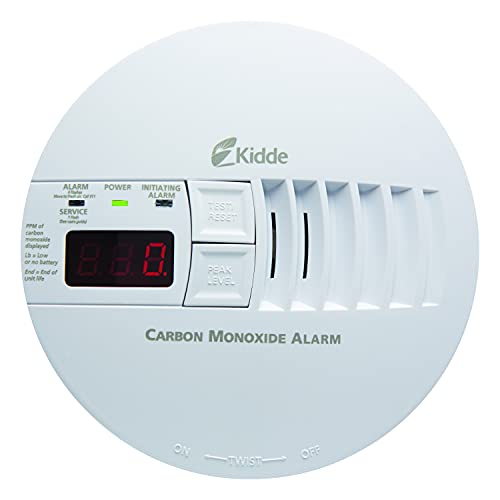
Should you want reliable, home-wide CO protection with battery backup, the Kidde KN-COP-IC hardwired detector is a solid choice because it combines a UL-listed electrochemical sensor, a digital LED that shows current and peak CO levels, and a 120V connection with a 9V battery so it keeps working during power outages. You’ll get a compact 5.75″ unit with Smart-Hush, peak memory, and a display updating every 15 seconds. Install it on walls or ceilings, interconnect up to 24 Kidde devices, and rely on a loud 85 dB alarm. It’s UL-listed, meets NFPA standards, and includes a 10-year limited warranty.
- Power Type:120 VAC hardwired with 9V battery backup
- Detects:Carbon monoxide (CO) — dedicated CO detector
- Sensor Type:Electrochemical (CO)
- Audible Alarm Volume:85 dB
- Interconnectability:Interconnects up to 24 Kidde devices (up to 18 initiating)
- Warranty Length:10-year limited warranty (begins when powered on)
- Additional Feature:Digital LED CO display
- Additional Feature:Peak level memory
- Additional Feature:Smart-Hush test/silence
Factors to Consider When Choosing a Hardwired Smoke and Carbon Monoxide Detector
Upon choosing a hardwired smoke and carbon monoxide detector, you’ll want to check the power source type and whether it has a reliable battery backup with sufficient duration. Consider the sensor technology—photoelectric for smoldering fires or ionization for fast-flaming—and how the unit interconnects with other alarms. Also evaluate alarm sound options and alert features so you get loud, clear warnings and notification methods that work for your home.
Power Source Type
Pick a power configuration that matches your home’s reliability and maintenance preferences: hardwired detectors run on 120 VAC for continuous primary power, but most include a battery backup (AA, 9V, or sealed 10‑year lithium) so they stay functional during outages and still need a charged cell in each unit on interconnected systems. You’ll want units that show clear AC and battery-mode indicators so you can tell at a glance whether they’re on mains or backup. Choose sealed 10-year batteries should you prefer low maintenance and a predictable service life; opt for replaceable AA/9V cells in case you’d rather swap batteries periodically. Match warranty length to the expected battery lifespan, and bear in mind interconnected systems still require functioning backups in every detector during power loss.
Sensor Technology Choice
Because different fires and hazards produce different signals, you’ll want detectors whose sensors match the risks you face: photoelectric smoke sensors catch smoldering, large‑particle fires with fewer nuisance triggers, ionization sensors spot fast‑flaming, small‑particle fires sooner but false‑alarm more easily from cooking, and electrochemical sensors provide the reliable CO readings you need for poisoning prevention. Choose photoelectric or combination photoelectric+electrochemical units for broad protection against smoldering fires and CO. Should you be concerned about fast‑flaming scenarios, add ionization where allowed, but accept higher nuisance alarms near kitchens. Prioritize sensor lifespan and replace devices per manufacturer guidance—most last 7–10 years—to avoid sensitivity loss. Always check certifications and test alarms regularly to confirm proper operation.
Interconnectivity Options
Consider through how your detectors will talk to each other, since hardwired systems can link dozens of units so one alarm wakes the whole house. You’ll want to confirm the network capacity—many systems support roughly two dozen devices but only about 16–18 can act as initiating devices, the rest respond. Check whether signaling uses a dedicated interconnect wire or digital communication over AC wiring; installers must wire correctly and use compatible device types for reliable group operation. Some setups distinguish smoke versus CO events with different patterns or voice messages, which helps identify hazard type and location without confusing occupants. Whenever expanding or replacing units, match the interconnect protocol/version and UL listing across all devices to preserve compatibility and safety.
Alarm Sound & Alerts
Once your detectors are linked, the way they alert you becomes the next priority: alarms must be loud, distinct, and informative so everyone in the home can recognize and respond. Choose units with at least an 85 dB output at 10 feet to wake sleeping occupants. Prefer devices that use separate voice or tone patterns for smoke versus carbon monoxide so you can identify the hazard immediately. Verify visual indicators—flashing LEDs or status lights—so alerts reach people in noisy rooms or with hearing impairments. Confirm interconnectivity so one triggered alarm notifies the whole house. Finally, make sure the alarm has a hush/silence feature that mutes nuisance alerts temporarily (typically 8–10 minutes) without disabling detection.
Battery Backup Duration
Planning for battery backup duration matters because a hardwired detector only protects you during outages provided its backup can run the sensors and the alarm long enough for evacuation or power restoration. You should check the specified runtime—hours or days—rather than vague claims. Common backups use AA, AAA, or 9V alkaline cells giving roughly 24–72 hours of active alarm, while some lithium designs offer months to years in low-power standby. Make sure the listed runtime covers both sensor operation and alarm circuitry. Decide whether you prefer replaceable batteries (replace every 6–12 months or per instructions) or sealed long-life units that match the detector’s service life. Test regularly and bear in mind that temperature and humidity can reduce actual battery life, so plan replacements accordingly.
Installation Requirements
Because hardwired detectors tie into your home’s electrical and safety systems, you need to verify power, wiring, and mounting requirements before buying one. Check for a nearby 120 VAC junction box and compatible 3-conductor-with-ground wiring to supply continuous power and support interconnection. Confirm circuit capacity and local code—some installs need a dedicated circuit or must tie into lighting, and a licensed electrician might be required. Make certain backup battery seating (9V or AA) is accessible and installed per code so the alarm works during outages. Follow manufacturer and code specs for interconnect wiring (supervised initiation line) and the allowed number of interconnected units. Finally, choose mounting locations per code—ceiling or high wall, away from vents and humidity—and fasten to a junction box or approved bracket.
Certification And Compliance
Whenever you’re choosing a hardwired smoke or CO detector, prioritize certification and compliance to make sure the device will perform reliably and meet legal requirements. Check for UL listing—UL 217 for smoke and UL 2034 (or current equivalent) for CO—to confirm third‑party testing and safety. Verify the unit meets local building codes and NFPA 72 requirements for placement, interconnection, and power source. Should the alarm have wireless or voice features, confirm FCC or equivalent electromagnetic compliance. For interconnected systems, make certain the device is certified for multi‑device networks and supports the required number of initiating and total devices. Finally, verify warranty terms and stated service life (commonly 7–10 years) match manufacturer certification and any local replacement mandates.
