

Most homeowners don’t realize hardwired smoke and CO detectors can still fail provided you skip end‑of‑life replacement or ignore battery backups. You want dependable 120V units that interconnect, resist nuisance alarms, and give clear voice or 85 dB alerts whenever it matters. I’ll walk you through five trusted models—from long‑life sealed Kidde combos to First Alert/BRK multi‑packs and a Universal Security Instruments CO/gas option—so you can pick the right fit for your home.
| Kidde 10-Year Smoke & Carbon Monoxide Detector (3-Pack) |

| Best Long-Life | Power Type: Built-in 10-year battery (no AC hardwire) | Multi-hazard Detection: Smoke + Carbon Monoxide | Audible Alarm Loudness: 85 dB | VIEW LATEST PRICE | Read Our Analysis |
| First Alert 9120B Hardwired Smoke Alarm 5-Pack |

| Best for Coverage | Power Type: 120V AC hardwired with 9V battery backup | Multi-hazard Detection: Smoke (ionization) | Audible Alarm Loudness: 85 dB | VIEW LATEST PRICE | Read Our Analysis |
| Universal Security Instruments Hardwired CO & Natural Gas Alarm |

| Dual-Hazard Protection | Power Type: Hardwired with battery backup | Multi-hazard Detection: Carbon Monoxide + Natural Gas | Audible Alarm Loudness: (not explicitly listed) — typical hardwired alarms; (battery-backed model implies standard alarm output) | VIEW LATEST PRICE | Read Our Analysis |
| Kidde Hardwired Smoke & Carbon Monoxide Detector 3-Pack |
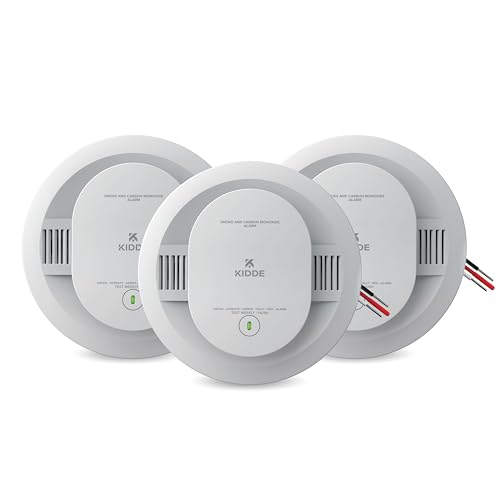
| Best Interconnectable | Power Type: 120V AC hardwired with AA battery backup | Multi-hazard Detection: Smoke + Carbon Monoxide | Audible Alarm Loudness: 85 dB | VIEW LATEST PRICE | Read Our Analysis |
| First Alert BRK 9120B Hardwired Smoke Detector 3-Pack |

| Reliable Hardwired Pick | Power Type: 120V AC hardwired with 9V battery backup | Multi-hazard Detection: Smoke (ionization) | Audible Alarm Loudness: 85 dB | VIEW LATEST PRICE | Read Our Analysis |
More Details on Our Top Picks
Kidde 10-Year Smoke & Carbon Monoxide Detector (3-Pack)
Should you want long-term, low-maintenance protection for a home or rental, the Kidde 10-Year Smoke & Carbon Monoxide Detector (3-pack) is a smart pick: its built-in 10-year battery and combined smoke/CO sensing give dependable, code-ready coverage without yearly battery swaps. You get dual detection with advanced sensors that claim over 25% faster smoke response and reduce false alarms from cooking or steam. The 85 dB alarm and red LED pair with voice alerts—“Fire” or “Warning, Carbon Monoxide”—for clear cues. Compact 5-inch units come in a three-pack, meet UL and FCC standards, and include a 10-year limited warranty.
- Power Type:Built-in 10-year battery (no AC hardwire)
- Multi-hazard Detection:Smoke + Carbon Monoxide
- Audible Alarm Loudness:85 dB
- Intended Users / Applications:Homeowners, property managers, contractors, professionals
- Warranty:10-year limited warranty (starts on power-on)
- Installation Type / Mounting:Surface-mounted (battery-operated; compact 5″ diameter)
- Additional Feature:Built-in 10-year battery
- Additional Feature:Voice alerts (“Fire”/“Carbon Monoxide”)
- Additional Feature:Compact 5-inch diameter
First Alert 9120B Hardwired Smoke Alarm 5-Pack
In case you want reliable, always-on home protection, the First Alert 9120B 5-pack is a strong choice—each hardwired unit runs on 120V AC with a 9V battery backup so your alarms stay active even during outages. You’ll get ionization sensors tuned for fast-flaming fires and 85 dB alerts to wake sleepers. Installers should confirm wiring polarity and secure wire-nut connections; a loose neutral can cause malfunctions. Units include tamper-resistant locking pins and a single-button silence/test for easy use. Pioneer Alert backs the product with warranty info and vendor return options, and customer reviews are available for reference.
- Power Type:120V AC hardwired with 9V battery backup
- Multi-hazard Detection:Smoke (ionization)
- Audible Alarm Loudness:85 dB
- Intended Users / Applications:Household/household safety (residential use)
- Warranty:Manufacturer warranty available (standard First Alert support)
- Installation Type / Mounting:Hardwired ceiling/wall mount (confirm wiring polarity; wire-nut connections)
- Additional Feature:Ionization smoke sensor
- Additional Feature:Tamper-resistant locking pins
- Additional Feature:Single-button silence/test
Universal Security Instruments Hardwired CO & Natural Gas Alarm
Should you want dual protection without installing two separate units, the Universal Security Instruments MCN108 hardwired CO and natural gas alarm is a great pick for homes, apartments, and mobile homes. You get 2-in-1 detection for carbon monoxide and natural gas in one device, reducing installation time and clutter. It hardwires into a standard junction box with a simple bracket mount and includes battery backup plus a quick-activation pull-tab. The front-loading battery drawer lets you replace batteries without removing the alarm from its bracket. Backed with a seven-year limited warranty, it’s a practical, space-saving safety choice.
- Power Type:Hardwired with battery backup
- Multi-hazard Detection:Carbon Monoxide + Natural Gas
- Audible Alarm Loudness:(not explicitly listed) — typical hardwired alarms; (battery-backed model implies standard alarm output)
- Intended Users / Applications:Houses, apartments, mobile homes (residential)
- Warranty:Seven-year limited warranty
- Installation Type / Mounting:Hardwired bracket mounts to standard junction box
- Additional Feature:Detects natural gas too
- Additional Feature:Front-loading battery drawer
- Additional Feature:Quick-activation pull-tab
Kidde Hardwired Smoke & Carbon Monoxide Detector 3-Pack
Choose this Kidde hardwired 3-pack in case you want dependable, code-ready protection that combines smoke and carbon-monoxide detection with AA battery backup for uninterrupted operation. You get 2-in-1 sensing with advanced technology that detects smoke over 25% faster*, plus an 85 dB alarm and red LED status light for clear alerts. These 120V units include two AA alkalines, interconnect with other Kidde alarms, and cut false alarms from cooking or steam. They meet UL 217 and UL 2034 standards, are FCC-compliant, and carry a 10-year limited warranty—good for homeowners, managers, and contractors.
- Power Type:120V AC hardwired with AA battery backup
- Multi-hazard Detection:Smoke + Carbon Monoxide
- Audible Alarm Loudness:85 dB
- Intended Users / Applications:Homeowners, property managers, contractors, professionals
- Warranty:10-year limited warranty (from first power-on)
- Installation Type / Mounting:Hardwired with interconnect wiring capability (120V AC)
- Additional Feature:Interconnects with other alarms
- Additional Feature:Two AA battery backup
- Additional Feature:Red LED status light
First Alert BRK 9120B Hardwired Smoke Detector 3-Pack
In case you want reliable, hardwired protection with battery backup for a whole house, the Premier Alert BRK 9120B 3-pack delivers—each unit runs on 120V AC with a 9V battery so alarms stay powered during outages. You get three ionization smoke detectors that focus on fast, flaming fires, an 85 dB alarm, and a single-button silence/test for quick checks. Install them with correct wiring polarity and secure wire nut connections to avoid malfunctions from a loose neutral. Units include tamper-resistant locking pins and alkaline 9V batteries. First Alert supports warranty service; return options follow seller policies.
- Power Type:120V AC hardwired with 9V battery backup
- Multi-hazard Detection:Smoke (ionization)
- Audible Alarm Loudness:85 dB
- Intended Users / Applications:Residential/home use
- Warranty:Manufacturer warranty information available
- Installation Type / Mounting:Hardwired ceiling/wall mount (confirm wiring polarity; secure connections)
- Additional Feature:9V battery backup included
- Additional Feature:Item weight 1 pound
- Additional Feature:Tamper-resistant locking pins
Factors to Consider When Choosing Hardwired Smoke And CO Detectors
Whenever choosing hardwired smoke and CO detectors, you’ll want to match detection types to the spaces you’re protecting—photoelectric for smoldering fires, ionization for fast flames, and electrochemical for CO. Check power-source reliability and interconnect/integration with your existing system so alarms don’t fail or leave gaps. Also consider sensor speed and long-term maintenance needs to guarantee timely alerts and manageable upkeep.
Detection Type Compatibility
Although you’ll want detectors that cover both smoke and carbon monoxide, focus on sensor types that match the hazards in each area: photoelectric sensors catch slow, smoldering fires typical in inhabited rooms and bedrooms, ionization sensors respond faster to fast-flaming fires near kitchens and garages, and CO sensors certified to UL 2034 protect against toxic gas; make sure smoke sensors meet UL 217 and that the alarm discriminates nuisance sources while allowing full interconnectivity so any smoke or CO event triggers all units. Choose combination units or matched sets that include the appropriate smoke sensor for each location plus a UL 2034 CO cell. Verify nuisance-reduction algorithms won’t delay real alarms, and confirm interconnected smoke and CO circuits communicate so every alarm sounds for any detected hazard.
Power Source Reliability
Because your detectors must work every minute of every day, prioritize reliable power configurations that combine 120V AC primary power with dependable backup batteries. Hardwired 120V power keeps day-to-day operation continuous so you won’t rely on user-replaced batteries for routine functionality. Make certain battery backup—often 9V or AA cells—is installed and replaced per manufacturer intervals to maintain operation during outages. Verify proper wiring polarity and secure neutral connections in the junction box; loose or incorrect wiring can cause malfunctions or false alarms. Use interconnected hardwired systems so one triggered unit alerts the entire home, improving notification reliability. For long-term peace of mind, choose models with sealed long-life or designed-life batteries that match the detector’s warranty to minimize maintenance lapses.
Sensor Performance Speed
Reliable power keeps detectors running, but you’ll only get value from that uptime provided the sensors respond quickly to a real fire or CO event. Faster detection—often cited in seconds or percentages—buys vital evacuation time, so compare manufacturers’ response-time claims. Match sensor type to likely household fires: photoelectric units catch smoky, smoldering fires sooner, while ionization detects fast-flaming blazes more rapidly. Consider combination or multi-criteria sensors that blend optical and ionization principles or algorithmic analysis to cut delays to true alarms. Keep in mind alarm volume or voice prompts don’t speed detection; they only matter whether occupants hear and act. Finally, factor environmental impacts—dust, humidity, and poor placement can desensitize sensors—so pick models with resistance to false triggers and long-term sensitivity retention.
Interconnect And Integration
Consider how detectors communicate with each other and with your home systems, since interconnect and integration determine whether a single alarm can warn the whole household and trigger remote alerts. You should confirm interconnect capability—wired or wireless—so one unit’s detection activates all alarms for whole-home notification. Verify the interconnect method (120V hardwired signaling versus proprietary wireless) and make certain model and manufacturer compatibility before buying. For hardwired systems, check wiring polarity, signaling conductors, and that the circuit can handle added alarm loads to keep operation reliable. Plan device placement and network topology to cover all sleeping areas and levels, then test the network so every alarm triggers during one-alarm checks. Also consider integration with smart hubs or monitored panels for remote alerts and automated responses.
Installation And Maintenance
During the installation and maintenance of hardwired smoke and CO detectors, make sure your home’s 120V wiring and interconnect conductors are compatible and correctly polarized, with secure wire-nut connections, and choose units that include battery backup so they still work during outages. Install alarms on every level, inside each sleeping area, and within 10 feet of bedrooms, mounting them on ceilings or high on walls per local code for peak sensing. Follow manufacturer and local wiring diagrams whenever interconnecting units so a single alarm triggers whole-home notification. Test each detector monthly using the built-in test/silence button, replace backup batteries per manufacturer intervals or at least annually, and swap out entire units at the manufacturer’s end-of-life (commonly seven to ten years).
