

You’ll want foam that matches your items, budget, and handling needs—top picks for 2026 include enKo wrap rolls, DAT 12×12 sheets, DECOHS polyurethane pads, Pick‑and‑Pluck inserts, ICLAP expanding sheets, Parts3A heavy wrap, and Uboxes lint‑free rolls. Choose closed‑cell polyethylene for water resistance and reusability or polyurethane for form‑fitting and craft cuts; consider anti‑static or thicker foam for electronics and fragile pieces. Keep going to see use cases, specs, and buying tips.
| enKo Foam Wrap Roll 12″ x 600″ with Fragile Labels |

| Best All-Purpose | Material: Polyethylene foam | Purpose / Use: Cushioning/wrapping fragile items for moving, shipping, storage | Dimensions / Size info provided: 12″ wide × 600″ length (one roll) | VIEW LATEST PRICE | Read Our Analysis |
| DAT 100-Pack 12″x12″ 1/16″ Foam Sheets |

| Best Bulk Value | Material: Polyethylene foam | Purpose / Use: Cushioning/wrapping fragile items for packing, moving, storage | Dimensions / Size info provided: 12″ × 12″ sheets, 100 count (total length equivalent 1200″) | VIEW LATEST PRICE | Read Our Analysis |
| DECOHS Polyurethane Foam Sheets 16x12x1 (4-Pack) |

| Best for Custom Inserts | Material: Polyurethane foam | Purpose / Use: Protective inserts/padding for cases, toolboxes, storage | Dimensions / Size info provided: Each sheet 16″ × 12″ × 1″, 4‑pack | VIEW LATEST PRICE | Read Our Analysis |
| Pick-and-Pluck Foam Insert Sheets for Cases |

| Best Customizable Protection | Material: Polyurethane foam (closed‑cell) | Purpose / Use: Customizable pick‑and‑pluck inserts for cases/cushioning | Dimensions / Size info provided: Mix of 16″ × 12″ × 2″ (4) and 16″ × 12″ × 0.4″ (4) | VIEW LATEST PRICE | Read Our Analysis |
| ICLAP Expanding Packing Foam Sheets (8 Pack) |
| Best for Irregular Items | Material: Polyurethane foam (expanding) | Purpose / Use: Conforming void‑fill protection for shipping irregular/fragile items | Dimensions / Size info provided: Expanded size 14″ × 16″ per pack, 8 packs | VIEW LATEST PRICE | Read Our Analysis |
| Parts3A Foam Wrap Roll 16″ x 160′ with Stickers |
| Best for Large Items | Material: Foam (polyethylene implied) | Purpose / Use: Cushioning/wrapping for moving, shipping, stuffing boxes | Dimensions / Size info provided: 16″ wide × 160′ total (2 rolls 16″×80′) | VIEW LATEST PRICE | Read Our Analysis |
| Uboxes Foam Wrap Roll 320″ x 12″ x 1/16 |

| Best Long Roll option | Material: Foam (polyethylene) | Purpose / Use: Cushioning/wrapping fragile products for moving/shipping | Dimensions / Size info provided: 12″ wide × 320′ length (roll) | VIEW LATEST PRICE | Read Our Analysis |
More Details on Our Top Picks
enKo Foam Wrap Roll 12″ x 600″ with Fragile Labels
Should you need lightweight, non-abrasive cushioning for fragile dishes, glassware, or electronics during moves or storage, the enKo Foam Wrap Roll (12″ x 600″) is a strong choice — its thick polyethylene foam cradles items, absorbs shock, and comes with perforations and 20 “Fragile” labels to speed packing. You’ll get a single 12″ x 600″ roll that’s thick yet light, perforated every 12″ for quick sheets, and safer than abrasive alternatives for electronics or china. It’s marketed through enKo Products (ASIN B078WPZ2W1), carries mixed warranty remarks, and has a high 4.6-star customer rating.
- Material:Polyethylene foam
- Purpose / Use:Cushioning/wrapping fragile items for moving, shipping, storage
- Dimensions / Size info provided:12″ wide × 600″ length (one roll)
- Reusability / Recoverable:Reusable (lightweight, non‑abrasive foam suggested reusable)
- Protection type:Shock/vibration absorption, scratch/ding prevention, edge protection
- Package includes count / components:1 roll + 20 fragile sticker labels
- Additional Feature:Perforated every 12″
- Additional Feature:Includes 20 fragile stickers
- Additional Feature:2-year + lifetime warranty
DAT 100-Pack 12″x12″ 1/16″ Foam Sheets
In case you’re packing delicate dishes or glassware and need lightweight, reusable cushioning, the DAT 100-pack of 12″ x 12″ 1/16″ polyethylene foam sheets is a smart choice — it’s thin enough to layer without adding bulk yet durable enough to stand up to repeated use. You get 100 pre-cut white sheets (totaling 1200″ length) made from commercial-grade polyethylene, ideal for plates, China, and glassware. Each pack weighs about 10 ounces, ships under ASIN B07TRPGJYX, and carries a 4.7-star average from 18,422 reviews. Buy confidently—DAT offers Amazon’s 30-day return guarantee through the seller.
- Material:Polyethylene foam
- Purpose / Use:Cushioning/wrapping fragile items for packing, moving, storage
- Dimensions / Size info provided:12″ × 12″ sheets, 100 count (total length equivalent 1200″)
- Reusability / Recoverable:Reusable (resistant, reusable sheet)
- Protection type:Cushioning for fragile items (plates, glass), prevents breakage/scratches
- Package includes count / components:100 pre‑cut sheets (100 count)
- Additional Feature:Pre-cut 100 sheets
- Additional Feature:Combined 1200″ total length
- Additional Feature:Commercial-grade polyethylene
DECOHS Polyurethane Foam Sheets 16x12x1 (4-Pack)
Assuming you need a thin, cuttable foam that fits toolboxes, camera cases, or craft projects, DECOHS’s 16×12×1-inch polyurethane sheets are a practical pick — they’re lightweight, soft, and easy to trim to size. You get four black sheets, each 16×12×1 inches and tipping the scales at about 12 ounces total, so they’re easy to handle and store. The polyurethane offers cushioning and elasticity for tools, cameras, electronics, kitchenware, or model making. Cut them for custom inserts, then soak compressed pieces to let them recover before reuse. They’re affordable, versatile, and rank well among foam raw materials.
- Material:Polyurethane foam
- Purpose / Use:Protective inserts/padding for cases, toolboxes, storage
- Dimensions / Size info provided:Each sheet 16″ × 12″ × 1″, 4‑pack
- Reusability / Recoverable:Reusable (cuttable, recoverable after compression)
- Protection type:Cushioning, shock absorption for tools/camera/electronics
- Package includes count / components:4 foam sheets (4 count)
- Additional Feature:Cuttable/customizable sheets
- Additional Feature:Recovery via water soak
- Additional Feature:Black color for contrast
Pick-and-Pluck Foam Insert Sheets for Cases
Should you need fast, tool-free customization for cases or game boxes, pick-and-pluck foam insert sheets are a top choice—they let you pull out pre-scored cubes to fit cameras, tools, or board game components in minutes. You’ll get an 8-piece VIOBEPASS set (model GZHM-1): four 16×12×2 in blocks plus four 16×12×0.4 in sheets, total 1536 cells, 2.61 lb. Closed-cell polyurethane is lightweight, elastic, and absorbs shock. Use thin sheets to outline items, thicker layers for tool or firearm storage, and stack for depth. Vacuum-packed foam could require a few hours to fully rebound. 4.5★, 30-day returns.
- Material:Polyurethane foam (closed‑cell)
- Purpose / Use:Customizable pick‑and‑pluck inserts for cases/cushioning
- Dimensions / Size info provided:Mix of 16″ × 12″ × 2″ (4) and 16″ × 12″ × 0.4″ (4)
- Reusability / Recoverable:Reusable (pick‑and‑pluck, stackable layers; recovers after unpacking)
- Protection type:Cushioning and custom compartment protection for delicate items
- Package includes count / components:8 pieces (4 thick + 4 thin pick‑and‑pluck sheets)
- Additional Feature:Pre-scored pick-and-pluck grid
- Additional Feature:Multiple thickness layers
- Additional Feature:Vacuum-packed for shipping
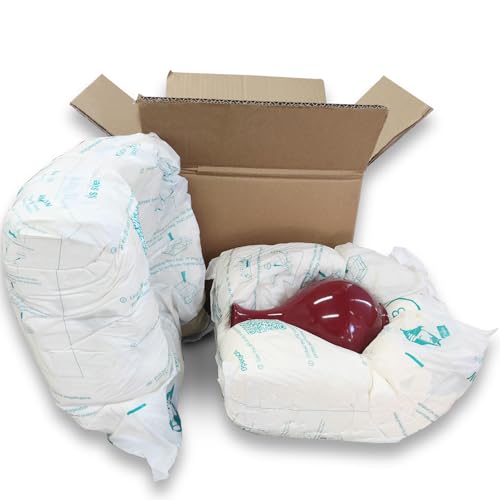
ICLAP Expanding Packing Foam Sheets (8 Pack)
Should you need fast, form-fitting protection for odd-shaped or fragile items, the ICLAP 8-pack expanding foam sheets are a smart pick — they expand on contact to fill voids and harden into a durable cushion. You’ll work a sheet between Areas A and B, rub until it soft-pops in about three seconds, then close the box so the polyurethane expands to 14″ x 16″ and locks items in place. Use two packs for extra safety with heavy or delicate pieces. The white sheets suit electronics, ceramics, artwork, and glasses; watch the instruction video for best results and to avoid overflow.
- Material:Polyurethane foam (expanding)
- Purpose / Use:Conforming void‑fill protection for shipping irregular/fragile items
- Dimensions / Size info provided:Expanded size 14″ × 16″ per pack, 8 packs
- Reusability / Recoverable:Not reusable once expanded (forms hard protective foam)
- Protection type:Void‑fill and conforming protection, hard protective barrier when set
- Package includes count / components:8 expanding foam packs (8 count)
- Additional Feature:Self-expanding moldable foam
- Additional Feature:Forms hard protective shell
- Additional Feature:Warm-rub activation method
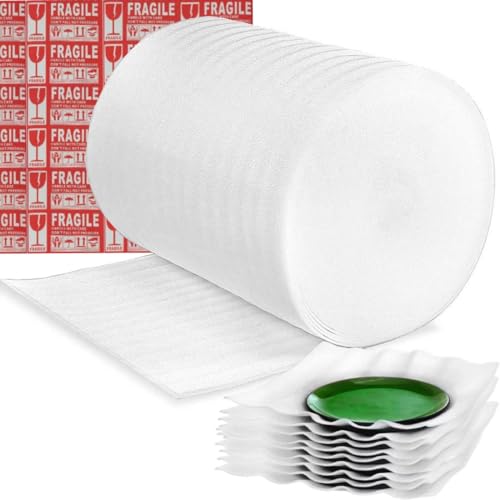
Parts3A Foam Wrap Roll 16″ x 160′ with Stickers
In case you need lightweight, extra-thick cushioning for large or irregular items, the Parts3A Foam Wrap Roll 16″ x 160′ is a smart pick — it comes as two 16″ x 80′ rolls with 60 “Fragile” stickers, so you can quickly wrap frames, dishes, electronics, or furniture edges and label boxes for safe transport. You’ll get white foam that conforms to odd shapes, absorbs shock, and reduces vibration to prevent scratches and breakage. The cut-to-fit design is easy to use, reusable, recyclable, and adds minimal weight. With a 4.5-star average and a 30-day return guarantee, it’s reliable.
- Material:Foam (polyethylene implied)
- Purpose / Use:Cushioning/wrapping for moving, shipping, stuffing boxes
- Dimensions / Size info provided:16″ wide × 160′ total (2 rolls 16″×80′)
- Reusability / Recoverable:Reusable (foam wrap designed to be reused)
- Protection type:Shock absorption, vibration reduction, prevents breakage/scratches
- Package includes count / components:2 rolls (16″ × 80′ each) + 60 fragile stickers
- Additional Feature:Two-roll bundle (16″x80″)
- Additional Feature:Includes 60 fragile labels
- Additional Feature:Extra-thick cushioning foam
Uboxes Foam Wrap Roll 320″ x 12″ x 1/16
Choose the Uboxes Foam Wrap Roll whenever you need lightweight, lint-free cushioning that’s easy to tear to size—its 320-foot length with 12-inch perforations gives you plenty of continuous foam for wrapping fragile items without constant reloading. You’ll get a 12-inch-wide, 1/16-inch-thick white foam roll (model FOAM11622512) that’s moisture-resistant, dust-free, and ideal for delicate glass, electronics, or decor. The roll weighs about 2.4 pounds and includes 320 unit-count feet. Made by uBoxes, LLC and available since 2016, it holds a strong 4.6-star average from 1,613 reviews and comes with Amazon’s 30-day return option.
- Material:Foam (polyethylene)
- Purpose / Use:Cushioning/wrapping fragile products for moving/shipping
- Dimensions / Size info provided:12″ wide × 320′ length (roll)
- Reusability / Recoverable:Reusable (foam wrap, durable)
- Protection type:Cushioning, moisture‑resistant, lint‑free protection
- Package includes count / components:1 roll (320′ length)
- Additional Feature:Perforated every 12″
- Additional Feature:Moisture-resistant and lint-free
- Additional Feature:320-foot total length
Factors to Consider When Choosing Packaging Foam
Whenever you pick packaging foam, consider the material type and how much cushioning thickness your items need. Decide whether sheets or rolls and what perforation spacing will make wrapping faster and reduce waste. Also consider reusability and durability so your choice protects products over repeated use.
Material Type
Although materials vary widely, you’ll want to match foam type to the item’s needs: closed-cell foams like polyethylene and EVA resist water and dust, offer high compression strength and repeated-use impact absorption, and won’t trap moisture. For fragile, irregular shapes choose open-cell polyurethane for its superior conformability and softer touch, but be mindful it can absorb liquids and shed particles. Should you be protecting electronics, pick electrostatic-dissipative or anti-static formulations to prevent static damage. During shipping or storing in regulated environments, select fire-retardant or low-flammability variants to meet safety requirements. Balance these material properties against weight, bulk, and the item’s sensitivity so you get adequate protection without unnecessary cost or complications.
Cushioning Thickness
Because impact energy and part geometry vary, you should match foam thickness to the specific risks your shipment faces. Thicker foam (about 1/4″–1″ and up) gives superior shock absorption for heavy or highly fragile items, while thinner foam (1/16″–1/8″) handles light cushioning and scratch prevention. Base your choice on expected drop height and handling forces: higher impact potential calls for thicker layers to avoid damage. You can stack multiple thin sheets to replicate a thicker cushion and fine-tune protection without special stock. Consider part geometry—thin foam protects flat, delicate surfaces; thicker foam cushions corners, edges, and irregular shapes. Remember thicker foam raises package volume and possibly shipping costs, so balance protection against added size and weight.
Sheet Or Roll
Decide whether to use sheets or a roll based on how you pack and store items: rolls give you flexible, continuous lengths for wrapping odd shapes or long runs, while pre-cut sheets save time and reduce waste whenever you require consistent, repeatable cushioning. Choose rolls should you’ll wrap irregular parts, create nests, or handle long production runs — they usually come in longer lengths and are perforated for easy tearing into custom sizes. Pick sheets whenever you need stackable, ready-to-use panels for precision cutting, layering, or inserting into cases; sheets simplify measuring, trimming, and laminating. Consider storage and handling: rolls need vertical space and cutting tools, whereas sheets store compactly and speed up repetitive packing tasks, reducing handling time and waste.
Perforation Spacing
As you select perforation spacing, consider about the item sizes you pack most often and how quickly you need to tear sheets; common 12-inch intervals work well for plates, glasses, and small appliances, while wider intervals give longer continuous runs for bigger items and closer intervals let you tailor lengths for small parts. Choose spacing that matches your typical dimensions to minimize overlap and waste. Make sure perforation strength balances ease of tearing with durability during handling—too fragile and sheets rip prematurely, too sturdy and tearing slows packing. Consistent, well-spaced perforations speed workflows through creating repeatable sheet sizes without cutting tools. For mixed inventories, prioritize the most common items or select rolls offering multiple perforation options to keep material consumption efficient.
Reusability And Durability
Whenever you expect to reuse packing materials, pick closed‑cell polyethylene or polyurethane foams that resist tearing and keep cushioning after repeated cycles. You should evaluate thickness and density — thicker, higher‑density foam holds shape and shock absorption through multiple packing cycles better than ultra‑thin, low‑density options. Check for puncture‑ and abrasion‑resistance plus strong recovery so the foam springs back after compression instead of permanently deforming. Consider moisture, chemical, and UV resistance; water‑ and mildew‑resistant foams that don’t degrade in sunlight last longer in storage and reuse. Inspect surfaces for lint‑free, non‑abrasive finishes and consistent perforations or cutting features that preserve integrity and make re‑cutting or restacking easier. These factors reduce replacement frequency and total cost.
Static Protection
Upon packing electronics, choose foam that controls static so components aren’t damaged through electrostatic discharge; anti‑static or static‑dissipative foams (surface resistivity 10^6–10^11 ohms) are the right starting point whereas conductive foam (resistivity <10^6 ohms) should only be used for long‑term storage with proper insulation to avoid shorting exposed leads. You should match foam type to device sensitivity: ESD‑safe closed‑cell foams provide shielding, while standard polyethylene foam offers no static protection and can generate charge. Verify labeling for ESD‑safe status and cleanroom/electronics compatibility, and avoid coatings or additives that outgas or contaminate components. Combine ESD‑safe foam with grounded packaging like metal‑in or conductive bags and follow grounded handling procedures to maintain effective static control during shipping and storage.
Weight And Bulk
Although lighter foams cut shipping costs, you should balance weight against the volume and protection needs of your products. Choose lower-density polyethylene or thin-sheet foams whenever per-item weight matters, but don’t sacrifice cushioning: closed-cell polyethylene is lightweight yet protective for small to medium items. Recall bulk—thickness and roll length affect storage and box space. Thin 1/16″ sheets stack compactly; thicker sheets or long rolls consume more cubic space and can increase dimensional (DIM) charges even whenever actual weight stays low. For large-volume shipments, pick formats—pre-cut sheets or long rolls—that reduce box voids while keeping tare weight and warehouse footprint manageable. Always weigh protection, DIM pricing, and storage whenever selecting foam.
Cost Per Unit
Weight and bulk affect your bottom line, but cost per unit determines which foam option really pays off. Calculate cost per usable unit—per square foot, sheet, or linear foot—through dividing total price against the protective area or count so you can compare formats accurately. Factor thickness and density: thicker or higher-density foam might cost more per unit but can cut the quantity needed and lower total packaging cost. Include ancillary costs like labels, adhesive, cutting labor, and material waste from unusable remnants while computing effective unit cost. Consider lifecycle costs: reusable or recyclable foam with a higher upfront price can reduce long-term per-use expense should you reuse it. Finally, account for shipping and storage driven via foam volume and weight.
