

Ready for a fresh look in your home? Installing peel and stick vinyl tiles is an incredibly easy to diy project you can often finish in just one weekend! You don’t need special skills to install peel and stick floor tile; it’s super beginner-friendly.
Did you know self-adhesive peel-and-stick tile offers a total cost 40% lower than other options like Luxury Vinyl Plank? This makes vinyl peel-and-stick tile a smart, affordable choice for updating your floors. Many homeowners love tackling flooring updates themselves; in fact, 41% of flooring projects are DIY! This step-by-step diy guide will show you how easy it is to install, helping you transform your space from preparing your subfloor to finishing your new tiles. Get ready to enjoy beautiful new tiles!
Prepare to Install Peel and Stick Floor Tile
Good preparation makes your flooring project much easier. This initial stage sets you up for success.
Gather Tools and Materials
Before you start, collect everything you need. This saves you time later. You will definitely need your peel and stick vinyl tiles, of course! You also need a measuring tape to get accurate dimensions. A utility knife is essential for cutting your tiles. You will also want a straightedge or ruler to guide your cuts. A pen helps you mark your cutting lines. For softer tiles, you just score a line with gentle pressure. Then, you snap the tile. If you have harder tiles, score firmly, then bend. If it doesn’t snap, keep scoring until it separates. A roller helps ensure strong adhesion. Don’t forget cleaning supplies to prepare your subfloor. An optional primer can help your tiles stick even better.
Calculate Tile Quantity
You need to know how many tiles to buy. First, measure your room’s length and width. Multiply these numbers to get the total square footage. This tells you the basic amount of tiles you need. Now, you must add extra for cuts and mistakes. Experts recommend adding 10% to your total square footage. This extra amount covers any cuts you make or any tiles you might damage. For example, if your room is 100 square feet, buy 110 square feet of tiles. This small buffer prevents you from running out of tiles in the middle of your project.
Subfloor Prep for Vinyl Peel-and-Stick Tile
Proper subfloor preparation is super important for your new floor. It makes sure your vinyl peel-and-stick tile sticks well and lasts a long time. You want a clean, dry, and smooth surface.
Clean and Repair the Surface
First, you need to make sure your subfloor is spotless. Think of it like a fresh canvas for your new tiles. You must remove all dirt, dust, grease, and wax. Any leftover debris can stop your tiles from sticking properly. Surface contamination is a big problem for tile adhesion. Industry experts even suggest using specific tile cleaners, like a degreaser, before you do anything else. This ensures the surface is truly clean. Inadequate surface preparation is a frequent cause of adhesive failure. Your subfloor must be clean, dry, and free of dust, grease, or any other contaminants. If you don’t prepare the surface right, the adhesive won’t bond well, and your peel-and-stick tile might come loose.
You can also remove existing baseboards now. This is an optional step, but it gives you a cleaner, more professional finish.
Address Unevenness and Damage
Next, check your subfloor for any problems. You need a smooth, level surface.
Repair Cracks and Holes: Fill any cracks or holes with caulk or spray foam. Let the caulk dry for a full 24 hours if you use it.
Secure Loose Boards: If you have a wood subfloor, make sure all boards are firmly attached. Screw down any loose ones.
Level Uneven Spots: Unevenness can cause your new floor to look bad or even fail.
For high spots: If you have a wood subfloor, you can sand down high spots with a random-orbit sander. For concrete floors, you can grind down high spots with an angle grinder.
For low spots: You can use self-leveling compounds to fill low spots. Mix the compound to a slightly thicker than water consistency. Then, apply it starting from the lowest point, working towards an exit. Use a squeegee to spread it evenly. Let it dry for at least 12 hours before you install your new flooring.
Check for Damage: Some damage is too severe for simple repairs. If your subfloor is rotted or feels spongy, you must remove it. Water damage from a leaky appliance can cause extensive problems. You might need to cut out and replace those damaged sections.
You can even install vinyl peel-and-stick tile over existing ceramic tiles! Just make sure the ceramic surface is clean and perfectly level.
Priming the Subfloor
Sometimes, you need to apply a primer to your subfloor. This step is crucial for optimal adhesion.
When to Prime: If your subfloor is porous, like lauan plywood, an acrylic-based primer-sealer is a good idea. This helps manage how quickly the adhesive dries and gives you more working time. Priming is especially necessary for porous substrates.
How Primer Helps: Primers do a lot of good things for your floor.
They ensure the surface is properly prepared by helping to remove dirt, grease, or residue.
They create a bonding layer that improves the adhesive’s grip, making your tile installation stronger.
Some primers even offer moisture resistance, protecting the adhesive in humid areas.
For porous materials like concrete, primers seal the surface. This stops the adhesive from soaking in too much, ensuring a strong, lasting bond.
Primers reduce the porosity of the subfloor, creating a smoother surface for better adhesion.
They also help reduce the risk of chemical reactions between certain subfloors and adhesives.
Always follow the primer manufacturer’s instructions for the best results.
Plan Your Peel-and-Stick Tile Layout
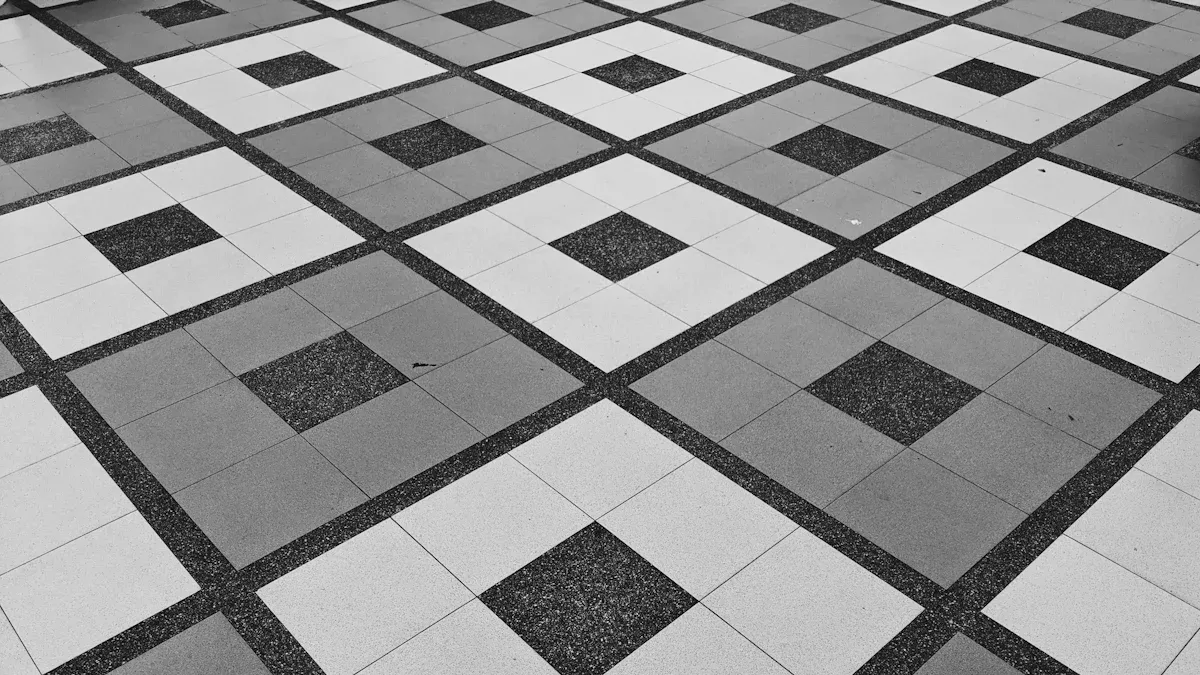
Planning your tile layout is a smart move. It helps you avoid mistakes and makes your new floor look great. A good plan ensures your peel-and-stick tile project goes smoothly.
Find the Room’s Center
Finding the true center of your room is key. This helps you start laying tiles evenly. First, measure both the length and width of your room in several spots. This checks if your walls are straight. Then, divide these measurements in half. This gives you the center point. You can convert measurements to inches for easier math. Mark this center on your floor. You can measure from the wall to find this spot.
You can also make a “cheat sheet” for optimal tile placement. Measure a few of your tiles to find their average size. Tiles are not always perfectly uniform. Then, decide on your grout joint size. A 3/16-inch joint is good. It helps with uneven floors and small tile size differences. Add “one Tile + the grout joint” together. Keep adding this sum to itself (like 12, 24, 36). Do this until you go past the longest part of your room. This cheat sheet will guide you when you draw grid lines on the floor.
Dry Lay Tiles for Pattern
Before you stick anything down, dry lay tiles on your floor. This means placing them without removing the backing. Start by creating two straight lines that cross each other at the center of your room. These are your reference lines. Then, place your tiles along these lines. This lets you see how the pattern looks. You can also see where you will need to make cuts. This step helps you visualize the final look. It also helps you adjust your plan if needed.
Minimize Visible Cuts
You want your new floor to look professional. This means minimizing awkward cuts. Start laying your tiles from the center point. Work your way outwards. This helps keep things symmetrical. It also means fewer cuts overall. For smaller rooms, simple patterns like a straight lay or grid design work best. They make the room feel bigger and need fewer cuts.
Properly laid tiles are centered in the space. They have roughly equal cuts on opposite sides. If you find you’ll use less than half a tile along an edge, you can shift your starting chalk line. Move it by half a tile. This helps even out the cuts on both sides of the room. For awkward spaces, you can cut 12-inch tiles in half. Use these 6-inch pieces along the longest wall. This saves material. The other half can be used for the next row. Dry fitting in the middle helps make sure cuts along all walls are even. This avoids tiny, odd pieces.
Tile Installation Steps
Now that you have prepared your subfloor and planned your layout, it is time to install peel and stick floor tile. This is where your hard work pays off!
Start Laying Tiles from Center
You want to begin laying your tiles from the center point you marked earlier. This ensures your layout stays balanced and symmetrical. First, find the room’s centerline by measuring and marking the midpoint of each wall. This central point becomes your starting reference for tile placement. You can dry lay a few tiles without adhesive to test your layout and verify how they will align.
When you are ready to apply tiles to floor, start at that center point. Peel the backing paper slowly and carefully from your first tile. Align it precisely with your chalk lines. Then, press the tile firmly into place. Work methodically from your center point outward. This helps you maintain a straight line and a consistent pattern. You should ensure each tile is tightly butted against the previous one. This avoids unsightly gaps between your new flooring.
Ensure Strong Adhesion
Applying enough pressure after you place each tile is super important. Many people make a common error by not pressing down hard enough. This step is vital for creating a strong adhesive bond. Without it, your peel and stick vinyl tiles might lift or shift. This compromises the whole installation’s integrity.
To ensure strong adhesion and prevent lifting or misalignment, you must apply consistent and firm pressure. Use a floor roller or a heavy rolling pin. Start from the center of each tile and roll outward in multiple directions. Your main goal is to eliminate air bubbles and maximize adhesive contact. For hard-to-reach areas, you can use a clean, heavy book or a flat wooden block. Apply pressure systematically across the entire surface. Pay special attention to the edges and corners. This ensures durability and a lasting finish for your vinyl peel-and-stick tile.
Address Poor Adhesion
Sometimes, a tile just does not want to stick. Do not worry; you have a solution! If you find a tile that does not adhere well, you can use a spray adhesive. A product like 3M 90 works great. Simply spray both the back of the tile and the subfloor surface where it will go. Allow the adhesive to tack up for about a minute. Then, press the tile firmly into place. This extra step helps create a much stronger bond, ensuring your peel-and-stick tile stays put.
Cutting and Finishing Your New Floor
You are almost done! Now you need to handle the edges and give your new floor a professional touch.
Cut Tiles for Edges and Obstacles
You will find yourself needing to cut tiles to fit around walls, doorways, and other obstacles. This is where your utility knife and straightedge come in handy. Measure the space you need to fill. Mark your peel-and-stick tile carefully. Use your straightedge as a guide and score the tile with your utility knife. For most vinyl tiles, you can score it a few times and then snap it along the line. For more complex shapes, like around a toilet, you can create a paper template first. Then, trace the template onto the tile and cut it out. Take your time with these cuts for a neat finish.
Secure All Tiles with a Roller
After you lay all your tiles, you need to make sure they are really stuck down. This is a crucial step for long-lasting results. Use a floor roller to apply firm, even pressure across your entire new floor. Roll over every tile, working from the center outwards. This pushes out any trapped air and ensures the adhesive bonds completely to the subfloor. If you do not have a floor roller, a clean, heavy rolling pin works well too. For those tricky spots or hard-to-reach areas, you can use a clean, heavy book or even a flat wooden block wrapped in a soft cloth to press down firmly. This step prevents edges from lifting later.
Optional Grouting for Finish
You might think grouting is only for traditional tiles, but you can grout vinyl peel-and-stick tile too! Grouting offers several benefits. It can make your floor look more like traditional tile. You can grout immediately after installation, unlike traditional tiles that need time for mortar to dry. These tiles are also easy to cut, so you do not need special tools. You can use regular grout, and it dries much quicker because the tiles are thinner. Groutable peel and stick tiles are durable and work well in places with moisture, like kitchens and bathrooms. Plus, they feel warmer underfoot than traditional tiles.
Final Cleaning and Maintenance
Congratulations! Your new floor is in. Now, you need to clean it and know how to keep it looking great. For vinyl peel and stick floors, you can damp mop as needed. Use a solution of 1 part Vital Oxide to 9 parts water. Avoid harsh cleaning agents like bleach or ammonia-based cleaners. These can damage your new floor. Regular sweeping or vacuuming will also help keep dirt and debris from scratching the surface.
You just learned how to install peel and stick floor tile! This project is truly an easy to diy update. You transformed your space, adding value and beauty to your home. Now, enjoy your durable new floor. You will feel great satisfaction from this successful DIY project! ✨
FAQ
Can you install peel and stick tile over existing flooring?
Yes, you can often install peel and stick tile over existing flooring. Make sure the surface is clean, dry, and level. You can lay it over old vinyl, linoleum, or even ceramic tile if it is smooth. Always check for loose spots first.
How long does peel and stick tile last?
Peel and stick tile can last for many years, usually 5 to 25 years. Its lifespan depends on the quality of the tile and how well you prepare the subfloor. Proper installation and good care help it last longer.
What if a tile lifts after installation?
If a tile lifts, you can often fix it. Gently lift the tile and clean any debris from the back and the subfloor. Apply a spray adhesive, like 3M 90, to both surfaces. Let it get tacky for a minute, then press the tile firmly back into place.
Can you use peel and stick tile in bathrooms?
Yes, you can use peel and stick tile in bathrooms. Many types are water-resistant, making them suitable for high-moisture areas. Ensure your subfloor is completely dry before installation. Proper sealing around edges helps prevent water damage. 💧


